
My parent's bought a house just before they got married. They both lived in this house until they died in their 80's. The house sat on 23 acres of land, which included a small pond and associated swamp. There was a hill going down to this pond, and the hill and the pond were important community gathering spots in winter.
The hill was for sliding down, whether it be on a piece of cardboard, on a sled, on a tobaggan, or on the aluminum disks we called flying saucers. Near the bottom of the hill you could go left, which was the longer wider path. Or you could take the middle path straight to the ice, or you could take the right-hand path which offered a little jump.
 |
| On the jump with my new Flexible Flyer™ in 1967 |
The pond itself was a popular skating hangout. Sometimes we even lit bonfires in the middle, marshy part of the pond.
 |
| Skating on the pond, 1958 |
What I was thinking about this year was my parent's attitude towards this property. Even though the hill and the pond technically belonged to us, they were viewed as community property—we had to wait in line like everyone else to slide down the hill.
The outlet of the pond flowed into nearby Cedar Lake (Cedar Swamp Pond on topo maps), the headwaters of the Mad River. The lake was man-made lake and it was owned by Scovill Manufacturing Company. It one of their water supplies. My father worked for this company for most of his career.
Keeping the pond alive became a bit of a challenge. Most of the smaller, open water bodies in that area eventually morphed, by means of natural succession, into woodland swamps dominated by red maple (aka swamp maple) trees. To slow this process down, one had to keep building up the dam at the outlet of the pond. Initially this was done by us kids, but after we moved away, one of our neighbors put a lot of effort into it. At this point, the open water part of the pond is quite small, and it is only a matter of time until the trees take it over. But even then it will still function as a vital wetland at the headwaters of the Mad River.
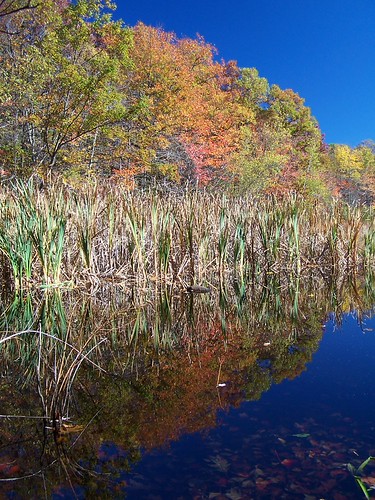 |
| Fall Colors on the Pond, 2007 |
Eventually, my father tired of paying taxes on the back part of the land, and he sold this off. At the same time, he donated the pond and surrounding wetland to the town as a wetland preserve, now known as the Russell Preserve.
The Preserve remained land-locked; so to maintain permanent public access to the pond, in the months before she died, my mom attached a permanent easement to the property deed for a strip of land going to the pond. This is the part we used to slide down. Just watch out for the poison ivy on the way.
My parents tried to instill in us the value of holding loosely to our posessions.
In a similar vein, Jesus told us to hold loosely to our very lives, and He modeled this for us. Paul wrote of this in his letter to the church in Philippi:
6 who, though he was in the form of God, did not count equality with God a thing to be grasped, 7 but emptied himself, by taking the form of a servant, being born in the likeness of men. 8 And being found in human form, he humbled himself by becoming obedient to the point of death, even death on a cross. 9 Therefore God has highly exalted him and bestowed on him the name that is above every name, 10 so that at the name of Jesus every knee should bow, in heaven and on earth and under the earth, 11 and every tongue confess that Jesus Christ is Lord, to the glory of God the Father. (Phil 2:6-11, ESV, emphasis mine)
Jesus refused to grasp his own life for the of something greater. One translation uses the word cling. Jesus teaches that we should use not only our possessions, but our very lives, for the service of others. We are not to be clingy with our lives and our stuff. He said:
For even the Son of Man came not to be served but to serve, and to give his life as a ransom for many. (Mark 10:45, ESV)
The way Jesus did this stands in contrast with many leaders—even Christian leaders—today. They hang on to power and seek even greater power and money. Some even refer to those who sacrifice for the sake of others as "losers." That's actually not a bad term, even Jesus uses it:
For whoever would save his life will lose it, but whoever loses his life for my sake will find it. For what will it profit a man if he gains the whole world and forfeits his soul? Or what shall a man give in return for his soul? (Matthew 16:25-26, ESV)
The missionary Jim Eliot, writing in his journal in 1949, put it this way "He is no fool who gives what he cannot keep to gain what he cannot lose."
Jesus told a parable about a man who was very successful and was able to store up all kinds of wealth. But then he died and his wealth was of no use to him. (Luke 12:16-21)
Better to be remembered by what we give away while we were alive than by what we have in our possession when we die.
The wetland in my childhood back yard lives on as a reminder not to be clingy.

No comments:
Post a Comment