Sunset Over the Mekong River

Showing posts with label directions. Show all posts

Wednesday, February 14, 2024

Navigation

We've been back in North America almost half a year now and we have most of our boxes unpacked. It's kind of fun, finding some of the things we've kept stored away in various places over the years. One of the things I've found is compasses. Four of them. Each with their own story. I'll begin with the oldest one.

This first compass folds shut like a pocket watch, locking the needle in the process. It is one that had been my father's. It appears to be an old military compass because it is stamped "US" on the top. It was a bit grungy when I re-found it, so I polished it up a bit.

Compass b1
Old Military Compass


Compass b2
Old Military Compass


The second compass is an old boy scout compass, which I've had since the 1960's. This one has a ruler base, which allows for tracing lines on maps.

Compass e
Boy Scout Compass


The third compass is just a cute souvenir of Thailand—a carved turtle that opens up to show a compass.

Compass c1
Turtle Compass


Compass c2
Turtle Compass


The last compass is a more professional version. This is a newer one I bought to replace the one I originally purchased when I was studying forestry—that one developed a bubble in its liquid-filled center, which made it hard to use. The original one had an aluminum bezel similar to the Boy Scout compass, but now they have tried to save a few bucks by changing to plastic.

Compass d2
Silva Compass with Mirror


This compass has a few features that make it more useful than the others. First it is liquid-filled. This keeps the needle from shaking so much so that it is easier to use. The second feature is the mirror. By partly folding the compass, you can line up the view of you destination in the notch and the line with the compass to make a more accurate sighting. The third feature is an adjustment for magnetic declination. Since compasses point to magnetic north, they need to be corrected to true north. This declination was typically printed on the bottom of topograpic maps, but magnetic north has been shifting a lot in recent years, so it is best to check online for current values.

This compass differs from my old one in that it reads azimuth where my old compass used bearings. (Back in the day, foresters measured directions in bearings and distance in chains, so I became adept at using those systems. You can learn about the difference between bearings and azimuth here.)

Compass d3
Silva Compass with Mirror

These days, people tend to use GPS units for navigation. Both the compass and GPS have limitations. A compass, by itself, can tell you which way is north, but it can't tell you where you are. A GPS device alone can tell you where you are but can't tell you which way is north (unless you are moving, then it can calculate it. Some devices these days will also have a built in digital compass.) For either of these devices to be useful, you need a map. A compass is used with a paper map and a GPS unit typically uses a built-in digital map. Without a map of some kind, we can have very precise information as to where we are, but we may not know where we need to go or the best way to get there.

I am a fan of paper maps, and I have lots of them. But I am okay with both paper and digital maps. In my old job, I used to produce both kinds. One of the things I missed about my old job was access to high-end map software and and spatial data.

But more important than our physical location is the direction we want to go with our lives. Where do I want to end up? How do I get there? To answer those questions, our "map" might consist of counselors, edcucators or self-help books.

We may also think about what are our ultimate goals in life. What kind of person do I want to be? How do I want to be described on my tombstone? Where do we want to end up when this life is over? Which map do I use for these things?

For myself, my goal in this life is to be more like Jesus. For that, my map is the word of God, the Bible.

David prayed,
    Let me hear in the morning of your steadfast love,
for in you I trust.
    Make me know the way I should go,
for to you I lift up my soul.

Psalm 148:3 (ESV)

and also,
    Your word is a lamp to my feet and a light to my path.
Psalm 119:105 (ESV)

And if our desire is to go to heaven, then we need as our map the words of Jesus:

1“Let not your hearts be troubled. Believe in God; believe also in me. 2In my Father’s house are many rooms. If it were not so, would I have told you that I go to prepare a place for you? 3And if I go and prepare a place for you, I will come again and will take you to myself, that where I am you may be also. 4And you know the way to where I am going.” 5Thomas said to him, “Lord, we do not know where you are going. How can we know the way?” 6Jesus said to him, “I am the way, and the truth, and the life. No one comes to the Father except through me. John 14:1-6 (ESV)

A compass is good. A GPS unit is useful. But without the right map, we can't get to where we want to go.

Friday, January 20, 2017

Where am I?

Thai geography naming can be a bit confusing to learn, but it has a very organized structure which is very appealing to systems people like me.  It has a very hierarchical structure with the largest division being a province and the smallest division a village.  It looks like this:

Thai Word Official transliteration Translation American Analogue
จังหวัด Cangwat Province State
อำเภอ Amphoe District County
ตำบล Tambon Sub-District Town, Muncipality
หมู่บ้าน Mooban Village Village, Subdivision
Mooban literally translates "house cluster" and is often shortened to just "Ban"

In Bangkok province, they use slightly different terminology, using เขต/Khet instead of Amphoe and แขวง/Kwaeng instead of Tambon.

This structure makes it very handy when you travel around Thailand.  Almost all of the villages have signs that give the name of the village, sub-district, district and province.  Because of this you know where you are and how you fit in the big picture.


Sign for the village of Ban Muang, Muang Yai sub-district,
Wiang Kaen district, Chiang Rai Province


This methodology also adds a sense of belonging--the village may be small, but it is also part of something bigger.

However, the challenge is writing addresses, as it will include the street number and name and all of the above elements.  This makes for very long addresses.

Points of confusion

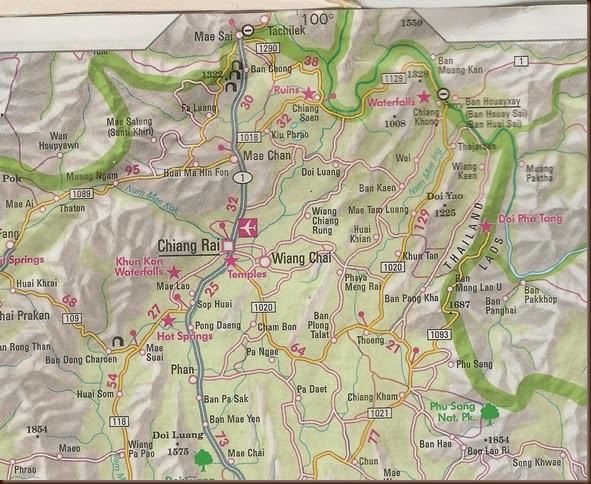
It can get very confusing for outsiders, though.  The colloquial name used for a place may not actually match its legal name.  I remember searching for the city of Chiang Khong on Google maps many years ago.  Google would position the map in a rural area, no where near a town, certainly not over the town that I thought of as Chiang Khong.  And this is because there is no town named Chiang Khong.  Chiang Khong is the name of a district.  But people will often use the name of the district to refer to the place where the county offices are.

Our house is located close to the Wiang Kaen district office, so people might refer to it as "Wiang Kaen", but it is actually the village of Ban Muang in the sub-district of Muang Yai.  However, the main business district is on the other side of the Ngao River in the village of Lai Ngao in the sub-district of Lai Ngao.  So people might refer to either of those places as Wiang Kaen.

It doesn't help that a lot of names are used over and over again.  In our district of Wiang Kaen, there are two villages named "River Crossing", one each in adjoining sub-districts, and one of those sub-districts is also named, "River Crossing".  "Wiang" is also popular.  It is an old Thai term for a place that has a wall or moat around it.  "Wiang" is the actual name of the village commonly called Chiang Khong. It is helpful to know these things when you ask for directions, because locals will use the actual village names. (They will also use the names of businesses, not all of which have signs on them, so that may not actually be helpful.)

Where am I?

The good news is, though, that God is not confused by all of this.  He knows where we are, having a flawless, built-in GPS system that He has been using since He created this planet.  Not only does He know where we are, He knows how we fit in the big picture as well.

Many years ago in the history of Israel, a large number of the people had been removed from their home and brought to live in the Kingdom of Babylon.  They were confused.  They were in a new place and they did not know their way around.  They were lost.

But God knew where they were.  He was not confused.  He sent a message to these captives in exile by the hand of the prophet Jeremiah:

For I know the plans I have for you,” says the LORD. “They are plans for good and not for disaster, to give you a future and a hope. (Jeremiah 29:11 NLT)

God not only knew where they were on the planet, He knew where they were in history.  And it all fit into a plan that was much greater than the people in exile could imagine.

So the next time I find myself off the map, or perhaps just in a village where I can't read the signs because they are in another language, I take comfort in the fact that God knows where I am and how I fit in the grand scheme of things.

Friday, November 14, 2014

I’m Not Lost


NorthernThailand

Last Sunday I was teaching in church from the story of Zacchaeus.  Luke closes the story with Jesus explaining why he came.  Jesus says, “For the Son of Man came to seek and to save the lost.” (Luke 19:10 ESV)

A challenge in seeking the lost, I explained, is that the lost don’t always think they are lost.  Usually they think they’re doing just fine.

A few weeks ago, we were hosting a team at the Changing Life Center.  Arrangements had been made for a van to take the team back to Chiang Rai.  However, due to the amount of luggage, another vehicle was needed.  I volunteered to take the luggage in our truck.

The problem was, I had no idea where this hotel was that they were going to, and I didn’t have time to research it.  (The person who had made the arrangements was not there.)  So I check my phone to see if perhaps the location was in Google ® maps.  It was!  So I turned on the GPS and had the program get me directions how to get there.

(One might ask, why not call and ask for directions.  The challenge with that in Thailand is invariably I get  names of landmarks/streets that 1) I don't know, 2) don't exist on or differ from what is listed on any map, and 3) don't have any signs posted to let me know when I see them.)

A couple of hours later, we get a call from some of the other team members, “Our van just arrived at the hotel, where are you?”  “I’m just a few minutes away”, I replied.

The problem was, I was lost, but I didn’t know it.  For as we got near the destination we found out that the location on the map was wrong.  Where the map said the hotel should be, there was a temple.  Our hotel, we found out, was 9 kilometers south of where we were.

Since the lost don’t always know they are lost, it was necessary for Jesus not only to save them, but also to first seek them.

When I became as Jesus-follower, I had not been look for Jesus or even any kind of religion.  But Jesus knew I was lost—even if I didn’t—and He sought me.

Thank you, Jesus, for being the seeker of the lost.