Sunset Over the Mekong River

Wednesday, June 4, 2014

Remembering Phawkham

Somewhere we once read that two of the ways to get to know a culture are to go to a wedding and go to a funeral.  This past week we became very familiar with one of these.

Last Thursday, our next door neighbor, Phawkham, died after a bout with lung cancer.

Phawkham and his wife lived with their only son and two grandchildren.   He had been sick some time and had been using oxygen for several weeks.  I first knew something was wrong when I saw his granddaughter running home from school with tears in her eyes.  Many others started showing up at their house and at 9am we went to see what was happening.  He had just died.

It was then that the frenzy of activity began that was to occupy the next few days.  Because of the very close proximity of our houses and the fact that Phawkham is a relative of our landlord, it became very much a part of our lives as well.

The rental company was there by 11 am to set up canopies, tables and chairs.  The canopy stretched to beneath the eaves of our house.
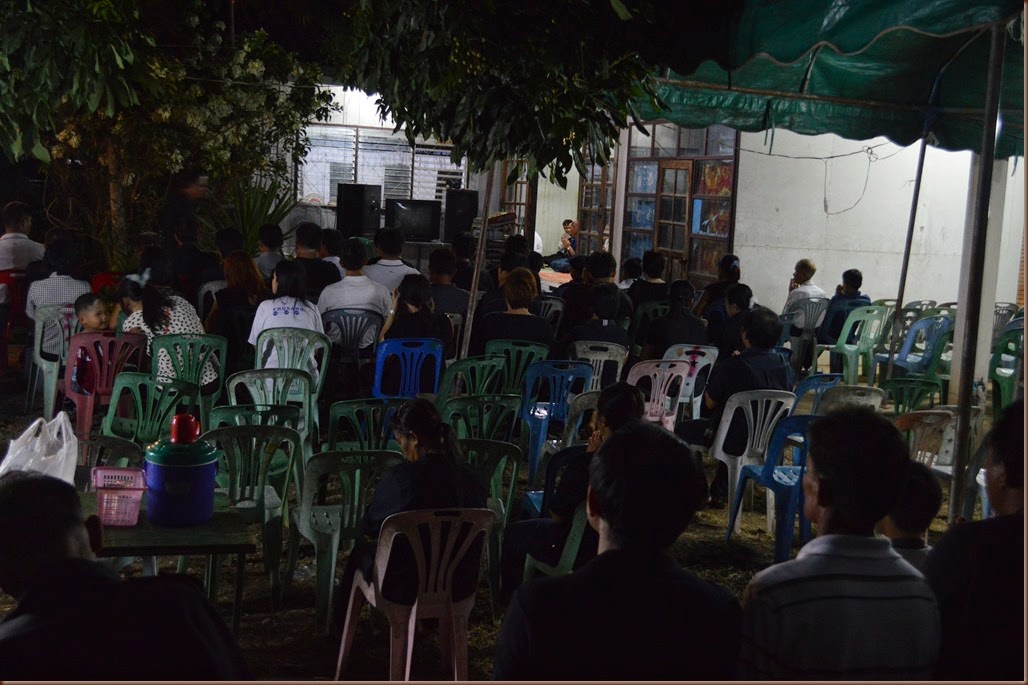
Funeral 029
The chairs set up between our houses

By afternoon, two construction projects were begun.  On the far side of their house a gazebo was constructed.  Then, between our houses, some trees were cut down or cut back in order to construct a small house.

Funeral 008
Constructing the house for the deceased

Throughout the rest of the day and for all of Friday, Saturday and Sunday, many people came to eat (3 meals a day were served to any who came), to assist the various projects, to pay respects to the widow, and make merit offerings for the deceased.

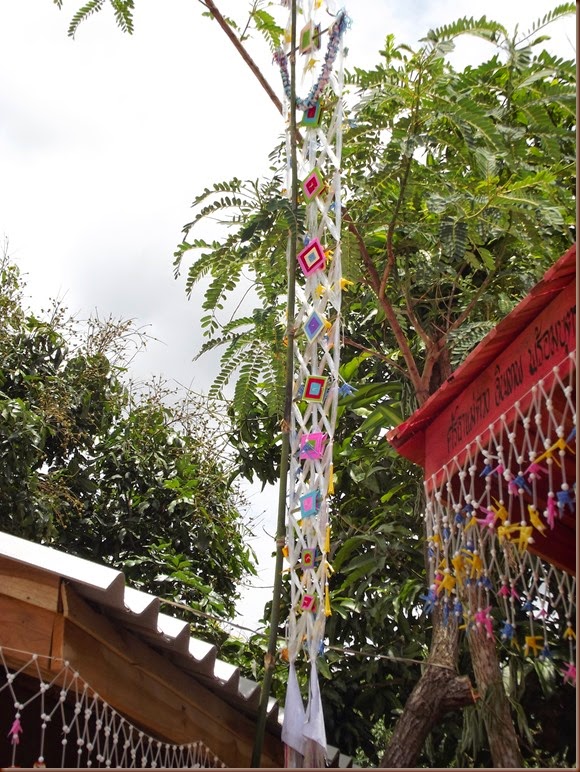
Besides work on the gazebo and house, others were involved in making the various decorations that were to be used on them.
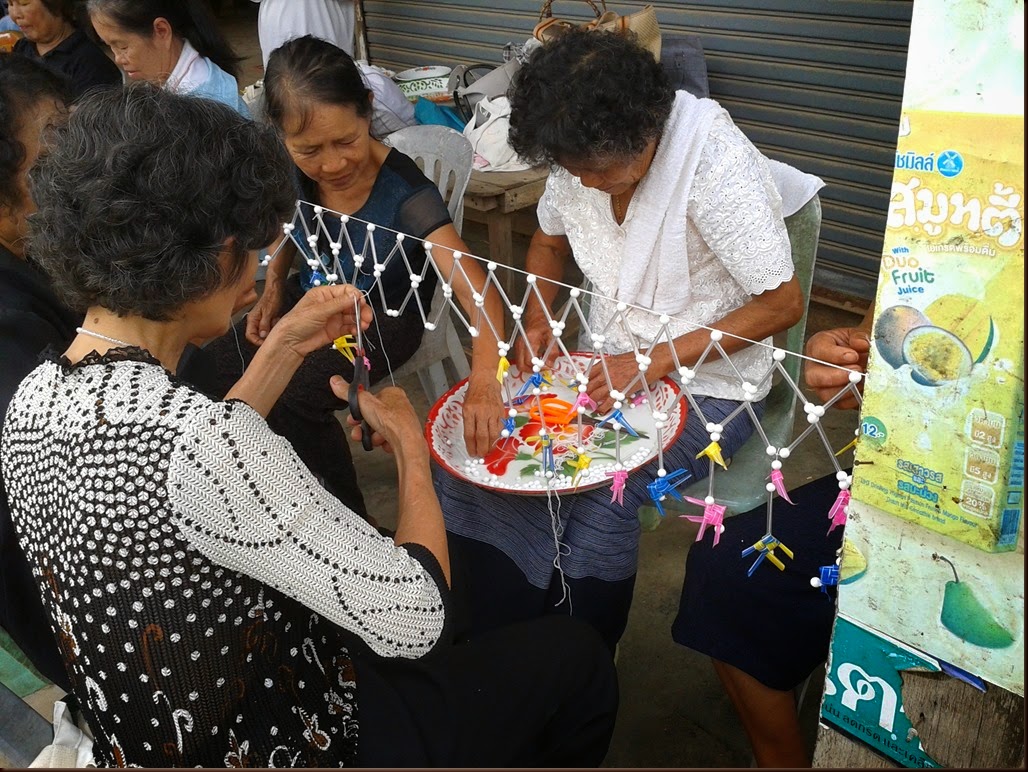
Funeral 007
Making decorative garlands.  The "fish" are made from drinking strawas

Funeral 039
Another one of the handmade decorations.  Ingrid worked on some of this.

Still others were at work in the makeshift kitchen behind the house—it seems like there was someone working there almost 24 hours a day.

The widow would be sitting in the main room of the house almost all of the time.  The coffin was there, kept in a special refrigerated case that was bedecked with flowers.  There were pads for kneeling in front of it for those wishing to offer prayers of merit for the deceased.


Funeral 003
The widow and son in front of the refrigerated chest containing the coffin

In the evening, somewhere between 8 and 9 pm, a group of monks would come and offer chants for a while.  After they left, the party began.  People would hang out and drink until all hours of the morning.  The loudest night was Saturday night, with partying going on outside our bedroom window until 4:30 in the morning.

Evening Chanting

By Saturday morning, the small house was completed.  It was filled as if someone were living there.  It contained a widescreen TV, refrigerator, mosquito net, fan, pillows and many other things.  A side room had a makesift (non functioning) squat toilet, washing machine and a dish cupboard.  Some of the kids would hang out here and watch TV.

A white string (สายสิญจน์) was attached to the front of the small house that had been built that ran into the main house where the coffin had been placed earlier.  This was to allow the dead person to move out of the main house and into the small one.

Funeral 038
The house for the deceased.  The white "sacred string" (สายสิญจน์) connects to the main house.

On Sunday evening the gazebo was set on a trailer and brought to the front of the house.  The casket was brought out of the case from inside of the house and placed in the gazebo.

Placing the coffin on the gazebo

An altar for offering incense and merit offerings was set up in front of the gazebo.  It was also a place for the family to make more formal photos of those who came.

Funeral 026
Standing by the altar in front of the gazebo

On Monday, even more canopies were set up across the street, blocking the entire side street.  A band was playing traditional music in front of their house.  Lunch was served early.

Funeral 033
The canopy across the street.  By lunch time this was full

After lunch, the string from the small house to the main house was cut so that the dead person could not go back.  The trailer with the gazebo was attached to the truck.  Two long ropes were extended out from the front of the truck so that the mourners could symbolically tow the coffin to the crematorium.

Funeral 040
Getting ready to tow the gazebo

The band moved to a waiting farm truck and started playing.  Some people got an early start and drove to the crematorium.

Funeral 043
Final preparations before the procession

Once things were in order, the procession began.  Two girls led the procession carrying the floral display that held a photo of the deceased.  Then came the mourners “pulling” the rope.  Then was the pickup truck which had a sound system playing sacred music while it towed the gazebo.

Lastly, the truck with the band followed.


A man carried a long bamboo pole with a fork on it to push up any low hanging wires or branches that might snag the top of the gazebo.

Funeral 049
Rounding the corner.  The bamboo pole is used to clear branches and wires out of the way

A humorous incident happened when the gazebo had trouble navigating between trees on the side of the road.

Funeral 050
Trying to navigate through the trees on the side of the road

Eventually we all got to the crematorium grounds.  The gazebo would normally have been rolled under a roofed structure in front of the crematorium, but it was too wide to fit, so it was placed in front.

Funeral 060
The gazebo arrives in front of the crematorium

A group of school kids distributed cold water and orange drink to the hundreds that were gathered.  It was definitely appreciated on the hot day!  They also distributed special paper flowers and pens.  The flowers had a small piece of candle attached in order to facilitate burning.  The pens had a “scroll” that pulled out containing some Pali words that could be chanted every day.
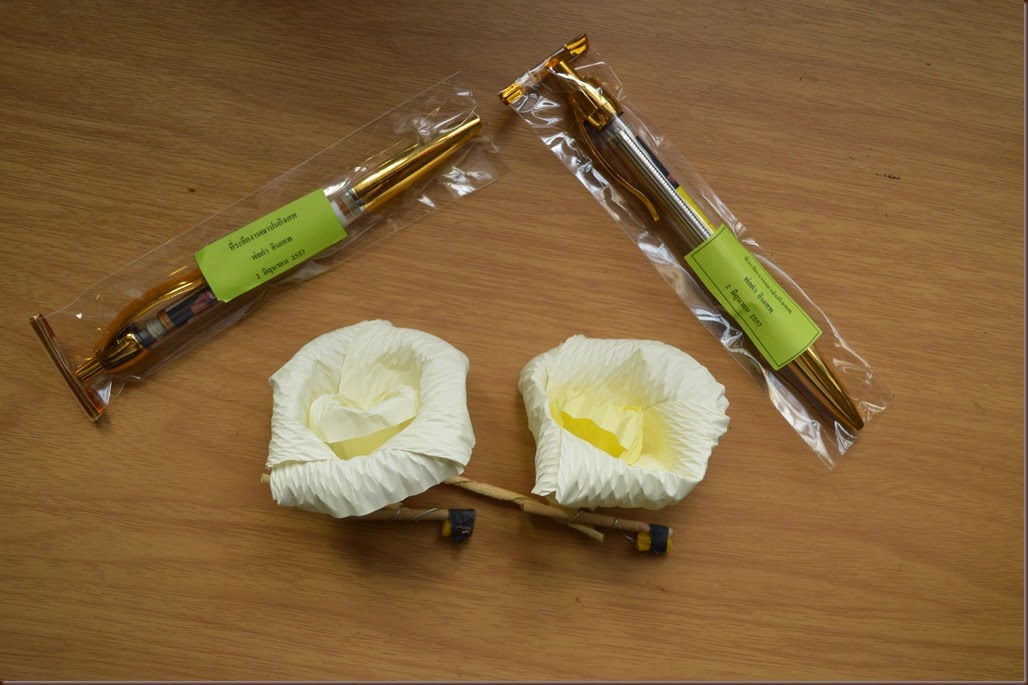
Funeral 073
The pens and paper flowers that were distributed

The first order of business was to take official pictures of select groups of people.  Then, a group of people were called up, one at a time, to offer a ceremonial towel for the monks to use.  These were placed on a table in front of the gazebo.  When they were all piled up, a group of 7 monks came up to receive them. Next, a smaller group of people were called up one at a time to offer a special pedestal with a monks robe on it.  These were also placed on the table.  A smaller group of monks came up to receive this offering.

Funeral 066
Monks receiving the ceremonial towels
Funeral 067
Monks receiving robes and pedestals

Lastly, some words were spoken about the deceased.  Then the coffin was taken off the gazebo and placed into the crematorium.  The widow went up to place her paper flower on the coffin and then she was taken home in a car.  Next, all those assembled went to throw their flowers on the coffin.  Then then coffin was ignited.

Funeral 072
The crowd goes forward to place their paper flowers on the casket

The gazebo would be donated to a park or a school according to the wishes of the family.
Back at the house, the small house was carefully disassembled and placed onto a pickup truck.  It would later be brought to a temple and reassembled where it would serve as lodging for a novice monk.

A smaller crowd of people stayed on at the house to help clean up and socialize throughout the night.  Cleanup was complete by Tuesday evening and the widow began to settle down to life with a new normal.

It was a privilege for us to be included in all of these festivities, even though we did not participate in the chanting or merit-making aspects.  It was a great way to meet new people and it gave us an opportunity to tell how different it was from our Western way of doing things.  To some we also got the opportunity to explain why funerals are different for a Christian. 

Funeral 020
Remembering Phawkham-a good neighbor


Monday, May 19, 2014

Get Organized

After living in Thailand a while, I’ve become used to the level of organization not quite being what I am used to in North America.

But there are exceptions.

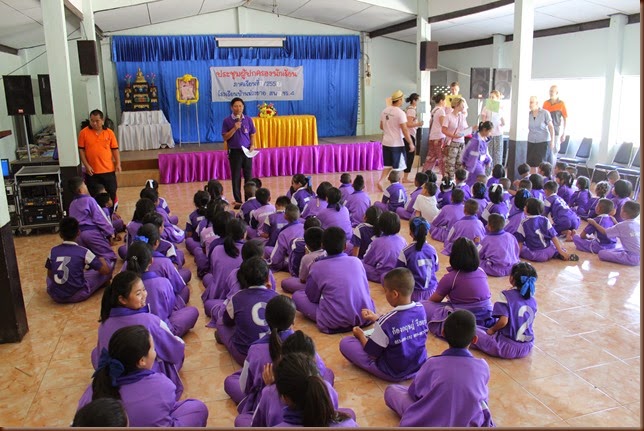
And a great exception to this was the recent English Camp we put on at the Muang Yai school across the street from where we live.

This was the first major outreach event we have put on in our community.  We wanted it to go well, but there were a lot of uncertainties going into it.  A big unknown was that our organization had never done anything at this school before, so we did not know what to expect from the teachers and staff.

Another unknown for us was the team from Northview MB Church SOLA (young adults)—lots of new faces in that group and we had no idea going into this what level of participation to expect.
But all expectations were exceeded.

So many thanks to all those who helped pull this off.

Seksan (เสกสรร) and the teachers and staff at Muang Yai school.

IMG_6673

Our first contact was with the principal of the school, Udom Buddi (นายอุดม บุดดี).  But since it was English teaching, he handed most of the organizational part over to Seksan.  But everyone performed admirably.  The teachers and students were there early.  We had lists of names of students which helped us to organize the teams.  The classrooms were ready to go.  Great job, teachers.

Northview MB Church-SOLA.

IMG_6879

It was a hot day, even by our standards, but these young people from Canada poured out their hearts (and sweat) for the young people at Muang Yai school.  They even took all the pictures so we missionaries could be free to concentrate on the things that we needed to do.

Christina Davis

IMG_6841

Christina has a lot of experience putting on English Camps in this area.  So she was a great help with ideas for the teaching stations and she also had lots of teaching materials to use.  She even took a lot of time out of her already busy schedule to help.

Ingrid

IMG_6735

Every team needs someone who is good at remembering all those little things that need to get done to make something happen.  And while Ingrid and Lie did a great job at organizing and teaching the crafts, most of what she did happened before hand.

Me

IMG_6845

I had the easy job.  I got to use my computer skills to organize schedules and produce materials in a nice color-coded fashion to try to help all the volunteers be in the right place at the right time.  And the icing on the cake was that I got to do the story telling—a simplified account of creation in English.

All in all, it seemed like it went well.  The kids were having fun, and people got to know who we are.  Already we see the difference in how the kids in the neighborhood react to our presence.  A few of the young children seemed to have adopted Ingrid as a grandma as well.

In his grace, God has given us different gifts for doing certain things well. Romans 12:6a (NLT)

Thanks to Jon Stevens for the pictures 

Sunday, May 11, 2014

Gratitude


Today in Kids Club, we told the story of the ten lepers who Jesus healed.

11 It happened that as he made his way toward Jerusalem, he crossed over the border between Samaria and Galilee. 12As he entered a village, ten men, all lepers, met him. They kept their distance 13 but raised their voices, calling out, "Jesus, Master, have mercy on us!"

14 Taking a good look at them, he said, "Go, show yourselves to the priests." 

They went, and while still on their way, became clean.  15One of them, when he realized that he was healed, turned around and came back, shouting his gratitude, glorifying God.  16 He kneeled at Jesus' feet, so grateful. He couldn't thank him enough—and he was a Samaritan.

17Jesus said, "Were not ten healed? Where are the nine?  18Can none be found to come back and give glory to God except this outsider?"  19Then he said to him, "Get up. On your way. Your faith has healed and saved you." 
Luke 17:11-19 (MSG)


In telling this story, we were able to teach the children many new words, but the most important one was not actually in the text.

Gratitude.

ความกตัญญู


In this story, Jesus essentially commends the one out of the ten lepers who shows gratitude.

So after telling the story, we gave the children the opportunity to show gratitude.

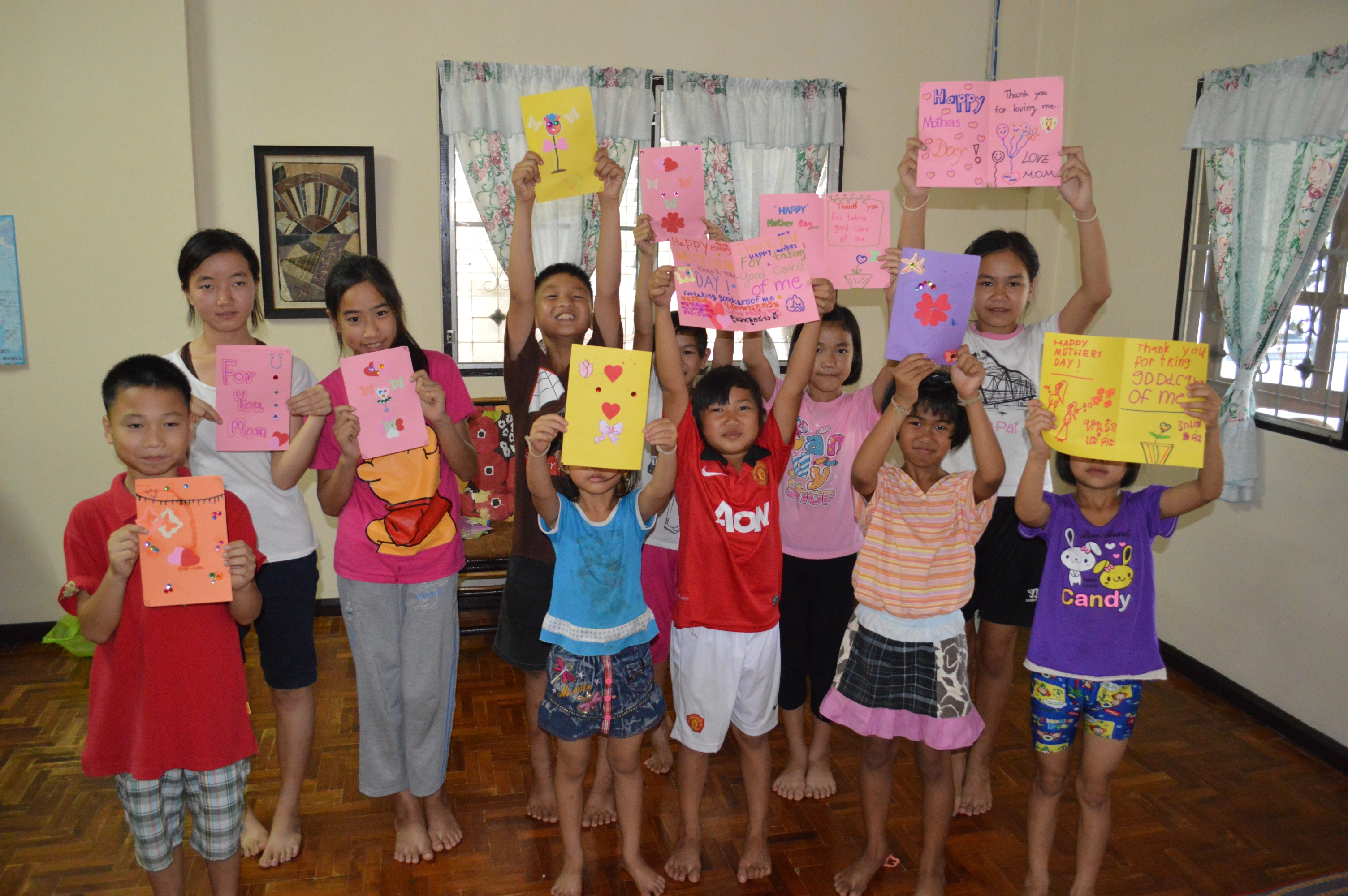
Mother's day in Thailand coincides with the Queen's birthday in August.  But in many places around the world, tomorrow is Mother's Day.  So we had the children make Mother's Day cards with a note of thanks for their mothers.  Since we're teaching English, we had them use English as much as possible, but for some it was easier to use their native Thai.  We just wanted to make sure that the mothers felt appreciated for what they pour into the lives of their children.

We gave them ideas as to the types of things they could thank their moms for.  Some came up with their own ideas.  Some used all of our suggestions.  Some struggled to write anything.  One of my favorites: "Thank you for loving me."


Kids Club 2014-5-10 11

Thank you to all of the mothers out there who work hard at loving your children.  We appreciate your hard work.

Sunday, April 27, 2014

Decisions, Decisions

The other day I was out exploring/exercising on my bicycle.  I was trying to follow a dirt track which, according to Google maps, went back out to the main road.  But Google maps has not always proved correct when it comes to some of these back roads.

At any rate, I came to a fork in the road and it was time to make a decision.  The road to the left was newer, wider, in better condition, and went in the general direction I needed to go.

But I took the other road—and it turned out to be a wise decision.

The reason for my decision: it looked like the road to the right had been around a while and was well used.  Hence it was narrower (overgrown with time) and in poorer shape because it was used more.


In the fields above Thung Kham 2

People tell me I can be a fairly good navigator.  Since I was a child I’ve loved maps.  I remember studying the maps on a cross-country road trip that our family took when I was seven.  Back then, most gas stations gave out free maps--that was always a highlight for me!  And it certainly helped to have good map reading and navigational skills in my previous occupation where I made maps.

But navigating is not just about maps—it’s also reading road and traffic conditions.  One trick I will often use in unfamiliar territory is to follow the dominant traffic flow—at least if I’m trying to stay on a through road.  Occasionally that backfires—as when I once ended up at a Coscto.

I think of my crossroad decision—where I followed what appeared to be the more “traveled” road—and I compare it to the last lines of Robert Frost’s famous poem:

Two roads diverged in a wood, and I—
I took the one less traveled by,
And that has made all the difference.


Robert Frost has a different take on navigation here.  And his take is perhaps a bit more relevant to how we navigate through life.

Often, if we want to do the right thing, we will not be doing the popular thing.  Or if we are leading in a given area, we will often be blazing a new trail.

Jesus said:

13 "Enter by the narrow gate. For the gate is wide and the way is easy that leads to destruction, and those who enter by it are many.
14 For the gate is narrow and the way is hard that leads to life, and those who find it are few.
–Matthew 7:13-14 (ESV)

This well-know verse comes near the end of the Sermon on the Mount.  And in the Sermon on the Mount there is a collection of sayings that go like: “you have heard it said…, but I say to you…” where Jesus contrasts the normal way of doing things with God’s way.  The implication is that God's way of doing things is often along the "road less traveled".

Sometimes it can be lonely when you take the road less traveled.  It is a road where we can find ourselves misunderstood quite often.  It takes courage to walk that road.

Today in church, a young woman got up during the sharing time and started telling a story.  I had a hard time following what she was saying because she was talking very fast and in a mixture of Thai and Khmu all of which was muffled by her tears.  The young woman was confessing some sin in her life and apologizing to those she had offended.

It took a lot of courage for her to do that.  Afterwards, one of the church leaders got up and reminded people about the importance of what had just happened, commending the young woman for daring to do what she just did, and trying to make sure that she was not misunderstood. This opened the way for mending of relationships that had been broken or messed up because of her behavior.

This young woman had come to one of the many crossroads in life and had to decide whether she was going to follow the well-traveled road—and pretend like her misbehavior was okay or did not matter—or whether she was going to follow the less-traveled road of obedience to Jesus.

She took the road less-traveled…

…and it made all the difference.

Friday, April 25, 2014

Seafood Buffet

Yesterday we went for a short afternoon drive to get a break from the heat (the car has A/C, the house does not).  While we were out we checked out a store in our town that we had not been to before.

Wiang Kaen has lots of little stores that sell pretty much the same thing, but each store has its own unique personality and carries some things the others don’t.  I’m glad we checked out this one because it is the only one we’ve found so far that sells wheat flour and it sells 3 kinds—all-purpose flour, bread flour and cake flour.

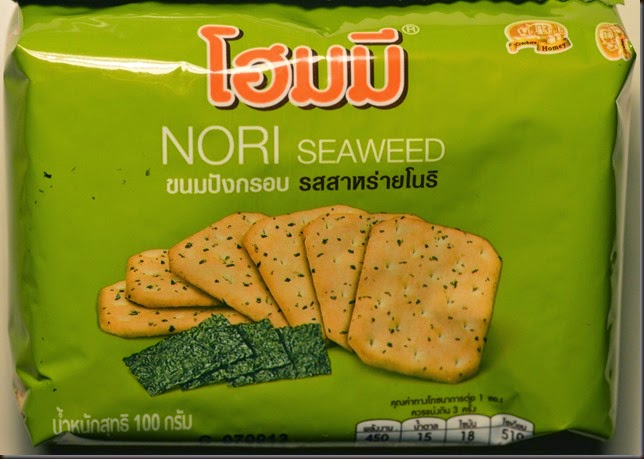
Since it was such a hot day, we we’re looking for something salty to eat so we got some crackers.  A challenge buying crackers here in Thailand is they tend to be sweet rather than salty—so we settled on some seaweed laced crackers that had less sugar than most.  Ingrid found a can of sardines.  And that became dinner (along with raw veggies).

Nori seaweed crackers

As we were eating dinner, all of a sudden, I was having a memory flashback to about 30 years ago.  At the time we lived in Perry County, Alabama, where I was working on a soil survey.  MacArthur Harris was my supervisor.  He good teacher and manager and he was also a lot of fun.

Soon after we arrived in the county, MacArthur and I were out working in a place called Suttle—about half way between Marion and Selma.  Suttle was named after the family that owned the main ranch in the area.  The family had a small store that sold various groceries and miscellaneous items.  We stopped in there to get lunch; I figured that I would get something at the deli counter.  But MacArthur said he was going to get the seafood buffet.  This really got me wondering, “seafood buffet?”  “In Suttle Store?”  I had been in the store more often than MacArthur and I had never seen such a thing.

image
Soil map of Suttle area in Perry County, Alabama.
The store is the large building between the "14" and "MlA"

After we made our purchases, we carried the brown bags containing our purchases to the picnic table outside to eat.  MacArthur proceeded to pull out an onion, a box of saltines, and a can of sardines.  He sliced the onion and then laid a slice of onion and some sardine on the each cracker.

MacArthur, wherever you are, you trained me well.  The tradition lives on.

Our Second Home in Marion Alabama
The house where we lived in Marion--we rented the upstairs.

Saturday, April 12, 2014

You can’t get lost…

…if you don’t have a destination

DSCF8124

Today, I was out on my bicycle, combining my morning workout with exploring parts of our district that I had not visited before.  My journey took me up an unpaved road that turned into a field road that petered out on a hillside garden.

As I was coming back, I decided to check out some of the side streets of the nearby village.  As I was rounding one corner, I noticed a group of people standing around in one of the yards.

“Are you lost?” they asked.

I told them that I was not lost but I was new to the area and I was exploring.  What I wanted to say, but I did not know how to say in Thai, is that you can’t get lost if you don’t have a destination.  Instead, it is more like how the old saying puts it, “wherever you go, there you are.”

While this kind of attitude is great for exploring, it is not very helpful for most things in life, whether it be working or writing or doing a project around the house.  And I must confess that I do struggle in this area—I’m a better starter than a finisher.

I know I’ve listened to sermons that were put together by someone who did not have a goal.  After a while the listening gets tiring and I check out.  “Where is he going?” I’ll as myself.  Sometimes the speaker will get me by surprise and actually reach a destination. At other times I’ll notice that the speaker himself did not seem to have a goal.  I find myself looking to be fed but coming up empty.

The destination is important.

I see the importance of having a goal these days in continuing my Thai studies.  When we were in language school, there was always a goal—usually marked by the completion of a workbook and a test of some sort.  Now the struggle is to find a goal that is reasonable, in the light of ministry commitments, and then to work towards that goal.  Without such a goal, it is hard to stay motivated to study.

Our life also needs a goal.  While I don’t underestimate the value of the journey itself—our life is all about that journey—it should be a journey to someplace.

Paul noted the importance of a life goal.

10 that I may know him and the power of his resurrection, and may share his sufferings, becoming like him in his death, 11 that by any means possible I may attain the resurrection from the dead.
 12 Not that I have already obtained this or am already perfect, but I press on to make it my own, because Christ Jesus has made me his own. 13 Brothers, I do not consider that I have made it my own. But one thing I do: forgetting what lies behind and straining forward to what lies ahead, 14 I press on toward the goal for the prize of the upward call of God in Christ Jesus.
Philippians 3:10-14


Paul’s goal was to know Jesus and be like Him.  He notes that this is not an easy goal to attain, but that it was worth straining forward for and pressing on towards.

It is interesting to note that Paul’s goal was not to win X number of people to Jesus—though he spent his life trying reach those who had not yet heard about Jesus.  In fact, in Acts 9:15 we read that Jesus gave him a clear call to do this very thing. Yet even though his life was consumed with bringing the good news to the non-Jewish world, his actual goal was to know and be like Jesus.

Reaching people for Jesus was his task.

Being like Jesus was his goal.

I admit that my pursuit of this kind of goal often seems to lack the ardor and zeal that marked Paul’s life.  It is easy to get distracted with other things—even good things.

We read a story about this kind of thing in Luke 10:38-42 (NIV):

38 As Jesus and his disciples were on their way, he came to a village where a woman named Martha opened her home to him. 39 She had a sister called Mary, who sat at the Lord's feet listening to what he said. 40 But Martha was distracted by all the preparations that had to be made. She came to him and asked, "Lord, don't you care that my sister has left me to do the work by myself? Tell her to help me!"
41 "Martha, Martha," the Lord answered, "you are worried and upset about many things, 42 but only one thing is needed. Mary has chosen what is better, and it will not be taken away from her."


Martha missed out on the "better" part because she let the task (serving Jesus) distract her from what should have been her goal (knowing Jesus).  Both the task and the goal are important—but if we lose sight of the goal, the task has no value, and we get lost.

God, help me to fix my eyes on that which is better—that which is most important.

Thursday, April 3, 2014

Eternal Bliss

A few weeks ago we were in the city of Chiang Rai for the weekend.  One morning I was walking around looking for a baking supply store and I found myself in the part of the city that caters to budget tourists and backpackers.

I stopped at a roadside stand for a coffee and noticed that the hotel across the street seemed to be quite busy, even though it was only 7:30 am.  The hotel looks like it might have been quite a nice place a few decades ago, but the tropical rain and sun seemed to have dulled its appearance over the years.

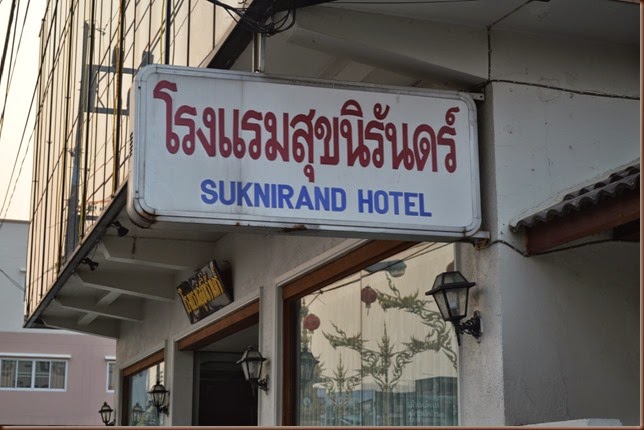
After I finished my coffee, I walked across the street and noticed the sign for the hotel:

Eternal Bliss Hotel
Suknirand Hotel sign

As is fairly normal for us anglophiles, I read the English name first.  Suknirand—I thought it might be a name or something.  But then I noticed that it was just a transliteration of the Thai.

สุขนิรันดร์

The name roughly translates “eternal bliss”.

I’ve never been inside this hotel and it may be quite nice.  But somehow when I think of eternal bliss, an older hotel does not come to my mind.  I’m not sure that it does for a Thai person either, though their thinking on eternity and heaven may be considerably different than mine—something that makes it a challenge to communicate the good news about what Jesus has done for us.

This differences in thought about heaven, hell, and eternity is apparent when one visits the “White Temple” an unconventional Buddhist Temple designed by artist Chalermchai Kositpipat.(เฉลิมชัย โฆษิตพิพัฒน์).  It is located about a 20 minute drive south of the city of Chiang Rai.

The center of the temple is the judgment hall.  From here you can either cross a bridge to the “heaven” (Nirvana) side or another bridge to the “hell” side.

The “hell” side is by far the more ornate side with lots of images of serpents and demons and such.  It appeals more to the senses than the heaven side because of the ornate detail.

When one talks about “eternal life” to a Buddhist here, it is not seen as desirable because means forever being caught up in the cycle of birth and rebirth into a life of suffering and not attaining Nirvana.

White Temple 2
The "hell" side of the White Temple

The “heaven” side, on the other hand, is very plain looking.  I’m guessing this is because the most desirable end for the Buddhist is Nirvana which is basically extinction.  One ceases to exist as an individual anymore.  The only way to get to Nirvana is to cease desiring--hence the design with little to appeal to the senses.

White Temple 16
The "heaven" side of the White Temple

This is a strong contrast to the Christian for whom heaven is a desirable place to spend eternity.
In the Bible, we read a description of heaven as the New Jerusalem.  And while I don’t know how literally the author, John, wants us to take this description, we get the idea that heaven is supposed to be a really nice place:

The foundations of the wall of the city were adorned with every kind of jewel. The first was jasper, the second sapphire, the third agate, the fourth emerald, the fifth onyx, the sixth carnelian, the seventh chrysolite, the eighth beryl, the ninth topaz, the tenth chrysoprase, the eleventh jacinth, the twelfth amethyst.  And the twelve gates were twelve pearls, each of the gates made of a single pearl, and the street of the city was pure gold, transparent as glass.
Revelation 21:19-21 (ESV)

In reality, I don’t think John really had words to describe what he saw in the vision—it was just the ultimate place to imagine spending eternity.  I’m thinking that the Eternal Bliss hotel, though it may be a really nice place to spend a few days, does not quite meet the standards described by John in the book of Revelation.