Sunset Over the Mekong River

Showing posts with label Buddhism. Show all posts

Thursday, September 21, 2017

Memorable Scents

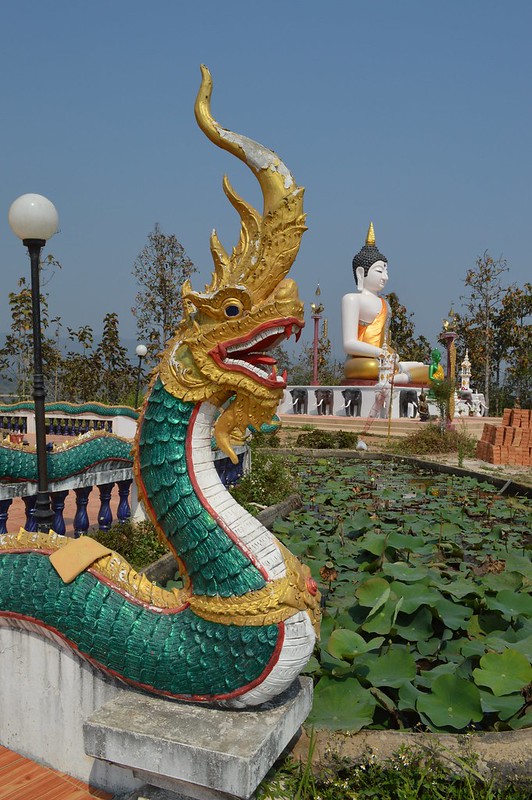
Phon Phisai is the center of Naga worship in Thailand.  The Great Naga (พญานาค-Phayanak in Thai) is a serpent God.  There is a Naga idol present in most Buddhist temples here in Thailand.  The Naga is often pictured with multiple numbers of heads, but always and odd number--3, 5, 7, or 9.

Wat Phratat 12 Rasi

Often the Naga is depicted covering a Buddha image.
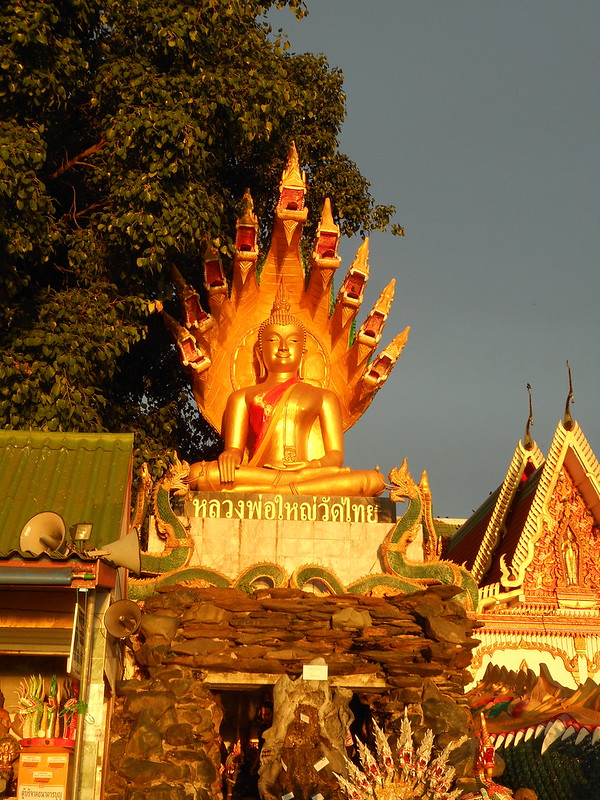
Buddha idol under naga


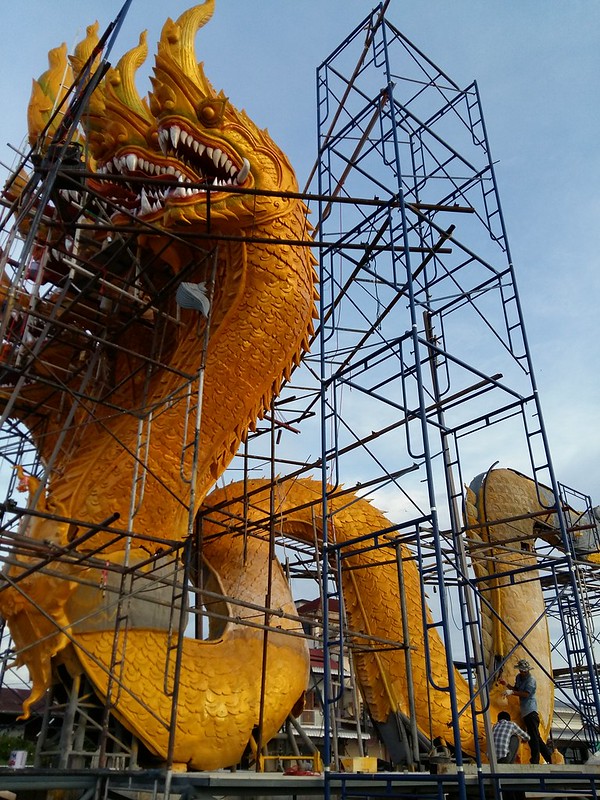
Every year, at the end of Buddhist Lent (Buddhist Lent follows a lunar calendar and this year the last day is October 5) there is a big celebration here known as the Naga Fireballs, when balls of fire come up from the Mekong River, supposedly emanating from the Great Naga.  This celebration is a big economic boon to the community, so they do a lot to get people to come here.  Right now they are constructing a large, 7-headed Naga along the Mekong River.  They are rushing to get it done before October 5th.
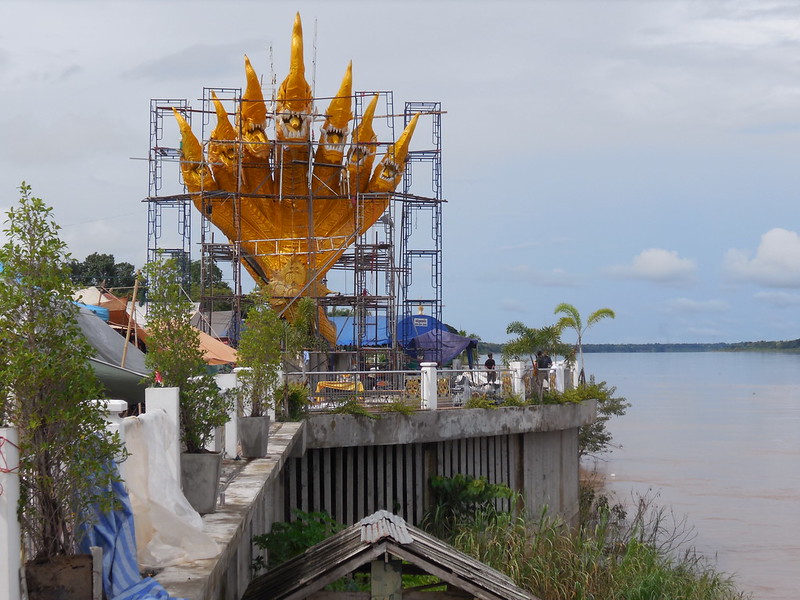
Naga construction 3


Naga Construction

As we were walking along the river near the site of this idol, a familiar scent wafted up to my nose.  It was a scent that brought me back about 35 years when I worked in a plastics factory. (More on that below.) That factory made primarily plastic housings for computers and electronics.  This "factory" I was passing now is set up outside and is used to construct the pieces of the Naga.
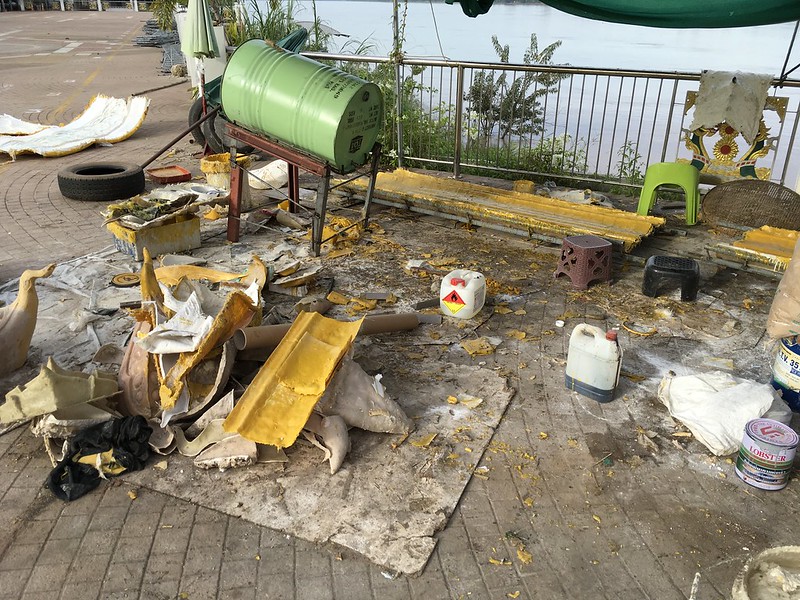
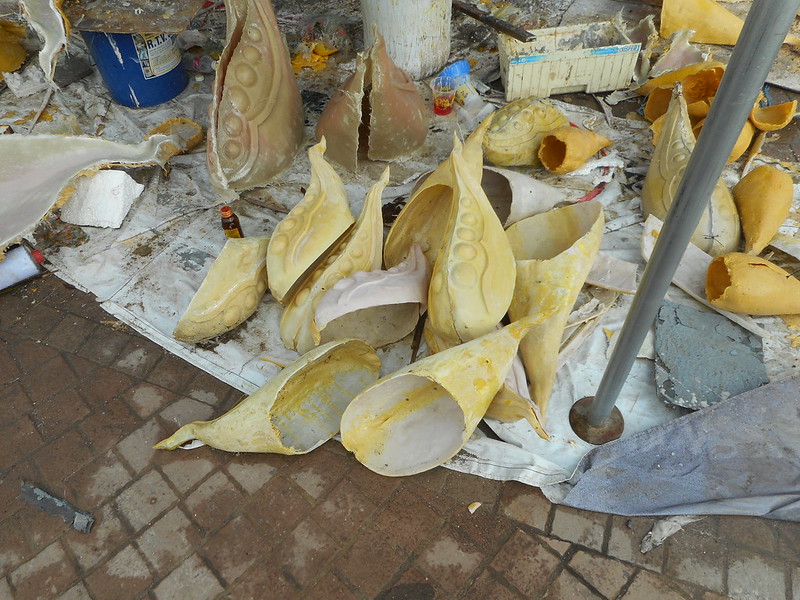
Naga Construction Plastic Factory 1


Fiberglass naga pieces 1

At one point during the construction, some of the pieces broke and fell off the steel framework.  It doesn't appear to be something that will last a long time. I find it strange that people will come and worship or make offerings to something that has been built by men.  Is not the one who creates something greater than the creation?  This is nothing but a hollow piece of plastic.

This reminds me of the writing of the Psalmist:

Their idols are merely things of silver and gold, shaped by human hands.
They have mouths but cannot speak, and eyes but cannot see.
They have ears but cannot hear, and noses but cannot smell.
They have hands but cannot feel, and feet but cannot walk, and throats but cannot make a sound.
And those who make idols are just like them, as are all who trust in them.
Psalm 115:4-8 NLT

The Apostle Paul writes this way:

They traded the truth about God for a lie. So they worshiped and served the things God created instead of the Creator himself, who is worthy of eternal praise! Amen.
Romans 1:25 (NLT)

We pray that the people of  Phon Phisai will one day no longer worship a god of their own making, or even something created by God, but will instead worship the God who created all things and Who will endure for all eternity..

Now, about that plastics factory...

After I graduated from UNH, I had a job for a while working at Jotko Enterprises, a factory that was owned by a member of my church, Dover Baptist Church.  This was in 1980, and our church at that time sponsored a refugee family from Vietnam.  Joe, the factory owner, hired the Vietnamese man.  The fellow was fairly smart—he spoke 5 languages.  Unfortunately, English (nor any Latin-based language I was familiar with at the time) was not among the 5 languages.  Joe gave me the job of training this new employee.  It was a bit challenging, using only gestures and modeling to do this.

At the time I knew little or nothing about the geopolitics of Southeast Asia.  I was ignorant of the complexities of languages and people groups in this region. I only knew that this family must have come from a desperate situation and we were trying to help.  This family was the first of many connections I made to this region before I eventually ended up moving here.

Jotko Enterprises closed in the mid-1980's.  Several years later Joe told me that he appreciated some instructions I had written about packing and shipping products.  They used these instructions for quite a while after I left.  (I had not even remembered writing them!) When he sold the business, Joe thanked us by sending a donation for the ministry we were doing in Haiti in the time.  This enabled us to attend a workshop that we really wanted to go to but had no idea how we could afford it.  Some of the things I learned at that workshop I used throughout the time we lived in Haiti.
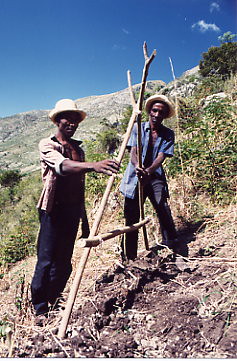
A-level (nivo-A; niveau-A)
One of the things we learned at the conference was how to make an A-level
(for soil conservation work) using no tools and only sticks, some string and a rock.

I shouldn't be amazed at the way all these life experiences have come together the way they have.  Even those pieces of the puzzle that don't seem to fit at first eventually find a place.


Thursday, May 12, 2016

Inviting-Not!

A portion of the road to Wiang Kaen follows the Mekong River.  Perched on a hill on a bend in the river is a stupa and Buddhist shrine.

Interestingly, there is no name of this place posted along the road. There is a staircase from main road up to the stupa (though it does not get used much because it is also possible to drive up).  On either side of the stair case are these interesting statues.  One is a man holding a scythe, the other is a man wielding a club.

Welcoming Committee?


Welcoming Committee? 

I'm not sure how the locals interpret these statues.  But what I DON'T read is "Welcome, come on up," or "We're glad you're here."  It looks more like they are saying, "we dare you to come up."  In my eyes, this is anything but welcoming.

What a contrast to how we see God depicted in the Bible.  We have an invitational God.  In the Old Testament, we see God was welcoming the alien and stranger.

He executes justice for the fatherless and the widow, and loves the sojourner, giving him food and clothing.  Love the sojourner, therefore, for you were sojourners in the land of Egypt. (Deuteronomy 10:18, 18 ESV)

The temple was to be a  place where everyone was invited to come pray.

these I will bring to my holy mountain and give them joy in my house of prayer. Their burnt offerings and sacrifices will be accepted on my altar; for my house will be called a house of prayer for all nations. (Isaiah 56:7 NIV) 

Jesus welcomed all people.  He invites people to follow him. He invites the weary to come find rest. He invites even children into his presence.

Jesus answered him, “If anyone loves me, he will keep my word, and my Father will love him, and we will come to him and make our home with him. (John 14:23 ESV)

Come to me, all who labor and are heavy laden, and I will give you rest. (Matthew 11:28 ESV)

but Jesus said, “Let the little children come to me and do not hinder them, for to such belongs the kingdom of heaven.”  (Matthew 19:14 ESV)

God is a welcoming God.

But what about us?  Are we as inviting as Jesus was?

I have not seen any strange statues outside our church buildings that would deter people from entering.  But sometimes the buildings themselves can be quite intimidating.  In an historically non-Christian culture like we find in Thailand, very few people would dare go into a church building unless they are already believers or they are pretty much ready to receive Christ.

We believers can be a bit intimidating as well.  Sometimes our speech or behavior can be less than inviting.

I pray that my life would not be like these statues below the stupa, but that it would bear testimony to our God who welcomes all who come to Him.


Sunday, September 27, 2015

Our Helper?

Recently, one of the Buddhist temples in our area erected this interesting idol with multiple arms.  It is an interesting looking idol, but I wasn’t quite sure what the significance is of this latest idol was.

Guan Yin-เจ้าแม่กวนอิม
Guan Yin เจ้าแม่กวนอิม

But last week, while I was out bicycling, I noticed that there were several young monks out working in the yard by the statue.  So I detoured and chatted with them a few minutes.

The first inquiry I made was concerning the name of the god depicted by the statue.  I found out that this was the goddess Guan Yin (เจ้าแม่กวนอิม).

Next I asked why this goddess had so many arms.

I found out that Guan Yin has so many arms because she is a helper goddess.  The term they used was Phu Chuai (ผู้ช่วย), the same term the Bible uses to refer to the Holy Spirit.

Interesting that since this idol was erected, it has yet to move from where it was made in order to go help anyone. And even though it has 12 pairs of hands, it has yet to lift a finger to provide assistance to those who come.  And even if it could move and wiggle its fingers, 12 pairs of hands is not going to make much of a dent in assisting however many billion people live in the world.

I think, if I wanted a god that could help me and the rest of mankind, this god would first have to be a living entity, not a bunch of stones and mortar formed by another person.  Secondly, this god should not be bound by human limitations, such as a finite number of arms.

And this is what Jesus promised us.

And I will ask the Father, and he will give you another Helper,  to be with you forever, even the Spirit of truth, whom the world cannot receive, because it neither sees him nor knows him. You know him, for he dwells with you and will be in you. (John 14:16, 17 ESV)

So I won’t be posting any pictures of the True Helper.  Because if the Holy Spirit were small enough to be photographed, He would not be much help. And if the Holy Spirit were a visible physical entity, He would not be able to dwell in the people of God in order to change their lives.

It is interesting that the Buddhists recognize the need for a helper.  In a religion that tells them that according to the laws of karma, you get what you deserve, there is a recognition that perhaps they need more or better than what they deserve.  Unfortunately, this hand-crafted idol won’t be able to help them much
.
I thank God for the Holy Spirit, Who was able to make changes in my life that I was powerless to do.  I thank God for grace that says it is possible to get more or better than I deserve.

Men, why are you doing these things? We also are men, of like nature with you, and we bring you good news, that you should turn from these vain things to a living God, who made the heaven and the earth and the sea and all that is in them. (Acts 14:15 ESV)

Thursday, June 11, 2015

Armed and dangerous

Last week my wife brought in a leaf from our rose bush.  It had several very small, yellowish-green insect like creatures crawling over the back of the leaf.

On examination, I wasn't sure if they were some kind of caterpillar (moth or butterfly larvae) or if they were larvae or nymphs of some other insects.

I did notice that they were covered with some furry hairs.

While looking at them, I accidentally touched one of them.

Ouch!

Limacodidae-Spiny slug caterpillar
Yes-that's my thumb for scale

How could such a minute hair on a minute insect inflict such an intense burning pain!

And why is it that the hairs on some creatures are soft and cuddly while others are itchy and painful?  How does one even know except to purposefully or accidentally come in contact with the animal?

Appearances can be deceiving.

I have lived in several countries and I have noticed a commonality among all of them: people like stuff.  People mortgage their homes and their souls in order that they might obtain more and nicer things in order that they might be fulfilled, happy, comfortable, or perhaps perceived as having higher status.

But it fails so often.

Why do people who seem to have it all end up committing suicide?

Why do winners of mega-lotteries often end up worse off than they started?  (And why do governments promote such systems that ultimately fail at what they are hyped to achieve?)

Jesus calls it "the deceitfulness of riches."

That which appears soft and cuddly may in fact be prickly and poisonous.

As for what was sown among thorns, this is the one who hears the word, but the cares of the world and the deceitfulness of riches choke the word, and it proves unfruitful.  (Matthew 13:22)

Not only does that which appears to be good actually fail at being good, it ultimately ends up choking what little good one had to start with.

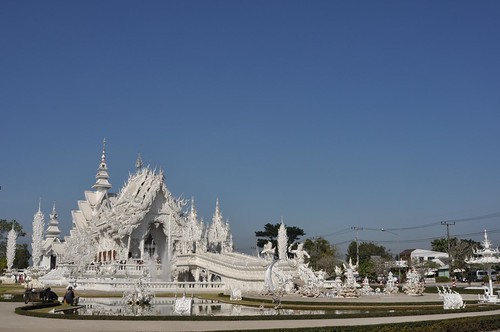
While I am not a proponent of Buddhism, I have had the opportunity to visit is an interesting temple about 10 miles south of Chiang Rai often referred to as "the white temple".  The artist/creator of the temple makes an interesting contrast.

The temple is divided into two sides.  One side is very ornate with lots of interesting sculptures and such which draw the eye.  It is quite beautiful in many ways.

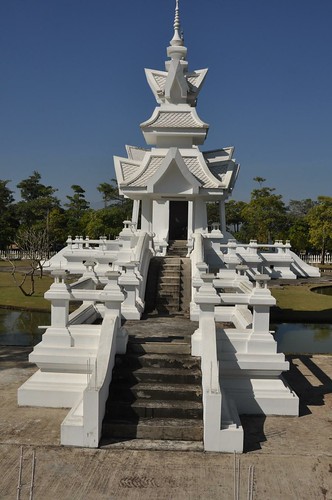
The other side is quite plain and almost boring.

The two sides are reached by bridges from a central structure.  One starts their journey there and has to decide: "Which side shall I choose.  Should I choose the beautiful and ornate side?  Or should I choose the plain and boring side?"

The catch here is that the "beautiful" side is side of karma-the endless cycle of birth, suffering and death.  The "plain" side is the side of Nirvana.

Many years ago, two men representing two large, extended families stood at a crossroad.  Their combined families were too big to be raising their livestock together and they needed to separate.  The older man said to his nephew, "take your pick, you go one way, I'll go the other."

The nephew looked one way and saw barren, rocky hills.  He looked the other way and saw a lush fertile plain.  He said to his uncle, "I think I'll head down to the valley over there."

The older man took his cattle to the barren hills.  God blessed him and he prospered.  The younger man found himself living among people whose only purpose in life was having a good time.

Eventually the older man had to rescue his nephew from the destruction of the city. The younger man ended up spending the rest of his life in a cave.  The older man prospered and became a great nation. (Genesis 13; 18:22-19:38)

Sometimes, that which appears soft and cuddly is in fact prickly and poisonous.

When you come to the crossroad, which side will you choose?

White Temple 9
Wat Rong Khun (วัดร่องขุ่น) - the 'hell" side


White Temple 11
Wat Rong Khun (วัดร่องขุ่น) - the "heaven" side

Tuesday, April 7, 2015

The Walled City

And the mountains shall be thrown down, and the cliffs shall fall,
and every wall shall tumble to the ground.
 Ezekiel 38:20b (ESV)


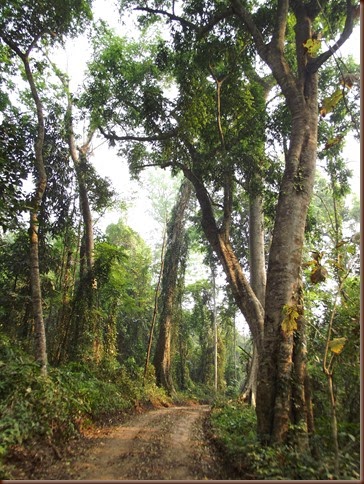
Soon after we moved to Wiang Kaen, we discovered a forest near our home that still had a lot of very large, old trees.  We were surprised because there aren't a lot of old native trees left in Thailand, especially near towns.

Satan Boran Forest scenes 8
Road through the forest

Looking at Google maps, we noticed that this Forest was fairly large in size.


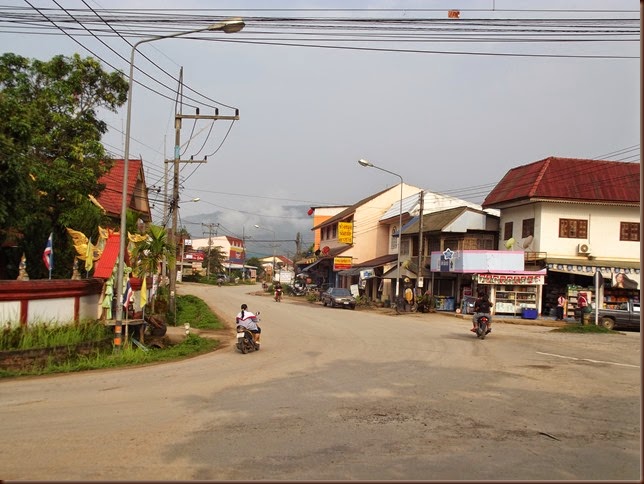
Another thing that struck us when we moved here is the name of the place: Wiang Kaen. “Wiang” is a term used to describe walled cities, and we certainly didn't seem to be any walls around that we could notice.

Downtown Wiang Kaen
Wiang Kaen today: Where's the wall?

Recently, they have been doing some cleaning up around the old forest, and in the process we have discovered something—the reason that this old forest still exists is because it is the old, walled city—it’s just that the forest have covered up a lot of the walls and moats and other historical landmarks in the place.  But now there is a map that shows the general layout.  Knowing this we have become aware of the old moat, quite deep in places and often near the present roads, but obscured by brush and trees.

The name of this place is “Boran Satan Wiang Kaen” (โบราณสถานเวียงแก่น which roughly translates: ancient Wiang Kaen) or “Wiang Kaen Forest” (ดงเวียงแก่น).  The old city was founded about 700 years ago.


Boran Satan 3
Map of the old city

The general pattern of the border is an exterior wall, then the moat, then a larger, interior wall.  Below are two photos of where the interior wall has been cut for a road.

Satan Boran Wall 1
The cut through the wall looking into the old city

Satan Boran Wall 1b
The cut through the wall looking out of the city

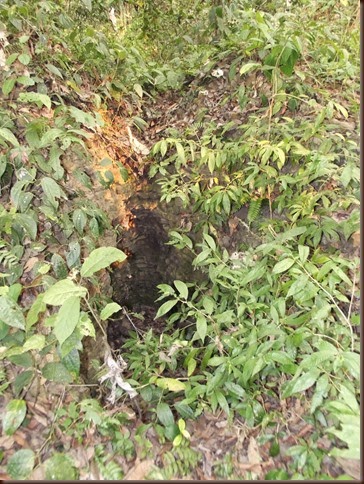
The moat is so grown over with vegetation, it is usually hard to notice that it exists.  In the photos below, I traced the approximate cross section of the moat.

Satan Boran Moat e
The moat


The Moat


The are a few small “hills” which are the remains of old chedis.  The one below is labeled #3 on the map.  It has been opened up so that you can see some of the old bricks inside.


Satan Boran Point 3 Chedi 2
One of the old chedis

Satan Boran Point 3 Chedi 8
Looking down into the chedi

Another old chedi is across from the present, simple, Buddhist temple.  This one has a large tree growing in it.

Boran Satan Point 4 Chedi
Another remains of an old chedi

The are other, interesting relicts scattered about the forest.  This Buddha image of uncertain vintage is along a mostly overgrown trail.  Some “lucky bamboo” plants in front of it show that it seems to have received some attention in recent times.

Boran satan Buddha image 1
Old Buddha image with newer
planting of lucky bamboo

The Buddhist temple is a bit different.  It is constructed like an ordinary building instead of using the usual ornate architecture.  The entrance is a roll-up steel door.  Often it is closed.

Muang Yai Forest Temple 1
The temple

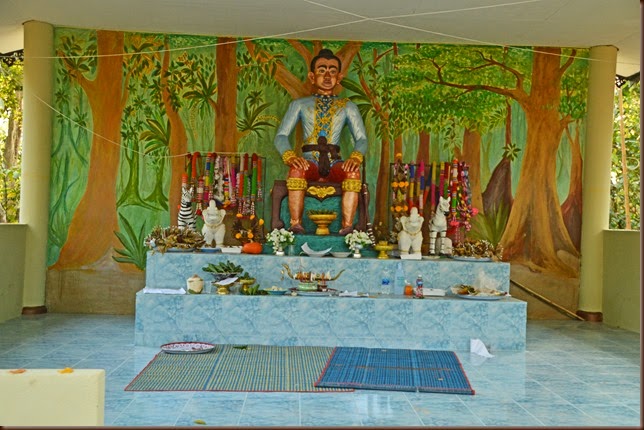
There is a shrine to the “Lord (spirit) of Wiang Kaen” (เจ้าหลวงเวียงแก่น).  A new one has just been built in the last couple of months; it is adjacent to the old one.

Jao Luang Wiang Kaen Shrine
Shrine of the "Lord of Wiang Kaen"

It's interesting to look back at this old city and see what it has become.  I'm sure that the people of the old city thought that what they built would endure for ages, but instead all that remains are a few mounds of dirt.

In the same way, we often behave like or think that the things we see around us, the product of the labors and imaginations of mankind, will last forever.  In reality, we really have no idea what our hometown will look like in 50 or 100 years.

Only God is the eternal, unchanging one; He and His word will remain forever.


Why spend money on what is not bread,
    and your labor on what does not satisfy?
Listen, listen to me, and eat what is good,
   and your soul will delight in the richest of fare.
Isaiah 55:2 (NIV) 

For he is the living God
   and he endures forever;
his kingdom will not be destroyed,
   his dominion will never end.

Daniel 6:26b (NIV)

Wednesday, June 4, 2014

Remembering Phawkham

Somewhere we once read that two of the ways to get to know a culture are to go to a wedding and go to a funeral.  This past week we became very familiar with one of these.

Last Thursday, our next door neighbor, Phawkham, died after a bout with lung cancer.

Phawkham and his wife lived with their only son and two grandchildren.   He had been sick some time and had been using oxygen for several weeks.  I first knew something was wrong when I saw his granddaughter running home from school with tears in her eyes.  Many others started showing up at their house and at 9am we went to see what was happening.  He had just died.

It was then that the frenzy of activity began that was to occupy the next few days.  Because of the very close proximity of our houses and the fact that Phawkham is a relative of our landlord, it became very much a part of our lives as well.

The rental company was there by 11 am to set up canopies, tables and chairs.  The canopy stretched to beneath the eaves of our house.

Funeral 029
The chairs set up between our houses

By afternoon, two construction projects were begun.  On the far side of their house a gazebo was constructed.  Then, between our houses, some trees were cut down or cut back in order to construct a small house.

Funeral 008
Constructing the house for the deceased

Throughout the rest of the day and for all of Friday, Saturday and Sunday, many people came to eat (3 meals a day were served to any who came), to assist the various projects, to pay respects to the widow, and make merit offerings for the deceased.

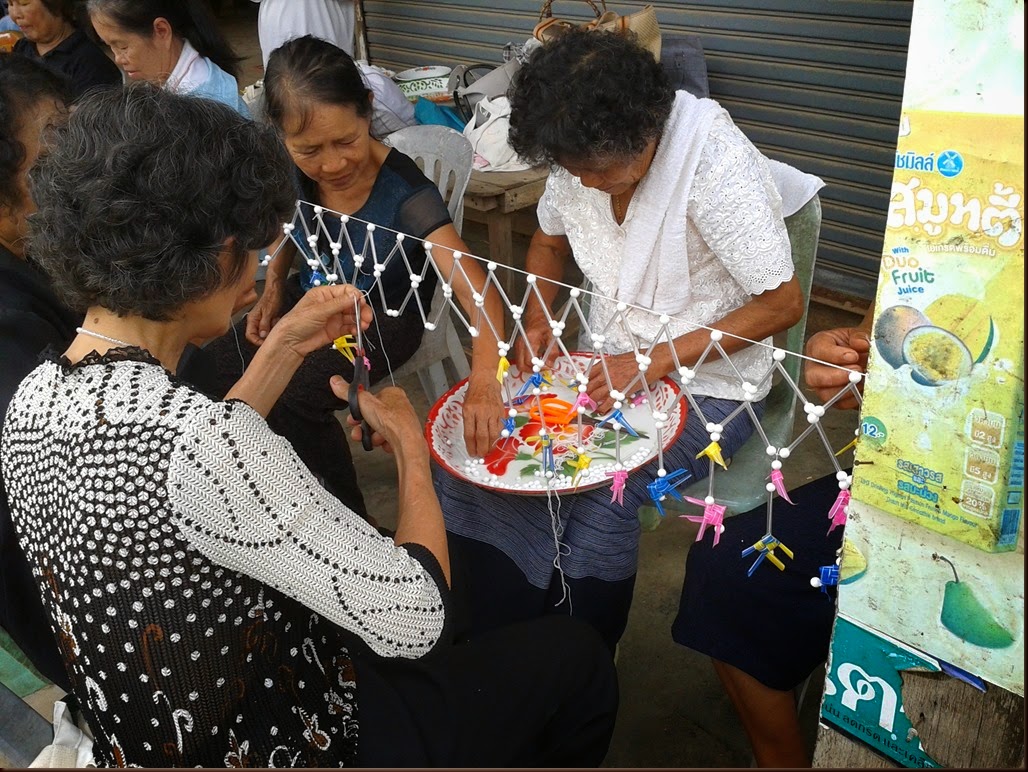
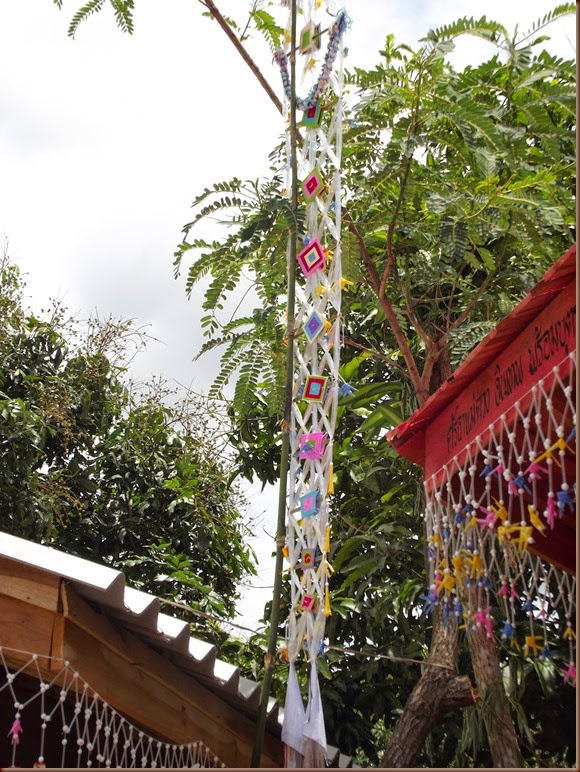
Besides work on the gazebo and house, others were involved in making the various decorations that were to be used on them.

Funeral 007
Making decorative garlands.  The "fish" are made from drinking strawas

Funeral 039
Another one of the handmade decorations.  Ingrid worked on some of this.

Still others were at work in the makeshift kitchen behind the house—it seems like there was someone working there almost 24 hours a day.

The widow would be sitting in the main room of the house almost all of the time.  The coffin was there, kept in a special refrigerated case that was bedecked with flowers.  There were pads for kneeling in front of it for those wishing to offer prayers of merit for the deceased.


Funeral 003
The widow and son in front of the refrigerated chest containing the coffin

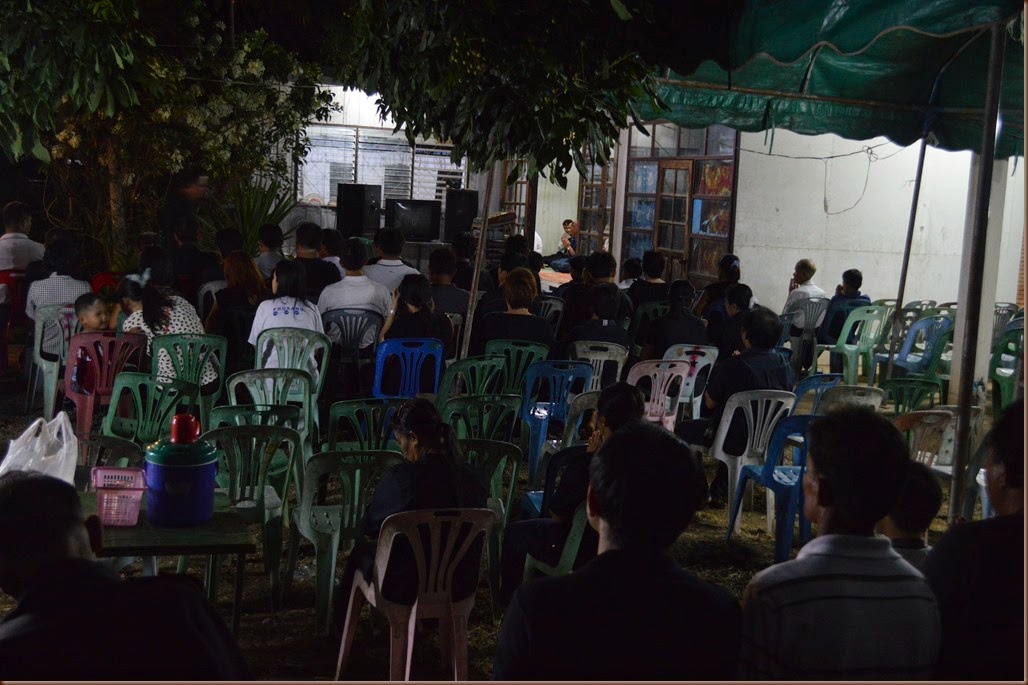
In the evening, somewhere between 8 and 9 pm, a group of monks would come and offer chants for a while.  After they left, the party began.  People would hang out and drink until all hours of the morning.  The loudest night was Saturday night, with partying going on outside our bedroom window until 4:30 in the morning.

Evening Chanting

By Saturday morning, the small house was completed.  It was filled as if someone were living there.  It contained a widescreen TV, refrigerator, mosquito net, fan, pillows and many other things.  A side room had a makesift (non functioning) squat toilet, washing machine and a dish cupboard.  Some of the kids would hang out here and watch TV.

A white string (สายสิญจน์) was attached to the front of the small house that had been built that ran into the main house where the coffin had been placed earlier.  This was to allow the dead person to move out of the main house and into the small one.

Funeral 038
The house for the deceased.  The white "sacred string" (สายสิญจน์) connects to the main house.

On Sunday evening the gazebo was set on a trailer and brought to the front of the house.  The casket was brought out of the case from inside of the house and placed in the gazebo.

Placing the coffin on the gazebo

An altar for offering incense and merit offerings was set up in front of the gazebo.  It was also a place for the family to make more formal photos of those who came.

Funeral 026
Standing by the altar in front of the gazebo

On Monday, even more canopies were set up across the street, blocking the entire side street.  A band was playing traditional music in front of their house.  Lunch was served early.

Funeral 033
The canopy across the street.  By lunch time this was full

After lunch, the string from the small house to the main house was cut so that the dead person could not go back.  The trailer with the gazebo was attached to the truck.  Two long ropes were extended out from the front of the truck so that the mourners could symbolically tow the coffin to the crematorium.

Funeral 040
Getting ready to tow the gazebo

The band moved to a waiting farm truck and started playing.  Some people got an early start and drove to the crematorium.

Funeral 043
Final preparations before the procession

Once things were in order, the procession began.  Two girls led the procession carrying the floral display that held a photo of the deceased.  Then came the mourners “pulling” the rope.  Then was the pickup truck which had a sound system playing sacred music while it towed the gazebo.

Lastly, the truck with the band followed.


A man carried a long bamboo pole with a fork on it to push up any low hanging wires or branches that might snag the top of the gazebo.

Funeral 049
Rounding the corner.  The bamboo pole is used to clear branches and wires out of the way

A humorous incident happened when the gazebo had trouble navigating between trees on the side of the road.

Funeral 050
Trying to navigate through the trees on the side of the road

Eventually we all got to the crematorium grounds.  The gazebo would normally have been rolled under a roofed structure in front of the crematorium, but it was too wide to fit, so it was placed in front.

Funeral 060
The gazebo arrives in front of the crematorium

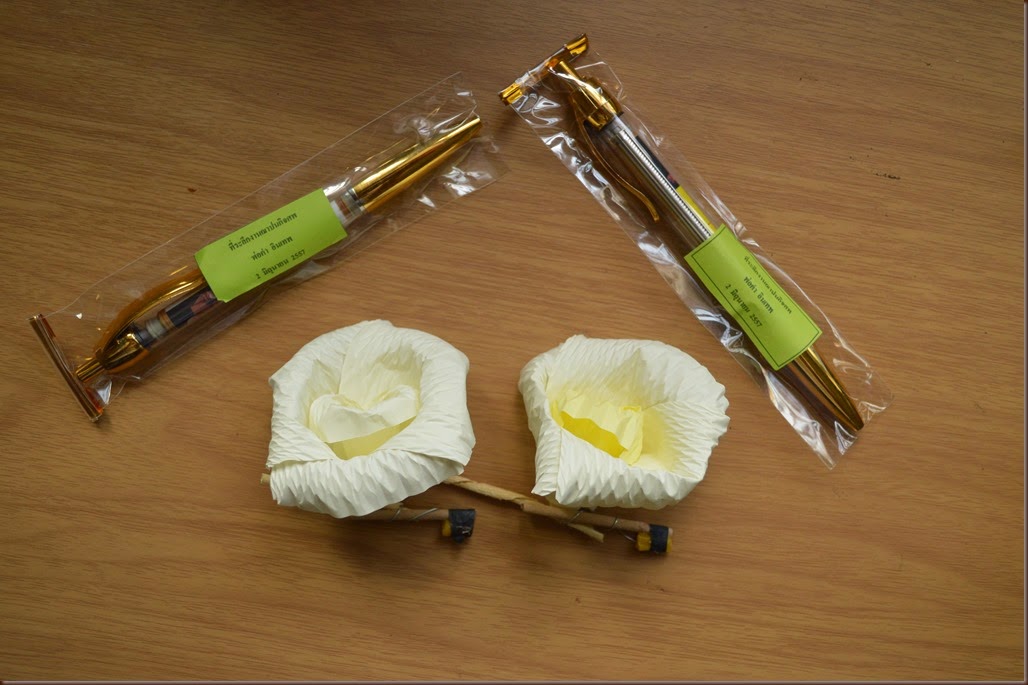
A group of school kids distributed cold water and orange drink to the hundreds that were gathered.  It was definitely appreciated on the hot day!  They also distributed special paper flowers and pens.  The flowers had a small piece of candle attached in order to facilitate burning.  The pens had a “scroll” that pulled out containing some Pali words that could be chanted every day.

Funeral 073
The pens and paper flowers that were distributed

The first order of business was to take official pictures of select groups of people.  Then, a group of people were called up, one at a time, to offer a ceremonial towel for the monks to use.  These were placed on a table in front of the gazebo.  When they were all piled up, a group of 7 monks came up to receive them. Next, a smaller group of people were called up one at a time to offer a special pedestal with a monks robe on it.  These were also placed on the table.  A smaller group of monks came up to receive this offering.

Funeral 066
Monks receiving the ceremonial towels
Funeral 067
Monks receiving robes and pedestals

Lastly, some words were spoken about the deceased.  Then the coffin was taken off the gazebo and placed into the crematorium.  The widow went up to place her paper flower on the coffin and then she was taken home in a car.  Next, all those assembled went to throw their flowers on the coffin.  Then then coffin was ignited.

Funeral 072
The crowd goes forward to place their paper flowers on the casket

The gazebo would be donated to a park or a school according to the wishes of the family.
Back at the house, the small house was carefully disassembled and placed onto a pickup truck.  It would later be brought to a temple and reassembled where it would serve as lodging for a novice monk.

A smaller crowd of people stayed on at the house to help clean up and socialize throughout the night.  Cleanup was complete by Tuesday evening and the widow began to settle down to life with a new normal.

It was a privilege for us to be included in all of these festivities, even though we did not participate in the chanting or merit-making aspects.  It was a great way to meet new people and it gave us an opportunity to tell how different it was from our Western way of doing things.  To some we also got the opportunity to explain why funerals are different for a Christian. 

Funeral 020
Remembering Phawkham-a good neighbor


Sunday, May 5, 2013

Spirit of Addiction

Of the many offerings on the altar at the spirit house in our community is Betel chewing packs containing betel leaves, areca palm nuts (หมาก), tobacco and other ingredients that are chewed together. Which raises the questions:

Is this to keep the spirits addicted?

Or are they offerings to the spirits of addiction?

In any case it is interesting that it shows that these spirits have as much a problem with pleasure-seeking and gratifying the "flesh" as do humans.

Makes me glad that we serve a God who is above such things, who is able to help us who struggle with such things.

For we do not have a high priest who is unable to sympathize with our weaknesses, but one who in every respect has been tempted as we are, yet without sin. (Hebrews 4:15-ESV)

Thursday, March 15, 2012

Sunrise over Isaan

Sunrise at Green View Resort 9

Welcome to Isaan
Driving the Friendship Highway (Highway 2) east out of Saraburi you come to a crack in a narrow ridge of mountains (a feature that I presume gives rise to the name of the nearby community, Pak Chong=”mouth of the hole”).  This seemed an appropriate location for someone to put a dam, so there is a very nice lake here.  But as you pass through this gap in the hills, you enter the elevated portion of Northeast Thailand called the Khorat Plateau.  This is known as the Isaan Region (variously spelled in English, Isarn, Isan or Esarn). 

Map Showing the Isaan Region of Thailand
CC BY-SA 3.0, https://commons.wikimedia.org/w/index.php?curid=51258


Lake at Gateway to Isaan

Gateway to Isaan

Isaan is an area that is more Lao than Thai.  The language (Isaan) is more similar to Lao than Thai as is the food and culture.  While most people can speak Thai (it is taught in schools and heard and seen in mass media), the older people all speak Isaan.

Social Issues
Over 30% of Thai citizens live in the Isaan, but it remains the neglected and poorest part of the country.  For that reason, many people have left Isaan to work in Bangkok or other cities, or work overseas.  It is the goal of many parents to have a child marry a foreigner, for it offers them a way up.  I heard somewhere that there are about 100,000 Isaan people are married to foreigners and living overseas.  Another 20,000 foreigners are married to Isaan people (primarily foreign men and Isaan women) and live in the Isaan.  It seems most villages have at least one foreigner living there-though they often don’t speak the language.

(Our little corner of Bangkok is almost like little Isaan.  The streets are filled with vendors selling all kinds of cooked food—much of it Isaan style food cooked by people who have migrated to the city to improve their economic outlook.)

The cities have a lot of problems common to cities throughout the world.  Drug and alcohol abuse.  Infidelity. (Infidelity is a problem throughout the country. A Bangkok Post commentator (originally at http://m.bangkokpost.com/opinion/271595, but link is not longer valid) referenced a survey in which just over 50% of both men and women reported cheating on their partner.) Incomes that are not on par with the standard of living or, more likely, not on par with a desired lifestyle. While in the past women might have been sold into prostitution, these days women enter the trade because they can earn for more money than they can with a "normal" job.  So it is not surprising that there are a significant number of people that are HIV positive.  In one province for which there is data, 16.66% of children under the age of 2 are HIV positive.(data originally from http://www.unescap.org/esid/psis/population/database/thailanddata/northeast/NakhonRatchasima.htm, but link is no longer valid)

There are a couple of reasons for Isaan being economically depressed. One is that it is a bit remote. It is not on the way to any place in particular except Lao, which is also much poorer than Thailand. There are not many resources there to cause factories to locate there. Agriculture is the dominant industry, but the area is also dry. It is the driest part of Thailand and there is no irrigation water in much of the area.  As a result they can only grow one crop a year, unlike the 2 or 3 crops that are grown throughout most of the rest of the country.


Isaan Produce-Note the Red Chilies!

Hog Farm

Sugar Cane Truck

Photogenic Cow

Religion
The Isaan is strongly Buddhist.  The temple remains the center of community life.


There are few or no Christians in most towns and villages. Some of the cities might have several churches but they are generally quite small.  (For more detail, you can view the map at http://e-star.ws/harvest/christian-presence-map.html)


Sakon Nakhon Baptist Church

Living Water Community Church in Borabue

At this point it looks like we will be moving to the Isaan in the near future.  There would be many opportunities for us to use our technical skills and abilities as we start building communities of faith.  Pray that the light of Jesus would shine brightly through us.

In the same way, let your light shine before men, that they may see your good deeds and praise your Father in heaven. Matthew 5:16 (NIV)