Sunset Over the Mekong River

Monday, September 5, 2016

Bucket List


Recently I read a facebook post about a "Bucket List Challenge".  It was a list of 60 or so things that you could go through and check off what you've done so that you can compare yourself with others.

What was interesting to me was the list of items.  How does one decide what goes on the list?  And why should my list even resemble someone else's list?  Who cares if I ever bungee jump?  Certainly not me.  And there was nothing in the list about laying down the first set of tracks on the snowy trail-not something I ever wrote down on a to-do list, but it felt kind of special.

Some people think a cruise needs to go on a bucket list.  I'm a strong introvert with tendencies towards claustrophobia--why would I want to stick myself on a crowded boat for more than an hour or two?

I once survived a hailstorm above treeline with lightning coming down all around me.  Check that off my list.  Wait-don't even write that one down!

For sure, there are things I would like to see and do that I have not seen and done. Maybe they will happen, maybe they won't.  It's possible that we can get so consumed with checking off our list that we miss something even better.

Take, for example, the bat cave in Huai Yang.  Have you ever been there?  Is it on your list?  It's really quite interesting.  But does anyone even know where this place is? There are no signs that the cave even exists.  But if you go back to the karst hill behind the village Huai Yang (wherever that is) and walk over towards the ladder up to the Buddha statue, you will find it.  It's not you typical cave.  It's certainly not very spectacular, as caves go.  It's not even very big.  But there are a lot of bats in there--more than I would expect to see under this slab of limestone that fell of the mountain.  I never would have thought to put this cave on my list.  But I'm glad we were not in such a rush to get home one day that we said to ourselves, "let's go check out that hill over there" and drove down the narrow levee between the rice paddies to do so.

Maybe I'll get to Bryce Canyon.  Or maybe not.  Maybe I'll get to Kakadu National Park.  Or maybe not.  Maybe I'll get to the last two states I've not yet been to.  Or maybe not.  In the big scheme of things, none of this is really important.

The adventure is all around us.  Often we miss it, though, because we are looking for something else.  What I can do is hold hands with my wife as we do our next adventure together--whatever it is and wherever it is.

In Luke 10, There are two stories that illustrate how being consumed with a task can cause people to miss out on things.  In the first, The parable of the Good Samaritan (Luke 10:25-37), some religious leaders were able to check off their list that they kept themselves undefiled that day (by NOT helping the injured man), but then they missed out on doing what was important--helping the injured man. In the second (Mark 10:38-42), Martha was able to check some things off her list (made dinner, did the dishes) but missed out on what was important--spending time with Jesus.

It's not wrong to have a list of things you would like to do.  But if you check off everything on your list, and miss the important stuff, what benefit is it?

I must confess, I do have a bucket list--but it's a short one.  Only two items:

1. Be faithful to God for the rest of my life.
2. Be faithful to my wife for the rest of my life.

What's on your list?

Worn Pretty

In a recent post, I wrote about being worn out.

Lots of things are subject to wear and tear.  But wear and tear can have different affects on things.
Even things of the same nature can be differently affected by wear and tear.

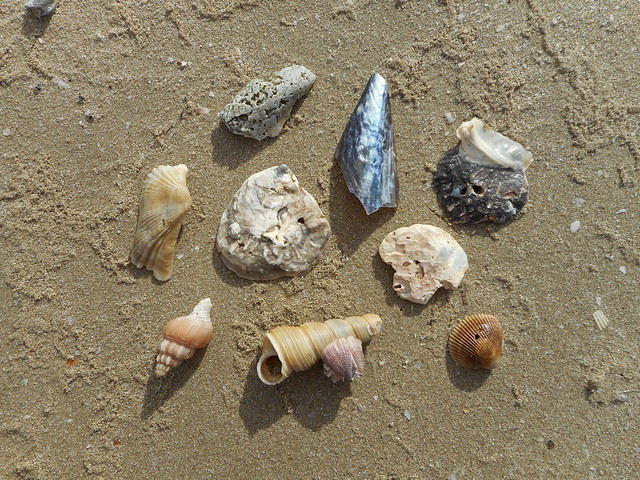
The other day I was noticing some seashells.  Some seashells as they get old look just plain old.  Broken. Worn. Chipped.


Seashells 2

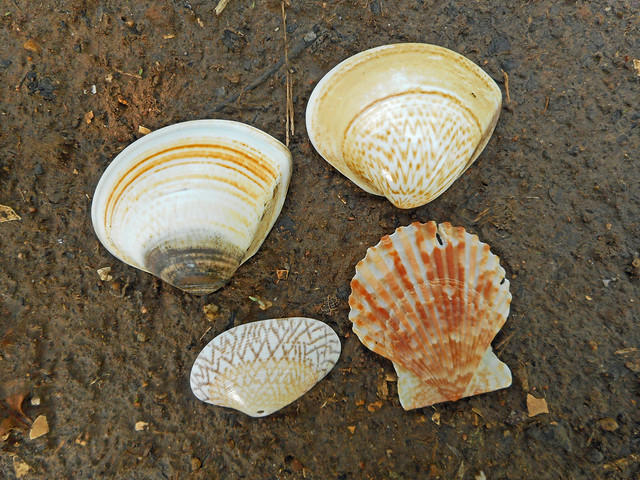
On the other hand, aging and wearing down seems to enhance or bring out beauty hidden some shells.

shells 4


About 30 years ago I made the observation that when people get old they seem to go one of two ways.  Some people get better with age.  Others just get bitter.

I determined that I would rather be one of those who gets better than bitter.  But I'm not totally sure I know how to do that.

Now, a few decades on, I can see how one can easily slip from the path to being better to the path of being bitter.

So how do I do it?  How do I become like one of those sea shells that gets more beautiful with time?

One one of the key ingredients that seemed apparent to me even back then is forgiveness.  If we don't learn to forgive, we will get bitter sooner rather than later.

Another characteristic of non-bitter people seems to be gratefulness.  They don't think the world owes them anything and they are grateful for what they have.  They don't compare what they have with what others have.

Another thing I notice about non-bitter people is that they are good listeners.  They are truly  interested in others and listen not with the intent of one-upping them but to really hear what they have to say.

There may be other things and perhaps some of those who are older than me could add to the list.

Jesus said: "You are the salt of the earth. But if the salt loses its saltiness, how can it be made salty again? It is no longer good for anything, except to be thrown out and trampled by men." (Matthew 5:13 NIV)

We who believe in Jesus are supposed to be like salt to the earth-enhancing the quality of it.  If we get better as we age, we can continue to do so.  But if we get bitter, we become like salt without saltiness-just plain grit that scratches things and roughs things up.

Lord, help me to get better with age.  Help me to forgive those who have offended me.  Help me to be grateful and appreciative for what I have. Help me to really be interested in others.  Help me to hang onto my saltiness.


Tuesday, August 9, 2016

Of Whom Shall We Be Afraid

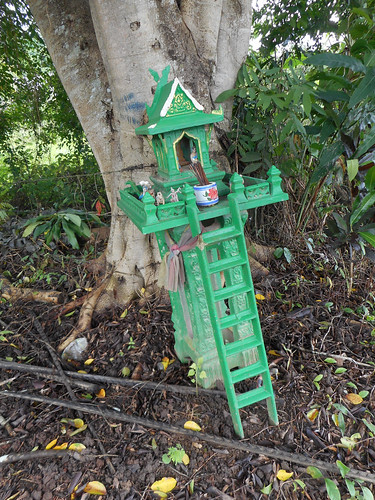
What strikes you about this photo?

Leaning spirit house 1 

Is it the lean of the spirit house?
The gaudy green color?
The desecration of a natural area by a man-made object?

To me, one of the interesting things about this spirit house (and many others) is the presence of a ladder.

The spirit house is a structure built to make offerings to the land-spirit in return for using the land.   They are present in most yards and agricultural fields. Devoted worshipers will leave fresh offerings every day.

But why the ladder?

Does the spirit actually need a ladder to get in the shrine?

In a similar way, old traditional Thai house were built on stilts with a ladder to get in.  The ladder could be pulled up to keep the spirits from getting in the house.

I don't know about you but to me, a spirit that needs a ladder to get to the shrine does not seem terribly intimidating.

Mind you, I take the spirit  world seriously and don't want to trivialize their power or presence.
 
But whom shall we fear?

Jesus said: "I'm speaking to you as dear friends. Don't be bluffed into silence or insincerity by the threats of religious bullies. True, they can kill you, but then what can they do? There's nothing they can do to your soul, your core being. Save your fear for God, who holds your entire life—body and soul—in his hands." Luke 12:4-5 (MSG)

Many are those who go about their days without giving a thought to God.  They are concerned about things of this life: what to eat, what to wear, how to be safe, etc.  Concerned about their earthly existence, they buy car insurance and wear a seat belt.  But they neglect their soul.

Here in Thailand, people will make offerings at various shrines and temples, trying to placate a plethora of deities, yet not acknowledge the God who created us (though some may add an image of Jesus to their shrine as if to hedge their bets).

Of whom shall we be afraid.

King David wrote:

  The LORD is my light and my salvation— so why should I be afraid? The LORD is my fortress, protecting me from danger, so why should I tremble?
  When evil people come to devour me, when my enemies and foes attack me, they will stumble and fall.  

  Though a mighty army surrounds me, my heart will not be afraid. Even if I am attacked, I will remain confident.  
  The one thing I ask of the LORD— the thing I seek most— is to live in the house of the LORD all the days of my life, delighting in the LORD’s perfections and meditating in his Temple.  
  For he will conceal me there when troubles come; he will hide me in his sanctuary. He will place me out of reach on a high rock.  
  Then I will hold my head high above my enemies who surround me. At his sanctuary I will offer sacrifices with shouts of joy, singing and praising the LORD with music.
   Psalm 27:1-6 (NLT)  


Don't be afraid of the one who needs a ladder,
Fear the One who created the world on which it rests.

Sunday, August 7, 2016

Cup of Happiness

One of the premises for the founding of my home country is that all people have the right to pursue happiness.  (No guarantee that you will find it but only that the government shouldn't stop you from trying.)

One of the popular promises of the current government of Thailand is that they want to return happiness to the people.

Everyone, so it seems, wants to be happy.

Why wait?  Your opportunity has come!

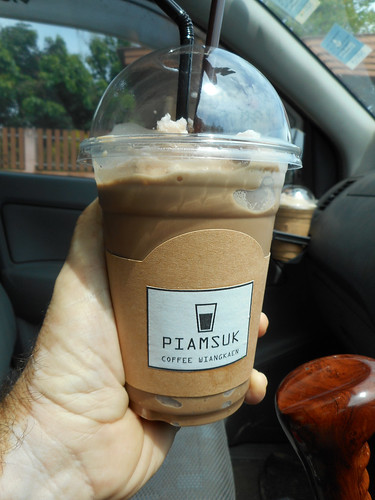
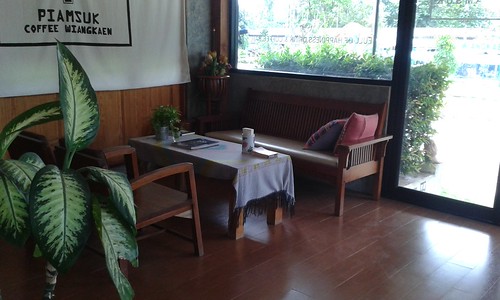
A little over a year ago, a new coffee shop opened in Wiang Kaen.  It is the most expensive coffee shop in town, probably out of the range of most of the people in the waiting area of the hospital across the street.

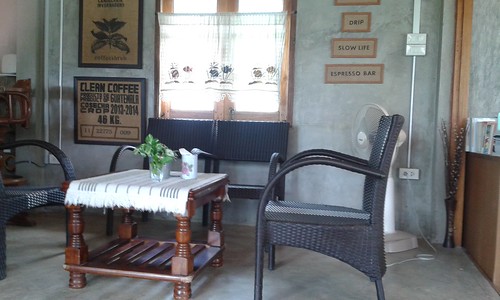
But it is a coffee shop.  I mean, there might be a couple of tea items on the menu, but mostly they sell coffee.  No cake.  No cookies.  No biscotti.  The decor of this place tells you that this place is about coffee.


Cup of happiness 2


And the coffee is good.  Flavorful.  Not bitter.  And they make it the way I want it.


Cup of happiness 5


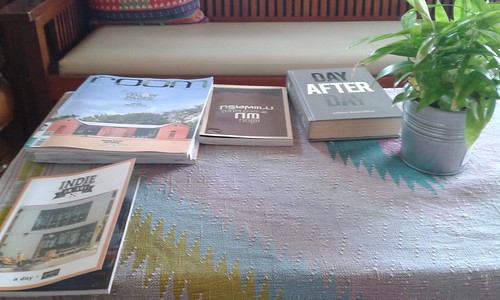
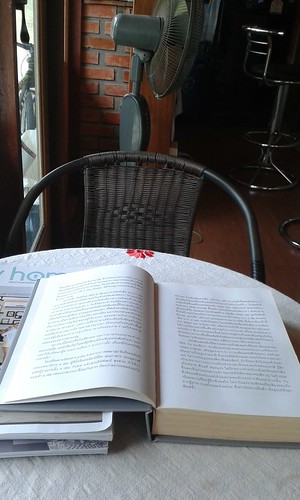
The decor is a bit different.  There is a book theme going on.  There are lots of books--real books--not just the borderline porn that passes for popular magazines that you find at the other coffee shops.


Cup of happiness 2

Cup of happiness 3


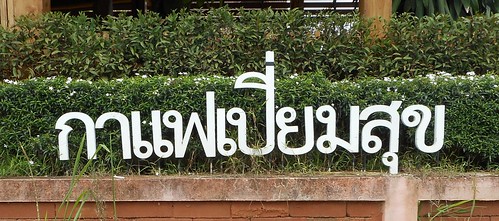
The name they chose for this place: เปี่ยมสุข - piam suk.


Cup of happiness 3


Which translates: cup of happiness.


Cup of happiness 4

The problem with my cup full of happiness is that an hour after I start drinking it, it is not merely not full, it is rather quite empty.

So much for my happiness!

So where do I get a cup that never runs out?

Jesus said there are two things we need to do to keep our cups full: ask and abide

Until now you have asked nothing in my name. Ask, and you will receive, that your joy may be full.
     John 16:24 (ESV)

If you abide in me, and my words abide in you, ask whatever you wish, and it will be done for you. By this my Father is glorified, that you bear much fruit and so prove to be my disciples. As the Father has loved me, so have I loved you. Abide in my love. If you keep my commandments, you will abide in my love, just as I have kept my Father’s commandments and abide in his love. These things I have spoken to you, that my joy may be in you, and that your joy may be full.
     John 15:7-11 (ESV)

Jesus promises something that Piam Suk, as good as it is, cannot do.

A full cup.  Forever.

Take a big sip.  It's still full.  The ultimate bottomless cup.

All we have to do is abide and ask.

And not only enough for us.  There's some to share as well--because our cup overflows.  As King David wrote at the end of one of the more famous passages of scripture:

You prepare a table before me in the presence of my enemies;
     you anoint my head with oil; my cup overflows.
Surely goodness and mercy shall follow me all the days of my life,
     and I shall dwell in the house of the LORD forever.
          Psalm 23:5-6 (ESV) 

Now that's a good cup o' joe.

Saturday, July 16, 2016

A Pleasing Aroma

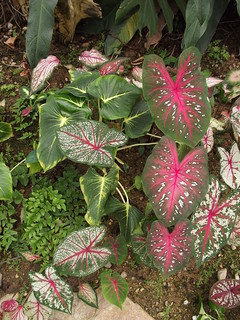
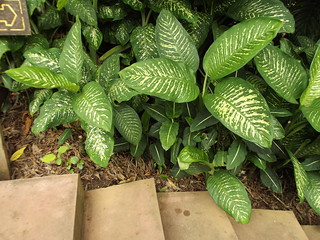
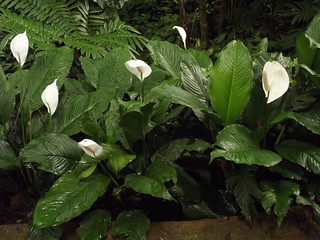
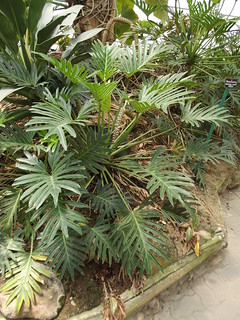
The Araceae plant family contains many plants that are common as houseplants in the US.  Plants such as Caladium, Diffenbachia, Spathiphyllum, and Philodendron are but a few.


Caladium bicolor (Aiton) Vent Araceae Aroideae-บอนสี, บอนฝรั่ง (Central)
Caladium

Dieffenbachia amoena Bull. Araceae-dumb cane, สาวน้อยประแป้ง อโมนา
Diffenbachia

Spathiphyllum sp. Araceae Monsteroideae/Spathiphylleae-peace lily, เดหลี
Spathiphyllum


Philodendron sp. Xanada Araceae
Philodendron

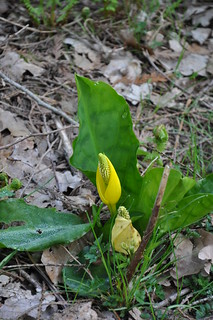
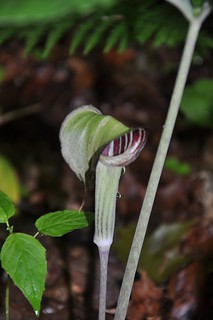
There are some species that are native to the cooler parts of North America such as skunk cabbage and jack-in-the-pulpit. But the humid tropics are the native home to many of the different species of this plant family.


Lysichiton americanus Araceae: American skunkcabbage
Skunk Cabbage
smells bad-but not as bad as some

Arisaema triphyllum Araceae: Jack in the Pulpit
Jack-in-the-pulpit

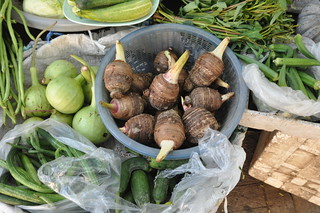
One species, taro, has an edible root that is an important food plant in the tropics.


Colocasia esculenta (L.) Araceae taro in the market
Taro roots in the market

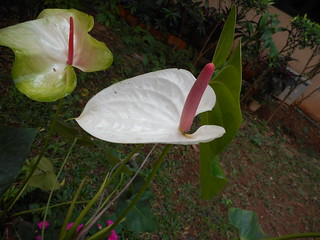
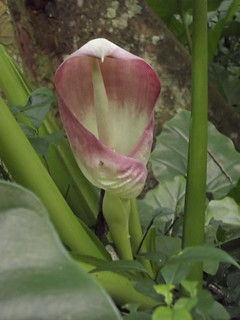
A characteristic of this plant family is the flower.  It is a spike called a spadix which is surrounded by or above a leafy bract called a spathe.


Anthurium andraeanum Linden ex André Araceae-painters pallette, flamingo flower, หน้าวัวดอก
Spathe on flamingo flower

Alocasia macrorrhizos (L.) G. Don  Araceae: giant taro, กระดาดด่าง
Spathe on giant taro

But the Araceae family has a notorious member as well.  One species, Amorphophallus titanum, has the largest unbranched infloresence of any plant species in the world--and perhaps the smelliest. It blooms at most only once every 2-7 years.  When specimens in gardens are about to bloom, large crowds will come to witness the event, despite the fact that the smell is compared to that of rotting flesh (which attract the flies that pollinate it) that gives rise to the name "carrion flower".

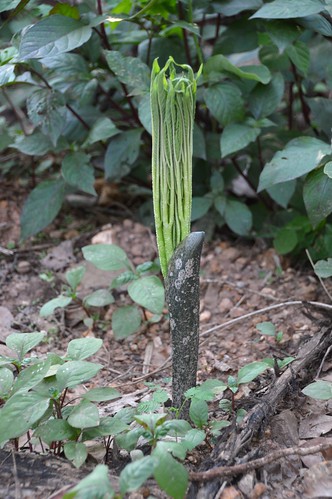
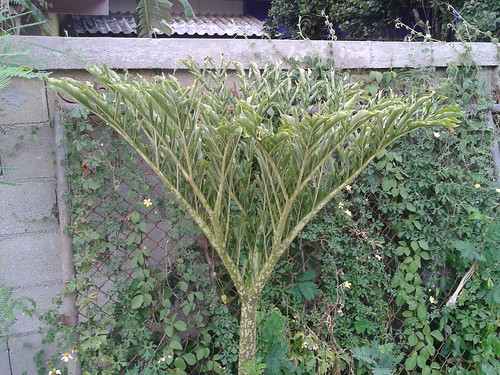
In Thailand we have a smaller relative of the carrion flower called the voodoo lily.  They are quite common here and they have an interesting growth habit.  They die back every year and then they will send up shoots in the spring.  The stalk of the plant has a unique blotchy appearance and the leaves and plant form are also quite unique.


Amorphophallus yunnanensis Engl. Araceae-voodoo lily, บุก, บุกด่าง
Voodoo lily sprouting from the bare ground

Amorphophallus yunnanensis Engl. Araceae-voodoo lily, บุก, บุกด่าง
Unique shape and blotchy bark of the voodoo lily

But I had yet to see one flower.


Until now.


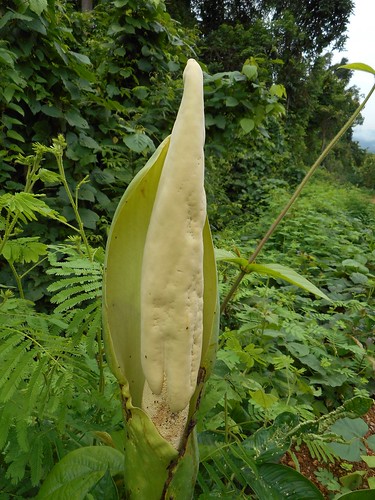
The other day when I was out walking, I spotted a bloom of this plant.  When I went close to examine it I caught a whiff of the almost nauseating  smell emanating from the bloom.  Lots of little flies were attracted to the flower, but I was a bit repulsed.


Amorphophallus yunnanensis Engl. Araceae-voodoo lily, บุก, บุกด่าง
Voodoo lily flower

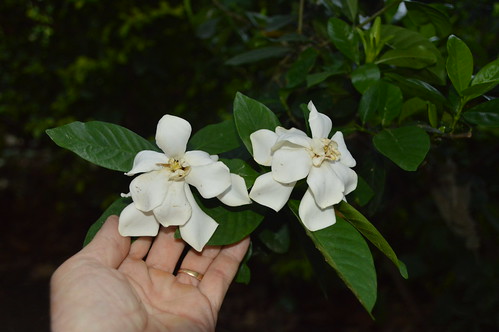
As I was thinking about that flower, I began to think about myself, what kind of flower am I?  Am I like a gardenia with a pleasant aroma that attracts people?  Or am I like a voodoo lily that drives people away?

I know people who profess to be lonely.  In their mind, I think, they imagine they are lonely because they are following God and no one else is.  But they don't seem to realize that it is often their attitude towards others that tends to repel them.

This is a warning to me to be mindful of how I "smell".  I want to have the fragrance of Christ.  To be more like a gardenia and not so much like a voodoo lily.


Gardenia jasminoides J.Ellis Rubiaceae-Gardenia, พุด
Gardenia

But thanks be to God, who in Christ always leads us in triumphal procession, and through us spreads the fragrance of the knowledge of him everywhere. 2 Corinthians 2:14 (ESV) 

Thursday, June 16, 2016

Worn Out?

I can't say it owes us anything.

Almost 33 years ago we received a wedding gift from my brother and sister-in-law.  It was a set of metal measuring cups and measuring spoons that came with a little tree-like stand to hang them from.

They were mailed to us in Alabama, where we were living at the time.  From there they traveled with us to Haiti.  Then to Mountain View, California.  Then to Bakersfield.  Then to Fresno.

In preparing to move to Thailand, we decided to dispose of the little tree and just bring the utensils.  So they traveled with us to Bangkok.  Then to Chonburi.  Then to Chachoengsao.  And lastly they made the trip to Northern Thailand.

They have served us well.  Baking things for ourselves and others.  Teaching kids. Teaching adults.

A lot of tasty memories and fun times are attached to these little pieces of stainless steel.

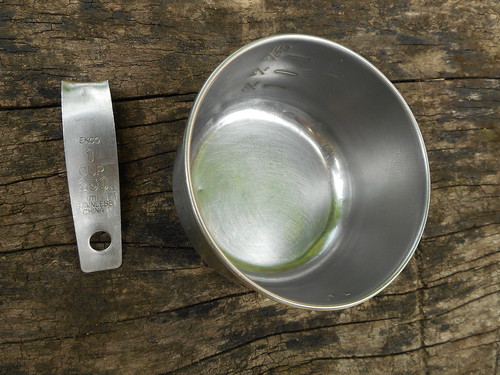
But finally, all that strain got to the biggest cup...

and the handle came off.


Measuring cup 1

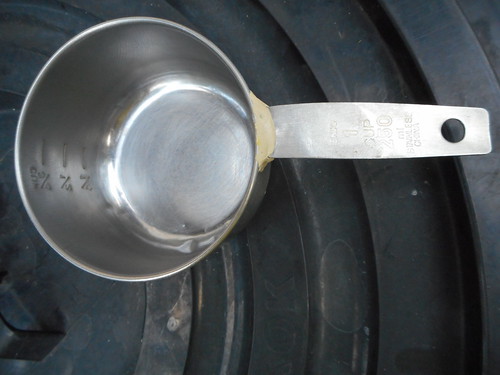
At first I thought we would just throw it out.  It served well for many years.  Maybe it was time for it to retire.  But my frugality got the better of me and so I bought some epoxy putty on our last trip to Chiang Rai.

Back in business.

Measuring Cup 3

Hopefully, these little utensils will last us for many years to come (though I don't know that they would be a priority item if we move back to North America).  Like our bodies, they are a little worn with time but they still serve the purpose for which they were made.  Maybe they need a little more attention now, but they still work.

I'd like to be like Caleb who said:

And now, behold, the LORD has kept me alive, just as he said, these forty-five years since the time that the LORD spoke this word to Moses, while Israel walked in the wilderness. And now, behold, I am this day eighty-five years old.  I am still as strong today as I was in the day that Moses sent me; my strength now is as my strength was then, for war and for going and coming.  (Joshua 14:10-11 ESV)

It's hard to imagine me being like this at 85 when I wake up with achy joints in the morning--and I'm not even 60 yet.  (Maybe my cycling muscles are even stronger than when I was 40 just because I do it more--though when I start my rides it feels like it's been ages since I last rode, even if it was only the day before.)

But God only calls me to be like the cup and serve the purpose I was created for.  If I do this, then I can trust the One who gives me that purpose to also provide the strength I need.

Have you not known? Have you not heard? The LORD is the everlasting God, the Creator of the ends of the earth. He does not faint or grow weary; his understanding is unsearchable.  He gives power to the faint, and to him who has no might he increases strength.  Even youths shall faint and be weary, and young men shall fall exhausted;  but they who wait for the LORD shall renew their strength; they shall mount up with wings like eagles; they shall run and not be weary; they shall walk and not faint. (Isaiah 40:28-31)


Monday, May 16, 2016

Targets and goals-Part 2:Systems and Goals

Recently we had a visitor, who, doing the course of our conversation, mentioned that he is a "systems guy."  Immediately I could relate, for I am also a systems guy.  I  have not usually used that term to describe myself, preferring to use symbology from my previous occupation: map making.

Systems guys are those who use inputs (could be data or resources of some kind) and then work to devise away to achieve a desired output (could be a report, or goal of some kind).


Most of the time we don’t think about the systems guy and they seldom get mentioned.  For example, when I write a newsletter, I use Microsoft Publisher (r) to create the document.  For my supporter database I use software called TNTConnect (r).  The systems people at TNTConnect created a way to link my data to Microsoft Access (r).  The systems people at Microsoft created a way from me to link my Publisher document to Access in order to personalize it and send it to MS Outlook (r) which sends out the e-mail messages.  But I don’t mention that in my newsletter.  The systems people work, often invisibly, behind the scenes to help people be successful.

To design a system, one needs to know the value of and limitations of the inputs.  One also has to be very clear about what the desired output is.

When designing a system, one should also be able to think beyond the stated desires of the customer and plan for other potential uses for the system that could arise.  It may get to the point where the system needs to be tossed and replaced. This is always a hard decision to make, because converting can take a lot of  effort.

When I first started working with NRCS in California, we were using a database program called Prelude that ran on a Unix operating machine.  It was a simple and fairly easy to understand system and I became quite proficient at using it.  But it was also quite limited.  So the powers that be decided to switch to a program called Informix.  Informix is much more powerful and I enjoyed it's capabilities.  But as we moved into the multi-dimensional world of geospatial data servers, it became time to switch, this time to SQL Server. This was a much more complicated than the previous change.  I'm sure I would love the new system, but the switch happened just after I left.

A problem can arise, though, when we get to like our system so much, the system becomes the goal.  I have seen this in government, religion and elsewhere.

We see this situation in government, for example, when an agency is created to address a certain problem.  Later on the problem is solved or the agency isn't needed anymore for some other reason, such as becoming redundant.  But the agency isn't dissolved.  They find some reason to keep it going.  This original goal no longer exists--the mission has become the goal.

We also see this in the realm of religion.  As a systems guy, I like the concept of Systematic Theology.  If God is indeed God then He has to be beyond human understanding.  But we humans want to understand God better so we develop these systematic theologies to help us.  I like that.  The problem comes when we use a system created to help us understand what God is like to instead define what God is like.  Then we end up creating silly ways to look at scripture verses that don't quite seem to fit so they are no longer a problem for us.  Or if God were to do something in the world that does not fit into our carefully crafted boxes we write it off saying, "that's not from God" or "that's from the devil."

We can do the same in ministry.  We might start a program or institution to accomplish a certain goal.  But then we like our program or institution so much, it becomes a goal.  That is not necessarily a problem as long as it remains a secondary goal and the primary goals remain the main goals.  But that doesn't seem to happen.  When the system becomes the goal, as opposed to a means to reach a goal, then usually the primary purpose for it seems to suffer.

Back when I was working for the government, our agency was under pressure to get models written for our soils database that would show how soils would behave in certain situations.  Another agency with a lot more clout than ours was driving this.  The problem was that the model used certain data about soils that wasn't necessarily relevant to all soils.  But we were under orders to put data in those boxes in the database so the model would work.  So, under protest, we did so.  The model worked fine.  However that particular data element is now only meaningful for that model.  We tweaked the data to fit the model rather than fix the model to use the data.  The system (the model) became more important than the original purpose for use of the data.

The reason I am thinking so much about systems these days is that we are encountering situations where the system has become the goal.  For me, as a systems guy, this has been quite frustrating.  But it is a reminder, as we move forward, to, as the adage goes, "keep the main thing the main thing."

So what IS the main thing for us?

I try to keep reminding myself and our Khmu partners of MB Mission's vision and ministry focus.

Our vision: Holistic church planting that transforms communities among the least reached.

Our central ministry focus: multiply healthy disciples and missional leaders.

That is what we're about at MB Mission.  We have all kinds of systems in place to try to accomplish that, but systems are just systems, they are not the goal.

Not that I have already obtained all this, or have already been made perfect, but I press on to take hold of that for which Christ Jesus took hold of me. (Philippians 3:12 NIV)