An excellent wife who can find?
She is far more precious than jewels.
Proverbs 31:10 (ESV)
A couple of days ago we were invited to a nearby Khmu village for a house dedication ceremony. However, the person who had invited us was at a dowry ceremony, so we got to sit in on that instead.
At the beginning, there were only a few men, but the crowd gradually grew to include women as well.
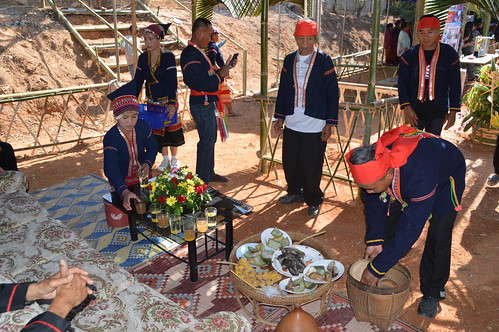
In the photo below, the father of the groom is assembling the dowry tray. Among other things, several parts of a pig are included, especially, we were told, the head and the tail. Without those two things, the dowry would not be accepted. In this photo, the heart and the tongue are being tied together by a piece of bamboo cord.
The man in the light blue shirt on the left is the father of the bride.
Below is a photo if the tray, which contains most of the dowry. There is a bamboo basket containing cash and a few ingots that date back to the days of French Indochina. From a pig there is the split skull, a piece of the rump skin with tail attached, the heart, and the tongue. There is also a small boiled chicken.
The green leaves are from a special plant that is revered for decor because it does not suffer from insect or disease damage. There pink flowers are Bougainvillea, the red ones are a type of Ixora.
The fellow in the orange shirt appears to be the dowry broker as he is the one who checked to see that everything is in order. Having counted the cash, he has the father of the bride verify the count before placing it back in the basket for the official presentation.
You can also see from this photo that there are generous amounts of orange Fanta going around.
The broker then takes the chicken and removes its legs and and wishbone to see if they are sufficient quality.
After he inspects the chicken parts. The broker then grabs the heart, which has already been cut open, and checks to see if it is good. Then he examines the split open skull to see it that also is of good quality. (The rest of the pig is in process of becoming dinner.)
Once everything has been inspected and approved, it is officially presented to the parents of the bride. The father of the groom, groom and bride to be hold the basket on one side and the father and mother of the bride receive it on the other.
In addition to the gift to the parents of the bride, there is a gift to the bridal couple as well. There is a package of fabric to be used as a wrap-around skits (ผ้าถุง), which is opened and the pieces of fabric are counted--there are twelve of them. There are also a couple of blankets. In the photo below you can also see a bamboo canister which contains sticky rice (there are two of these.)
The groom's family is Christian and does not drink alcohol. However, this is not the case for the bride's family. A bottle of strong liquor is opened and a shot glass is filled and given to the father of the bride. The same cup is refilled again and again until the important guests are served. The bottle and shot glass are then passed among the guests. It seems to spend most of its time with a group of three men.
The father of the groom then offers up a prayer for the bridal couple.
Throughout most of this ceremony, the bridal couple seems disinterested and somewhat bored. I'm not sure they ever smiled. (That was also the case for the two Khmu weddings we have attended since moving here.)
Finally, dinner is served. Trays of various foods are placed on the floor and bags of sticky rice are distributed to the guests. Ingrid and I share one bag of rice. I don't eat too much of this special food as four of the five dishes are heavily laced with cilantro. The soup contains just a little bit of cilantro and so it is tolerable for me to dip the rice in that.
The dishes on the tray are:
Top left: raw pigs blood mixed with a few other things.
Top right: chopped organ meat and other meat
Bottom left: pork soup
Bottom right: ground raw pork
Off to the right is minced pork (lab ลาบ).
The wedding itself is scheduled for the following day.
While we enjoyed being a part of this cultural event, I have mixed feelings about the concept of dowries in general. To me there seems to be the implication that a woman is "property", which can be sold. Functionally, I'm not sure what the difference is between selling a daughter as a bride or selling her to be a prostitute.
To the husband, then, she is not an equal human, but merchandise that he has paid for. If he gets tired of her, he can buy another, newer one. Or maybe just a temporary one. After all, you can cheat on your wife, but not your property.
There is also the problem of the amount of the dowry--is the measure of the value of a woman only the amount of money that the father thinks he can get for her?
If wives could only be had for what women are worth, then even the Donald Trumps of this world would be single.
Some will say that the dowry is to help cover the cost of raising the daughter. If that is the case, why are the sons not also sold?
Still, it is better than some cultures where the parents of the bride pay the parents of the groom to take her--as if the woman has negative value.