Sunset Over the Mekong River

Showing posts with label relationships. Show all posts

Saturday, December 12, 2020

Christmas Confusion

One of the memories of my childhood was winters with lots of snow.

1961 Jan Snow on house
Christmastime in New England


At Christmastime, we would go to the Christmas tree farm down the road and we would wade through the snow to find a tree as tall as my dad.

1964 or so Christmas
Our 6-Foot Tall Tree


My brain still associates Christmas trees with snow. And so when I see the Christmas tree in the house where we are now staying and the golden leaves on the mulberry tree through the window behind it, I get a sense that something is off—something is out of place—something is not as it should be. I see both fall and winter at the same time, and my brain is confused.

Christmas Trees and Fall Foliage 1
Christmas Trees and Yellow Leaves


This year I think the whole world has felt that way. Whole economies are shaken by COVID-19.  Social distancing has redefined how we do relationships. Systemic racism has given rise to protests and riots. US Elections have turned into a political circus. Like my snowless Christmas tree, something seems very off. Can we please just have some normal?

Christmas is the time we remember Jesus coming to tell us that same message—that something is off—something is not how it should be. The world is marred by sin. Everything is affected. All relationships suffer from sin's poison in our lives. We weren't designed for this. We were designed for an intimate life with the Creator in a world unstained by sin. We were designed to have relationships without conflict and worlds without war. But everything is broken and needs to be fixed. So God sent His Son, the Prince of Peace, so that we can have a restored relationship with God and with each other.

For to us a child is born,
   to us a son is given;
and the government shall be upon his shoulder,
   and his name shall be called
Wonderful Counselor,Mighty God,
   Everlasting Father, Prince of Peace.

Isaiah 9:6 (ESV)

So if things seem unusual this year—if things seem out of place—we need to remember that the world has always been that way. It's just that this year many things have happened to remind us of just how broken this world really is.

Christmas comes at a good time. We could use a little reminder that Jesus came into the world to show us how different things can be. We may not attain to it in our lifetimes, but when Jesus comes back, He will show us what normal is really like.

The wolf shall dwell with the lamb,
   and the leopard shall lie down with the young goat,
and the calf and the lion and the fattened calf together;
   and a little child shall lead them.
The cow and the bear shall graze;
   their young shall lie down together;
and the lion shall eat straw like the ox.
The nursing child shall play over the hole of the cobra,
   and the weaned child shall put his hand on the adder’s den.
They shall not hurt or destroy in all my holy mountain;
   for the earth shall be full of the knowledge of the LORD as the waters cover the sea.

Isaiah 11:6-9 (ESV)

Tuesday, July 2, 2019

All in the family

Recently, one of my siblings wrote a blog about how we are distantly related (so many "-th" cousin, so many times removed) to some earl. The name of this earl did not mean anything to me so all the connections were of little interest to me.

But it did get me thinking about family.

Several years ago (and I'll date myself here), I started a job in a factory and one of my new coworkers, upon hearing my name, asked me jokingly (I think), if I was any relation to Bill Russell. I know very little about sports, but I did recognize the name, so I replied, "only in skin color."  That, too, was a joke, but I probably do have more in common with Bill's skin color than I do his ability to handle a ball. I'm not very dexterous when it come to handling those round things and while I can probably dribble on a ball, I'd be hard pressed to dribble with one.

Bill Russell (not my relative)
Image from:


Family, then, is more than just a name.  We, with our rather nomadic lifestyles, tend to think differently about what makes family.  In our missionary family, we are "aunt" and "uncle" to a number of missionary kids. We are commonly called aunt and uncle by Thai people.

But there is another family we belong to, and that is the family of God.  This past week, during our church meeting, we read together from Galatians 6:10: "Therefore, whenever we have the opportunity, we should do good to everyone--especially to those in the family of faith."

The family of faith is awesome. I've been to many places around the world and every place I've been there have usually been some family members. I can feel "at home" even when far from home.
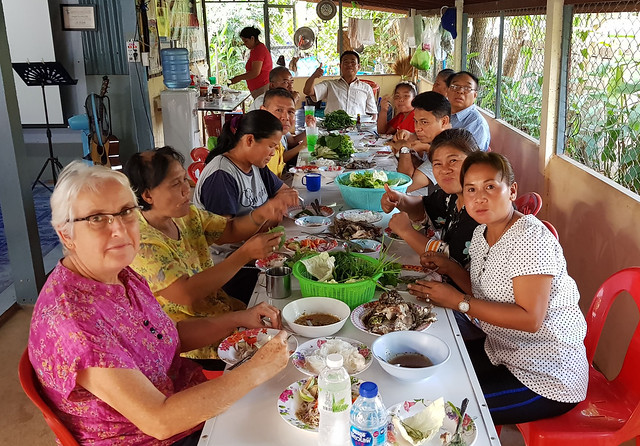

Dinner with Family
Dinner with Family


The significance of this family of faith is especially important in the culture here.  After our worship service last Sunday, we we're making plans on giving rides home to people from the next township over. One woman, Wari, who had come with us in the morning, said she would go home later. The reason she was staying, she said, was that she wanted to spend some time with the family.  Those were not actually her words, but that was the basic meaning of what she said.

When a person decides to follow Christ here in Thailand, it is a family matter.  To go against the religion of the ancestors is generally not well accepted, and a person who does so is often rejected by family. These days there is more tolerance than in the past, but in the region we work, the family pull is quite strong. To lose the support of family is also to lose the support of the village. Since this is the main method of socioeconomic support, people are reluctant to go against the wishes of family.  If a person does decide to follow Christ and stick with the decision it is because they have found a suitable replacement family in the family of God.

A few weeks ago we visited a man who was injured in a motorcycle a number of years ago and now has difficulty walking. He lives on the same compound with his wife's family, as is typical in Isaan, but he is currently estranged from his wife and is building a small house for himself behind the family compound. He was interested in the gospel message, and he repeated a prayer to follow Jesus, after which he let us cut the sacred strings from his wrist. Then we prayed that God would heal his legs so that he could walk normally. He received a Bible from us and was looking forward to having us visit more in the future to talk about the Bible.
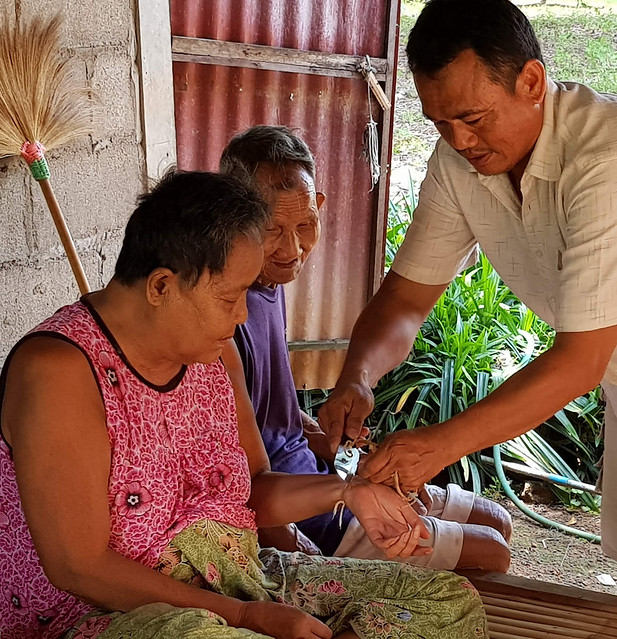

Cutting sacred string
Cutting Sacred String
A way of showing you're joining a new family.


But then family intervened. While they had been willing to let us come talk with this man, it was quite another thing for him to quit the family religion. It's okay to add Jesus in with the other gods on the altar, but not so okay to dispense with the other gods.  So the man's in-laws told him that if he persisted in following Jesus exclusively, he would be kicked out of the family compound. They even told him that they did not want us to pray for his healing.  Better to be crippled than Christian, they said. The man had no place place else to go. So he decided against joining the new family.

To follow Jesus is to be adopted into a new family, sometimes at the expense of the old one. Jesus said, "Do not think that I have come to bring peace to the earth. I have not come to bring peace but a sword.  For I have come to set a man against his father, and a daughter against her mother, and a daughter-in-law against her mother-in-law. And a person's enemies will be those of his own household."  (Matthew 10:34-36 ESV)

We Christians in North America do not tend to have this kind of experience, but it is very real for people in Thailand.

 It is very important, then, that the family of God be the kind of family to which one would want to belong. If our family is beset with problems and a lack of love, one will not want to risk losing their earthly family to join this new one. Instead, we should have such a love in our new family that we become the talk of the town. Jesus said, "By this all people will know that you are my disciples, if you have love for one another." (John 13:35 ESV) If we fail at this, all our words spent preaching the gospel become unintelligible. (1 Corinthians 13:1)

It's not always easy. There is an old rhyme that goes something like:

To live above, with saints we love--
that's glory.
To live below, with saints we know--
that's a different story.

No wonder Jesus prayed, "And I am no longer in the world, but they are in the world, and I am coming to you. Holy Father, keep them in your name, which you have given me, that they may be one, even as we are one." (John 17:11 ESV)

So, if you think about us here in Thailand, pray for our family of faith. Pray that we will be one as The Father and the Son are one.  Pray that we will be the kind of family people will want to be a part of.  It's not always easy. We've had a couple of occasions where people started spreading untrue rumors to try to sow division among us (this by people who call themselves Christian). So far, fortunately, those who have tried to divide us have only caused us to draw closer together. The enemy wants us fighting and bickering rather than loving and accepting one another. He wants us to be ugly, and not attractive.

My hope is that it may be said of us who follow Jesus what Paul wrote to Philemon: "because I hear of your love and of the faith that you have toward the Lord Jesus and for all the saints." (Philemon 1:5 ESV)



Friday, December 8, 2017

Defining boundaries by relationship

Where do I belong?

We often think about boundaries as things delimited by a border or line.  Things inside the line belong with other things inside the line. But, historically, this has not always been the case. 
In the Bible, when the land was being divided up, it is often described by terminology like "Heshbon and her towns."  The areas outside the towns were described using words like, "these cities and their pasturelands."

The boundaries of a land were described by its cities, the towns associated with the cities, and the farmland and pastureland associated with the cities and towns.  The people in the towns would graze their animals in areas often without clear boundaries.  The ownership of this land was then associated with whoever was using it.

Thailand gives one of its claims to fame that it has never been colonized.  Yet, it did not have an actual boundary until the early 1900's, when the kingdom had already been around for a few centuries.  Before that time, it was more like the Biblical system, with the kingdom consisting of whatever cities were under the rule of the king along with their associated towns and rural lands.  The cities under the rule of the King of Siam varied with time, as there was often conflict with adjoining kingdoms and a given city might belong to different kingdoms over time. "Borders" between kingdoms thus tended to have very jagged edges. Trying to put lines up between two countries becomes problematic, because the lines break some of these relational connections. Stability happens when all of most of the people living within a given physical boundary claim allegiance to the same ruler (or to the same rules, in a constitutional state).

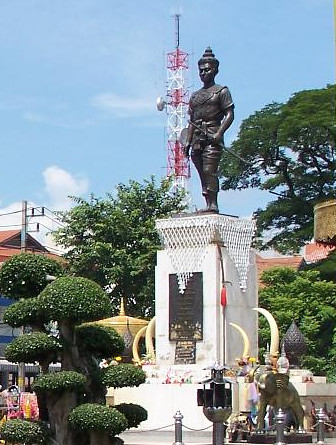
King Meng Rai Monmument, Chiang Rai, Thailand
Statue of Mengrai the Great in Chiang Rai
First King of the Lanna Kingdom
(Northern Thailand)


Even in present-day Thailand, you still see this fuzzy boundary system to some degree.  When you drive around the rural areas, you may pass through a village, then you typically pass through 4 to 6 kilometers of farmland until you get to the next village, with no clear demarcation dividing the two.

The political boundaries here are fairly well structured.  Each province is divided into districts, districts are divided into sub-districts and sub-districts are divided into villages.  Along the road you may see a sign marking when you enter a village, but I often wonder, when I am in farmland, to which village does a piece of land belong.  It may be less related to proximity than to other forms of connectedness.  If the main access road goes to one town, the land may be considered (practically, if not legally) as belonging to that town instead of one that is closer.  Transportation corridors that form this connectedness may be roads, paths or waterways.

When I was young, I lived in what was called a bedroom community.  Wolcott did not have much business of its own and most people worked in the adjoining towns of Waterbury or Bristol.  Even though we lived only 1/2 mile from Bristol, we were Waterbury people.  My father worked in that city and we went to church in that city.  We did most of our business there.  My aunt and uncle down the street were Bristol people.  My uncle worked in Bristol and they went to church in Bristol and they did a lot of their business in Bristol.

A few years ago, we lived in the province of Chachoengsao.  But the village we were in was close to Bangkok and most of the people worked in Bangkok and we did most of our shopping in Bangkok.  Because of this, our circle of relationships was different than that of our teammates who lived closer to the city of Chachoengsao. So even though we legally lived in Chachoengsao, for all practical purposes we lived in Bangkok.  The line on the map had little impact on our daily life.

In my previous occupation, we often looked at things on a watershed basis.  With this method, whatever waterway draining a piece of real estate became the common factor determining relationship.  I actually like this method a lot, and one of the first things I like to know when I go someplace is where the water flows.

When we lived in Wolcott, there was a pond in our backyard. This pond was the headwaters of the Mad River, which drained south into Waterbury.  Along the way, it passed through Cedar Swamp Pond, that actually was half in Bristol.  So even those people living along the edge of the pond in Bristol had a relationship with Waterbury.  The nutrients leaking from their septic systems went into the lake and the downstream into Waterbury, eventually flowing into the Naugatuck River.

Just beyond the rise east of our pond was some forested swampland.  This swamp was the headwaters of Roaring Brook which flowed east into Southington where it joined the Quinnipiac River.  Even though we lived in the Mad River watershed, my favorite place to hang out was in the undeveloped forest land on the east side of town that was in the Quinnipiac River watershed.  And I tended to hang out with people who lived there as well as my circle of friends was a youth group from a church in that area.

Connecticut Watershed Map
from http://www.ct.gov/deep/cwp/view.asp?a=2719&q=325628&deepNav_GID=1654%20


This relational-defined boundary has applications in our spiritual lives as well.  When Jesus came to earth, he talked a lot about the Kingdom of God.  The Kingdom of God or Kingdom of Heaven (not all Christians consider these to be the same, but I do) consists of all those who submit to the Kingship of God.  This is not a geographically defined kingdom but one defined by relationship.

Some of us are reluctant to declare a relationship with only one king.  Just as, in the past, a remote city might pay homage to two kings to hedge its bets, so we like to have both a relationship with ruler of the Kingdom of God and a relationship with the god of this world. 

Paul tells us that Satan is the god of this world.

Satan, who is the god of this world, has blinded the minds of those who don’t believe. They are unable to see the glorious light of the Good News. They don’t understand this message about the glory of Christ, who is the exact likeness of God.
2 Corinthians 4:4 (NLT)

The picture we have then is of two kingdoms, and we need to decide which one we want to be a part of.  Will I declare allegiance to the creator of the universe or will I declare allegiance to the rebellious leader who wants to claim this world as his own?

Changing allegiances can be difficult.  If a person in this part of the world wants become a part of the kingdom of God, he or she will be surrounded by and greatly outnumbered by those claiming allegiance to another kingdom.  It would be like a city in the middle of a country rising up in rebellion and claiming allegiance to a different country.  All the cities around it might not be too happy about it. Pray that the new believers here remain strong in their new allegiance.

Wednesday, September 16, 2015

Not My Relatives


A number of months ago I was walking in the hills above where we live and I saw a tree with some unusual looking fruit.  I had forgotten about that tree until I came across a photo of these fruit last week which enabled me to identify the tree.

Turns out the tree is called Engelhardtia spicata and it is in the Botanical plant family Juglandaceae.

Engelhardtia spicata Lechen ex Blume Juglandaceae-ข่าหด

Juglandaceae!?!

I remember that from my forestry school days.  That is the same plant family as pecans…

Canadian Thanksgiving dinner 2014 3

and walnuts…

Walnut Orchard

How can these relatively closely related trees have such different fruit.   I think of Juglandaceae and I think of large, edible nuts.  And here is this tree in Wiang Kaen with a small, leafy bract at the base of which is a minute seed.

The relationship between these trees as being in the same plant family is determined by scientists using the principals of phlyogenetics-trying to figure out what might have derived from common ancestors based on genetic studies.  The results are sometimes quite interesting, with apparently related organisms having very dissimilar appearances.

As we look through there trees and roots of our human family relationships, we may often be surprised at who our relatives are.  We may be quick to trace some line of our family tree back to some famous, good person.  We are perhaps less apt to make the connections to notorious criminals.  There may be cousins we wish to deny relationship with.  Other relatives make us question the veracity of the adage, "the fruit doesn't fall far from the tree."

"We can't pick our relatives," the saying goes.

And while we can't pick who we're related to, we can choose how we relate to them.

Ultimately, we're all related to each other.  It's our choice how we relate to all these relatives.

Jesus told us that one of the great commandments is to "love your neighbor as yourself."  And he chose to illustrate the concept of neighbor with a person who would be regarded more like an enemy.  (Luke 10:25-37)

Elsewhere, Jesus was more direct.  "Love your enemies," He said. (Matthew 5:44)

I confess, I am not always a fan of that commandment.

My dad was fond of they saying, "There are no strangers, only friends I haven't met."

But it is hard to keep up that sentiment with people who are threatening to annihilate you.  It's hard to love someone who killed or hurt someone you love. And it is easier to not love someone if they aren't like you.

So just because you're a walnut and they're an Engelhardtia, and you don't look anything like them, it doesn't mean you're not related.

I can think of lots of reasons no to love some people or even some whole categories of people.  But Jesus didn't give us this option.

Ultimately, Jesus showed us how to love our enemies by offering up His life for those who hated him (which would include me).  "While we were yet sinners", Paul writes, "Christ died for us." (Romans 5:8).  Jesus did not wait for me to start loving Him before He started loving me.

Someone has to make the first move.

In this day and age we justify the killing of people as a preemptive strike.  "Kill them before they kill us," we say.

Jesus was all about preemptive strikes: Love them before they love you.

Love your enemies.

After all, they're your relatives.


Sunday, March 17, 2013

Welcome Home

There have likely been thousands if not millions of discussions over the years as to what constitutes “home”.  People talk about things like:
  • How long do you have to live some place before if feels like home?
  • What do you need to have (things/rountines/etc) at a given location before you feel it is home?
  • is home based on proximity to family?
Since we have moved a lot of times among several countries over the years, this becomes pertinent to us.  We have seldom lived close to family members during out 30 years of marriage.  If you ask me where home is, I would likely say, “home is where my sweetheart is.”

Perhaps similar to this is the question of belonging in a certain area.  I usually feel if I meet people I recognize when I’m about town then it is a bit more like “my” town.  I remember randomly meeting an acquaintance in Bangkok and feeling amazed—we did not know a lot of Thai people in Bangkok outside of our neighbors—so when we met up with one in that city of over 12 million people it was quite a surprise.

Maybe another measure of “home” is whether any one misses you when you are gone.  I remember belonging to an organization once where we tried hard to build relationships and be connected, but we were not very successful.  After a while we gave up and quit.  About half a year later we met up with a member of that organization and from the discussion we realized that he did not even realize that we were no longer going to meetings!

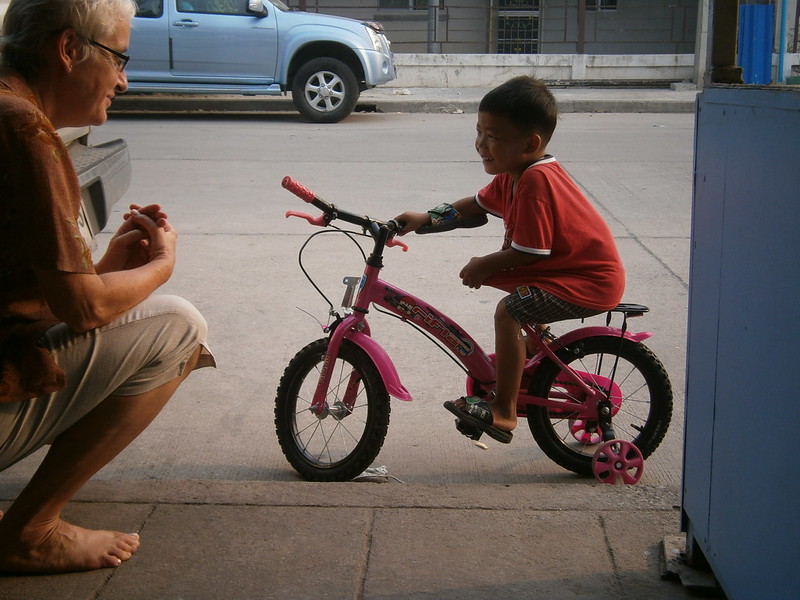
About three months ago we moved to the subdivision we currently live in.  There is a little fellow of about three, Cartoon, who can frequently be seen riding his tiny pink bicycle up and down the road.  Once in a while, if we are out on the side walk, he will stop and visit.

Ingrid chatting with child 2
Cartoon Comes to Welcome us Home


We recently got back from a two-week long trip.  We arrived at night and so it wasn’t until the next morning that I was up getting our truck loaded with stuff we would need for some activities that day.  I saw Cartoon down the road and when he noticed me, he rode his bike up to me, got off, and wrapped his arms around my leg in a big hug.

Welcome home.