Sunset Over the Mekong River

Showing posts with label sin. Show all posts

Saturday, December 12, 2020

Christmas Confusion

One of the memories of my childhood was winters with lots of snow.

1961 Jan Snow on house
Christmastime in New England


At Christmastime, we would go to the Christmas tree farm down the road and we would wade through the snow to find a tree as tall as my dad.

1964 or so Christmas
Our 6-Foot Tall Tree


My brain still associates Christmas trees with snow. And so when I see the Christmas tree in the house where we are now staying and the golden leaves on the mulberry tree through the window behind it, I get a sense that something is off—something is out of place—something is not as it should be. I see both fall and winter at the same time, and my brain is confused.

Christmas Trees and Fall Foliage 1
Christmas Trees and Yellow Leaves


This year I think the whole world has felt that way. Whole economies are shaken by COVID-19.  Social distancing has redefined how we do relationships. Systemic racism has given rise to protests and riots. US Elections have turned into a political circus. Like my snowless Christmas tree, something seems very off. Can we please just have some normal?

Christmas is the time we remember Jesus coming to tell us that same message—that something is off—something is not how it should be. The world is marred by sin. Everything is affected. All relationships suffer from sin's poison in our lives. We weren't designed for this. We were designed for an intimate life with the Creator in a world unstained by sin. We were designed to have relationships without conflict and worlds without war. But everything is broken and needs to be fixed. So God sent His Son, the Prince of Peace, so that we can have a restored relationship with God and with each other.

For to us a child is born,
   to us a son is given;
and the government shall be upon his shoulder,
   and his name shall be called
Wonderful Counselor,Mighty God,
   Everlasting Father, Prince of Peace.

Isaiah 9:6 (ESV)

So if things seem unusual this year—if things seem out of place—we need to remember that the world has always been that way. It's just that this year many things have happened to remind us of just how broken this world really is.

Christmas comes at a good time. We could use a little reminder that Jesus came into the world to show us how different things can be. We may not attain to it in our lifetimes, but when Jesus comes back, He will show us what normal is really like.

The wolf shall dwell with the lamb,
   and the leopard shall lie down with the young goat,
and the calf and the lion and the fattened calf together;
   and a little child shall lead them.
The cow and the bear shall graze;
   their young shall lie down together;
and the lion shall eat straw like the ox.
The nursing child shall play over the hole of the cobra,
   and the weaned child shall put his hand on the adder’s den.
They shall not hurt or destroy in all my holy mountain;
   for the earth shall be full of the knowledge of the LORD as the waters cover the sea.

Isaiah 11:6-9 (ESV)

Tuesday, July 17, 2018

Justification

Recently, I read an article about a televangelist who said that God told him he needs to get a 54 million dollar jet (to augment his other 3 aircraft).

In asking for money, he told his listeners that Jesus "wouldn't be riding a donkey."

Mind you, Jesus didn't actually own a donkey, he borrowed one—once—when he went into Jerusalem the last time to be crucified.

I don't know whether God actually told this televangelist to buy a plane or not.  That is not the point of this blog.  What I wanted to point out was his use of justification—the reasons why he has to have this particular jet.

Here are a couple of reasons given, according to the article:

"Standing beside framed pictures of his current fleet, he said that the jet he bought 12 years ago was no longer sufficient for his ministry because he could not fly non-stop, meaning he had to pay "exorbitant" refueling costs."

 (It's going to take a long time to recover the cost of the plane in saved refueling costs. Nor would we want to consider that even flying first class commercial would be a lot cheaper.)

"Mr Duplantis justified the request by saying that Jesus had told people to "go into the world and preach the Gospel to every creature, now how we gonna do that? I can't live long enough to travel by car or by ship or by train, but I can do it by an aeroplane"."

 (Mind you, I don't recall any scripture directed at Mr. Duplantis, specifically, that this was his job. )


As I thought about my response to these justifications, I was reminded that as I pointed my finger at this man, I had several fingers pointing back at myself.  How often do we have to try to come up with "excuses" to do the things we do.  Sometimes we want to justify acquiring something or doing something we know deep down is not necessary or commanded by God.  Sometimes we are deceiving ourselves with our excuses, we may actually think that God wants us to do something that perhaps He does not want us to do.  Sometimes, God may actually want us to acquire goods or services for our ministries and there may be a very good reason to spend more money on a better product or service.

It's a challenge to honestly evaluate our decision-making, because advertisers are very good at coming up with all the reasons why we have to have the product they are hawking.  Plus its good for the economy: if I keep up with all the latest gadgets then all the industries involved in making and marketing the products do well and the economy keeps growing.  "Yeah me! I'm helping keep the economy strong!" I can always absolve my conscience by giving away my old iPhone to a needy person. (I don't actually own an iPhone, but you get my point.)

I would suggest we need to pray about procurement related decisions, but it may not be a good idea.  Why pray if we've already made up our minds and aren't willing to truly hear from God?

Every way of a man is right in his own eyes, but the LORD weighs the heart. (Proverbs 21:2 ESV)

 It's probably good to have other people in your life to help you with these kinds of things. As we read in Proverbs: The way of a fool is right in his own eyes, but a wise man listens to advice. (Proverbs 12:15 ESV)

While it might be easier to condemn others for the choices they make, it is probably more important that we examine our own hearts and our own choices.  I don't want to be like the ones Paul addressed: Therefore, anyone of you who judges is without excuse. For when you judge another, you condemn yourself, since you, the judge, do the same things. (Romans 2:1 HCSB)

And while I think the person mentioned above is probably in the wrong, I don't know for sure, and he will have to answer to God for his actions not to me.  I'm sure others judge me as well, but I am not trying to please others, but God.  However, I do well to listen to my critics, because perhaps they may be right and perhaps God is speaking through them.

I've gotten off track before and I'm thankful for those who have gently and with humility (not with a judgmental spirit) helped me back onto the right track. As Paul writes, "Brothers, if someone is caught in a sin, you who are spiritual should restore him gently. But watch yourself, or you also may be tempted. " (Galatians 6:1 NIV)

Sunday, October 15, 2017

What kind of sin

Recently, I was walking back home from the Mekong River and I passed through the yard of one of the many Buddhist temples in the area.  There is a stupa in the temple yard that has wooden doors with carvings on them.  I couldn't help but notice the cute, white cat sitting in front of one of the doors. Carved in the door above where the cat was sitting was the word "sin".
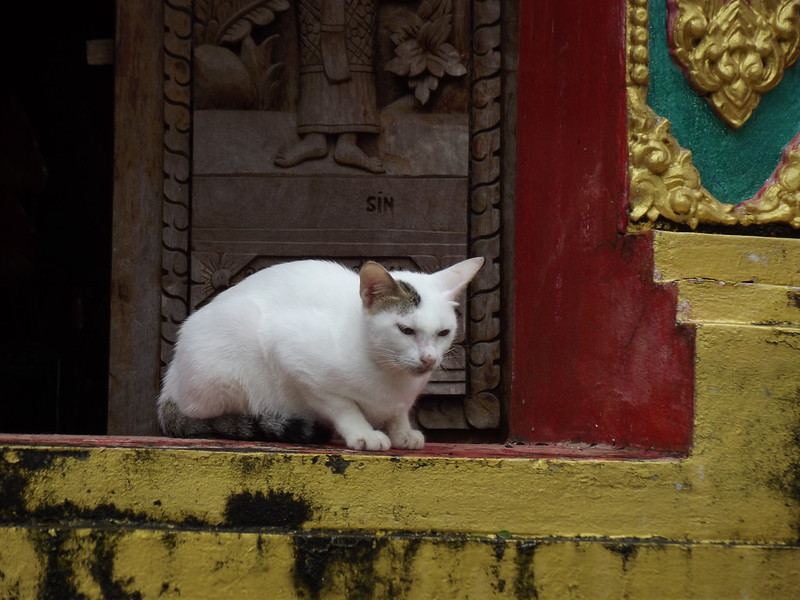

Sinful Cat?
Sinful cat?

At first I thought it strange to have the word "sin" carved into the door of the stupa.  But then I realized that it was totally appropriate, because the word "sin" is a transliteration of the Thai word ศีล, which is a religious commandment.

Unlike Judaism, which has 10 main commandments, Buddhism has 8 "precepts",  five of which lay people are expected to keep, the other 3 are supposed to be kept by the monks (as well as the first 5). These commandments are referred to as the "5 Precepts" and "8 Precepts".  The 5 Precepts can be summarized:

1. Don't harm living beings.
2. Don't steal.
3. Don't engage in sexual misconduct.
4. Don't lie.
5. Don't get drunk or take drugs.

To a Thai person, sin (ปาป  (bap)) is breaking one of these precepts.  Other types of wrongdoing go under the category of karma (กรรม (kam)). Karma can be either positive or negative but is usually viewed as negative.  In other words, "getting what you deserve" means you are not getting something good.

Keeping the precepts is considered important.  It is not uncommon when you enter a village to see a sign that says: "this village keeps the precepts".

In reality, all but the second "sins" are fairly common in Thailand (though certainly not exclusive to this country).

The first of these precepts refers not just to killing people (as in the 6th commandment of the Bible), but to all creatures.  You would think, then, that this would be a country of vegetarians, but it is far from the case. People justify eating meat by the fact that they don't typically do the killing, they just eat the meat from animals someone else killed. The fact that the animals would not be killed if there were no market for the meat does not seem to be relevant.  Interestingly, this precept does affect some kinds of pest control. You seldom see a typical rat trap or mouse trap.  What you usually find are glue traps. This is because these glue traps don't directly kill the rodents, so the person who set out the trap can honestly say, "I didn't kill the rat."  That the rat may have starved to death because of the glue trap, or died when the trap was buried in the trash heap is not their concern. (Others would say that glue traps are actually a less humane way of doing things.)   Keeping this precept also means no killing mosquitoes. So if a mosquito is in the process of sucking your blood, don't swat it.

I like the fact that the second precept is better observed.  It's nice that I don't normally have to worry if I forget to lock the doors of the house or car. This experience is certainly a lot different than other places I have lived.  Theft of intellectual property, on the other hand, is rampant.  For example, even if you want to buy a legitimate DVD,  sometimes it can be difficult to find one.  Even ones that seem legit may turn out not to be.

As for the third precept, just after we moved to Thailand in 2011, someone did a poll in Thailand and found that just over 50% of married men AND women admitted being unfaithful to their spouses.  I was even asked by a monk once, while Ingrid was present, if I had a Thai wife, as if the fact that I already had a foreign wife was irrelevant to the question.  And while there are laws prohibiting prostitution, it is still fairly common.  On several occasions, when we have told people we have been not been able to have children, we have been asked, "have you tried other partners?"

There are two words for "rape" in Thai.  Khomkheun (ข่มขืน) refers to rape by a stranger, and is definitely considered a sin and a crime.  However, blam (ปล้ำ) refers to things like date rape, which is normalized on TV and is viewed of as acceptable—or at least as something that women should be expected to endure.  A young Christian woman we know was counseled by her friends that if her boyfriend wanted to have sex with her, she should, because he needs it. (I guess the needs of the women don't count for much.)

Regarding the fourth precept, truthfulness takes a backseat to saving face and desire to please.  The most common form of lying, though it is not really viewed as lying, is to say "yes" when you don't don't mean it.  This is done because you don't want to be seen as disagreeable and a desire to make the person who asks the question feel good.  I even wonder sometimes if I should answer truthfully, as my Western culture dictates, or just say yes, which is not necessarily understood as a yes.  Or would I be misunderstood because they expect me to answer as a foreigner?

One wonders why in Thailand liquor and other alcoholic beverages are even sold, with the 5th precept being what it is.  Yet all kinds of alcoholic beverages are readily available, though they do ban sales in stores (not restaurants and bars) on certain Buddhist holidays.  A common late afternoon and evening activity is the drinking circle, kind of the equivalent of happy hour in my home culture. This past week there was a festival associated with the end of Buddhist Lent.  Alcohol was served at most of the events, even though his was a Buddhist celebration. We are saddened when we hear, "I wish my father would stop drinking" or "I wish my husband would stop drinking."

I write all this not to say that the Thai people are bad people.  Indeed, they are normal people.  They struggle with the same things people all over the world struggle with, regardless of what their religion or nationality is.  Thai people aren't the only ones to try to find justification for their actions so that they aren't "sinful,"  we are very good at that in my home culture as well.  It is also not a new kind of behavior.  Two thousand years ago, Jesus talked about those who "strain out a gnat and swallow a camel." (Matthew 23:24)

We can also be pretty selective about which commandments or precepts we wish to follow—not just as individuals but as cultures or sub-cultures.  We have what I call socially acceptable sins. The problem with socially acceptable sins is that they change with time, so someone who may have once been considered a good person is now a bad person, without the person having changed.

We also like to rate sins and crimes so that we come out on the better side.  He ran a red light (bad boy); I drove over the speed limit (socially acceptable).  She cheated on her taxes (everybody does it—and it's only the government who taxes too much anyway); he spanked his child (what an awful parent).

The Bible speaks a lot about the struggle of mankind to observe rules.

Not a single person on earth is always good and never sins.
Ecclesiastes 7:20 (NLT)

All of us, like sheep, have strayed away. We have left God’s paths to follow our own. Yet the Lord laid on him the sins of us all.
Isaiah 53:6 (NLT)

For everyone has sinned; we all fall short of God’s glorious standard.
 Romans 3:23 (NLT)

If we claim we have not sinned, we are calling God a liar and showing that his word has no place in our hearts.
1 John 1:10 (NLT)

At first, reading all these verses can be a bit depressing.  If we are all sinners, what hope is there for us?

Which is why Jesus came to bring us incredibly good news!

First, the sins we've committed can be forgiven.

But if we confess our sins to him (Jesus), he is faithful and just to forgive us our sins and to cleanse us from all wickedness.
1 John 1:9 (NLT)

Second, the Holy Spirit is given to those who believe in Jesus to help them not to sin.

Those who have been born into God’s family do not make a practice of sinning, because God’s life is in them. So they can’t keep on sinning, because they are children of God.
1 John 3:9 (NLT)

And this is his commandment: We must believe in the name of his Son, Jesus Christ, and love one another, just as he commanded us. Those who obey God’s commandments remain in fellowship with him, and he with them. And we know he lives in us because the Spirit he gave us lives in us.
1 John 3:23, 24 (NLT)

But the Holy Spirit produces this kind of fruit in our lives: love, joy, peace, patience, kindness, goodness, faithfulness, gentleness, and self-control. There is no law against these things!
Galatians 5:22, 23 (NLT)

Thank you, God, for sending Jesus to die for us that our sins might be forgiven.  Thank you for sending your Holy Spirit to all those who believe in Jesus to help make it possible for us not to sin.


Saturday, March 26, 2016

Keeper of the books

Good Friday.

What's so good about it?

The other day I was looking up a word in my Thai-English dictionary and my eyes caught an adjacent entry that piqued my interest.  This began a chain of looking up words that help explain other words until I came across this one:

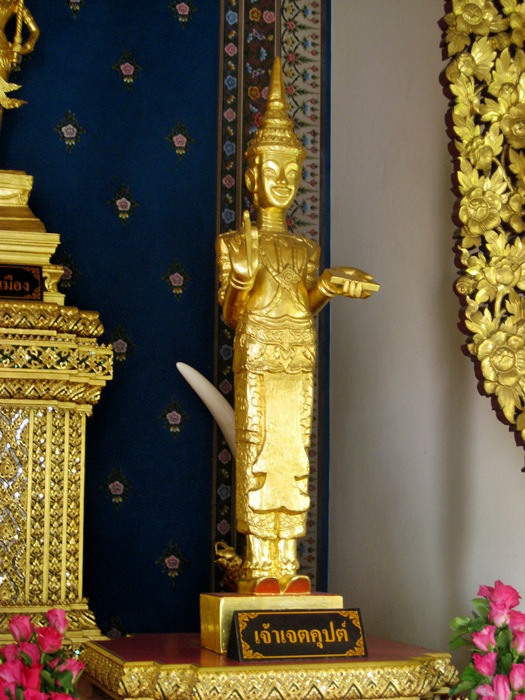
เจ้าพ่อเจตคุปต์

Which roughly translates: guardian spirit that keeps the thoughts


Transliterated it comes out something like Jao Paw Jettakoup

Jao Paw Jettakoup is one of five idols in the City Pillar Shrine in Bangkok.


Image credit:
http://2g.pantip.com/cafe/gallery/topic/G11881443/G11881443.html


The job of Jao Paw Jettakoup is to remember all of the bad deeds people have committed and to recite them to the god of hell after the person dies. (It's probably not a good idea to try to bribe him to edit the record.)

Many Buddhists here in Thailand believe in the existence of an account book called the Account of Good Deeds and Account of Sin (บัญชีบุญบัญชีบาป).  When a person dies, that account book is opened and the good deeds are weighed against the bad deeds to see what kind of punishment a person will get. They also believe that merit made on behalf of the dead person will be taken into account, which probably accounts for many of the merit-making activities in Buddhist funerals here.  (Note: not all Buddhists believe this, some believe one's fate is determined by an automatic cause-and-effect process that does not involve a deity as a judge.)

For most of us, the existence of such a record book would not be a good thing.  If the book was something tangible we might go through a lot of effort to seize and destroy the book--or at least edit it--but in the process earn a bunch of entries on the "bad deeds" side.

This is where Good Friday comes in.

By His death on the cross, Jesus is able to take away the sins of those who believe in Him.  This is why, when John the Baptist saw Jesus, he cried out, "Behold the Lamb of God who takes away the sin of the world!" (John 1:29)  It's as if  by submitting to crucifixion, Jesus earned the right to take an eraser to the Account of Sin.

That is Good News!  That is why it is called Good Friday.

The Cross - Good News for us

The Lamb of God takes away the sins of the world.

David writes, "as far as the east is from the west, so far does he remove our transgressions from us." (Psalm 103:12, ESV).  Jesus is able to take the one side of the ledger and heave it as far as the east is from the west.

Good News!  Good Friday.

When I think about this Buddhist concept of a Book of Deeds, I am reminded of Paul wrote in 1 Corinthians 13:4.  Love, he says, "keeps no record of being wronged".

Jesus tells us that "God is Love."


There is no reason to take an eraser to the Book of Deeds if you don't keep such an account in the first place.

This is what Love does.

This is what God does.

  Dear friends, let us continue to love one another, for love comes from God. Anyone who loves is a child of God and knows God. But anyone who does not love does not know God, for God is love.
  God showed how much he loved us by sending his one and only Son into the world so that we might have eternal life through him. This is real love—not that we loved God, but that he loved us and sent his Son as a sacrifice to take away our sins. (1 John 4:7-10, NLT)

Good News!  Good Friday.

So we compare:

Jao Paw Jettakoup-the one who ensures none of your bad deeds is forgotten.

Jesus Christ-the one who ensures none of your bad deeds is remembered.

Which will you choose?


Good News!  Good Friday.

Monday, August 13, 2012

Disguised in Beauty

Today I made what may be my last visit to Russell's Pond. This is the pond that was on the property that my Dad bought back in 1946. Several years ago, he gave it over to a local Conservation Trust to protect it.

clip_image002
Russell Pond 1973

But the pond is not the same as when I grew up. Then it was mostly open, with some grassy marsh on one end and scattered pond lilies floating, showing off their yellow booms each year. Indeed, if we and the neighbors did not build up the dam, the pond would have long since succumbed to eutrofication and would now be a red maple swamp like so many other hundreds of acres in the area, including one known as "Long Swamp" after which a nearby street is named.

But now, the pond is slowly filling in. First came the cattails--a native plant. But then came the purple loosestrife and exotic pond lilies--invaders that are not native to the area and which have a reputation for quickly changing the natural cycle of wetlands.

clip_image004

The surprising thing is that these exotic invaders can be quite pretty. In fact, the pond lilies that have come in are planted as ornamentals.

Quite beautiful.

Quite deadly to native ecosystems.

If caught early, these exotic plants can be controlled fairly easily. But once established, they are almost impossible to get rid of.

There is another kind of exotic invader that we also have to watch out for. One that is even more dangerous and more insidious: The Angel of Light.

Paul writes about this character in 2 Corinthians 11:14 (ESV)

And no wonder, for even Satan disguises himself as an angel of light.

Paul is writing in this chapter about false apostles--those who claim to be Christian but who come with a message that will actually undo the work that Jesus has started. The message of these false apostles will have a ring of truth to it--in fact they will use the Bible to support their claims. But they will twist and distort the scripture to accomplish their task of turning people away from true faith in Jesus. In this chapter, Paul is writing about those who would say that there is some kind of work we need to do, other than believe in Jesus, in order to obtain salvation. The implication of this is that what Jesus accomplished for us by His death and resurrection is not enough. It becomes a form of idolatry because it puts us on a par with Jesus in being able to secure our salvation.

The most difficult thing about all of this is that any one of us can easily become one of these "angels of light." Whenever we take scripture and twist it to meet our own ends and then try to get others to accept this as the true gospel, then we are guilty of the same thing. In fact, when we do this the gospel--which means "good news"---becomes no good news at all because we are adding requirements to salvation that are not necessary.


God, help me to walk in the simple truth of your good news--your gospel--as you revealed to us through the prophets, through Jesus and through the Spirit-filled apostles. May I not distort your gospel by adding things to it that you did not intend. May I not distort your gospel by living a life that is contrary to it. Help me to live my life so that my life and my words point others to the amazing grace of the Gospel message: that Jesus came to bring us salvation from the penalty for our sin by His death on the cross and to bring us new life by His resurrection.