Sunset Over the Mekong River

Showing posts with label grace. Show all posts

Wednesday, February 1, 2023

Beauty in Suffering

It's not what they're supposed to look like. In fact they look very unhealthy. I had caught a glimpse of some leaves to the side of the forest road in Kamalasai and noticed the sickly leaves. "But", I thought, "they are very pretty".

Leaf patterns from Insect Damage 1

The leaves appear to have some sort of disease that turned the edges white, but left a green pattern near the veins. There is beauty in the leaves that was brought about by the affliction. This got me thinking, what I am like when I am not well or when things are not going well? Do I get more beautiful? Or do I just turn withered and brown? Do I suffer gracefully? Or do I gripe and complain?

I always marvel at those who are inflicted with some kind of disability, but who seem to be consistently joyful. I'm not sure I could pull that off. There is a scripture related to this that I find particularly challenging. James writes, "My brothers and sisters, consider it nothing but joy when you fall into all sorts of trials." (James 1:2 - NET) Paul writes in a similar vein, "in everything give thanks. For this is God’s will for you in Christ Jesus." (1 Thessalonians 5:18 NET)

In everything, really?! In good times AND bad?

When I read these verses, I'm tempted to answer, "No! I don't want to." For me to respond any other way definitely requires the work of the Holy Spirit in my life, and I don't always pull that off successfully.

It's interesting that the Bible's most famous book on the topic of suffering addresses this very point. When Satan was going to test Job, he said to God, "But extend your hand and strike everything he has, and he will no doubt curse you to your face!” (Job 1:11 NET). Job's response to the temptation was, "Naked I came from my mother’s womb, and naked I will return there. The LORD gives, and the LORD takes away. May the name of the LORD be blessed!” (Job 1:21) And the writer adds this commentary to it: "In all this Job did not sin, nor did he charge God with moral impropriety." (Job 1:22)

From this we see that the non-sinful response to trials is to respond with grace. The implication is that to respond in another fashion could be sinful.

God, by Your Holy Spirit enable me to go through trials with grace. May may life become more beautiful in the face of challenges, like these leaves I saw in the forest.

Tuesday, July 17, 2018

Justification

Recently, I read an article about a televangelist who said that God told him he needs to get a 54 million dollar jet (to augment his other 3 aircraft).

In asking for money, he told his listeners that Jesus "wouldn't be riding a donkey."

Mind you, Jesus didn't actually own a donkey, he borrowed one—once—when he went into Jerusalem the last time to be crucified.

I don't know whether God actually told this televangelist to buy a plane or not.  That is not the point of this blog.  What I wanted to point out was his use of justification—the reasons why he has to have this particular jet.

Here are a couple of reasons given, according to the article:

"Standing beside framed pictures of his current fleet, he said that the jet he bought 12 years ago was no longer sufficient for his ministry because he could not fly non-stop, meaning he had to pay "exorbitant" refueling costs."

 (It's going to take a long time to recover the cost of the plane in saved refueling costs. Nor would we want to consider that even flying first class commercial would be a lot cheaper.)

"Mr Duplantis justified the request by saying that Jesus had told people to "go into the world and preach the Gospel to every creature, now how we gonna do that? I can't live long enough to travel by car or by ship or by train, but I can do it by an aeroplane"."

 (Mind you, I don't recall any scripture directed at Mr. Duplantis, specifically, that this was his job. )


As I thought about my response to these justifications, I was reminded that as I pointed my finger at this man, I had several fingers pointing back at myself.  How often do we have to try to come up with "excuses" to do the things we do.  Sometimes we want to justify acquiring something or doing something we know deep down is not necessary or commanded by God.  Sometimes we are deceiving ourselves with our excuses, we may actually think that God wants us to do something that perhaps He does not want us to do.  Sometimes, God may actually want us to acquire goods or services for our ministries and there may be a very good reason to spend more money on a better product or service.

It's a challenge to honestly evaluate our decision-making, because advertisers are very good at coming up with all the reasons why we have to have the product they are hawking.  Plus its good for the economy: if I keep up with all the latest gadgets then all the industries involved in making and marketing the products do well and the economy keeps growing.  "Yeah me! I'm helping keep the economy strong!" I can always absolve my conscience by giving away my old iPhone to a needy person. (I don't actually own an iPhone, but you get my point.)

I would suggest we need to pray about procurement related decisions, but it may not be a good idea.  Why pray if we've already made up our minds and aren't willing to truly hear from God?

Every way of a man is right in his own eyes, but the LORD weighs the heart. (Proverbs 21:2 ESV)

 It's probably good to have other people in your life to help you with these kinds of things. As we read in Proverbs: The way of a fool is right in his own eyes, but a wise man listens to advice. (Proverbs 12:15 ESV)

While it might be easier to condemn others for the choices they make, it is probably more important that we examine our own hearts and our own choices.  I don't want to be like the ones Paul addressed: Therefore, anyone of you who judges is without excuse. For when you judge another, you condemn yourself, since you, the judge, do the same things. (Romans 2:1 HCSB)

And while I think the person mentioned above is probably in the wrong, I don't know for sure, and he will have to answer to God for his actions not to me.  I'm sure others judge me as well, but I am not trying to please others, but God.  However, I do well to listen to my critics, because perhaps they may be right and perhaps God is speaking through them.

I've gotten off track before and I'm thankful for those who have gently and with humility (not with a judgmental spirit) helped me back onto the right track. As Paul writes, "Brothers, if someone is caught in a sin, you who are spiritual should restore him gently. But watch yourself, or you also may be tempted. " (Galatians 6:1 NIV)

Sunday, October 15, 2017

What kind of sin

Recently, I was walking back home from the Mekong River and I passed through the yard of one of the many Buddhist temples in the area.  There is a stupa in the temple yard that has wooden doors with carvings on them.  I couldn't help but notice the cute, white cat sitting in front of one of the doors. Carved in the door above where the cat was sitting was the word "sin".
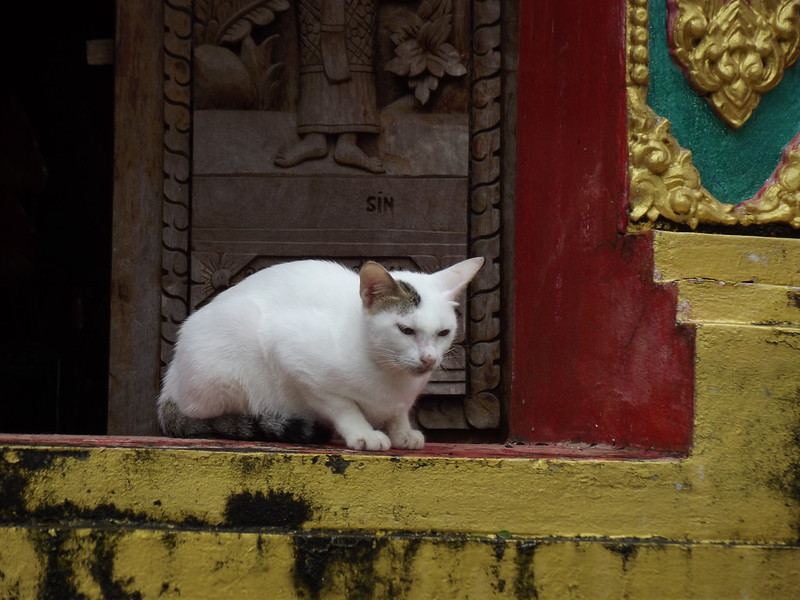

Sinful Cat?
Sinful cat?

At first I thought it strange to have the word "sin" carved into the door of the stupa.  But then I realized that it was totally appropriate, because the word "sin" is a transliteration of the Thai word ศีล, which is a religious commandment.

Unlike Judaism, which has 10 main commandments, Buddhism has 8 "precepts",  five of which lay people are expected to keep, the other 3 are supposed to be kept by the monks (as well as the first 5). These commandments are referred to as the "5 Precepts" and "8 Precepts".  The 5 Precepts can be summarized:

1. Don't harm living beings.
2. Don't steal.
3. Don't engage in sexual misconduct.
4. Don't lie.
5. Don't get drunk or take drugs.

To a Thai person, sin (ปาป  (bap)) is breaking one of these precepts.  Other types of wrongdoing go under the category of karma (กรรม (kam)). Karma can be either positive or negative but is usually viewed as negative.  In other words, "getting what you deserve" means you are not getting something good.

Keeping the precepts is considered important.  It is not uncommon when you enter a village to see a sign that says: "this village keeps the precepts".

In reality, all but the second "sins" are fairly common in Thailand (though certainly not exclusive to this country).

The first of these precepts refers not just to killing people (as in the 6th commandment of the Bible), but to all creatures.  You would think, then, that this would be a country of vegetarians, but it is far from the case. People justify eating meat by the fact that they don't typically do the killing, they just eat the meat from animals someone else killed. The fact that the animals would not be killed if there were no market for the meat does not seem to be relevant.  Interestingly, this precept does affect some kinds of pest control. You seldom see a typical rat trap or mouse trap.  What you usually find are glue traps. This is because these glue traps don't directly kill the rodents, so the person who set out the trap can honestly say, "I didn't kill the rat."  That the rat may have starved to death because of the glue trap, or died when the trap was buried in the trash heap is not their concern. (Others would say that glue traps are actually a less humane way of doing things.)   Keeping this precept also means no killing mosquitoes. So if a mosquito is in the process of sucking your blood, don't swat it.

I like the fact that the second precept is better observed.  It's nice that I don't normally have to worry if I forget to lock the doors of the house or car. This experience is certainly a lot different than other places I have lived.  Theft of intellectual property, on the other hand, is rampant.  For example, even if you want to buy a legitimate DVD,  sometimes it can be difficult to find one.  Even ones that seem legit may turn out not to be.

As for the third precept, just after we moved to Thailand in 2011, someone did a poll in Thailand and found that just over 50% of married men AND women admitted being unfaithful to their spouses.  I was even asked by a monk once, while Ingrid was present, if I had a Thai wife, as if the fact that I already had a foreign wife was irrelevant to the question.  And while there are laws prohibiting prostitution, it is still fairly common.  On several occasions, when we have told people we have been not been able to have children, we have been asked, "have you tried other partners?"

There are two words for "rape" in Thai.  Khomkheun (ข่มขืน) refers to rape by a stranger, and is definitely considered a sin and a crime.  However, blam (ปล้ำ) refers to things like date rape, which is normalized on TV and is viewed of as acceptable—or at least as something that women should be expected to endure.  A young Christian woman we know was counseled by her friends that if her boyfriend wanted to have sex with her, she should, because he needs it. (I guess the needs of the women don't count for much.)

Regarding the fourth precept, truthfulness takes a backseat to saving face and desire to please.  The most common form of lying, though it is not really viewed as lying, is to say "yes" when you don't don't mean it.  This is done because you don't want to be seen as disagreeable and a desire to make the person who asks the question feel good.  I even wonder sometimes if I should answer truthfully, as my Western culture dictates, or just say yes, which is not necessarily understood as a yes.  Or would I be misunderstood because they expect me to answer as a foreigner?

One wonders why in Thailand liquor and other alcoholic beverages are even sold, with the 5th precept being what it is.  Yet all kinds of alcoholic beverages are readily available, though they do ban sales in stores (not restaurants and bars) on certain Buddhist holidays.  A common late afternoon and evening activity is the drinking circle, kind of the equivalent of happy hour in my home culture. This past week there was a festival associated with the end of Buddhist Lent.  Alcohol was served at most of the events, even though his was a Buddhist celebration. We are saddened when we hear, "I wish my father would stop drinking" or "I wish my husband would stop drinking."

I write all this not to say that the Thai people are bad people.  Indeed, they are normal people.  They struggle with the same things people all over the world struggle with, regardless of what their religion or nationality is.  Thai people aren't the only ones to try to find justification for their actions so that they aren't "sinful,"  we are very good at that in my home culture as well.  It is also not a new kind of behavior.  Two thousand years ago, Jesus talked about those who "strain out a gnat and swallow a camel." (Matthew 23:24)

We can also be pretty selective about which commandments or precepts we wish to follow—not just as individuals but as cultures or sub-cultures.  We have what I call socially acceptable sins. The problem with socially acceptable sins is that they change with time, so someone who may have once been considered a good person is now a bad person, without the person having changed.

We also like to rate sins and crimes so that we come out on the better side.  He ran a red light (bad boy); I drove over the speed limit (socially acceptable).  She cheated on her taxes (everybody does it—and it's only the government who taxes too much anyway); he spanked his child (what an awful parent).

The Bible speaks a lot about the struggle of mankind to observe rules.

Not a single person on earth is always good and never sins.
Ecclesiastes 7:20 (NLT)

All of us, like sheep, have strayed away. We have left God’s paths to follow our own. Yet the Lord laid on him the sins of us all.
Isaiah 53:6 (NLT)

For everyone has sinned; we all fall short of God’s glorious standard.
 Romans 3:23 (NLT)

If we claim we have not sinned, we are calling God a liar and showing that his word has no place in our hearts.
1 John 1:10 (NLT)

At first, reading all these verses can be a bit depressing.  If we are all sinners, what hope is there for us?

Which is why Jesus came to bring us incredibly good news!

First, the sins we've committed can be forgiven.

But if we confess our sins to him (Jesus), he is faithful and just to forgive us our sins and to cleanse us from all wickedness.
1 John 1:9 (NLT)

Second, the Holy Spirit is given to those who believe in Jesus to help them not to sin.

Those who have been born into God’s family do not make a practice of sinning, because God’s life is in them. So they can’t keep on sinning, because they are children of God.
1 John 3:9 (NLT)

And this is his commandment: We must believe in the name of his Son, Jesus Christ, and love one another, just as he commanded us. Those who obey God’s commandments remain in fellowship with him, and he with them. And we know he lives in us because the Spirit he gave us lives in us.
1 John 3:23, 24 (NLT)

But the Holy Spirit produces this kind of fruit in our lives: love, joy, peace, patience, kindness, goodness, faithfulness, gentleness, and self-control. There is no law against these things!
Galatians 5:22, 23 (NLT)

Thank you, God, for sending Jesus to die for us that our sins might be forgiven.  Thank you for sending your Holy Spirit to all those who believe in Jesus to help make it possible for us not to sin.


Friday, November 11, 2016

Ten Hanky Movie

Your love has given me much joy and comfort, my brother, for your kindness has often refreshed the hearts of God’s people. (Philemon 1:7 NLT)

Recently someone was wondering about my emotional response to something.  He was a bit confused, so I offered up some explanation.

God has blessed me with the ability to generate copious amounts of body fluids.  One of the chief among them are tears.

Lots of things cause me to cry.
  • Laughing.
  • Sneezing.
  • Cool winds below about 70F/20C (makes bike riding challenging in Fresno winters)
  • Yawning. (Hate to burst your bubble, preachers, but those probably aren't tears of conviction and repentance.  Maybe you need to shorten the message; not lengthen it.)

I do also shed tears for emotional reasons, something I seem to have inherited from my mom.  There are two categories of these.

  • Tears of empathy for others.  I cry when I sense either hurt OR joy on the part of others.  Forget the "ten-hanky movie"--just bring me the whole box.
  • Tears related to my own pain OR joy.  I would say that the majority of these by far are tears of joy (I seldom cry at my own pain or sorrow).

I have shed a lot of tears this past week.  As we have processed some of the difficulties we have encountered this past year, I have been overwhelmed by the love, grace and support shown me by the people of God. It's not like I deserve it.  It's because people have been responding out of the tremendous reserve of love they have in Jesus.  And it's overwhelming.

But it gets better.  This great love I have experienced this week is nothing compared to the love shown to us by Jesus.  One night in the garden, Jesus faced a choice.  Would Jesus act within his rights and walk the path of self-preservation?  Or would he choose the path of love--love for those who don't deserve it?  He chose the path of love: the path to the cross.

"God shows his love for us", scripture says,  "in that while we were still sinners, Christ died for us." (Romans 5:8 ESV)

Which path would we choose?  Do act within our rights and choose the path of self-preservation?   Or do we choose the path of love, the path of the cross?  (This seems an especially pertinent question in light of the recent election in America.) It is a very difficult path to choose the path of love--but what a blessing we can be to others.

Jesus said: So now I am giving you a new commandment: Love each other. Just as I have loved you, you should love each other. Your love for one another will prove to the world that you are my disciples.” John 13:34-35 (NLT) 

We are the vehicles God has chosen to show His love to the world.  If we don't do it, who will?

I am so grateful this week for those who have chosen the path of Jesus.  I have been overwhelmed by His love as demonstrated by others.

One day, when I depart from this life, don't be surprised if it rains.  If the love I have received this week from God's people has caused me so much joy, how much more will the joy I experience in the presence of Jesus cause an outpouring of tears


Sunday, May 17, 2015

Bitter-Sweet

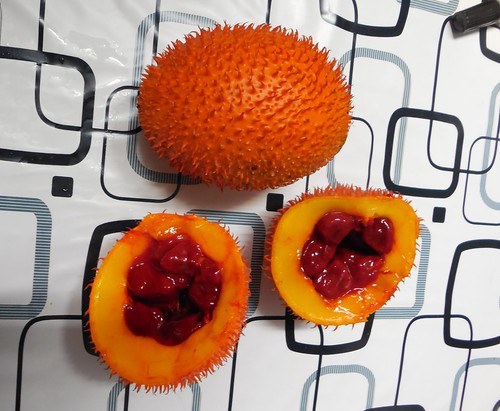
Recently, our teammates gave us a fruit (vegetable?*) that a market vendor persuaded them to buy.  They did so, owing to the fact that it was such an unusual looking thing.

I immediately recognized it as a fruit from the melon/squash family (Cucurbitaceae) because I had seen smaller ones growing in our neighborhood.  I could remember, however, neither the English nor Thai name for it.  (Our teammates told us the vendor had said it was called fakkhao).  And I certainly had no idea how to eat it.

Since I had my computer open, I quickly found that its name is Spiny Bitter Gourd (Momordica cochinchinensis; Thai: ฟักข้าว), and it certainly seemed like an appropriate name.


Momordica cochinchinensis (Lour.) Spreng. Cucurbitaceae-Spiny Bitter Gourd, ฟักข้าว


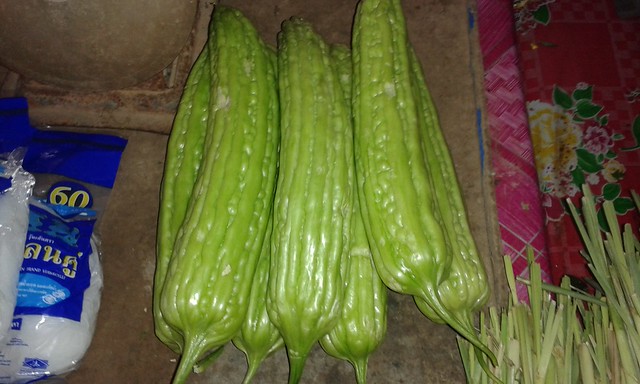
The plant is related to the bitter melon**, a popular vegetable in some SE Asian cultures.

We took the fruit home and cut it open.


Momordica cochinchinensis (Lour.) Spreng. Cucurbitaceae-Spiny Bitter Gourd, ฟักข้าว


A quick taste of the orange flesh let us know quickly how it got its name: it certainly was bitter.  However, we decided to suck the pulp on the seeds and it had a slightly sweet, pumpkin-like flavor.  (Apparently the seeds are used to add a red color to some food dishes.)

Bitter.

Sweet.

Both in one.

So it struck me that the fruit is somewhat a picture of life.  Our life gets filled with many kinds of experiences and some of them are sweet, but some of them are also bitter.  Maybe the bitter parts make the sweet parts sweeter--like sucking on the red seeds AFTER eating some of the orange flesh.

I don't think it's possible to escape this life without having both bitter and sweet.  The challenge is to get through it while still remaining sweet and not becoming bitter oneself.  I've met many old people who have allowed their experiences to make them bitter, and they are certainly not pleasant to be around.  People tend to avoid them--which make them even more bitter.

I don't want to end up that way.  So I want to try to practice what the bitter people seem to avoid doing:

Forgive easily.

Don't hold onto grudges.

That way I can be more like the sweet smooth seeds of the Spiny Bitter Gourd and less like its prickly, bitter flesh.

As Paul writes in Colossians 4:6--Let your conversation be always full of grace, seasoned with salt, so that you may know how to answer everyone. 

* Botanically, this is a fruit.  Some however might consider it to be a vegetable.  In a similar way to how people consider a cantelope to be a fruit, but its close relative and similar looking food, the cucumber, is considered a vegetable.

**
The bitter melon, which one can buy in the markets, looks like this.  This is the cultivated version.


Momordica charantia L. var. charantia Cucurbitaceae: bitter cucumber, มะระ


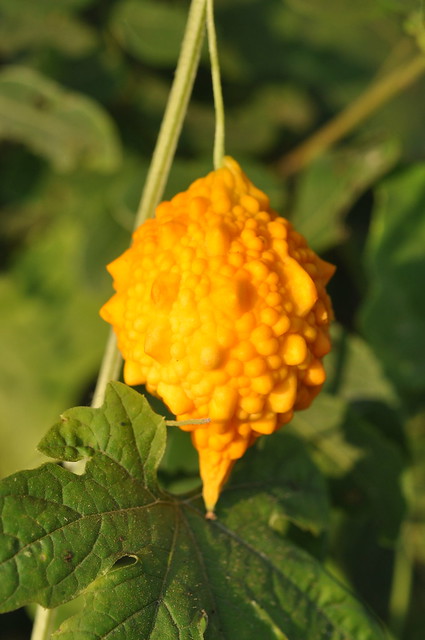
The wild version of the same species, however, looks much different.


Momordica charantia L. Cucurbitaceae: bitter cucumber, มะระ


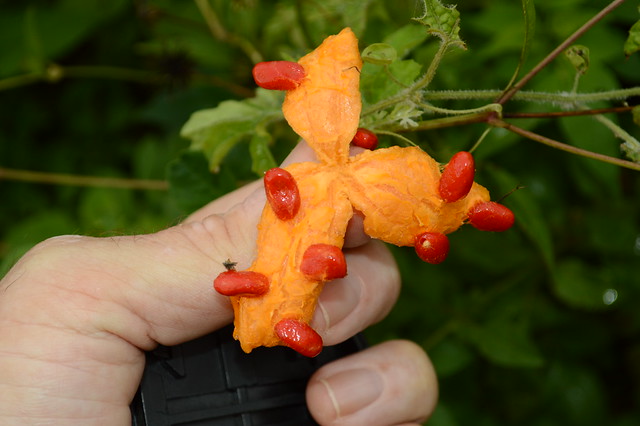
When the wild bitter melon matures, it bursts open to reveal red seeds, similar to the Spiny Bitter Gourd.


Momordica charantia L. var. abbreviata Cucurbitaceae: bitter cucumber, มะระ