Sunset Over the Mekong River

Showing posts with label fruit. Show all posts

Wednesday, November 14, 2018

Longevity

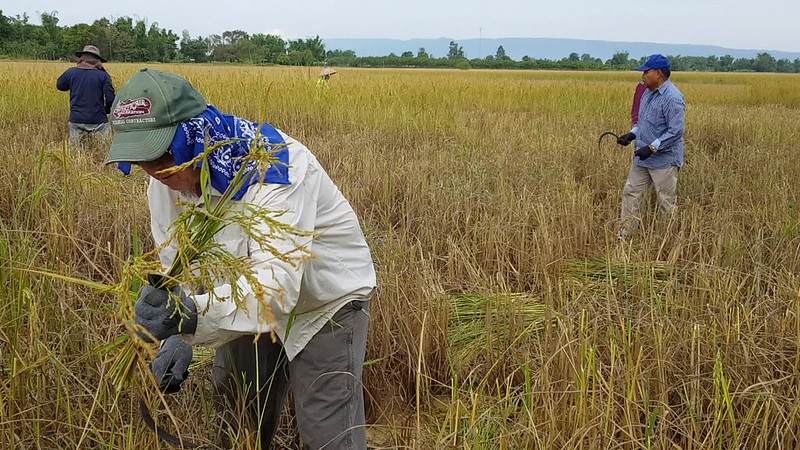
This past week we were invited by some friends to help harvest rice.  We don't have much experience with rice harvesting--only one other occasion two years ago—but we thought we've give it a try.

I dug out my sickle to see what condition it was in.  The sickles they make here have somewhat of a serrated edge, which makes them tend to be self-sharpening—as long as you only cut rice.  Ours however has been used to cut weeds close to the ground and so has had numerous run-in with gravel—so I knew it would need some sharpening.
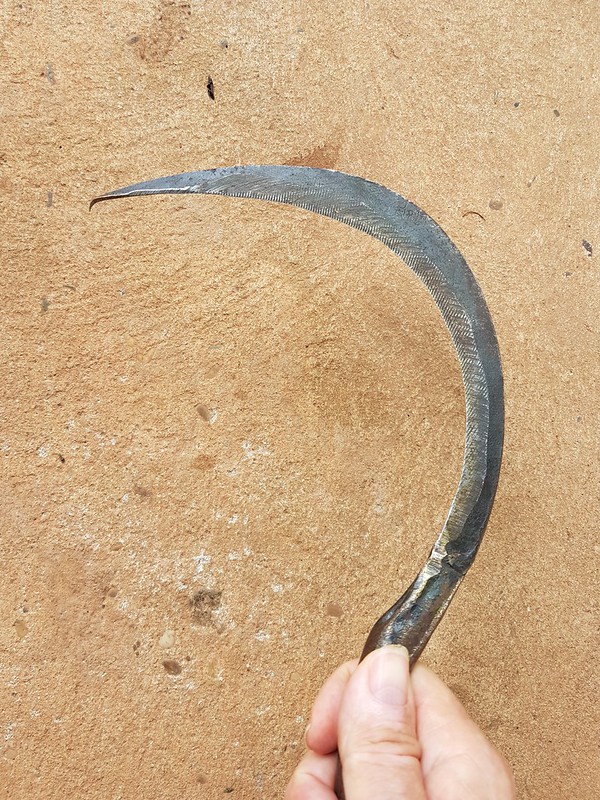
Sickle 2

I put a bit of an edge on the sickle with an ordinary stone.  The I figured I would finish off with a finer stone, so I dug out an Arkansas stone that I inherited from my dad.



Arkansas stone from 1902


Upon opening the stone I noticed the writing, "C.E.R. May 31, 1902".  C.E.R. are the initials of my father's step dad.  He was born in 1865, so he would have been about 37 when this stone was purchased.  My step-grandfather was a watchmaker, and he had an cabinet of small wooden drawers filled with all kinds of interesting tools, including this Arkansas stone.  He died the year after I was born and although I have seen a photo of me with him, I certainly don't remember the experience.

I never remember my father using these kinds of sharpening stones.  Usually things were sharpened with a file or with a electric grinder. So the stone remained in really good condition.  Only in my later years did I begin to appreciate a good Arkansas stone to put a keen edge on a knife.  And while these days I'm likely to use a diamond stone for a quick sharpening, there is something therapeutic about putting some oil on a stone and rubbing the knife edge back and forth, though I did not use sperm oil or lard oil as the stone suggested.

The sickle sharpening was a success, and I cut rice for about 4 hours—my back giving out before my arm.  Actually, it was the heat that wore me out by about 2 in the afternoon.
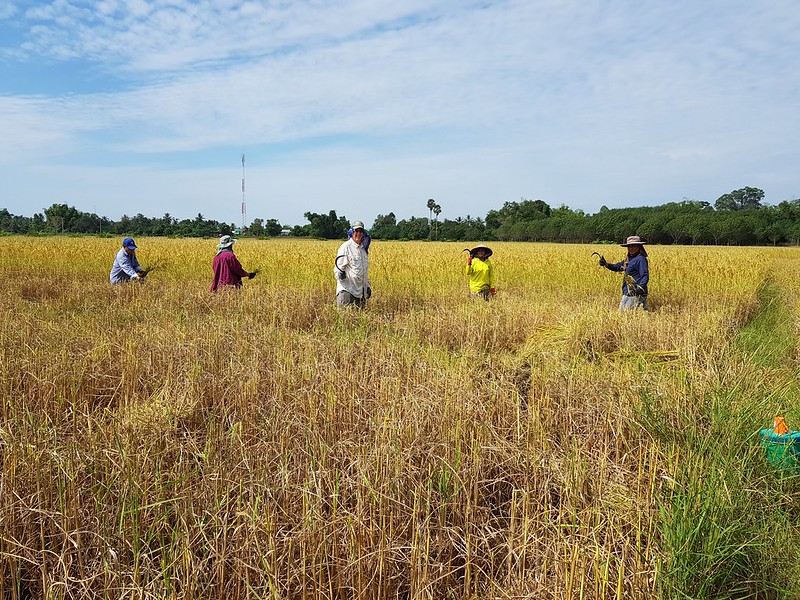
Rice Harvest 2
Rice Harvesters


Rice harvest video 1
Rice harvesting video

It was a good feeling to put to use this old stone to sharpen some tools.  Even though it has been around over 100 years, it still does what it is supposed to do.

I've been thinking about how this relates to our Christian life.  Will my ministry bear fruit that will stand the test of time?  Will what I build last not just 116 years, but on into eternity?

Paul writes:

11 The foundation that has already been built is Jesus Christ, and no one can build any other foundation. 12 People can build on that foundation using gold, silver, jewels, wood, grass, or straw. 13 But the work that each person does will be clearly seen, because the Day? will make it plain. That Day will appear with fire, and the fire will test everyone's work. 14 If the building they put on the foundation still stands, they will get their reward. 15 But if their building is burned up, they will suffer loss. They will be saved, but it will be like someone escaping from a fire.
1 Corinthians 3:11-15 (ERV)

A term we use in our ministry here is "multiplying disciples".  In fact, this gives rise to the new name of our organization (Multiply).  The idea is the show others how to be Jesus-followers so that they also will do the same thing.  Its not an easy task, and we never really know how long-lasting our fruit will be.

One day, the Arkansas stone I used to sharpen the sickle will no longer be of use.  But hopefully, those we have nurtured in the faith will bear fruit that lasts for many generations.

Tuesday, June 20, 2017

Pretty vs. Pretty

Ah! English!

What an interesting language I have grown up with.

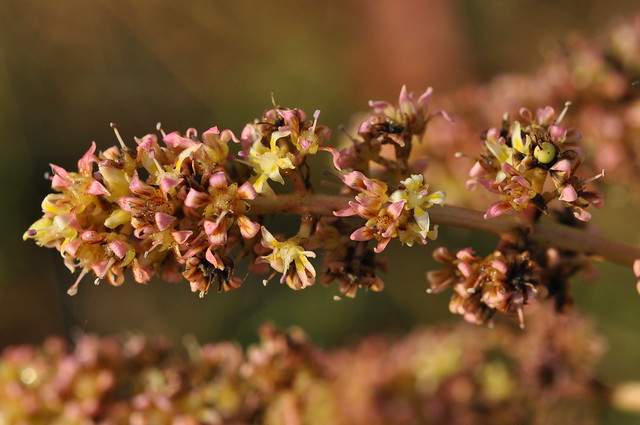
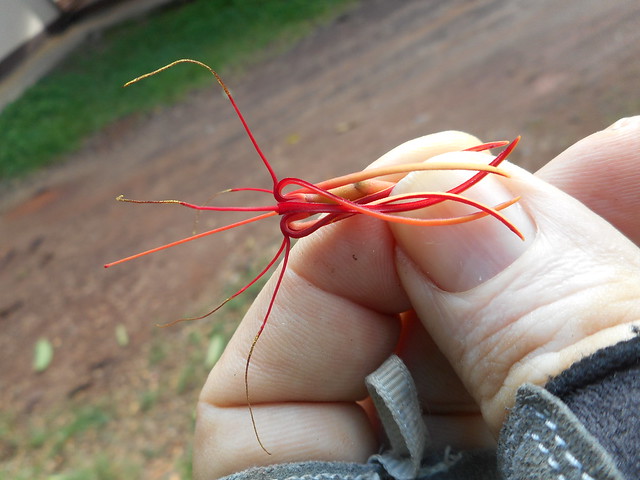
In a tree in our yard, there are some pretty red flowers.


Ligaria sp. Loranthaceae 3
Pretty red flowers


The problem is that these red flowers are growing out of a mango tree.

But they are not mango flowers.  These are mango flowers:


Mangifera indica L. Anacardiaceae: mango, มะม่วง
Mango flowers


The red flowers are growing on a parasitic plant.  This plant makes seeds that germinate on the branches of the tree and then tap into the trees vascular system of the tree for nutrients.  Let the host tree do all the work of making roots and getting water and nutrients from the soil.

So, pretty flowers, yes.

But pretty nasty as well.

(Somehow our language got to the point where "pretty" can end up being an adjective meaning "beautiful" and also an adverb meaning "very".  So we can say that one thing is pretty while another is pretty ugly, and they are opposites.  And why do we then say "very pretty" vs. "pretty pretty".  This is all pretty confusing.)

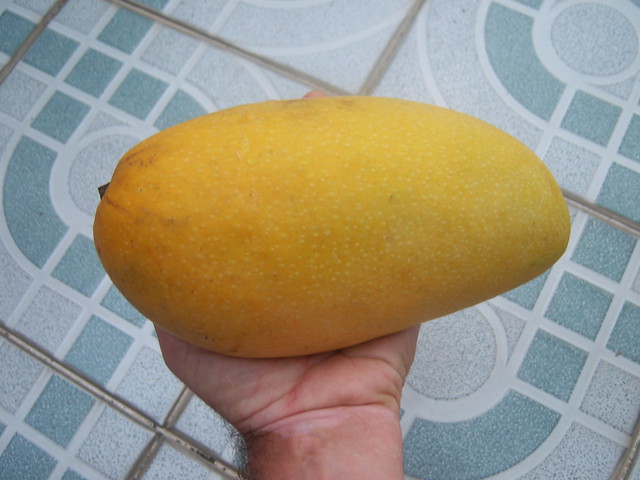
You see, the more pretty red flowers that the tree has, the fewer mangos it will have.  And I like mangos.  Mangos are my favorite fruit.  They're the reason I moved to Thailand.  (Well, not exactly, but close.)

Mangifera indica L. Anacardiaceae: mango, มะม่วง
A lot of mango goodness here

So, I'm left with a choice.

Do I want some pretty red flowers?

Or do I want some pretty tasty fruit?

I could leave the parasites on the tree, and have both red and yellow (mango) flowers.  But the mango production would be reduced more and more with time.

Life is like that.  Often are choices aren't between good and bad or right and wrong.   The choices are often between one way and a better way.

The apostle Paul writes about about a "better way" in 1 Corinthians 12, and 13.  In 1 Corinthians 12, Paul is talking about the use of spiritual gifts in the church.  In the church, the body of Christ, we are each given different gifts in order to help build up the church.  1 Corinthians 12:31 we read:

But eagerly desire the greater gifts. And now I will show you the most excellent way.

And then Paul goes on to talk about love.

It's great to desire spiritual gifts, but if we don't use our gifts in love, we are just like resounding gongs or clanging cymbals.

Or pretty, parasitic flowers.

In Phon Phisai, we have this nice community of new believers.  Most of them knew nothing about Christ until just a few months ago.  One of the challenges we have now is helping them to discover and use their spiritual gifts to help build each other up in the body of Christ.  But it is so much more than that.  It is about loving each other and using our gifts, with that love, to help build each other up.   We want to have a church of people who give, not just take.  Pretty flowers that bear fruit, not just parasites.


Sunday, December 27, 2015

Read the fine Thai print

Recently we were shopping in a bakery supply store and I noticed that they had some canned ripe olives at a good price.  Since I had not had them in a while, I decided to try them.

Looks kind of like olives


Looks not quite like the olives I know

Several days later, we opened the can, and I looked at the fruit that looked a bit different from the usual black olives.  So then I decided to read the label more closely.  The label listed the main ingredient in English as “olives” but in Thai it was written as หนำเลี้ยบ (namliap), not the word that I knew for olive, มะกอก (makawk).

But it says "olives"

I decided to look this up on the internet and found that the fruit we had bought are not even related to olives!  The taste was quite salty, so salty it is hard to distinguish from the salted plums that you can find in Mexican grocery stores in the states.

Not your usual olive pit

So it is that not everything is at may at first seem to be.

So it is with our work here in Thailand.  When we first visited MB Mission’s work here in Northern Thailand, it appeared to be a certain way.  Upon being here a while, we find that beneath the surface, things are not always what they appeared to be at first.  They are not necessarily better or worse, just different.

If we were to have made decisions based on appearances, we may have made decisions that might not have been appropriate.  Which is why during our first year here, we did not do much teaching; mostly we were just listening and observing.

And still there is a lot yet that we don’t know.  It’s not always easy to know how to respond to situations we encounter.

Jesus warned his disciples when he sent them out into a world where things are not always as they seem, to be, “wise as serpents and innocent as doves”. (Matthew 10:16)


May this be our prayer.

Sunday, May 17, 2015

Bitter-Sweet

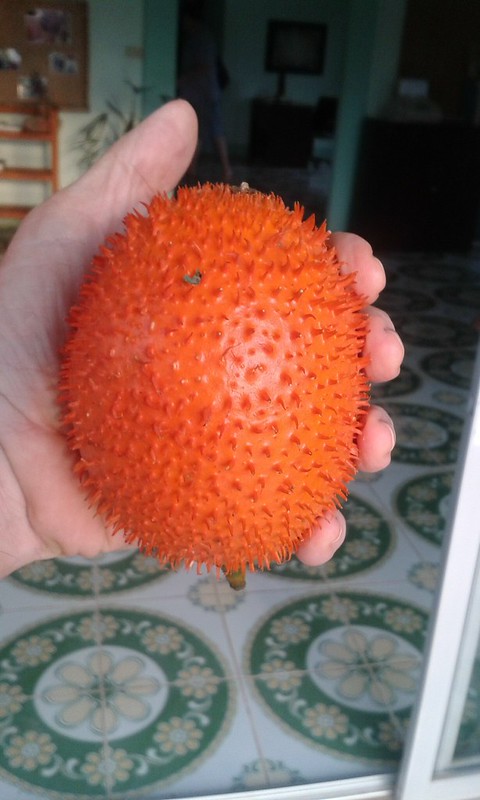
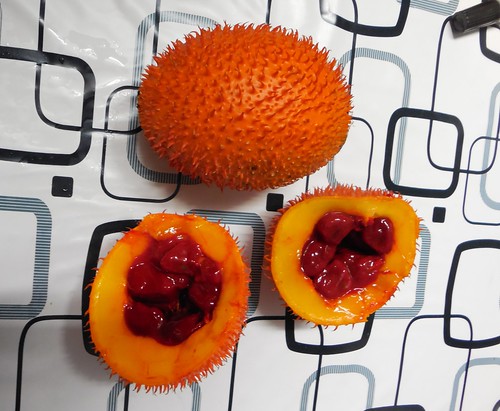
Recently, our teammates gave us a fruit (vegetable?*) that a market vendor persuaded them to buy.  They did so, owing to the fact that it was such an unusual looking thing.

I immediately recognized it as a fruit from the melon/squash family (Cucurbitaceae) because I had seen smaller ones growing in our neighborhood.  I could remember, however, neither the English nor Thai name for it.  (Our teammates told us the vendor had said it was called fakkhao).  And I certainly had no idea how to eat it.

Since I had my computer open, I quickly found that its name is Spiny Bitter Gourd (Momordica cochinchinensis; Thai: ฟักข้าว), and it certainly seemed like an appropriate name.


Momordica cochinchinensis (Lour.) Spreng. Cucurbitaceae-Spiny Bitter Gourd, ฟักข้าว


The plant is related to the bitter melon**, a popular vegetable in some SE Asian cultures.

We took the fruit home and cut it open.


Momordica cochinchinensis (Lour.) Spreng. Cucurbitaceae-Spiny Bitter Gourd, ฟักข้าว


A quick taste of the orange flesh let us know quickly how it got its name: it certainly was bitter.  However, we decided to suck the pulp on the seeds and it had a slightly sweet, pumpkin-like flavor.  (Apparently the seeds are used to add a red color to some food dishes.)

Bitter.

Sweet.

Both in one.

So it struck me that the fruit is somewhat a picture of life.  Our life gets filled with many kinds of experiences and some of them are sweet, but some of them are also bitter.  Maybe the bitter parts make the sweet parts sweeter--like sucking on the red seeds AFTER eating some of the orange flesh.

I don't think it's possible to escape this life without having both bitter and sweet.  The challenge is to get through it while still remaining sweet and not becoming bitter oneself.  I've met many old people who have allowed their experiences to make them bitter, and they are certainly not pleasant to be around.  People tend to avoid them--which make them even more bitter.

I don't want to end up that way.  So I want to try to practice what the bitter people seem to avoid doing:

Forgive easily.

Don't hold onto grudges.

That way I can be more like the sweet smooth seeds of the Spiny Bitter Gourd and less like its prickly, bitter flesh.

As Paul writes in Colossians 4:6--Let your conversation be always full of grace, seasoned with salt, so that you may know how to answer everyone. 

* Botanically, this is a fruit.  Some however might consider it to be a vegetable.  In a similar way to how people consider a cantelope to be a fruit, but its close relative and similar looking food, the cucumber, is considered a vegetable.

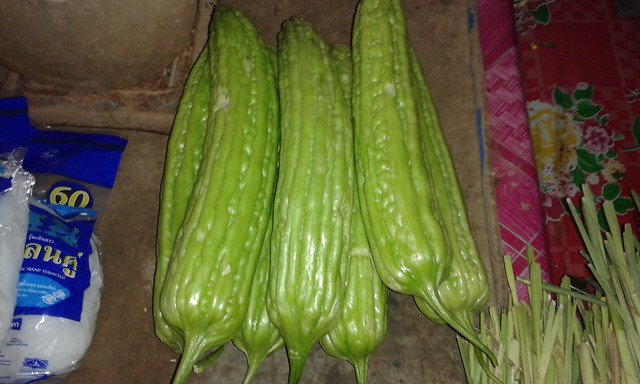
**
The bitter melon, which one can buy in the markets, looks like this.  This is the cultivated version.


Momordica charantia L. var. charantia Cucurbitaceae: bitter cucumber, มะระ


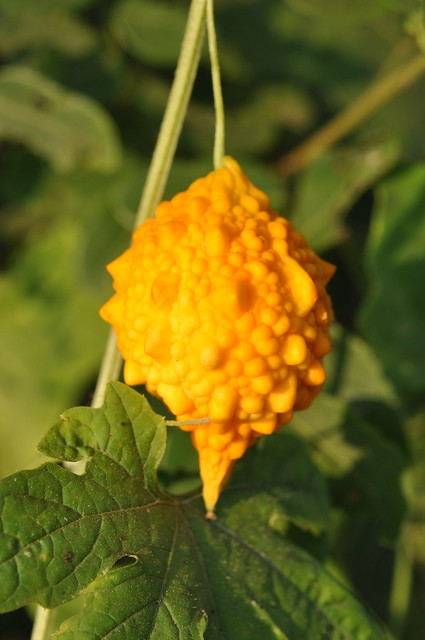
The wild version of the same species, however, looks much different.


Momordica charantia L. Cucurbitaceae: bitter cucumber, มะระ


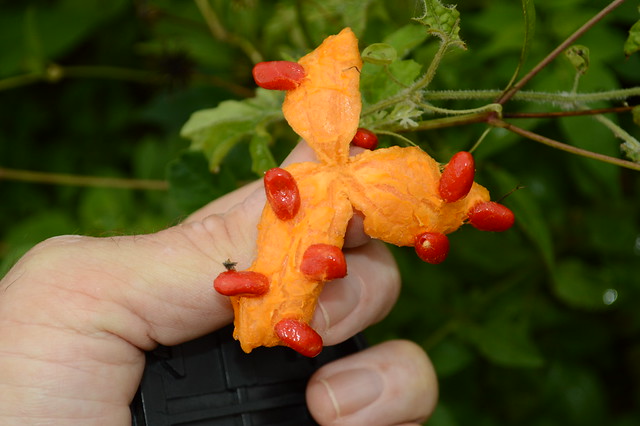
When the wild bitter melon matures, it bursts open to reveal red seeds, similar to the Spiny Bitter Gourd.


Momordica charantia L. var. abbreviata Cucurbitaceae: bitter cucumber, มะระ

Tuesday, April 14, 2015

The Wait

About Christmas-time last year, we were looking for a gift.  We thought that a desert rose would be a nice gift for the person had in mind.

The desert rose (Adenium obesum) is not actually related to a rose at all, but is in the same plant family as dogbane—a common weed where I grew up in Connecticut.  It is a plant that is often trained for bonsai.  By pinching back the tips, the shrub will remain short but will get quite stout.

The particular pant we saw was looking not very attractive in a pot that was overgrown with weeds.  The owner of the nursery seemed a bit reluctant to sell.  It was somewhat expensive, but I was expecting that, because he had been raising it for 7 years.

We brought it home, cleaned it up, and repotted the plant and soon it rewarded us by dropping what few leaves it had.

For three months we patiently watered and weeded the woody skeleton.

And then this happened.

Adenium obesum (Forssk.) Roem. & Schult. Apocynaceae desert rose, impala lily 3

About a week later it was like this.

20150407_104440

Perhaps one day it will look like this large specimen we saw in Chiang Mai.

Adenium obesum (Forssk.) Roem. & Schult. Apocynaceae: desert rose, impala lily, ชวนชม

While it seems like we had to be rather patient with the desert rose, our pineapple plants have done a much better job at testing our patience.

Shortly after we moved here in February of last year, we stuck a pineapple top in the ground.

Ananas comosus (L.) Merr. Bromeliaceae Pineapple 7

It seemed like it was doing OK, as it began to grow.  But once it got to a certain point, it seemed to stagnate—not dying but not growing either.  It was like this for many months.

Ananas comosus (L.) Merr. Bromeliaceae Pineapple 8

Then, all of a sudden, the innermost leaves started to turn red and a flower bud began to emerge.

Ananas comosus (L.) Merr. Bromeliaceae Pineapple 3

After several more weeks, it is looking more and more like a pineapple.  And who knew they had such pretty purple and white flowers.

Ananas comosus (L.) Merr. Bromeliaceae Pineapple 12

I’m not great at waiting.  But it seems that to achieve most good things in this life it takes patience and hard work.

The Bible is full of verses about “waiting on God” and being patient with others.  A few examples:

In the morning, O LORD, you hear my voice; in the morning I lay my requests before you and wait in expectation. Psalm 5:3 (NIV)

Therefore the LORD waits to be gracious to you, and therefore he exalts himself to show mercy to you. For the LORD is a God of justice; blessed are all those who wait for him. Isaiah 30:18 (ESV)

Love is patient 1 Corinthians 13:4 (NIV)

Be patient, therefore, brothers, until the coming of the Lord. See how the farmer waits for the precious fruit of the earth, being patient about it, until it receives the early and the late rains.  You also, be patient. Establish your hearts, for the coming of the Lord is at hand. 
James 5:7-8 (ESV)

 
I’m not sure how much longer it will be until we can eat some fruit, but we’re certainly looking forward to it, and I’ll try to be patient.

Ananas comosus Bromeliaceae: pineapple, สับปะรด


Sunday, August 10, 2014

Don’t Judge a Book…

Just down the street from where we live is a large shed.  Until a short while ago, we had not seen any activity going there.  There was a large conveyor across the back of the shed, so we assumed it was for some kind of agricultural packing operation.

Then, we noticed that there was a refrigerated semi-trailer running beside the shed.  What kind of packing would they do that needs refrigeration?  Most produce here is shipped in open trucks.

So on the way back from an evening walk we stopped by and found out that they pack pummelos.  That night they were packing a load for China.  They also ship to other nearby countries like Malaysia and Indonesia.

(If you’re in the import business and would like to import some pummelos from Thailand, I can get you the contact info.)

Who would have thought that our little town would have such an operation.  A little shed in Wiang Kaen, the least populous district in Chiang Rai, is impacting the diets of people throughout Asia. How cool is that?

There is an English saying, “Don’t judge a book by its cover,” that seems to fit this situation.

The Bible, too, is full of examples of misjudged expectations.   King David is one of the prime examples.  Here he was, the smallest guy from a large, insignificant, family chosen to be king and also the one to take down a giant.

"Do not consider his appearance or his height,” LORD said to Samuel, “for I have rejected him. The LORD does not look at the things man looks at. Man looks at the outward appearance, but the LORD looks at the heart."
1 Samuel 16:7 (NIV)

Many of the surprising examples from scripture are women.  Rahab, a harlot, is instrumental in the fall of Jericho and becomes an ancestor of Jesus and David.  Just down the genealogical line, Ruth, an unknown woman from Moab, enters the same line.  And Jael, remember her?  Didn’t think so.  She took out Sisera, the commander of an army that was tormenting Israel.

In the New Testament, there is Mary, from an insignificant town in an unimportant place called Nazareth.  But now millions of people know about Nazareth because Jesus is from there—because Mary was from there.  Then there is that other Mary—the woman of the streets who anointed Jesus feet.  We don’t know the names of many of the important people of that time—but we know her name.

These people weren’t trying to make names for themselves—but we know their names anyway.  No one would have picked these people as “most likely to succeed,” yet their names have been recorded in history.  We know the names of these people, not because they were prominent people in their day or because they sought glory and fame, but because they chose to love and serve God rather than men.

Some people have a goal in life that they want to be famous.

A better goal is that we be found faithful.

Citrus maxima (Burm. f.) Merr. Rutaceae-khao yai pummelo, ส้มโอ พันธุ์ข้าวใหย่
Pummelos in plastic baskets waiting to be packed

Citrus maxima (Burm. f.) Merr. Rutaceae-khao yai pummelo, ส้มโอ พันธุ์ข้าวใหย่
Unloading pummelos from a pickup truck

Citrus maxima (Burm. f.) Merr. Rutaceae-khao yai pummelo, ส้มโอ พันธุ์ข้าวใหย่
Putting labels on pummelos prior to putting in boxes

Citrus maxima (Burm. f.) Merr. Rutaceae-khao yai pummelo, ส้มโอ พันธุ์ข้าวใหย่
A 2 kilogram pummelo

Tuesday, March 4, 2014

Fragrance

One of our senses that can really make or break an experience for us, but which is hard for us to convey to others, is the sense of smell.  I think of places I’ve traveled or experiences that I have had where the dominant sensual impact was to my nose.  It can be hard to convey to others what the experience was like because they have not SMELLED it and I have yet to find a camera that will take “scratch and sniff” photos.

So, without being able to adequately describe it, I would like to say that our new home in Wiang Kaen is, so far, one of the most pleasant places we have ever lived.

The reason for that is the abundance of pummelo orchards here.

Pummelo orchard 1
Pummelo Orchard


For those who are not familiar with them, a pummelo is similar to a grapefruit in appearance—only larger—at least on the outside.  The pummelo has a very thick skin and the inside may actually be smaller than a typical grapefruit.

Citrus maxima (Burm. f.) Merr. Rutaceae: pummelo, ส้มโอ
Pummelo Fruit


The flesh between the membranes is generally sweeter than a grapefruit, but it can be quite variable.

Bangkok-Fruit plate 1
Fruit Tray with Pummelo Sections on the Bottom


But it is the scent of the flowers that seem to grab our attention right now.

Citrus maxima (Burm. f.) Merr. Rutaceae: pummelo, ส้มโอ
Pummelo Blossoms


If there were only a single pummelo tree, you would probably only notice the scent if you were really close by.  But here there are thousands—and it changes the fragrance of the whole area.

We who believe in Christ are also to be a pleasing fragrance to those around us.  We read in 2 Corinthians 2:14-16 (NIV):

14 But thanks be to God, who always leads us in triumphal procession in Christ and through us spreads everywhere the fragrance of the knowledge of him.
15 For we are to God the aroma of Christ among those who are being saved and those who are perishing.
16 To the one we are the smell of death; to the other, the fragrance of life. And who is equal to such a task?


If there were only one of us in a community, we would not have much of an impact.  But if there are many of us, we can have a positive impact on a large area.

The whole idea of our work in Thailand is not so much that we see a few individuals come to faith in Christ, but rather that we create communities of faith that are able to positively transform the area around them.  In the end, one would like to be able to go to an area and know that there are believers there because there is a fragrance of life present in the air.

But it is not an easy task.  As Paul writes, “who is equal to such a task?”  Certainly not us.  At least not without God’s help.  And not without the help of others who believe in Him.

But I can purpose to be the fragrance of life to those around me.

Pray with us that God will plant not just trees, but lots of orchards throughout Thailand.

Tuesday, September 3, 2013

Welcome to Canada


We had just arrived at Vancouver International Airport and Ingrid's sister was driving us to their place in Langley. As we were driving we passed a field where they were picking blueberries.

Now we haven't had fresh blueberries in 3 years and we really like them, so Lore was more than happy to turn around and inquire about buying blueberries.


The people picking the blueberries appeared to be Indo-Canadians and the ones we first tried to speak to hardly spoke any English.  We did find that they were not selling the blueberries there, but one of the pickers loaded our hands with some fresh berries.  They then pointed to a fellow back down the row of bushes a bit who did speak some English.


We chatted with this fellow a bit and then enjoyed the fresh berries.  While we were still back in Thailand we had talked about things we were looking forward to in Canada.  Ingrid was looking forward to being with her family.  As for me, I was thinking, "I think we will get in on the end of blueberry season."

This gift of blueberries was a nice welcome to Canada, given to us by those who have been welcomed to Canada themselves.

As Christians, we are to ones that welcome "aliens".  I think about all of those verses in the Bible that walk about welcoming the sojourners that come to our lands:

 
You shall not wrong a sojourner or oppress him, for you were sojourners in the land of Egypt. (Exodus 22:21 ESV)

You shall treat the stranger who sojourns with you as the native among you, and you shall love him as yourself, for you were strangers in the land of Egypt: I am the LORD your God.  (Leviticus 19:34 ESV)

For the LORD your God is God of gods and Lord of lords, the great, the mighty, and the awesome God, who is not partial and takes no bribe. He executes justice for the fatherless and the widow, and loves the sojourner, giving him food and clothing.  (Deuteronomy 10:17, 18)

Thus says the LORD: Do justice and righteousness, and deliver from the hand of the oppressor him who has been robbed. And do no wrong or violence to the resident alien, the fatherless, and the widow, nor shed innocent blood in this place.  (Jeremiah 22:3 ESV)

do not oppress the widow, the fatherless, the sojourner, or the poor, and let none of you devise evil against another in your heart. (Zechariah 7:10 ESV)

Most of all, we thank God that he welcomes sojourners like ourselves into the kingdom of God.


Monday, August 5, 2013

In Season


June is the saddest month of the year here in Central Thailand.  That’s because June marks the end of mango season.

I don’t have many favorites in my life.
I have no favorite color
no favorite song
no favorite food
no favorite movie
no favorite sport
etc.

But I DO have a favorite person (my wife)
AND a favorite fruit (mango).  My wife’s favorite fruit is mango as well.

We sometimes joke that we moved to Thailand because of the mangos.

Mangifera indica L. Anacardiaceae-mango, มะม่วง
image

But the good news is that June is the beginning of longan (Dimocarpus longan Lour. ลำไย) season

Longans are usually sold in bunches like this

Insides and seed of longan

What's left after eating
We never had eaten longan before we came to Thailand, but it is probably now the second favorite fruit for both of us.  But soon even it’s season will be over.

In the US we would sometimes be almost unaware of the cyclical nature of fruit harvest because in the grocery store you can get just about anything at any time of year due to the ability to transport fruit over great distances and store the harvested fruit while maintaining a reasonable quality.

But here in Thailand where we tend to buy our fruit in open markets, we tend to be more aware of the seasons of harvest.  And we adapt our fruit eating habits to whatever is in season.  (Though certain fruits are available all year long: banana, pineapple, papaya and watermelon.)

There is a seasonal nature to our work here in Thailand as well-even tough we are not involved in Agricultural production.  Paul alludes to the cyclical nature of our kind of work in 1 Corinthians 3:6 (ESV):

   I planted, Apollos watered, but God gave the growth.

We spend a lot of time planting and watering, so to speak, and aren’t always sure what the harvest will look like or if we will even be around for it.  Sometimes we get to harvest what others have planted.

Sometimes we think there is a crop coming along fine but then a storm comes up and beats the crop down.  I think of one person in our community who indicated a desire to follow Christ back in December.  But then some temptations came up and he succumbed to the temptation.  Now he seems too ashamed to be around us any more.

But while it is our responsibility to be faithful laborers. it is God who brings about the growth.  We don’t control that aspect of it.

So on one day my “sowing” might be holding a child whose parents are in prison and is pretty much neglected by his relatives.  It might be years before he can understand more fully the message of God’s love—what it means for God to send His Son and for His Son to take upon himself the sins of the whole world.

On another day I might be watering-teaching a young believer about the Bible and what certain scriptures mean to his life.

On perhaps another day we might enjoy a bit of harvest—praying with someone who is responding to the message of God’s love.

We plant.  We water.  We pray for God to make the crop grow.  And we bring in the harvest.
Like eating the seasonal fruit, we learn to enjoy each “fruit” in its season:

We enjoy planting in planting season
We enjoy watering in watering season
and we enjoy reaping in harvest season
And there’s always room for more laborers in the field.

 Ask the Lord of the harvest, therefore, to send out workers into his harvest field." Matthew 9:38 (NIV)