Sunset Over the Mekong River

Showing posts with label cycles. Show all posts

Tuesday, October 25, 2016

Cycles


What does the term "fall colors" mean to you?  When you hear that term, what do you see in your mind?

For many years, the term fall colors would cause me to picture standing on a mountain top in the White Mountains of New Hampshire looking across at the vast and varicolored display of reds and oranges and yellows and greens.  Later on in life, living in California, I would think of the non-native oramentals such as Chinese pistache, Chinese tallow and Liquiamber in shades of yellow to purple.

Now, I think of yellow.

For September and October is when the Siamese Cassia bloom in Thailand.
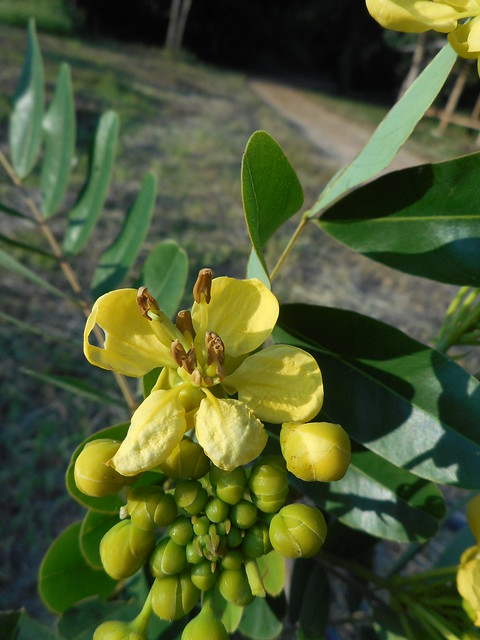
Senna siamea (Lam.) Irwin & Barneby Fabaceae Caesalpinioideae-Siamese cassia, ขี้เหล็กไทย, ขี้เหล็กหลวง 

I first recall seeing these blooms when we visited the Changing Life Center in October 2011 for the first Youth Camp they hosted there.  There was a tree on the campus that was blooming at the time.

But the Siamese Cassia are only  one of many indicators of the passing of time throughout the year.  Some indicators are natural such as when certain flowers bloom, when certain fruit are ripe or when birds pass through on migratory cycles.

Some cycles are agrarian in nature such as rice planting season, corn planting season, harvest, etc.

Some cycles are cultural such as memorial holidays or events such as throwing water during Sonkran or setting off fireworks on Independence Day.

Other cycles are religious.  Some Christians may look forward to things like Advent or Easter.  For the Jew it may be Passover.  For the Buddhist it may be Buddhist lent.

Many of the religious and cultural cycles are based on the cycles of the moon.

Furthermore, there are individual cycles such as birthdays and anniversaries.

No wonder many cultures think of time as cyclical instead of linear.

Solomon wrote:

What has been is what will be, and what has been done is what will be done, and there is nothing new under the sun.
Is there a thing of which it is said, “See, this is new”? It has been already in the ages before us.

 (Ecclesiastes 1:9-10 ESV)  

It takes a while to adjust to the cycles of a new place.  The first year you don't notice the cycles because you are new.  Perhaps each year you start to notice more and more.  Eventually you get used to the cycles and they become part of your norm.  Though perhaps if you grow up in a place, you may take the cycles for granted and hardly notice them at all.

Now that we have lived in northern Thailand for 2-1/2 years, we have become used to some of the cycles--especially the fruit cycles.  Especially mango season!  (Begins about March, peaks in June and July with some varieties carrying on later.)

As we prepare to head back to North America for a few months, part of me is already grieving some of the things I'll miss that we've grown accustomed to such as the cooler, drier weather and the dry-season blooming trees such as flambouyant, Cochlospermum and Tabebuia.  But then we will catch the fruit tree blooming period in the Central Valley of California.  I'm looking forward to the drive from Fresno to Reedley in peak bloom season!  And then there is that annual cultural event of the valley, the International Ag Exposition, which I used to go to every year.  There is also the possibility of a white Christmas for us this year.

We don't know what the future holds for us.  The cycles we may find ourselves in in the future may be different than what we have grown accustomed to.  But one thing doesn't change, and that is God.  Jesus Christ is the same, yesterday, today and forever, the writer of Hebrews tells us. (Hebrews 13:8)  He is the anchor of our lives, for which we are grateful.

I'm thankful for those rhythms God has placed in our lives.  But I'm more thankful that He will still be in my life even when those rhythms are gone.

Monday, August 5, 2013

In Season


June is the saddest month of the year here in Central Thailand.  That’s because June marks the end of mango season.

I don’t have many favorites in my life.
I have no favorite color
no favorite song
no favorite food
no favorite movie
no favorite sport
etc.

But I DO have a favorite person (my wife)
AND a favorite fruit (mango).  My wife’s favorite fruit is mango as well.

We sometimes joke that we moved to Thailand because of the mangos.

Mangifera indica L. Anacardiaceae-mango, มะม่วง
image

But the good news is that June is the beginning of longan (Dimocarpus longan Lour. ลำไย) season

Longans are usually sold in bunches like this

Insides and seed of longan

What's left after eating
We never had eaten longan before we came to Thailand, but it is probably now the second favorite fruit for both of us.  But soon even it’s season will be over.

In the US we would sometimes be almost unaware of the cyclical nature of fruit harvest because in the grocery store you can get just about anything at any time of year due to the ability to transport fruit over great distances and store the harvested fruit while maintaining a reasonable quality.

But here in Thailand where we tend to buy our fruit in open markets, we tend to be more aware of the seasons of harvest.  And we adapt our fruit eating habits to whatever is in season.  (Though certain fruits are available all year long: banana, pineapple, papaya and watermelon.)

There is a seasonal nature to our work here in Thailand as well-even tough we are not involved in Agricultural production.  Paul alludes to the cyclical nature of our kind of work in 1 Corinthians 3:6 (ESV):

   I planted, Apollos watered, but God gave the growth.

We spend a lot of time planting and watering, so to speak, and aren’t always sure what the harvest will look like or if we will even be around for it.  Sometimes we get to harvest what others have planted.

Sometimes we think there is a crop coming along fine but then a storm comes up and beats the crop down.  I think of one person in our community who indicated a desire to follow Christ back in December.  But then some temptations came up and he succumbed to the temptation.  Now he seems too ashamed to be around us any more.

But while it is our responsibility to be faithful laborers. it is God who brings about the growth.  We don’t control that aspect of it.

So on one day my “sowing” might be holding a child whose parents are in prison and is pretty much neglected by his relatives.  It might be years before he can understand more fully the message of God’s love—what it means for God to send His Son and for His Son to take upon himself the sins of the whole world.

On another day I might be watering-teaching a young believer about the Bible and what certain scriptures mean to his life.

On perhaps another day we might enjoy a bit of harvest—praying with someone who is responding to the message of God’s love.

We plant.  We water.  We pray for God to make the crop grow.  And we bring in the harvest.
Like eating the seasonal fruit, we learn to enjoy each “fruit” in its season:

We enjoy planting in planting season
We enjoy watering in watering season
and we enjoy reaping in harvest season
And there’s always room for more laborers in the field.

 Ask the Lord of the harvest, therefore, to send out workers into his harvest field." Matthew 9:38 (NIV)