Sunset Over the Mekong River

Showing posts with label harvest. Show all posts

Wednesday, August 21, 2019

Ten Years

Today marks 10 years since I quit my previous job. Ten years since I stepped out in faith to begin a new venture.

If I knew then what the next ten years would bring, I might not have made that step.  It's not that the ten years have been bad, but there have been a lot of challenges along the way.

Ten years ago we left our North American lives behind ready to give up our lives, if necessary, for the sake of the gospel.

But first, I think back to another August, 27 years prior to that.

As I write this blog, I am in the town of Barrhead, Alberta. Thirty-seven years ago this month I passed though Barrhead, crossing the country on a Greyhound bus. I was traveling from where I was living near Seattle to begin a new job in Alabama. I decided to make use of the 1-week Ameripass I had purchased to visit people along the way.

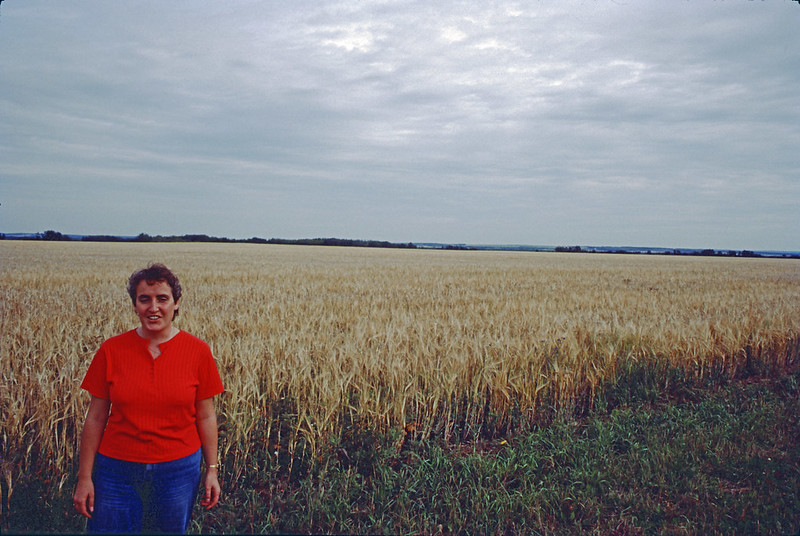
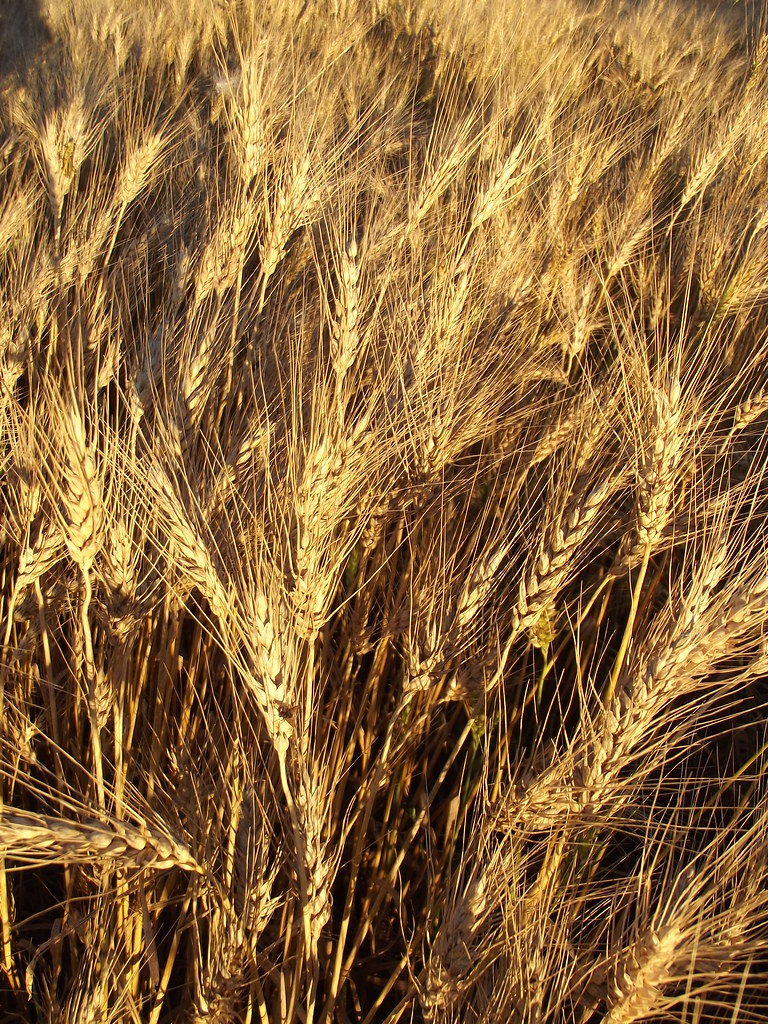
I came to Barrhead to visit the woman (who is now my wife), whom I had been on a team with in Haiti for a year. I didn't know at the time that this beautiful young woman would become my wife, but my choice to visit her at that time had consequences. As I visited her family farm, I was struck by the huge fields of ripening grain. (Huge to me, small compared to the farms in Southern Alberta.) In order to get these fields laden with grain, the farmer has to make a sacrifice. He has to take grain that is perfectly good to eat and throw it away into the soil. Short-term sacrifice for long-term gain.

Ingrid by wheat field Sept 1987 Kodachrome
How many bushels of wheat we sacrificed to get the bountiful harvest?


Jesus said that unless a grain of wheat falls to the ground and dies, it cannot bear fruit. (John 12:24) While Jesus was likely referring to the death he was to die, he also spoke to many who would give up their lives rather than give up Jesus.  This verse also speaks to the things in our life that we need to put to death in order to bear fruit for Jesus. Paul writes, "if by the Spirit you put to death the deeds of the body, you will live." (Romans 8:13)

Ten years ago, when we said we were willing even to give up our lives for the sake of the gospel, I'll confess, I didn't fully understand what it means to give up one's life--what it means to die. While we have not have physically died in the past ten years, we've had to put to death a lot of things. One of those things we have had to put to death is some of our dreams. It's not that the dreams were bad, it's just that God had something better and perhaps bigger in mind. When I put to death sinful deeds, it's not so bad. But putting to death dreams can be much harder. We've had let go of several dreams in the past ten years. And while in the long run we don't regret giving those up for better things, it hasn't always been easy.

These past two weeks, as we've been in North America visiting and helping family, we're reminded of some of the other costs of following Jesus. We miss our families when we are away from them. We also miss some of our favorite haunts from when we lived in the area. True, we have gained new "family" and have new favorite places to visit, but it's not quite the same.

Putting to death these things, however, has enabled there to be the birth of new things. We've seen people who have never heard the name of Jesus receive new life in his name. We've seen churches born where before there were none. We've seen ordinary men and women who were once slaves to sin become reborn as leaders in God's family. It has been worth it to have some things die in order that other things might come to life.

As we look forward, we have no idea what the next year will bring, let alone the next ten years. But we pray God will give us grace to put to death what is needed in order to ensure a great harvest in the future.

Wednesday, November 14, 2018

Longevity

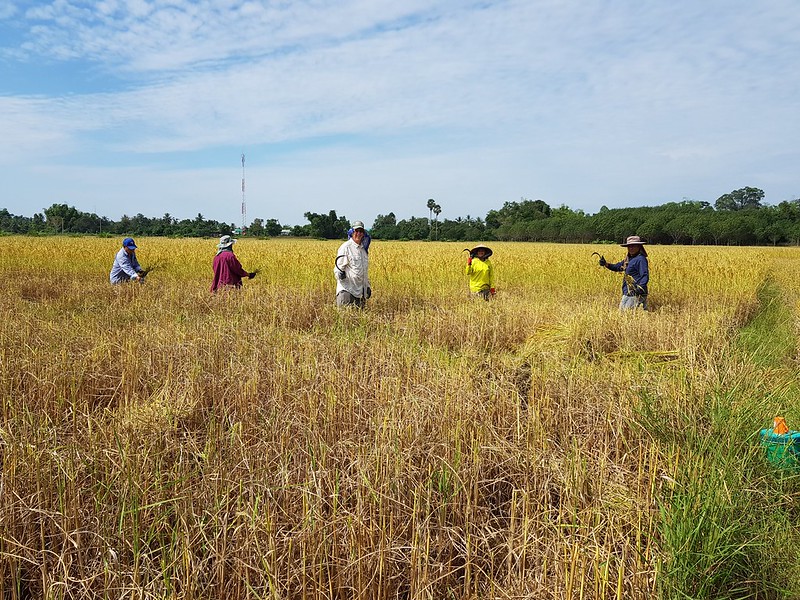
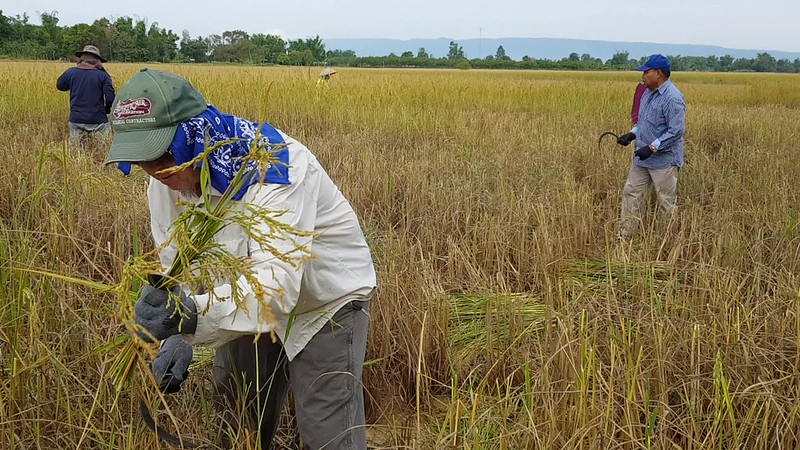
This past week we were invited by some friends to help harvest rice.  We don't have much experience with rice harvesting--only one other occasion two years ago—but we thought we've give it a try.

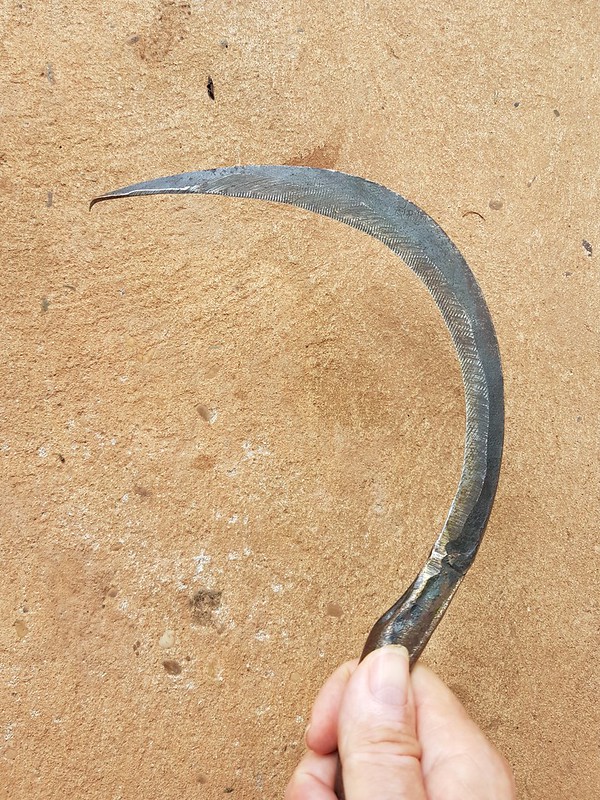
I dug out my sickle to see what condition it was in.  The sickles they make here have somewhat of a serrated edge, which makes them tend to be self-sharpening—as long as you only cut rice.  Ours however has been used to cut weeds close to the ground and so has had numerous run-in with gravel—so I knew it would need some sharpening.

Sickle 2

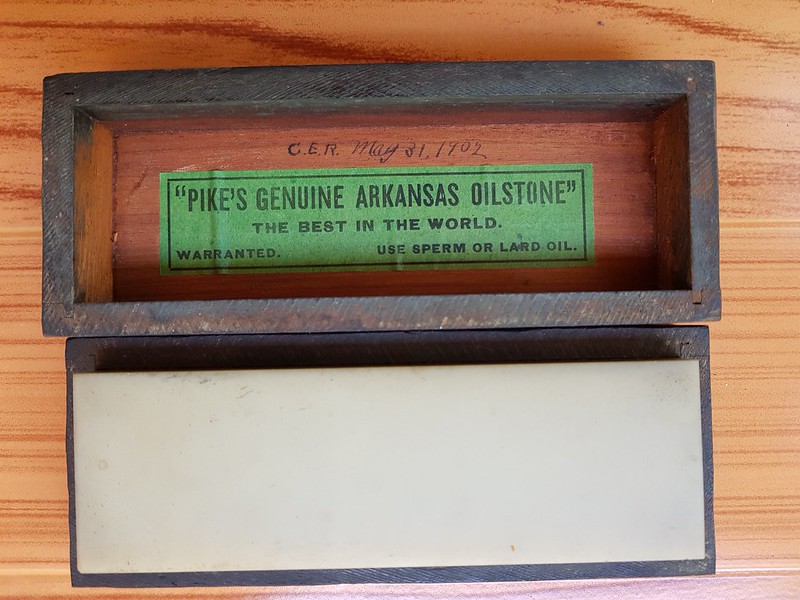
I put a bit of an edge on the sickle with an ordinary stone.  The I figured I would finish off with a finer stone, so I dug out an Arkansas stone that I inherited from my dad.


Arkansas stone from 1902


Upon opening the stone I noticed the writing, "C.E.R. May 31, 1902".  C.E.R. are the initials of my father's step dad.  He was born in 1865, so he would have been about 37 when this stone was purchased.  My step-grandfather was a watchmaker, and he had an cabinet of small wooden drawers filled with all kinds of interesting tools, including this Arkansas stone.  He died the year after I was born and although I have seen a photo of me with him, I certainly don't remember the experience.

I never remember my father using these kinds of sharpening stones.  Usually things were sharpened with a file or with a electric grinder. So the stone remained in really good condition.  Only in my later years did I begin to appreciate a good Arkansas stone to put a keen edge on a knife.  And while these days I'm likely to use a diamond stone for a quick sharpening, there is something therapeutic about putting some oil on a stone and rubbing the knife edge back and forth, though I did not use sperm oil or lard oil as the stone suggested.

The sickle sharpening was a success, and I cut rice for about 4 hours—my back giving out before my arm.  Actually, it was the heat that wore me out by about 2 in the afternoon.

Rice Harvest 2
Rice Harvesters


Rice harvest video 1
Rice harvesting video

It was a good feeling to put to use this old stone to sharpen some tools.  Even though it has been around over 100 years, it still does what it is supposed to do.

I've been thinking about how this relates to our Christian life.  Will my ministry bear fruit that will stand the test of time?  Will what I build last not just 116 years, but on into eternity?

Paul writes:

11 The foundation that has already been built is Jesus Christ, and no one can build any other foundation. 12 People can build on that foundation using gold, silver, jewels, wood, grass, or straw. 13 But the work that each person does will be clearly seen, because the Day? will make it plain. That Day will appear with fire, and the fire will test everyone's work. 14 If the building they put on the foundation still stands, they will get their reward. 15 But if their building is burned up, they will suffer loss. They will be saved, but it will be like someone escaping from a fire.
1 Corinthians 3:11-15 (ERV)

A term we use in our ministry here is "multiplying disciples".  In fact, this gives rise to the new name of our organization (Multiply).  The idea is the show others how to be Jesus-followers so that they also will do the same thing.  Its not an easy task, and we never really know how long-lasting our fruit will be.

One day, the Arkansas stone I used to sharpen the sickle will no longer be of use.  But hopefully, those we have nurtured in the faith will bear fruit that lasts for many generations.

Wednesday, February 28, 2018

No Looking Back

Jesus said to him, "No one who puts his hand to the plow and looks back is fit for the Kingdom of God." Luke 9:62

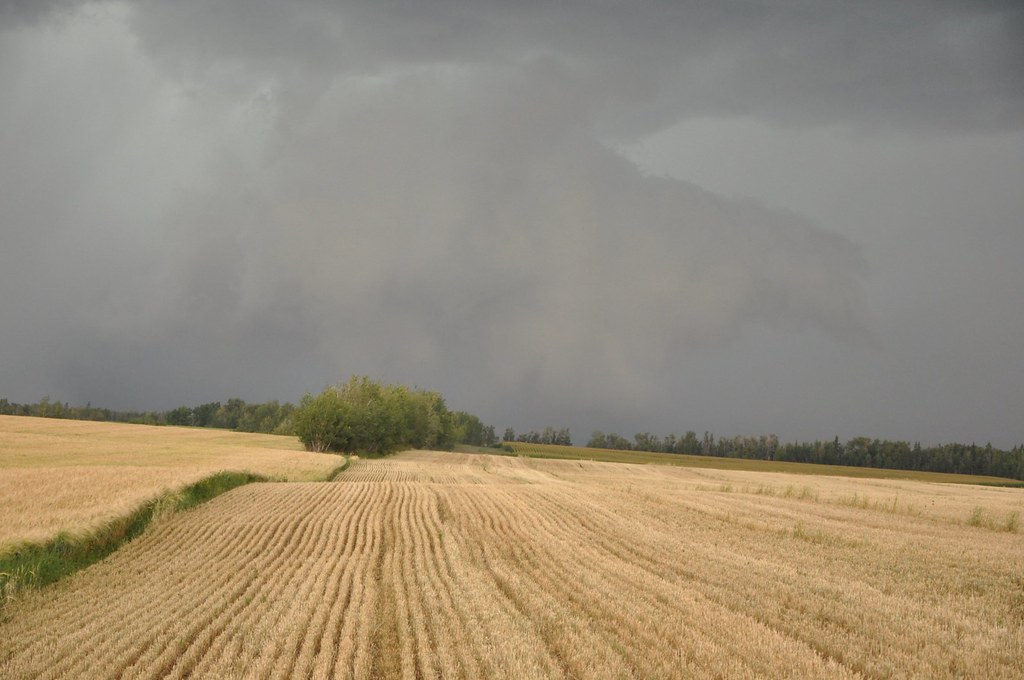
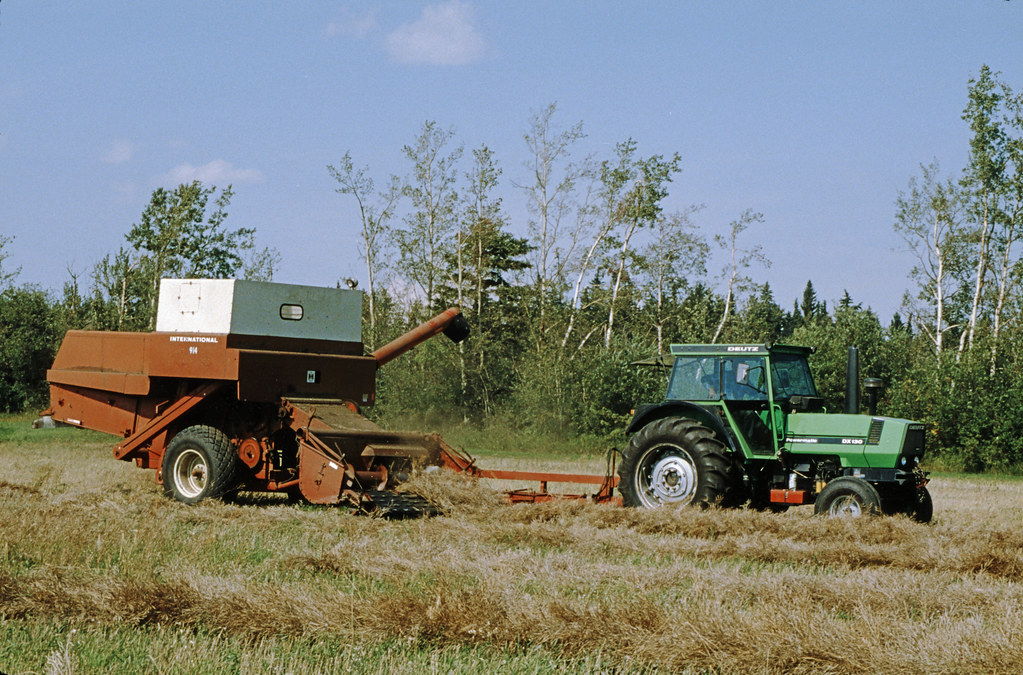
I admire a person who can drive a tractor in a straight line, especially in hilly areas. The ground is seldom smooth and it takes a bit of skill to keep the tractor going straight.  I remember helping my father-in-law once with the harvest, driving the swather, which we had just repaired.  He chided me because my rows weren't straight (it was my first time doing something like this).  Crooked lines meant the possibility of having to make an extra run or two across the field, which cost time and  money.

Engler Farm Freedom Alberta-Skies 6
Wheat fields on me father-in-laws farm

My father-in-law grew different kinds of crops, but in some places there was no fence or anything between them, there was only a marked pole on either end of the field.  Aim straight for the pole, and you get a straight line.  I could barely see the pole half a mile a way, let alone imagine tracking a straight line across the field to it.  And you couldn't let your eyes get distracted-if you turn around and start looking back, the tractor is liable to get off track. It's like what we were taught in driving school: "Where you look you will steer."  Or, as we read in Proverbs, "Let your eyes look directly forward, and your gaze be straight before you." (Proverbs 4:25 ESV)

So it was in Jesus' day.  Someone had told Jesus that he wanted to follow Him, but he told Jesus that he needed to say goodbye to his family first.  Jesus told him that a person who looks back is not fit for the Kingdom of God.

On the surface, the statement seems a bit harsh, but I can get the point.  If we're trying to go forward with Jesus, yet we keep looking back at what we're missing in our old life, we'll get off track, perhaps turned around completely.

The field is ripe and ready to harvest, Jesus said (John 4:35).  We need to direct our combine straight across the field.

Triticum sp L. Poaceae Wheat 3
Abundant Harvest

I remember looking back once.  It was my mid-life crisis.  A lot of guys go through that kind of thing, usually when the're in their forties and they start comparing the life they are living with the life they hoped they'd being living at that point.

I had a mid-life crisis as well.  It was a difficult period of my life and I thought about ditching what I was doing and starting over.  But my mid-life crisis only lasted about 30 seconds. Because when I looked back—back to my life before I was a believer—I remembered how miserable I was then.  Why would I want to go back to that?  The present may not have been rosy, but it wasn't that bad.

Combining in Freedom Sept 1987
Canola Harvest 1987


Now we're at the age when we might suffer from nostalgia.  They sometimes refer to this as looking back at the "good old days",  because we have a tendency to only remember the good times.  And there were good times to be sure.  It's fun to look at old photos and reminisce.  But we don't live there.  We rejoice that God allowed us to have those experiences in the past that helped us get to where we are in the present.  We were moving forward then and we're moving forward now.

Paul wrote, "12 Not that I have already obtained all this, or have already been made perfect, but I press on to take hold of that for which Christ Jesus took hold of me. 13 Brothers, I do not consider myself yet to have taken hold of it. But one thing I do: Forgetting what is behind and straining toward what is ahead, 14 I press on toward the goal to win the prize for which God has called me heavenward in Christ Jesus." (Philippians 3:12-14 NIV)

Saturday, December 20, 2014

White Unto Harvest, Black Unto…


Burnt rice paddies in Pang Hat 4

With the dry season and the end of harvest for some of the corn and rice plantings, it is common to see plumes of smoke coming from the fields.  As dry season goes on, the air just gets more and more smoky.

As I was looking bicycling past some of the fields this pas week, I noticed that there were people out in the blackened paddies.  And as I looked more closely, I saw that they were out planting in the fields.  In fact, some of the other paddies were flooded as if irrigating a new crop.

As I watched the workers in the black fields the words of Jesus came to mind: “the fields are white unto harvest.”  And I thought, “these fields are anything but white.”  But then, they were not harvesting, they were planting.

And I thought this is a good picture of one aspect of missionary life.  Before a field is “white unto harvest”, it must first be planted an cultivated.  And when we first plant the gospel, sometimes things seem very dark.

Today, one of the young women who comes to our English club had to rush off afterwards to join her family for some ritual involving ancestor worship.  She is a young believer but still under the authority of her non-believing father.

Darkness.

This afternoon, a long, slow parade of vehicles was following a car with a loudspeaker announcing a special opportunity to make merit—trying to increase the chances that one’s next life will be better than this one (but no guarantees).

Darkness.

But the good news is that darkness  hopeless.

Indeed it is in these blackened fields that we can plant seeds of hope and light.

Sowing.

There is the young man who went to school to become a teacher, and then, when he had opportunity, he moved back to his home village to bring the good news of Jesus to that place.  Still, few adults in this community want to risk getting the spirits angry by following Christ.  Yet this teacher perseveres in his faith.

Cultivating.

There is another young man who has been holding youth meetings in another village every week.  For the longest time there was no interest on the part of the adults in following Jesus.  But now there is talk about some of the village leaders even setting aside a piece of land for a church.

Harvest.

A group of people come from across the river to declare their faith by dipping in the Mekong River. 

We are grateful for the opportunity to help plant seeds of light in the darkened fields.  And we till the fields in hope of a great harvest.

Rice harvest

Thursday, January 2, 2014

Top Twelve 2013

I thought it would be fun to look back over my year by picking out a favorite photo from each month.  When I first thought of doing this it seemed a bit daunting because I have several thousand photos to pick from covering quite an array of activities.  And the object was not to pick out my best photos, per se, but ones that stand out to me for one reason or another.  So here it goes.

January-Egrets

It was with a bit of trepidation that we had moved to Ban Phrueksa 36 in rural Chachoengsao in December 2012.  It is not far from Lat Krabang, which was just over the line in Bangkok province.  The thought of living in such a tightly packed subdivision was a bit overwhelming.

But as we toured around, we discovered that there are a lot of birds adapted to the rice paddy/fish pond environment that we found ourselves living in.  So we started to enjoy bicycling, walking and driving around just to see the rural landscapes.  Often, on the way back from church, we will take a scenic route, where the roads are less crowded and the driving more relaxed.  And I usually keep my tripod in the car in case a photo op comes up.

At other times, we just hop in the car, go find us a cold coffee somewhere, and drive back along the back roads.  It was along such a trip we happened upon these frolicking egrets (mostly little egrets--Egretta garzetta--similar to snowy egrets).  The reason I liked this one, of the many I took, was the way the one egret flew with his legs hanging down.

Intermediate Egret: Mesophoyx intermedia
Little Egret-Egretta garzetta-Ardeidae-นกยางเปีย
February-Consultation

In our kid's clubs and other activities, one little fellow really took a liking to us.  This young guy, Toon (or perhaps his twin--I have a hard time keeping them straight) would tool around the neighborhood on his mini-bicycle with training wheels.  If we were outside the house, he would usually stop by to chat.

He happened to be visiting with Ingrid on this occasion.  I grabbed a camera quick and snapped the shutter.  If I had more time I might have set things up for a better exposure.  Still, I think this one came out really nice.


Ingrid chatting with child 2
Ingrid and Toon

March-Rice Rat
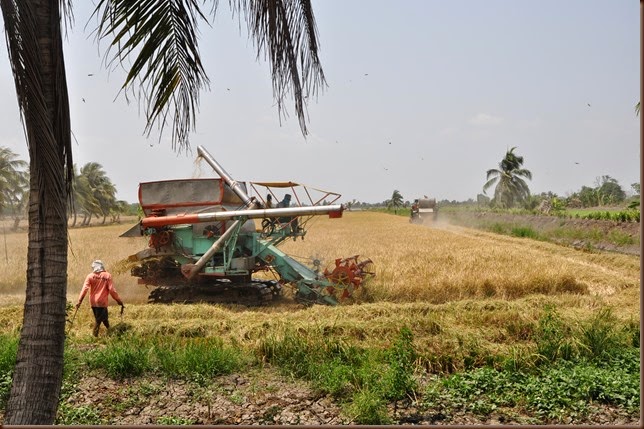
We were taking a scenic road home one day when we happened upon a combine harvesting rice.  We thought it would be great to grab a few shots of the brightly colored combines that they use here.  But it was while doing this that we noticed what we found was a common practice here--alongside the rice harvest there is also a rat harvest.

It seems to be the practice when they harvest in the dry season (the ground is too wet for this in wet season harvest) that some people will walk alongside to combine carrying sticks that they use to kill rats that are flushed out of the field by the combine.  This is not for pest control purposes--it is for dinner.

In these parts there are even roadside stands selling BBQ rice rat.

Rice harvest
Harvesting Rice Rat

April-Frog Legs

On one of my coffee runs, I decided to take a round about way home.  There was a rice paddy that was flooded between harvests, awaiting being tilled.  Birds love to hang out in these kind of fields.

Amongst the many photos I snapped that day was a Javan Pond Heron eating a frog.

My camera's auto focus was not working well and my eyesight is not so good anymore, so getting an in-focus shot through my telephoto is sometimes a bit of a challenge.  But this one came out reasonable.

Javan Pond Heron eating a frog
Javan Pond Heron eating a Frog

May-Snake Roots in Khao Yai

In May, Ingrid's nephew moved to Thailand to begin teaching in an international school.  When he first arrived, he stayed with us for a few days before moving to Bangkok.

While he was here we took a trip to Khao Yai National Park, located about a 3 hour drive north of here.  On our way to Heo Narok waterfall, we detoured down to the river that feeds it.  There was this interesting tree with snake-like roots that were reflected in the ponded water of the river bed.  It seemed like a scene out of some fantasy movie.

Beside Heo Narok Creek 7
Tree along Heo Narok River


June-Courage

My June photo is actually not one that I took--that's because I was more involved in the process of getting it set up.

In June we had a team from Heritage Bible Church in Bakersfield, California, come assist us.  There were three adults and 6 young people.

The first week they were here, we held an English Camp in a nearby school.  One day I noticed this big strange-looking beetle crawling on the floor.  I was thinking that with many beetles, they are similar in to a Saint Bernard--because of their size, Saint Bernards can be quite intimidating, but the only danger from them is if, in the process of kissing your face, they knock you over and you get hurt.

Using that line of reasoning, I reached down and let it crawl on my hand.  After I let it crawl on my hand a while, I asked if any of the young people wanted to give it a try.  ONLY ONE volunteered--a young woman named Dani.

I was really impressed by this act of courage.  If I was a young man looking for a potential spouse, it is this kind of behavior that would land someone in my "possibiities" list.  (Thirty years ago, I did, in fact, marry a courageous woman like that.)

I think the photo was actually taken by Bri, another young woman on the team.

IMG_1238
Dani and the Beetle

July-Making Cupcakes with Neighborhood Children

For much of the time that we lived in Ban Phrueksa, Ingrid has given baking classes. Typically, he students are adults, but sometimes the young people want to get involved as well (mostly because they want to eat the results.)

This particular day, we had two groups.  The adults were working one table and the kids on another.  I like this photo mostly because it reminds me of some of the fun time we had with the neighbor kids in the house.  You can tell by the photo that not all of them actually participate in the work.  Mostly it is an excuse for them to hang out together and have fun.  And eat cupcakes.

Cookie baking 2013-7-6 16
Making Cupcakes with the Neighborhood Children

August-Double Rainbow Over Mill Lake

We had only recently arrived in Abbotsford and had stopped to visit Ingrid’s brother and sister-in-law.  We weren’t planning on staying long at their place, but they asked if we wanted to go for a walk.

It was late in the day and the sun was getting quite low.  I didn’t think that there would be many photo ops, so I didn’t bother to reach into the car to get my camera.

Then, as we’re walking around Mill Lake, just at sunset, there was a beautiful double rainbow.  Not only did I not have my camera, but Ingrid did not have her phone (which has a reasonable camera).  So I used my old Samsung phone with it’s 640x480 camera and snapped about 5 photos with portrait orientation, which I later stitched into a panorama using Adobe Photoshop Elements.  It is not the greatest photo in the world, but it is a nice remembrance of the awesome rainbow that we saw.
 
Rainbow_Panorama1
Double Rainbow over Mill Lake

September-Columbia Icefields

After we were finished with all the necessary meetings at our office in Abbotsford, it was time for some vacation.  Ingrid's parents had driven down from the Edmonton area.  We drove back with them, taking the scenic route through the Icefields Parkway in Banff and Jasper National Parks.

While we have been through these mountains many times since we got married, we had not actually gone down to the Columbia Icefields.  When I was a child, our family had stopped here on one of our cross-country trips, during which time we had gone out on the icefield in one of the Snow Tracs.

This time we decided we had time to walk around a bit.  The place where we parked to walk up the terminal moraine was pretty much the edge of the glacier when we had visited there in 1970.  Now were were able to walk along that area which had been buried by ice back then--and we never even got as far as the tip of the glacier.

This photo was take with my little Fuji Finepix--the only camera I had brought along.  I used the built in panorama ability to capture the photo.

Athabasca Glacier-Columbia Ice Field
Columbia Icefields and Athabasca Glacier

October-30th Anniversary Trip to Monterey

October marked ur thirtieth anniversary.  Because of all the changes that have gone on in our lives the past few years, we never even made the big trip we wanted to take for our 25th.  Now, for our 30th, we still had little time or money to make much of a trip.

We decided to go to Monterey for a few days, only this time we stayed close to the beach in a better facility than the Motel 6 in Marina that we have typically stayed at in the past.

Our main activity was to walk along the beach and shoreline.  It was on one of these evening strolls that we happened on these brown pelicans on the rocks below.  I braced my little Fuji camera on the guard rail as I zoomed in in order that the picture would be somewhat sharp.
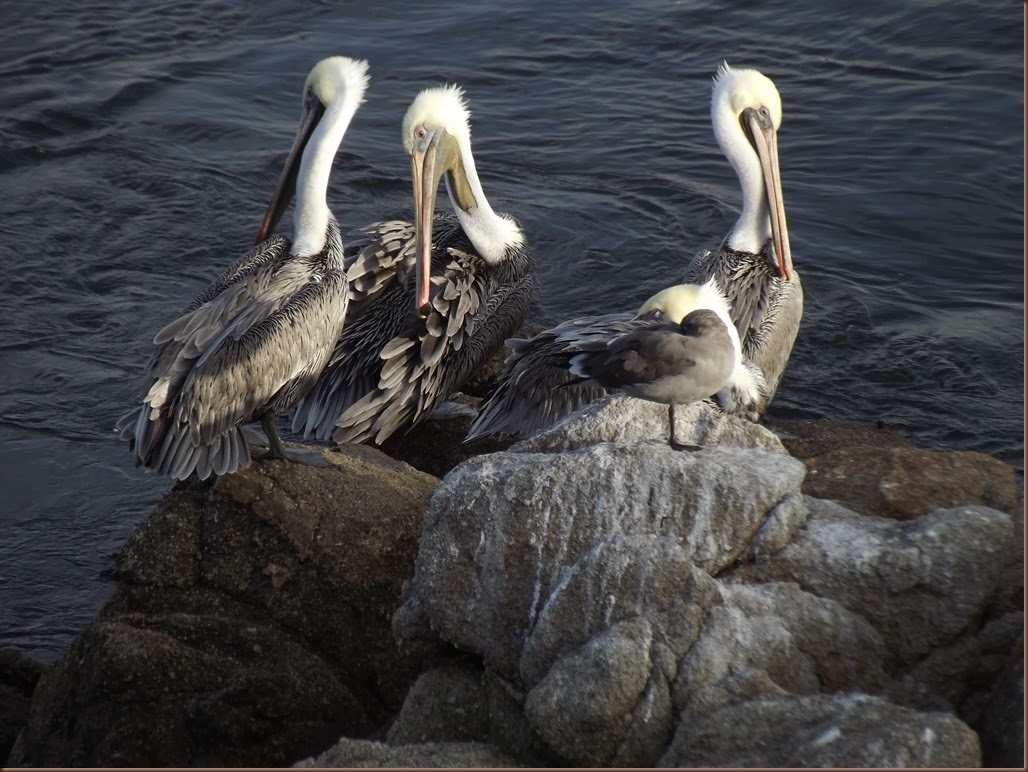

Brown Pelican: Pelacanus occidentalis
Brown Pelicans in Monterey

November-Birthday Trip to Morro Bay
This was a hard month to pick photos for  because we visited our two most favorite places in California: Lake Isabella and Morro Bay.

In the end I picked this photo taken from the trail to Valencia Peak, showing my favorite person in the world and Morro Rock and the Sand Spit in the background.

We have climbed Valencia Peak many times, but often the fog obscures any decent views.  We were happy to have such nice weather and an unusually warm day.  This was the first day I have been to Montana de Oro State Park where I did not wear a windbreaker while walking along the bluffs.

Valencia Peak hike
On Valencia Peak Trail in Montana de Oro State Park

December-Two Heads are Better than One

As our time in North America came to a close, we finished off by spending Christmas week with my sister and her family.  Her daughter and son-in-law and grandkids were there that week as well.

I spent a lot of time playing with the twins.  I tried to get some photos of them, but it was hard as they were little balls of energy--seldom sitting still long enough to pose.

Then, on one occasion, they were sprawled out on the floor, so I sprawled out on the floor in front of them to grab this photo.  In the photo, it looks like the twins share a single body with two heads coming out of it.

Christmas at the Haskins 6
The Twins at Christmastime