
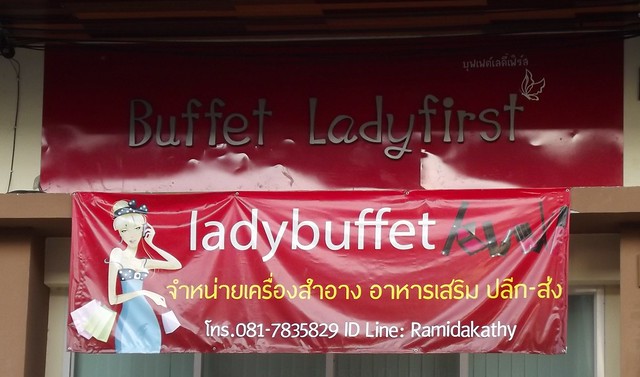
The use of English in Thailand is quite interesting. Places are sometimes named in English, even though they are marketing to the Thai. Perhaps this is supposed to be cool or make the place seem more upscale, I don't know. But sometimes one sees some intriguing signs.
Take the store I saw in Chiang Mai recently:
ladybuffet
The name of the store was only written in English, there was no Thai name nor even a Thai phonetic spelling of the English.
So what kind of place is ladybuffet?
The English suggests one of two things:
A place where women can taste from all kinds of food.
A place where one can taste from all kinds of women.
(Interesting, that in the strange grammar that is English, it could be said of either of these that "they serve ladies", depending on whether "ladies" is the direct object or the indirect object.)
However, I've been in Thailand long enough to figure that this establishment was not either of the scenarios that I listed above.
There is a chain of beauty supply stores in Thailand called "Beauty Buffet". My guess is that the owner of this place was playing off of that name and called it something similar, not realizing the strange nuances of the English language.
As I read the Thai, my suspicions were confirmed:
จำหน่ายเครื่องสำอาง อาหารเสริม ปลีก-ส่ง
which translates:
Sell cosmetics, nutritional supplements, retail-delivery
Language is interesting.
It's not just words and meanings of words. It's how we use the words. We often don't use words in a grammatically correct fashion but communication happens nonetheless. Context is extremely important.
By naming his establishment ladybuffet, the owner is trying to make a statement. I, as an outsider, may not get it. The Thai people who visit will likely not understand the English meaning, but will probably understand the owner's meaning better than I. For even though ladybuffet looks and spells like English, it is probably more of a Thai word than an English one.
So as we continue to try to improve our Thai language skills, we move beyond the words, to the context:
What did they say before and after?
What was their body language saying?
What was the venue in which it was spoken?
Are they, for cultural reasons, not actually saying what they mean?
What is the status of the speaker relative to the listener?
How do the speaker and the listener perceive each other?
Sometimes it can be rather simple to try to say what I mean. At other times it can be quite complicated.
As I move into a new role here, where I am often in a leadership position in meetings, I have to think about these things a lot more. What might have worked well for me in North America, may not work so well here.
I tend to speak short and to the point. Why say something in 10 words if you can say it in 5? Why do we need a 30 minute sermon if we can say the same thing in 10 minutes?
The Khmu people are storytellers. They go on for several minutes giving background and context before they get to the main subject. Sometimes I get lost before they get there and I'm wondering what they are talking about.
I, on the other hand, probably come across as if I don't care about them because I speak so directly.
As one leading a meeting, do I need to put the brakes on and redirect a speaker or do I let them continue? (I usually tend to let them speak more so I can speak less.)
This past week I went to visit one of our church leaders known as Uncle John. I didn't really have a lot to say. John had lots to say. Several days later he was still overflowing with gratitude, not because I went to say something to him, but because I spent time with him. "Worth more than gold," he said.
Sometimes in communication one just needs context, words aren't so important.
For everything there is a season, and a time for every matter under heaven:
... a time to keep silence, and a time to speak; (Ecclesiastes 3:1, 7b)

