Showing posts with label communication. Show all posts
Sunday, February 23, 2020
Translating words AND culture
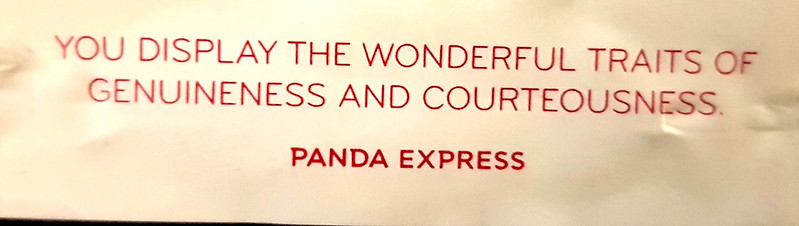
Not long ago, we stopped at Panda Express for lunch. It was our first time in Panda Express in a few years. I had forgotten about the fortune cookies that come with the meal. After consuming too much Bejing Beef, I cracked open my cookie to find the following:
"You display the wonderful traits of genuineness and courteousness."
This isn't much of a fortune, but a statement of character. How did they know me so well?
All humility aside, I do at least try to be genuine and courteousness.
The problem is that, in some cultures, genuineness is not a wonderful trait to have. We've occasionally gotten into a lot of trouble in such cultures because we are too genuine. What is more valued is agreeableness and calmness. Always say, "yes", even if you don't really mean it. Smile, even if you're angry. Don't say what you think, say what you think the other person wants to hear.
This is really hard for us. Genuineness comes much easier.
I'm surprised that this statement came in a Chinese restaurant as I think they would have similar communication values as Thailand.
The apostle Paul counsels us to "speak the truth in love." (Ephesians 4:15) I would amend it:
Speak the truth in love in a culturally appropriate manner.
And maybe one day, we will be able to communicate without offending someone.
Sunday, March 24, 2019
Nothing to Say
I have nothing to say
and hugs are too far away.
Then (Job's three friends) sat down with him on the ground for seven days and seven nights, yet no one spoke a word to him, for they saw that his pain was very great. -- Job 2:13
I have to admire Job's friends for their behavior. At least for the first week. It could not have been very easy for them. Job was probably not a pretty sight with all his festering sores. He was probably groaning a lot. And wafting up from his wounds would probably be something that, to borrow a phrase from George Carlin, "could knock a buzzard off a shit wagon".
I remember the day I got a phone call from my mom, telling me my sister's husband was killed in a freak motor vehicle accident. Since I was the sibling that lived nearest, I dropped what I was doing to make the 5 hour drive to her house. When I got there, I don't think I said anything, I just wrapped my arms around my sister. There wasn't much use in my voicing what we would have agreed upon: "this really sucks." It wasn't the time for platitudes. It was the time to just be there.
![]() |
| The Russell clan men when Mike was a part of it |
One of the disadvantages of our current vocation is that we are far from family. There are times when we just want to be there with them.
Now my sister, who already lost one husband, is dealing with her second husband having a rare form of cancer. Because this is not a common cancer, it is hard for doctors to give any prognosis. No one knows how long my brother-in-law has left this side of heaven. Whatever it is, from our perspective, it is not enough. And while I can FaceTime my friends and relatives, it is not the same as being there. And even when I FaceTime them, it's not like I want to say a lot. I want to be in their presence as much as technology allows us from across the waves. I would like just to be with my brother-in-law even at times when he hardly has strength to acknowledge me.
![]() |
| Precious memories with George and Family |
Last week, some of our co-workers were visiting a nearby country. While driving one night, they struck another vehicle. One of our friends was killed. Others ended up in a small hospital with not a great standard of care. I just wanted to be there to comfort my friends. Not to say anything in particular. Just to be there.
![]() |
| Remembering good times with some who have moved on to heaven |
There are many times when no words need to be spoken—times when words might actually disrupt important communication that needs to take place. These are the times it is hardest to be away from family and friends. So we resort to using words, even though it is not our favorite option. And sometimes we may say something awkward because it is awkward to even say anything at all at that moment.
Meanwhile, we look forward to that day of great reunion—when being separated from loved ones will no longer be an issue. When gestures of comfort will no longer be needed, for there will be no sorrow for which to receive it.
He will wipe away every tear from their eyes, and death will not exist anymore—or mourning, or crying or pain, for the former things have ceased to exist. (Revelation 21:4 NET)
Monday, July 3, 2017
Limitations of Letters
Last week, on our day off, we took a trip to see a skywalk. The skywalk is about a two and one half hour drive west from here, the other side of the city of Nong Khai. When we got there, we found out it was in Sangkhom District. When I saw the sign for Sangkhom, I was a little surprised. I though Sangkhom was just south of Phon Phisai, where we live.
Well, I wasn't imagining things, I just had not looked too carefully at the Thai spellings of the two places. Because Thai has more vowels than English, plus tones that English doesn't have, plus different vowel lengths, it can be difficult to render names into English. The Thai names for the two Sangkhoms actually look quite different from each other.
สังคม translates "society". สร้างคอม most simply translates "build a computer", but I have a feeling it means something different, I'm just not sure what.
A challenge we constantly face working with different cultures and languages is being misunderstood. Sometimes we just say the wrong thing, but sometimes we are misunderstood because of limitations related to language or culture. People will sometimes ask about something back in North America, but it is hard to explain because there is nothing like it here, so I have to make comparisons to things they already know, even though they are inadequate.
Jesus faced the some issue when talking to people. How do you describe what the Kingdom of God is like when we've never really seen it and it is a bit beyond human understanding. We've seen some parts of the Kingdom of God, for sure, but certainly not all of it. So Jesus used parables to describe the Kingdom of God--lots of them. So the kingdom is like a mustard seed. Or a farmer. Or a pearl. Or a net. Or a treasure.
Or...?
The good thing is that there is a Bible in the Thai language, so there is only one level of language limitations to people understanding God. Otherwise, the people I work with would not just have to deal with the issue of human limitations understanding the things of God, they would also have to deal with my limitations in communicating it.
Because of these things, our focus in working with the church here is to get the people reading and memorizing scripture. We try to help them understand the context of the various scriptures, but we also pray that the Holy Spirit will guide them in their understanding of God's word.
There is so much more I want to tell you, but you can’t bear it now. When the Spirit of truth comes, he will guide you into all truth. He will not speak on his own but will tell you what he has heard. He will tell you about the future. He will bring me glory by telling you whatever he receives from me. All that belongs to the Father is mine; this is why I said, ‘The Spirit will tell you whatever he receives from me.’
John 16:12-15 (NLT)
![]() |
| Looking down into the village of Sangkhom from the skywalk |
Well, I wasn't imagining things, I just had not looked too carefully at the Thai spellings of the two places. Because Thai has more vowels than English, plus tones that English doesn't have, plus different vowel lengths, it can be difficult to render names into English. The Thai names for the two Sangkhoms actually look quite different from each other.
สังคม vs. สร้างคอม
สังคม translates "society". สร้างคอม most simply translates "build a computer", but I have a feeling it means something different, I'm just not sure what.
![]() |
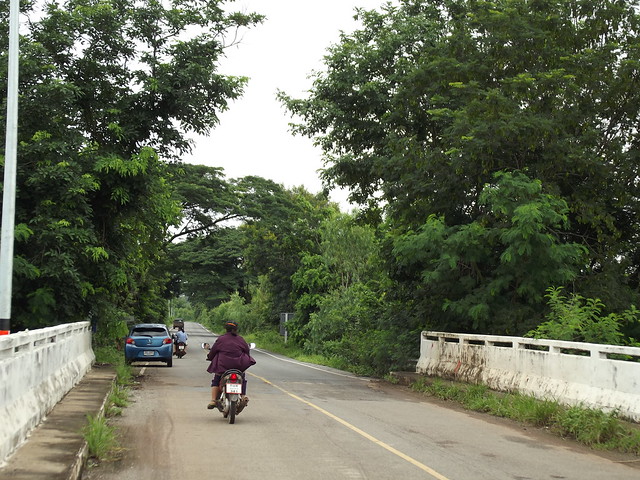
| Crossing into Sangkhom District, half an hour south of Phon Phisai |
A challenge we constantly face working with different cultures and languages is being misunderstood. Sometimes we just say the wrong thing, but sometimes we are misunderstood because of limitations related to language or culture. People will sometimes ask about something back in North America, but it is hard to explain because there is nothing like it here, so I have to make comparisons to things they already know, even though they are inadequate.
Jesus faced the some issue when talking to people. How do you describe what the Kingdom of God is like when we've never really seen it and it is a bit beyond human understanding. We've seen some parts of the Kingdom of God, for sure, but certainly not all of it. So Jesus used parables to describe the Kingdom of God--lots of them. So the kingdom is like a mustard seed. Or a farmer. Or a pearl. Or a net. Or a treasure.
Or...?
The good thing is that there is a Bible in the Thai language, so there is only one level of language limitations to people understanding God. Otherwise, the people I work with would not just have to deal with the issue of human limitations understanding the things of God, they would also have to deal with my limitations in communicating it.
Because of these things, our focus in working with the church here is to get the people reading and memorizing scripture. We try to help them understand the context of the various scriptures, but we also pray that the Holy Spirit will guide them in their understanding of God's word.
There is so much more I want to tell you, but you can’t bear it now. When the Spirit of truth comes, he will guide you into all truth. He will not speak on his own but will tell you what he has heard. He will tell you about the future. He will bring me glory by telling you whatever he receives from me. All that belongs to the Father is mine; this is why I said, ‘The Spirit will tell you whatever he receives from me.’
John 16:12-15 (NLT)
Monday, June 1, 2015
All you can eat?
The use of English in Thailand is quite interesting. Places are sometimes named in English, even though they are marketing to the Thai. Perhaps this is supposed to be cool or make the place seem more upscale, I don't know. But sometimes one sees some intriguing signs.
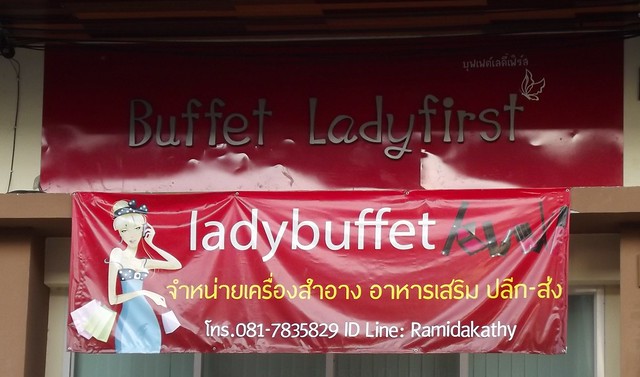
Take the store I saw in Chiang Mai recently:
ladybuffet
The name of the store was only written in English, there was no Thai name nor even a Thai phonetic spelling of the English.
So what kind of place is ladybuffet?
The English suggests one of two things:
A place where women can taste from all kinds of food.
A place where one can taste from all kinds of women.
(Interesting, that in the strange grammar that is English, it could be said of either of these that "they serve ladies", depending on whether "ladies" is the direct object or the indirect object.)
However, I've been in Thailand long enough to figure that this establishment was not either of the scenarios that I listed above.
There is a chain of beauty supply stores in Thailand called "Beauty Buffet". My guess is that the owner of this place was playing off of that name and called it something similar, not realizing the strange nuances of the English language.
As I read the Thai, my suspicions were confirmed:
จำหน่ายเครื่องสำอาง อาหารเสริม ปลีก-ส่ง
which translates:
Sell cosmetics, nutritional supplements, retail-delivery
Language is interesting.
It's not just words and meanings of words. It's how we use the words. We often don't use words in a grammatically correct fashion but communication happens nonetheless. Context is extremely important.
By naming his establishment ladybuffet, the owner is trying to make a statement. I, as an outsider, may not get it. The Thai people who visit will likely not understand the English meaning, but will probably understand the owner's meaning better than I. For even though ladybuffet looks and spells like English, it is probably more of a Thai word than an English one.
So as we continue to try to improve our Thai language skills, we move beyond the words, to the context:
What did they say before and after?
What was their body language saying?
What was the venue in which it was spoken?
Are they, for cultural reasons, not actually saying what they mean?
What is the status of the speaker relative to the listener?
How do the speaker and the listener perceive each other?
Sometimes it can be rather simple to try to say what I mean. At other times it can be quite complicated.
As I move into a new role here, where I am often in a leadership position in meetings, I have to think about these things a lot more. What might have worked well for me in North America, may not work so well here.
I tend to speak short and to the point. Why say something in 10 words if you can say it in 5? Why do we need a 30 minute sermon if we can say the same thing in 10 minutes?
The Khmu people are storytellers. They go on for several minutes giving background and context before they get to the main subject. Sometimes I get lost before they get there and I'm wondering what they are talking about.
I, on the other hand, probably come across as if I don't care about them because I speak so directly.
As one leading a meeting, do I need to put the brakes on and redirect a speaker or do I let them continue? (I usually tend to let them speak more so I can speak less.)
This past week I went to visit one of our church leaders known as Uncle John. I didn't really have a lot to say. John had lots to say. Several days later he was still overflowing with gratitude, not because I went to say something to him, but because I spent time with him. "Worth more than gold," he said.
Sometimes in communication one just needs context, words aren't so important.
For everything there is a season, and a time for every matter under heaven:
... a time to keep silence, and a time to speak; (Ecclesiastes 3:1, 7b)
Subscribe to:
Posts (Atom)