Sunset Over the Mekong River

Showing posts with label language. Show all posts

Wednesday, July 7, 2021

For Rent?

As I was driving into Kamalasai from the north, I was taken aback when out of the corner of my eye, I caught a glimpse of a sign รับเช่าพระ which translates Phra for Rent.

Rent a Phra มีพระให้เช่า 1
Phra for Rent Sign


"Phra" is a word that carries a lot of different meanings, but one of the more common ones is to refer to monks. So my brain quickly interpreted this as "monks for rent," and I was a bit stupefied. Is this some sort of temple prostitution being advertised? Which would be really weird because it it not really a thing in Thailand. It would even be against the teachings of Buddha. So there had to be some other meaning.

The Thai language has a very rich vocabulary and there are often many ways to say the same thing. So to me it is odd that they have words like Phra that have so many different connotations. So, on another day, I went by on my bicycle and looked more closely at the sign. There were images of amulets on the poster. Then I understood the meaning—someone was renting out religious charms. There are other words they could have chosen to be more clear about this meaning, but I guess thay chose Phra because it is the shortest.

The use of amulets is quite common in Thailand, particularly among men. Most people have at least one amulet hanging around their neck. Some people have so many amulets, I wonder how they keep their head up straight against the weight of them.

People believe that amulets have special power to protect one from dangers and hazards of various types. There are magazines dedicated to the subject where one can research which amulets can be used for particular types of protection. These pendants can be quite expensive, especially for a charm that was worn by a particular person that protected that person from harm. Or maybe the charm has special powers that were given to it by a monk who prayed an incantation over it.

Amulet vendors are everywhere and it is not unusual to see someone studying a pendant under a magnifier trying to determine if it is genuine.

Bangkok-Vendors near Wat Arun
Amulets for Sale


Since powerful amulets can be quite expensive, it makes sense that someone would make a business renting them out. Someone might want some special protection for a certain event. Or maybe they just need to impress someone in particular with their choice in amulets.

It can be easy to ridicule people for such superstitions, especially for someone like me who grew up in a religion that didn't use much in the way of symbols. I even struggle sometimes with the way that Christians use crosses.

The Bible is full of prohibitions regarding the use of idols—images resembling people, animals, birds, or mythical creatures. So it is interesting to hear people in Thailand say that one of the reasons they don't like Christianity is precisely because it doesn't have the idols. The are many people who want something that they can look at or touch. It is part of what makes their religion real for them.

The writer of Hebrews tells us: Now faith is being sure of what we hope for and certain of what we do not see. (Hebrews 11:1-NIV)

There is a saying that goes, seeing is believing. What makes Christianity difficult for some is that it reverses this to something like, believing is not seeing.

Since I grew up without the use of idols or amulets, it is easy for me not to depend on them. But it must be really hard for those people whose culture is full of statures and images and charms worn on the body. I really can't imagine what it must be like for them to believe in a God they cannot see. But one thing I do know is that when I put my trust in the One I cannot see, Jesus Christ, His presence became very real to me, as real as any statue that I can touch with my fingers.

Thomas, one of Jesus' disciples, had difficulty believing that Jesus rose from the dead. Then, when he finally saw Jesus, he believed the resurrection had actually happened. Jesus said to him, “Have you believed because you have seen me? Blessed are those who have not seen and yet have believed.” (John 20:29-ESV)

There is no need for us to buy or even rent a charm or statue. We need only put our faith in the One who died on the cross and rose again. We may not see Jesus, but He is real, and He is alive.

Monday, September 10, 2018

Context

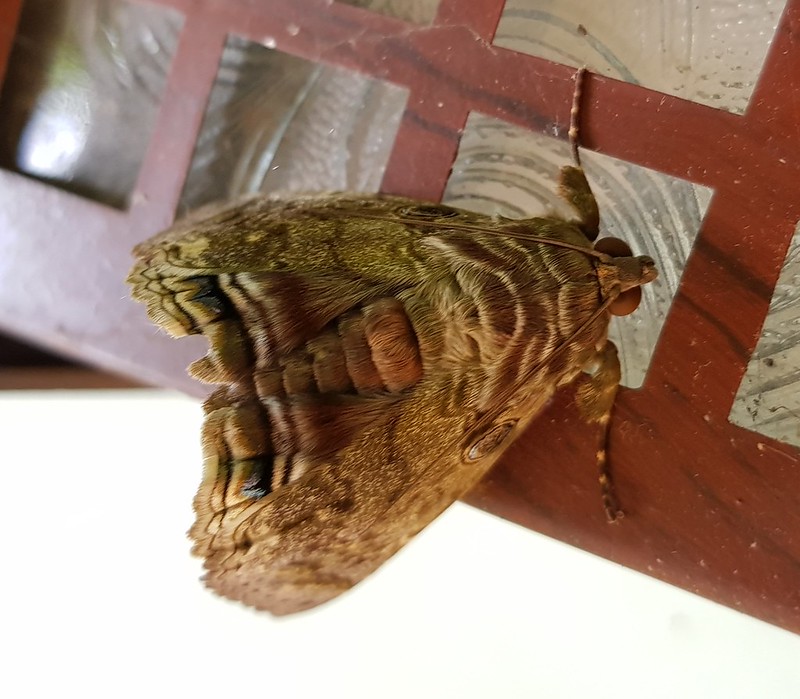
Earlier this week, we spotted an interesting looking moth hanging out on a lamp fixture on our neighbors house.  God gave this creature and amazing camouflage in order to blend in with tree bark, but on the light fixture, his camouflage was not terribly useful.

Unidentified brown moth a2


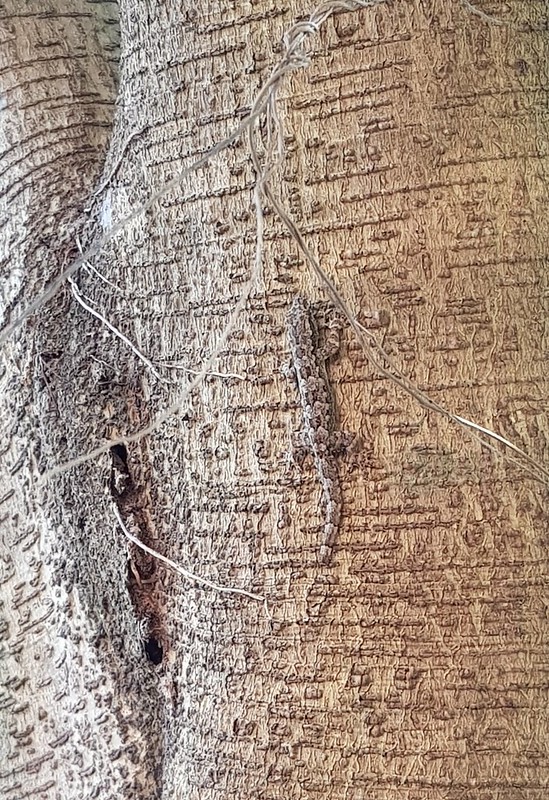
A few days later, we spotted a lizard on a ficus tree in our yard.  This lizard almost seemed to line up the stripes on his body with the stripes on the tree.  This made him rather difficult to spot.

Hiding in plain sight


This compares well with what it is like to live in another culture.  Sometimes, we're more like the moth and our behavior and appearance clash with the culture, making it easy to mark us as a disrespectful foreigner.


A not-so-lizard-like adaptation to Thai culture


Sometimes, we do a better job at adapting local ways and we blend in a bit better, more like the lizard.

The apostle Paul, though he was a Jew, tried to blend in with the non-Jews when he worked with them.  I don't think he forsook being Jewish, it just seems like he didn't want his Jewish ways become barriers to non-Jews coming to faith in Christ.


20  When I was with the Jews, I lived like a Jew to bring the Jews to Christ. When I was with those who follow the Jewish law, I too lived under that law. Even though I am not subject to the law, I did this so I could bring to Christ those who are under the law.  21  When I am with the Gentiles who do not follow the Jewish law, I too live apart from that law so I can bring them to Christ. But I do not ignore the law of God; I obey the law of Christ. 
22  When I am with those who are weak, I share their weakness, for I want to bring the weak to Christ. Yes, I try to find common ground with everyone, doing everything I can to save some.  23  I do everything to spread the Good News and share in its blessings. 1 Corinthians 9:20-23 (NLT2)

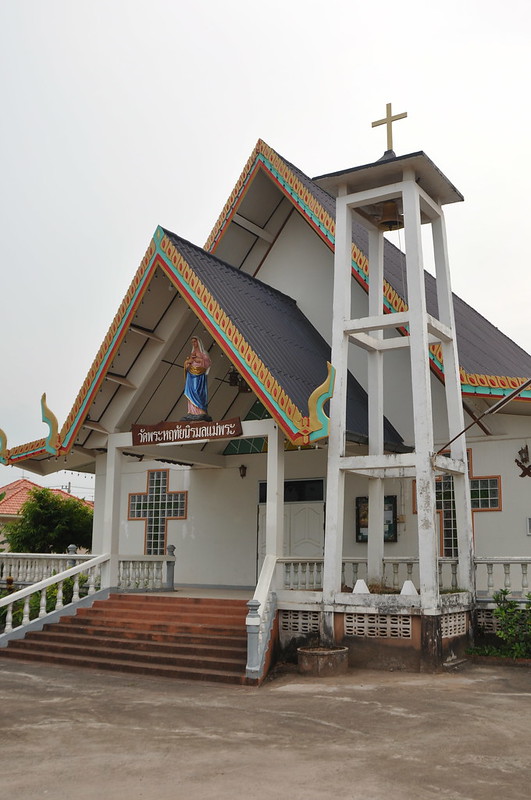
When we preach the gospel in another culture, it is a constant challenge to present the message as unencumbered as possible from Western and personal cultural baggage.  It is not easy and not everyone agrees with how far we can go to make the gospel palatable.  Some churches go so far as to make shrines to Christian saints that look identical to shrines to local deities.  Some put symbols of Naga (the serpent demon) on their rooftops.


Thabo Catholic Church
Catholic Church with Naga symbols on the ends of the eaves


While those are more extreme adaptations, other things are not so clear.  For example, do we use the word karma, along with the term sin when talking about sin, since the Thai people use the term sin in a more narrow sense.

Other examples are found in translating special words.  There is a Thai term for the hall where the Buddhist monks do their teaching called Salatham.  In the Catholic bible they used this term for "synagogue", which seems appropriate.  Most Protestant translations wanted to distinguish the Jewish term from Buddhist concepts, so they simply reversed the syllables, i.e. Thamasala.  One of the newer Bible translations did away with the concept altogether and refers to the synagogue as the "meeting place of the Jews".  Which one is best?

These are just a couple many instances where we have to think about how we present the gospel in the local culture.  While we Christians want to be like the lizard and blend in with our environment, we still want to remain a lizard and not become a tree.


Monday, July 3, 2017

Limitations of Letters

Last week, on our day off, we took a trip to see a skywalk. The skywalk is about a two and one half hour drive west from here, the other side of the city of Nong Khai.  When we got there, we found out it was in Sangkhom District.  When I saw the sign for Sangkhom, I was a little surprised.  I though Sangkhom was just south of Phon Phisai, where we live.


Wat Pha Tak Suea Skywalk and Views 10
Looking down into the village of Sangkhom from the skywalk


Well, I wasn't imagining things, I just had not looked too carefully at the Thai spellings of the two places.  Because Thai has more vowels than English, plus tones that English doesn't have, plus different vowel lengths, it can be difficult to render names into English.  The Thai names for the two Sangkhoms actually look quite different from each other.

สังคม vs. สร้างคอม


สังคม translates "society".   สร้างคอม most simply translates "build a computer", but I have a feeling it means something different, I'm just not sure what.


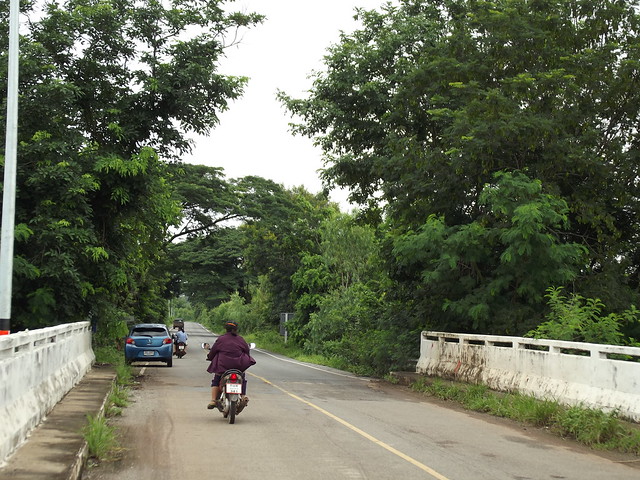
Huai Luang bridge-looking towards Udon Thani 2
Crossing into Sangkhom District, half an hour south of Phon Phisai


A challenge we constantly face working with different  cultures and languages is being misunderstood.  Sometimes we just say the wrong thing, but sometimes we are misunderstood because of limitations related to language or culture.  People will sometimes ask about something back in North America, but it is hard to explain because there is nothing like it here, so I have to make comparisons to things they already know, even though they are inadequate.

Jesus faced the some issue when talking to people.  How do you describe what the Kingdom of God is like when we've never really seen it and it is a bit beyond human understanding. We've seen some parts of the Kingdom of God, for sure, but certainly not all of it.  So Jesus used parables to describe the Kingdom of God--lots of them.  So the kingdom is like a mustard seed. Or a farmer.  Or a pearl.  Or a net.  Or a treasure.

Or...?

The good thing is that there is a Bible in the Thai language, so there is only one level of language limitations to people understanding God.  Otherwise, the people I work with would not just have to deal with the issue of human limitations understanding the things of God, they would also have to deal with my limitations in communicating it.

Because of these things, our focus in working with the church here is to get the people reading and memorizing scripture.  We try to help them understand the context of the various scriptures, but we also pray that the Holy Spirit will guide them in their understanding of God's word.

There is so much more I want to tell you, but you can’t bear it now. When the Spirit of truth comes, he will guide you into all truth. He will not speak on his own but will tell you what he has heard. He will tell you about the future. He will bring me glory by telling you whatever he receives from me. All that belongs to the Father is mine; this is why I said, ‘The Spirit will tell you whatever he receives from me.’
John 16:12-15 (NLT)

Thursday, June 1, 2017

Nong

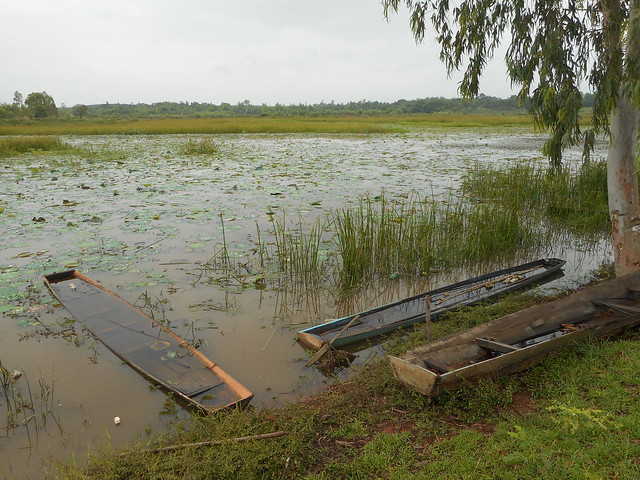
This past month we moved to the province of Nong Khai.  Nong Khai is one of a whole lot of places in Thailand, especially Isaan (Northeast Thailand), the has the term "Nong" in it.

Nong has two meanings.  One meaning is pus.  The other meaning--the one for which many places derive their names--is a swamp or bog.

The Korat Plateau, which is the landscape on which Isaan is located, consists of mostly undulating, low-relief landscapes.  Because of this, there are many areas from which water drains slowly or not at all.  Consequently, there are lots of swamps and ponds (some ponds are made with a little help from humans).  The only two provinces in Thailand that are named after nongs are both in Isaan: Nong Khai and Nong Bua Lamphu.  Sometimes they will name the nong after the creek (Huai) that is dammed up to make it--though it looks a bit funny to me to see a pond called a creek.

One of the cuter names here in Isaan is Nong Song Hong (หนองสองห้อง), which translates: Two-roomed swamp.  It gets this name because there is a pond with two main chambers located in the town.

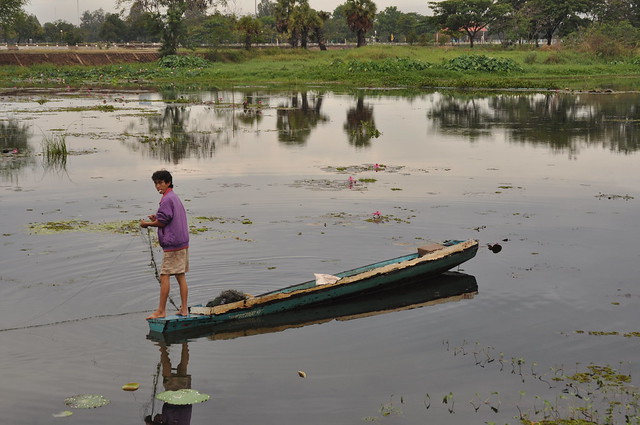
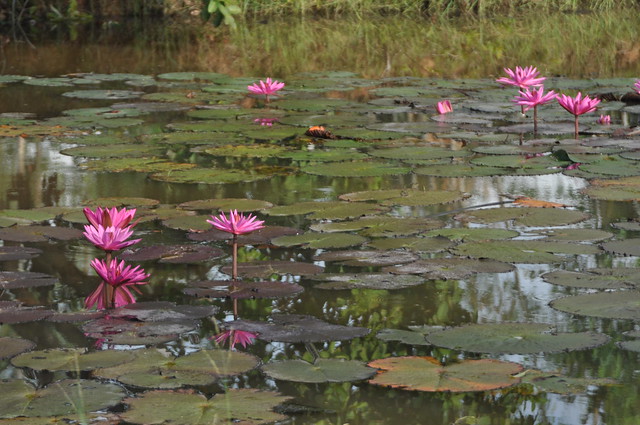
Many of these nongs in Thailand are adorned with water lilies or lotus plants.

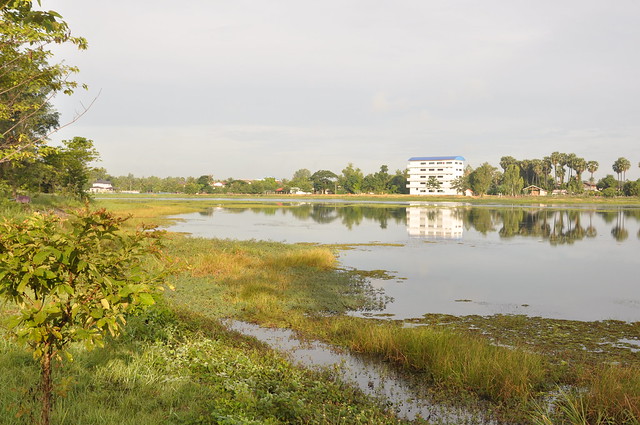
Here are a few of the nongs in Isaan:

Nong 2
Huai Kan Luang Reservoir
A Nong in Phon Phisai created by putting a dam on a low, flat area.

Easter Morning at the Nong Mon 76
Nong Mon in Sakhon Nakhon Province


Nong Khrok
Nong Krok in Sisaket

Nong SaAng-Khu Khan-Sisaket 17
Nong Sa-ang in Sisaket


Even my back yard in Connecticut had a nong in it.

Russell Pond Fall 2007
Nong Russell in Wolcott, CT

One has to be careful with how one says the word "Nong".  The pronunciation varies only very slightly (it has a similar, but different tone) from a very common term meaning "younger" that is used to refer to people younger than oneself or to servers in restaurants.  Even the firstborn of twins would refer to his younger twin as nong.

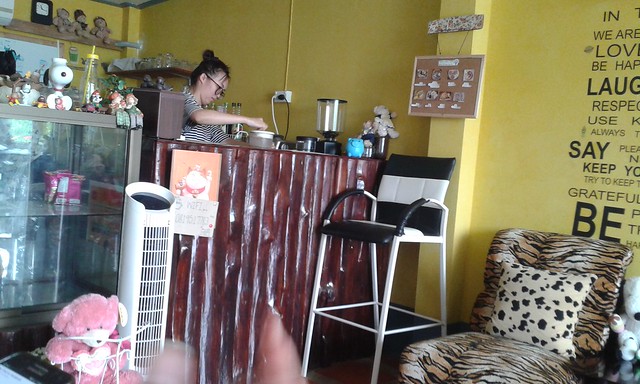
Forest Coffee
A "Nong" preparing my coffee
Probably doesn't want to be called "swamp" or "pus"

Since we are in our upper years now, a lot of people we meet are younger than us, so we use the term nong a lot.

I'm not sure that these younger people would appreciate being called "swamp" or "pus", but perhaps they would be forgiving of a foreigner.  I don't think I have made this mistake yet, but, being a foreigner, I probably have.  If so, forgive me.

I'd like to think we'd have mastered this tone thing by now, having spent 6 years in Thailand already, but that is not the case.  Learning the Thai language is a constant thing, and now we will attempt to learn some Isaan dialect as well.  It is not that we have a need to be experts, but we do want to be able   to explain the gospel clearly in a way that people can understand.

I can echo the words of Paul (except the part about the chains):

3 And pray for us, too, that God may open a door for our message, so that we may proclaim the mystery of Christ, for which I am in chains. 4 Pray that I may proclaim it clearly, as I should.
Colossians 4:3-4 (NIV)

Tuesday, May 26, 2015

cot cott cut

Last week we were teaching some high school students how to speak English.  The subject I briefly touched on that day was vowel pronunciation.

When one teaches such a subject, one becomes aware of just how complicated the English language is to read and write.  For as difficult as the Thai language is to write (because of the various symbols that can be used to represent the same sound), it is fairly easy to pronounce.  Vowels only have one sound.  Cononants only have one sound.  There are some exceptions to tone rules, but they are fairly few.

(For a light-hearted review of the Thai writing system, see https://www.youtube.com/watch?v=gKVtpCByEy4)

English, on the other hand...

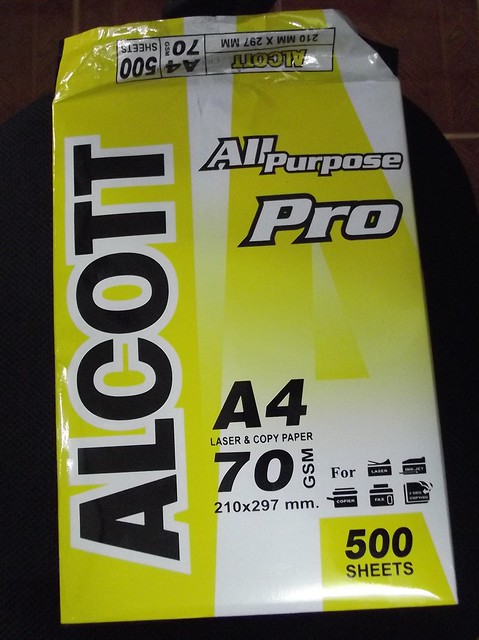
Well, lets start with a paper brand they sell in Thailand.  This particular brand, Alcott, is used by the largest copy shop here in Wiang Kaen.

Alcott paper

Alcott is a name that is dear to me.  It is the name of the school I attended for 8 years.  (I am one of few who did this.  When my siblings attended the school it only went to 6th grade.  After I left it became a middle school.)  The school is named after Amos Bronson Alcott (father of Louisa May Alcott).  I also have some relational connections to the name. (For more on that, see my brother's blog here: http://ramblinrussells.blogspot.com/2015/05/genealogy-story-my-wolcott-connections.html)

The pronunciation of the vowels in Alcott follows the standard rules.  Since both syllables each have only one vowel, the vowels have a short vowel sound.

The name of the town that the school is located in, however, is a different story:

Wolcott.

Wolcott is named after the person who was governor of Connecticut at the time the town was incorporated.  He played a critical role in its becoming separated from Farmingbury to be a town in its own right.  I have no idea how HE pronounced is name.  But I do know how I grew up saying it.

If one followed the normal rules Wolcott would be pronounced something like wahl-kaht.  And maybe in some places that is how they say it--

--but not where I grew up (who knows, maybe its changed since then).

Instead it's pronounced more like what happens when a sheep goes to the barber:

wool-cut


  Wolcott Shirt 2

Go figure!

Students of English, I feel your pain.

I summarize the difference between English and Thai this way:

In English a letter has many sounds.
In Thai, a sound has many letters.

A few weeks ago we were at a conference where there were representatives from several language and culture groups.  My favorite part is when we were all praying aloud in our own languages.  I quit praying just to listen.  I don't know what was being said, but it was beautiful.

Somehow God can figure all of that out.  For me I look forward to that day when language will no longer be a barrier to communication.  I imagine heaven to be somewhat like that time in the early days of the church when "they were bewildered, because each one was hearing them speak in his own language." (Acts 2:6b ESV)

(Meanwhile I will keep trying to improve my Thai language abilities.)

Saturday, October 25, 2014

A True Compliment


I walked up to the ticket counter to enter Doi Inthanon National Park, home of Thailand’s tallest mountain, Doi Inthanon.  The following brief conversation took place (in Thai):

     Me: Two adults and one car.
     Ticket agent: That will be 110 baht.

I walked away with my 3 tickets (one for each of us and one for the car) with a smile, having received one of the best compliments I’ve ever received for Thai speaking abilities.

DSC_0348

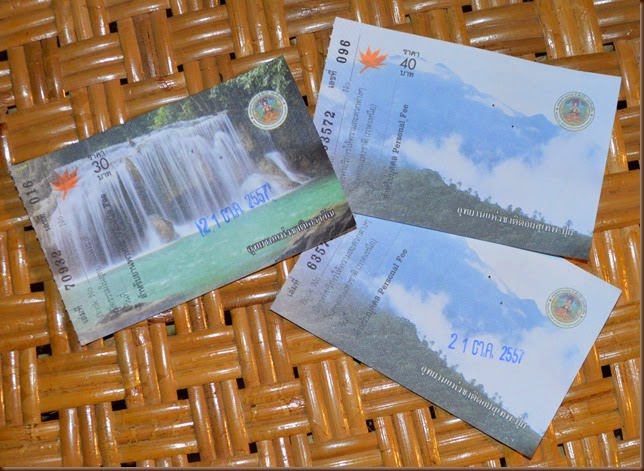
You see, in Thailand, attractions such as parks and museums often have two prices—one for Thai people and one for visitors.  The visitors don’t often know this because there will be two signs-one in Thai and one in English—with the Thai one using Thai numbers (0-9=๐ ๑ ๒ ๓ ๔ ๕ ๖ ๗ ๘ ๙) to help conceal this fact (most of the time they use Arabic numbers).

Sometimes, they will let foreigners with a long-term visa pay the Thai price.  Usually to get this price, one has to request the price and then show their visa or a Thai driver’s license (which I had to do the following day at another park).  However in this case, I was offered the Thai price just on my speaking ability.

To me this was a better compliment of my language skills than a direct one.  In Thai culture, being nice is a higher value than being truthful.  So people might sometimes give a false compliment because they don’t want you to feel bad.  There are occasions when I have been given compliments about my Thai speaking abilities when I KNOW I just butchered their language.  (And I’m sure there are many more times when I’ve been given a compliment when I UNKNOWINGLY butchered their language.)

Learning this cultural aspect of language use is just as difficult as grammar and pronunciation.  We are much more used to direct and even confrontational speech.  Here the emphasis is on making the other person feel good and especially to NOT offend.  And we can offend not just with our choice of words but also with they way we say the words.

The apostle Paul wrote: Let your speech always be gracious, seasoned with salt, so that you may know how you should answer everyone. (Colossians 4:6 (NET))

I pray, then, the God would help me not only know the correct words to use when I speak Thai, but that I would also use the correct words correctly.

Tuesday, March 18, 2014

Rice, Part 1: Eat Rice

(Note: I’m calling this Part 1, because I will probably add more blogs about rice at some point in the future)


Rice with kap khao
(กับข้าว-food that goes with rice)
Rice is an important part of Thai culture.


Rice is by far the most important crop grown in the country, and until some bizarre government policies changed things a couple of years ago, Thailand had for years been the worlds leading rice exporter.

The importance of rice shows up in how the Thai people view eating and even the way the word rice is used.

The phrase eat rice (กินข้าว kin khao) is synonymous with to eat a meal.  When Thai people greet each other, instead of saying, “How are you?” like we might do in America, they will often say “Have you eaten rice yet” (กินข้าวแล้วหรือยัง kin khao laew ruer yang).

The Thai people often eat rice, in some form or another, three times a day. For morning it might be rice soup.  Then it might be soup with rice noodles for lunch and steamed rice or sticky rice for dinner.

For many Thai people, unless they have had rice, they feel like they have not eaten.  One of our missionaries tells of an occasion when the youth got together for a pizza party.  When it was over, it was time to go eat because—you guessed it—they had not had rice yet.

Eating Pizza-Not Real Food


Today I was at a store with one of our co-workers.  The store had two main eating establishments—a KFC and a food court.  The food court had many individual booths each selling some variety of Thai food. Since it was lunch time, I asked our co-worker if she wanted to eat at KFC or the food court.  She said she wanted to “eat rice”, implying that she wanted to eat at the food court (the french fries at KFC just aren't same, I guess).

So I went to one vendor and got some crab fried rice.  She went to another and got noodle soup.  I mentioned to her that I’m not sure I will ever understand Thai people.  Here she did not want to eat at KFC, but instead she wanted to “eat rice”.  But then she ends up getting soup. (By the way, there are some rice options at KFC.  You can even get fried chicken with rice, something many people will buy on the street.)

My take home from this is that for some people, the phrase “eat rice”  may mean eating the kinds of food they are used to as opposed to foreign food.

As for us, we are okay if we don’t eat rice three times a day, in fact, we have rarely ever done so.  Also, when we buy food on the street, we will often not get rice with it.  Rather, we will cook our own brown rice at home which has a bit more nutritional value than the steamed white rice or sticky rice sold on the street.

So, whether you eat or drink, or whatever you do, do all to the glory of God.  (1 Corinthians 10:31 ESV)

Happy eating.

Monday, June 17, 2013

Lost in Translation


Satar Lite sign 2
Originally uploaded by SierraSunrise
In Thailand, it is not unusual for intersections to have names. It is only recently that I noticed the sign at a particular 3 way intersection we frequently pass--usually I am too occupied with watching out for traffic (if I am moving) or the sign is blocked by big trucks (if I am stopped).

I first noticed the Latin script text of the sign. I quickly assumed it must be a name of foreign origin because there were two sounds represented that the Thai language doesn't have--a final "r" sound, and a long "i" sound followed by a final t.

So I looked at the Thai to try to figure it out:

สตาร์ ไลท์

Sounding out the Thai letters, I came up with (using letters that represent approximate American English sounds):

sahtah lie (as in the English word "lie")

figuring in the unpronounced Thai letters (which are used frequently in words borrowed from other languages and often represented with a ์ symbol), I came up with:

satar lite (as the sign reads)

Then, I applied a little bit of mental processing, I came up with:

starlight

Which I later learned was the name of a factory located near the intersection.

It is quite common in Thailand to see signs representing English words written in Thai script. Sometimes it takes a lot of effort to figure them out. Sometimes I never do get it--at least not in the limited time I have while driving past a road sign.

I remember one of my language instructors joking to me: "you're the only American in this class and you have the hardest time reading English."

Isn't it so much easier when things are presented to us in a way we can understand? It is why we work so hard at learning the Thai language--in order that we can communicate with the Thai people--through words as well as actions--how much God loves them.

It is why God sent Jesus to earth--in order that God could communicate though the life and teachings of Jesus the things He wants us to know about Him and what our response to God should be.

As Jesus said:
Do not believe me unless I do what my Father does. But if I do it, even though you do not believe me, believe the miracles, that you may know and understand that the Father is in me, and I in the Father." --John 10:37-38 (NIV)

And as Paul later adds:
For we do not write you anything you cannot read or understand.--2 Corinthians 1:13 (NIV)

How thankful I am that we have a God that wants to communicate with us and who went to great lengths to do so.  I'm thankful that so many who went before us went to great effort to preserve the actions of God in world and the record of the words of God's prophets and especially Jesus.

Wednesday, March 13, 2013

Third Culture People

I was thinking about how little I know about my adopted country.  Sure, we have lived here for two years and have done lots of things and read lots of books about our new homeland.  But my knowledge is mostly facts

As we learn a new language, our goal would be to use the language as well as a native Thai speaker.  Some of those who teach the Thai language divide language learning into several stages—the last one usually occurring about 20 years into the process when you use the language almost as well as a native Thai speaker.  No matter how long you live here, you never get to use Thai just like a Thai.

Wat Yai Chai Mongkol-16
Thai people embracing a
and culture I will never
fully understand

Why is this?  Why is our knowledge so limited?

Being Thai is totally ingrained in a person born in Thailand to a Thai family and then raised here.  For them, using the language is not just a matter of what they’ve studied or learned from experience, it is a part of who they are.

The subject came up the other day as we were discussing returning to our homeland for a brief period. We come to a country and try to master the language and culture but never completely fit in. Then we go back to our own culture but, since we have changed, we don’t quite fit in there either.  And so we end up being a third culture and we end up relating best to people who have had similar experiences.

You could say the same thing about your relationship to anyone because everyone is unique.  In a sense, we each have our own culture.  Try as I might, I will never completely understand my wife, nor she me, even though we love each other and spend so much time together.  Miscommunication still sometimes occurs.

Some people don’t even try.  Spats, feuds, and even wars can be brought about between people or groups because the don’t understand each other and don’t want to try.

And then there is my relationship to God.  How can I begin to understand God who is so “other” than me?
God is at the advantage here because He is our creator and so understands us even better than we understand ourselves.

1 ​​​​​​​​O Lord, you have searched me and known me!
2 ​​​​​​​​You know when I sit down and when I rise up;
you discern my thoughts from afar.
3 ​​​​​​​​You search out my path and my lying down
and are acquainted with all my ways.
4 ​​​​​​​​Even before a word is on my tongue,
behold, O Lord, you know it altogether.
5 ​​​​​​​​You hem me in, behind and before,
and lay your hand upon me.
6 ​​​​​​​​Such knowledge is too wonderful for me;
it is high; I cannot attain it.
  (Psalm 139:1-6)

Fortunately God took the initiative to try to help us understand Him.  First, He sent His Son, Jesus Christ, to give us a better glimpse of what he is like.  Then, if we will believe the testimony of His Son, he will place His Spirit in our lives.

1 Therefore, since we have been justified through faith, we have peace with God through our Lord Jesus Christ,
2 through whom we have gained access by faith into this grace in which we now stand. And we rejoice in the hope of the glory of God.
3 Not only so, but we also rejoice in our sufferings, because we know that suffering produces perseverance;
4 perseverance, character; and character, hope.
5 And hope does not disappoint us, because God has poured out his love into our hearts by the Holy Spirit, whom he has given us.
Romans 5:1-5 (NIV)

One day I have the hope that I will understand God better, for I will see Him as He is. (1 Corinthians 13:12)
Meanwhile I live as a third culture person—a misfit, if you will—in more ways than one.