When you've done your research, you can boast about your pedigree with phrases like, "Queen Elizabeth is my nth cousin x times removed."
The thing is, by using that formula, you can demonstrate that just about everyone who has ever lived who is not in your direct lineage (ancestor, descendant, sibling, aunt, uncle, niece, or nephew) is your cousin. You may just have to use some large numbers for n and x. You just have to go far enough back down you family line—maybe as far as Noah, or Adam, or, if you don't like the Biblical accounts, whoever is our first Homo sapiens ancestor couple.
Everybody is your relative. It doesn't matter if they share the same skin color or language or ethnicity. We're all related to each other. We're all family.
I was recently going through some old photographic slides and I found this photo I took of a billboard back in the early 1980's when I was living in Alabama:
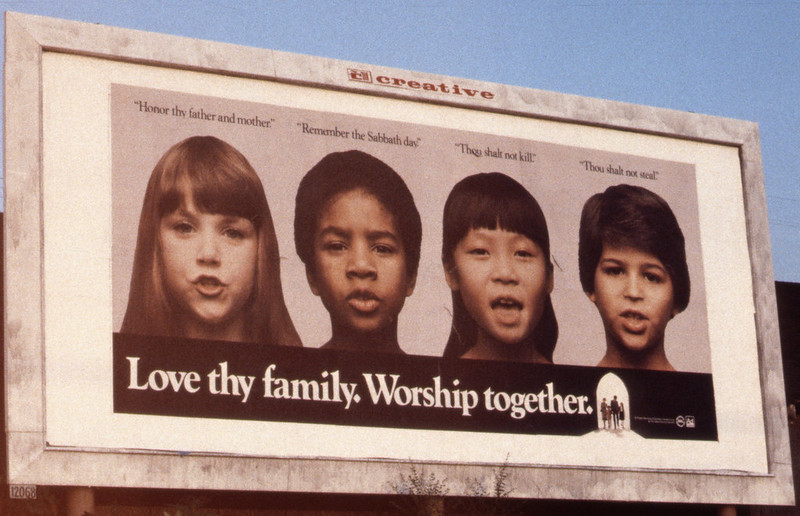
I don't want to get too nit-picky about the commandments that were chosen for this billboard or the choice of commandments chosen to place over each person other than to say with a caption that talks about worship, I find it strange that the first commandment is not listed.
What struck me was that at the time, and particularly in the South, the idea of worshiping together with people of different ethnicity was almost unheard of. Even in recent days I have often heard the quote, "Sunday mornings are the most segregated time in America."
What I like about the billboard is the first part of the caption: Love thy family.
My family. My brothers and sisters and cousins of every shade of color and who speak one or more of 6500 different languages scattered all across the globe.
In these days in the aftermath of the George Floyd killing, we are hearing many stories about how people of color are looked upon differently and treated differently, and not in a good sense. It breaks my heart to hear about such things happening in my family. Because ultimately, George Floyd is a distant cousin of mine. And what's sad is that Derek Chauvin, the guy who knelt on his neck—well that's also another distant cousin. I suppose such violence between cousins should not be surprising when even siblings can sometimes get so upset about trivial things that they don't speak to each other.
For the past several years I have had the privilege of working with distant cousins in another country whose language and culture differ drastically from mine and whose skin color is a shade or two darker. I've learned how easy it is to offend, or be offended by, people I love due to misunderstandings in language and culture. And when these offenses have happened, we've had a choice to make. We could hang onto the offenses and let them simmer until we do something stupid and/or violent. Or we could take a different path involving humility, grace, forgiveness and reconciliation. The latter choice is not always easy, in fact, it can be very difficult. It's often easier to hang onto an offense than to humbly ask forgiveness for where we screwed up. And sometimes I would rather nurture a grudge than forgive someone who has offended me.
I'm grateful, though, that God doesn't struggle so much with these issues. Through the blood of Jesus, He forgives all of our sins—not holding onto grudges. How many times have I had to go to God, for the umpteenth time, for some silly sin I repeated again (redundancy intended). I'm glad God doesn't have a three strikes law, because there would be no hope for me. Jesus, when asked if we needed to forgive people for an offense as many as seven times, said that we needed to forgive 70 times 7 times; but the implication was that we need to be ready to forgive even more than 490 times. (Matthew 18:21, 22)
This same Jesus said that when we pray to God we should say something like: "And forgive us our sins, For we also forgive everyone who is indebted to us." (Luke 11:4 NKJV) In that prayer, we are asking God to forgive use based on how much we have forgiven others. If that is the case, do I want to be stingy with forgiveness?
There is a lot of talk these days about justice. Justice is a good thing, it means everyone gets what they deserve, no more and no less, and all are treated the same. The Bible talks a lot about justice—about not showing favoritism to different classes of people. The prophetical books in particular point out the injustice that was prevalent at the time: the rich and powerful used their money and power to the disadvantage of the poor and the weak. Does that sound familiar? In our day and age people are still treated less favorably because of the color of their skin, or their accent, or the shape of their eyes, or because of their age, or something else. But these people who look, talk and act different than us are still our cousins. Why should they be treated differently?
And while I like the concept of justice, there is another concept in the Bible I like more, and that is mercy. You see with justice, I get what I deserve. And because I'm a sinner, I deserve death. In Romans 6:23 we read For the wages of sin is death. But that same verse also points out the mercy option available in Jesus: but the free gift of God is eternal life in Christ Jesus our Lord.(Emphasis mine)
If we're really honest with ourselves, we'll admit that we don't want what we deserve, we want better than we deserve. We want mercy.
One time, King David screwed up really bad. He raped a women and had her husband murdered. If there was ever a case for the death penalty, this would probably qualify, and he knows it. David didn't appeal to justice, he appealed to mercy:
1 Have mercy on me, O God,
according to your unfailing love;
according to your great compassion
blot out my transgressions.
2 Wash away all my iniquity
and cleanse me from my sin.
3 For I know my transgressions,
and my sin is always before me.
Psalm 51:1-3 (NIV)
James makes a challenging statement about justice and mercy:
12 Speak and act as those who are going to be judged by the law that gives freedom, 13 because judgment without mercy will be shown to anyone who has not been merciful. Mercy triumphs over judgment! (James 2:12-13 NIV)
Mercy can be sorely lacking. We can be quite hypocritical about justice and mercy. When we are offended or when we stand to gain, we will cry for justice. We shout, "I want what's mine!" or "I want what's coming to me!," but deep down we have to admit we want more than we deserve. However, when the tables are turned, and we are the ones who owe, we appeal to mercy. We want others to pay up, but we don't want to have to pay up ourselves.
So if I am offended or hurt by one of my cousins, regardless of the color of their skin or their appearance or the language they speak, I need to think carefully about how I will respond. And if somebody does something wrong or commits a crime we need to consider our response.The offense may even be so grave that the person deserves to die, according to the law. But that doesn't mean they should be put to death or punished to the max. Instead, we can chose to respond with mercy the same way God shows us mercy.
Especially since they are family.