Sunset Over the Mekong River

Showing posts with label racism. Show all posts

Monday, December 28, 2020

Beautiful Colors

Are you going to leave anything behind for us to remember you by? Here, you can use our daughter.

My Haitian co-worker and I were visiting a family in a village in the hills above Saint Marc when the mother made this comment. It was an awkward enough question to begin with and it was made even more so by the fact that this daughter that the mother was referring to was engaged to be married and we had already been invited to the wedding. Clearly we needed to do some teaching. But the question remained, why would the mother want me to have a baby with her soon-to-be-married daughter? This wasn't like the girls who where eyeing me—an eligible bachelor at the time—as a way to get out of poverty. The mother knew I would be leaving the country in a couple months, which was why this topic even came up.
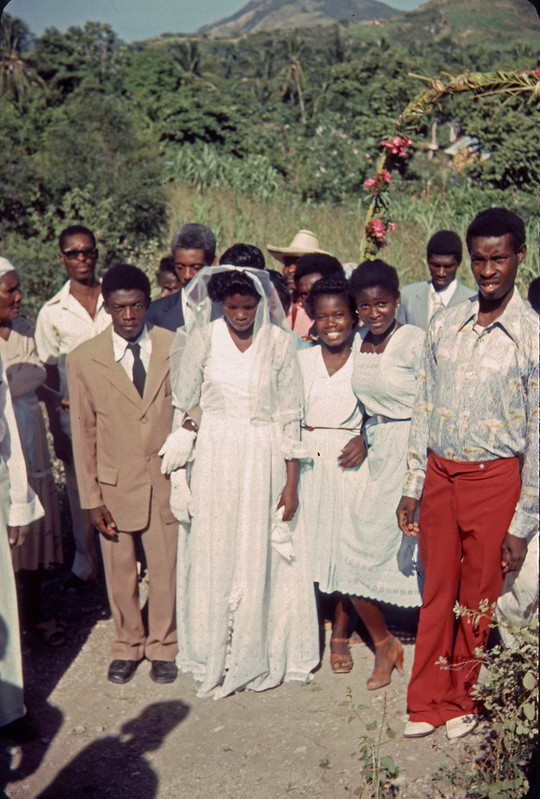
Wedding Haut St Marc Haiti Oct 1981
At the Wedding


It was about skin color. If someone had a child with a white person, there was a chance the baby would have lighter skin, and lighter-skinned people were felt to be at economic advantage even in this overwhelmingly black country run by black people.

As foreigners, we were used to being called blanc, which literally translates as white, although the term was used to refer to foreigners regardless of skin color. White was associated with foreignness and foreignness meant money and power, two things desperately lacking in that impoverished land. And while many saw hope in pale skin, I saw the beauty in their dark faces and the ugliness of the foreigners who often used their power and money to exploit the poor. It took a lot of moral character to not do that, especially when there were such easy opportunities for sex and abuse of power just because one had white skin.

This incident probably marked the beginning of my learning about the relationship between skin color and power; I realized that I had to be careful so as not to abuse that power. It isn't always easy and I don't always succeed.

Skin-color issues are not always simple to understand. Living in Thailand for the past while, I've been amazed at the number of skin products that have whitening properties. I'm challenged to find deodorant without bleaching agents. There are even whitening products to use in places where the sun doesn't shine! I hear girls bemoaning the fact that they are not beautiful because, among other things, their skin is too dark—even when it isn't as dark as my tanned skin. Teenage girls we know have shared a post on social media that says, "what guy would love a girl with small breasts and dark skin?" Their ideal of beauty comes from the very light-skinned models that they see pictured in magazines and on the internet. And these models are usually Asian, not European.

In Thailand the idea seems to be that since you get dark skin by working under the hot sun, if you have light skin, people are less likely to see you as an uneducated, unrefined hick. The term, "from the country," is not a compliment. And it is not just color that matters. Beauty and handsomeness are seen as signs of good karma, and whiter skin is part of that. The better-looking you are, the better your chance of getting a good job. I once saw a job posting on a bulletin board in the shopping mall for a "young attractive female." I expected it to be about selling beauty products, but it wasn't. It was an ordinary job staffing a sales booth and they were looking for eye candy. At least they were open about it.

We humans get so hung up on outward appearances. It is sad to me that the young people in Thailand find it necessary to try to have paler skin in order to have better job opportunities or to get a boyfriend or girlfriend. Why should that matter? Why should pale skin be a ticket up or a pass to get into the right crowd? Why can't people be fully accepted and integrated into society as they are with whatever skin color God gave them?

For me, one of the challenges of working in Thailand is understanding the complicated relationships between status (and all the things that go with that) and color and power. Unfortunately, skin color is one of those things that fits into the status equation. In my western egalitarian mindset, I don't want people to agree with me or defer to me just because I am higher status. It can be hard to get an honest opinion sometimes because people may outwardly agree with me just because I appear to have higher status. And I have to be extra careful that I not use my inferred power (white skin) to try to take advantage of people. (There is also discrimination against us due to skin color, but that is another story.)

This past year, we have been back in the USA, stuck here because of COVID-19. This has given me opportunity to be in America when issues related to skin-color are in the news and the topic of many conversations. I find I still have a lot of learning to do. Over the years, I've had black co-workers, supervisors and friends but I had not really thought much about the extra challenges they face due to their skin color. It shouldn't matter, but it does, and that bugs me.

I think it is especially troubling when there is racism and classism in the church. One of the characteristics of the New Covenant ushered in by Jesus is that there is no longer room for an "us and them" mentality. Prior to that it was acceptable for Jews to keep separate from non-Jews. But now those barriers are removed. Paul writes in Colossians 3:11 (MSG)

Words like Jewish and non-Jewish, religious and irreligious, insider and outsider, uncivilized and uncouth, slave and free, mean nothing. From now on everyone is defined by Christ, everyone is included in Christ.

In Christ we are all baptized into one body:

For we were all baptized by one Spirit into one body—whether Jews or Greeks, slave or free—and we were all given the one Spirit to drink. (1 Corinthians 12:13 - NIV)

There is no place in the church for division based on outward appearances. There is only one Holy Spirit, how can we then try to exclude or treat differently those who who share in the same Spirit?

A big challenge is that often disparate treatment of others happens unintentionally. We may not be aware of how our words or actions affect others. I've learned from experience that the way I perceive things may not be the way they are perceived by others. So, how can we know? I figure the best way is to ask—to invite people of color into conversation about these issues without getting defensive if the conversation becomes uncomfortable.

I like the words Jesus gave to His disciples:

Your love for one another will prove to the world that you are my disciples. (John 13:35 - NLT2)

When I read this, I like to picture a gathering of people from many different language and ethnic groups where each person's unique culture would lend to the character of the group. This miraculous display genuine love by the power of the Holy Spirit would become the distinctive of the church in the eyes of the world. How beautiful that would be. Wouldn't it be wonderful if we heard things like, "They must be Christians, look at how they get along with each other and treat one another even if they are so different and have so little in common."

Are we there yet?

Wednesday, July 8, 2020

Strange Fear

It's been my practice to read though the Bible on a regular basis. Each time I do this, I choose a different Bible translation to use. This time around, I've been reading The Complete Jewish Bible.

One of the things that's nice about reading in different translations is that variations in renderings will cause different things to stand out. Recently, I was reading Hebrews 13:2 where it reads, "don't forget to be friendly to outsiders." Most other translations use the term "show hospitality," and that was the way I had remembered this verse. This caused me to do a little research on the term "be friendly" or "show hospitality."

The term "show hospitality" comes from one Greek word: philoxenia (φιλοξενία) which is a noun meaning hospitality or love for/to strangers. This term is used in the the following verses:

Romans 12:13 (ESV)
Contribute to the needs of the saints and seek to show hospitality.

Hebrews 13:2 (ESV)
Do not neglect to show hospitality to strangers, for thereby some have entertained angels unawares.

There is a similar adjective also used in the Bible: philoxenos (φιλόξενος) meaning hospitable or given to hospitality. This term is used in the following verses:

1 Timothy 3:2 (ESV)
Therefore an overseer must be above reproach, the husband of one wife, sober-minded, self-controlled, respectable, hospitable, able to teach,

Titus 1:8 (ESV)
(of elders) but hospitable, a lover of good, self-controlled, upright, holy, and disciplined.

1 Peter 4:9 (ESV)
Show hospitality to one another without grumbling.


Both of these terms come from two other Greek words:

philos (φίλος) and adjective meaning: loved, dear, befriended, friendly, kind; you might recognize the Greek stem in the name of the city Philadelphia, the city of brotherly love.

xenos (ξένος) an adjective meaning: strange, foreign


To summarize, there are five verses in the New Testament that suggest that we should be friendly, kind or loving towards those who are strange or foreign to us.

When I saw these Greek terms, I was reminded of another Greek word that has made its way into the English language but was little used until our current president came to power: xenophobia. Xenophobia combines the Greek term xenos (strange or foreign) with phobia or fear.

White Temple-วัดร่องขุ่น
Statue that tries to elicit fear, in this case fear of suffering in hell


Xenophobia is kind of like the opposite of philoxenos or philoxenia, it is the fear of things strange or foreign. It seems almost normal for politicians to say things to make us afraid of uncertainty or the unknown—with the premise being that they are the ones best suited to deal with these things. In the past few years some have emphasized being afraid of people who aren't like us white folk: Mexicans, black people, Asians, you name it. Others make it seem like people with white skin are the ones to be feared.

I have written elsewhere of how racism is often a symptom of underlying fear. We can be afraid of people for lots of reasons. Maybe we've heard stories about how differently-colored people are violent, and without questioning the veracity or context of the stories, we are afraid. Maybe we're afraid that we might lose our jobs to people of a different race. Maybe we're afraid that if we try to make friends with other-colored people, we might have to confront the truth about ourselves, our biases and our sinful attitudes, including why there was never a reason to be afraid of them in the first place. In other words, we're afraid we might be wrong about them. The list could go on.

As the verses above show, xenophobia has no place in the church. Xenophobia is not a fitting character quality for Christian leaders. We are to welcome the strangers, not be afraid them. I admit I have an advantage here because I'm the kind of person who is drawn to people and things exotic and foreign. That's one of the reasons I've been able to live much of my adult life in other countries among people of different colors and languages. Even my wife was a bi-cultural and bi-lingual citizen of a foreign country when I met her and her foreignness was part of why I found her appealing.

Saturday Market in Phon Phisai-Water Buffalo Hide
Could I overcome my fear of strange food to eat this?


Even so, I am not immune to xenophobia and I have to be careful not to let it creep into my life. When I am bombarded with messages that try to make me afraid of a certain class of people, I have to make sure I am not sucked into that way of thinking.

I also have to watch out that freak experiences don't affect me in a negative way. One time someone tried to rob me at knife-point. It happened to be a black person but it just as well could have been a white person, I just happened to be in a predominantly black neighborhood at the time. I remember feeling afraid of black people for a several weeks after that—even while feeling guilty about feeling that way at the same time. It made no sense for me to have this fear, because I had already spent eight years living in a country that was 98% black and never had any problems. I had worked for two years in Alabama with a black supervisor who was as competent and professional as any white person I have ever known. Yet Satan was determined that I let one little incident try to twist my thinking.

Xenophobia is not from God. In fact, God sent his Son to a foreign place (from heaven to earth) where he showed love even to those determined to kill Him. Jesus was the ultimate example on how to live a life characterized by philoxenos, and we should follow his example.

Friday, July 3, 2020

Cousins

Genealogy is a popular thing these days. There is something exciting about doing some detective work to research who your ancestors are. And now, affordable DNA tests can shed a little more light on your genealogical research.

When you've done your research, you can boast about your pedigree with phrases like, "Queen Elizabeth is my nth cousin x times removed."

The thing is, by using that formula, you can demonstrate that just about everyone who has ever lived who is not in your direct lineage (ancestor, descendant, sibling, aunt, uncle, niece, or nephew) is your cousin. You may just have to use some large numbers for n and x. You just have to go far enough back down you family line—maybe as far as Noah, or Adam, or, if you don't like the Biblical accounts, whoever is our first Homo sapiens ancestor couple.

Everybody is your relative. It doesn't matter if they share the same skin color or language or ethnicity. We're all related to each other. We're all family.

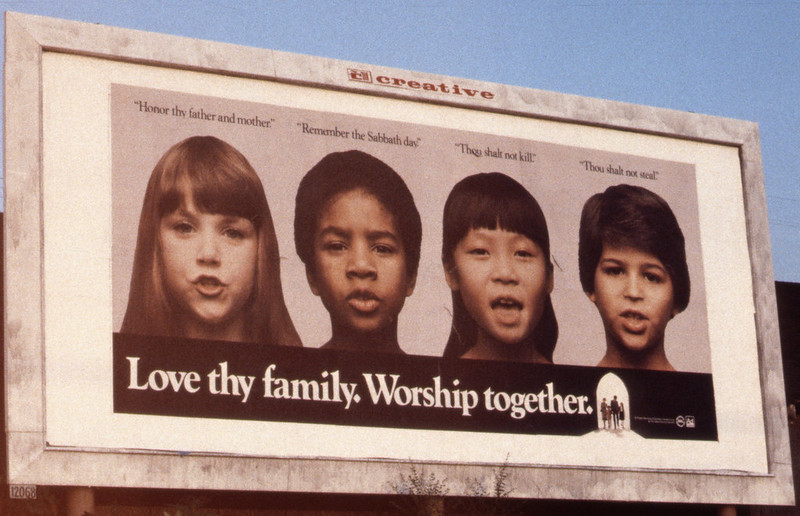
I was recently going through some old photographic slides and I found this photo I took of a billboard back in the early 1980's when I was living in Alabama:


One Family - billboard in Alabama Sept 1983


I don't want to get too nit-picky about the commandments that were chosen for this billboard or the choice of commandments chosen to place over each person other than to say with a caption that talks about worship, I find it strange that the first commandment is not listed.

What struck me was that at the time, and particularly in the South, the idea of worshiping together with people of different ethnicity was almost unheard of. Even in recent days I have often heard the quote, "Sunday mornings are the most segregated time in America."

What I like about the billboard is the first part of the caption: Love thy family.
My family. My brothers and sisters and cousins of every shade of color and who speak one or more of 6500 different languages scattered all across the globe.

In these days in the aftermath of the George Floyd killing, we are hearing many stories about how people of color are looked upon differently and treated differently, and not in a good sense. It breaks my heart to hear about such things happening in my family. Because ultimately, George Floyd is a distant cousin of mine. And what's sad is that Derek Chauvin, the guy who knelt on his neck—well that's also another distant cousin. I suppose such violence between cousins should not be surprising when even siblings can sometimes get so upset about trivial things that they don't speak to each other.

For the past several years I have had the privilege of working with distant cousins in another country whose language and culture differ drastically from mine and whose skin color is a shade or two darker. I've learned how easy it is to offend, or be offended by, people I love due to misunderstandings in language and culture. And when these offenses have happened, we've had a choice to make. We could hang onto the offenses and let them simmer until we do something stupid and/or violent. Or we could take a different path involving humility, grace, forgiveness and reconciliation. The latter choice is not always easy, in fact, it can be very difficult. It's often easier to hang onto an offense than to humbly ask forgiveness for where we screwed up. And sometimes I would rather nurture a grudge than forgive someone who has offended me.

I'm grateful, though, that God doesn't struggle so much with these issues. Through the blood of Jesus, He forgives all of our sins—not holding onto grudges. How many times have I had to go to God, for the umpteenth time, for some silly sin I repeated again (redundancy intended). I'm glad God doesn't have a three strikes law, because there would be no hope for me. Jesus, when asked if we needed to forgive people for an offense as many as seven times, said that we needed to forgive 70 times 7 times; but the implication was that we need to be ready to forgive even more than 490 times. (Matthew 18:21, 22)

This same Jesus said that when we pray to God we should say something like: "And forgive us our sins, For we also forgive everyone who is indebted to us." (Luke 11:4 NKJV) In that prayer, we are asking God to forgive use based on how much we have forgiven others. If that is the case, do I want to be stingy with forgiveness?

There is a lot of talk these days about justice. Justice is a good thing, it means everyone gets what they deserve, no more and no less, and all are treated the same. The Bible talks a lot about justice—about not showing favoritism to different classes of people. The prophetical books in particular point out the injustice that was prevalent at the time: the rich and powerful used their money and power to the disadvantage of the poor and the weak. Does that sound familiar? In our day and age people are still treated less favorably because of the color of their skin, or their accent, or the shape of their eyes, or because of their age, or something else. But these people who look, talk and act different than us are still our cousins. Why should they be treated differently?

And while I like the concept of justice, there is another concept in the Bible I like more, and that is mercy. You see with justice, I get what I deserve. And because I'm a sinner, I deserve death. In Romans 6:23 we read For the wages of sin is death. But that same verse also points out the mercy option available in Jesus: but the free gift of God is eternal life in Christ Jesus our Lord.(Emphasis mine)

If we're really honest with ourselves, we'll admit that we don't want what we deserve, we want better than we deserve. We want mercy.

One time, King David screwed up really bad. He raped a women and had her husband murdered. If there was ever a case for the death penalty, this would probably qualify, and he knows it. David didn't appeal to justice, he appealed to mercy:

1 Have mercy on me, O God,
    according to your unfailing love;
according to your great compassion
    blot out my transgressions.
2 Wash away all my iniquity
    and cleanse me from my sin.
3 For I know my transgressions,
    and my sin is always before me.

Psalm 51:1-3 (NIV)

James makes a challenging statement about justice and mercy:

12  Speak and act as those who are going to be judged by the law that gives freedom, 13  because judgment without mercy will be shown to anyone who has not been merciful. Mercy triumphs over judgment! (James 2:12-13 NIV)

Mercy can be sorely lacking. We can be quite hypocritical about justice and mercy. When we are offended or when we stand to gain, we will cry for justice. We shout, "I want what's mine!" or "I want what's coming to me!," but deep down we have to admit we want more than we deserve. However, when the tables are turned, and we are the ones who owe, we appeal to mercy. We want others to pay up, but we don't want to have to pay up ourselves.

So if I am offended or hurt by one of my cousins, regardless of the color of their skin or their appearance or the language they speak, I need to think carefully about how I will respond. And if somebody does something wrong or commits a crime we need to consider our response.The offense may even be so grave that the person deserves to die, according to the law. But that doesn't mean they should be put to death or punished to the max. Instead, we can chose to respond with mercy the same way God shows us mercy.

Especially since they are family.

Sunday, September 3, 2017

Judging from the outside

Culture Shock!

The worst culture shock I have experienced was not the first time that I lived overseas, but a bit later when I moved to the south (US).  I thought was moving to the same country I was raised in—did I had a lot to learn!

One thing I had to learn was a new vocabulary.  Some people talked about the "War of Northern Aggression," which I discovered was what we learned of as "The Civil War".  Different perspectives give rise to different names.

Another thing I had to learn about was the significance of the Mason-Dixon Line.

They had a joke that I heard A LOT that goes like this:
Q: What's the difference between a Yankee and a Damn Yankee?
A. The Yankee goes home.

The thing is, to some people it wasn't a joke—and I could tell.

I had moved to the south for work and over 3-1/2 years I lived in two different towns with two very different cultures.

When I arrived in the south, I was determined to hang onto my northern culture and not adapt a southern accent, but that was something I found impossible to do.  Still, I was not raised in the south and I had some behaviors that locals probably found a bit perplexing—things like riding a bicycle for fun.

The second town we lived in was quite small.  The population of the entire county was the same as my hometown—and my hometown was not very big.  Deer outnumbered people by a very large margin.

It was hard to fit in this town not only because I was a Yankee (from the north), but purely because I was an outsider.

In this town, my supervisor, who was very good at his job, happened to be black.  I was hoping that we might engage in some after-hours socializing, but that kind of thing was taboo there.  I didn't like how the blacks and whites were separated, and it made me angry.  My parents tried to teach me to think different than that.

We had a hard time finding a church to join. No one from the white churches would invite us to church because we were outsiders.  Some of the black Christians I met would invite us to their churches, but I wasn't sure how long I could last in town if we started doing that.

Eventually, for better or worse, we ended up going to one of the white churches.  There was one fellow in the church who was often ranting against blacks, Jews and communists.  I thought it was hatred, but I learned later that this was wrong.

My wife and I would often walk to church.  Rather than take the main highway (which was not all that busy), we would take a side road that ran parallel to it.  I'll call it High Street (not its real name).  Just after we got on High Street, there were a couple of very small houses we would pass where black people lived.  There were often people sitting or playing on the front porch so we would wave and say high.  These were usually the only people we would greet along the way.  The rest lived in houses set back from the road.  These other houses usually had A/C so the people stayed inside.

At the church we attended, I ended up helping out with the high school boys group.  One time, one of the boys said to me, "You walk down High Street.  I'd be afraid to walk down High Street."

I don't remember what I said.  I don't remember if I said anything at the time because I was so stunned.

You see, this boy was taught to be afraid of black people—these very black people who would smile and wave to us when we greeted them.  He probably learned this fear from his father.  His father was the one I referred to earlier who had nothing good to say about blacks, communists and Jews.  I wondered, then, how many people, both black and white were being taught to be afraid of people who weren't like them.

Right away, the realization came to me, "If I grew up here, I'd think just like these young people.  I would have been taught from childhood to be afraid of black people."

I wasn't at all trying to justify their thinking or say that it was right.  I was recognizing that I had the privilege of being raised differently.

It would be so easy for me to judge this young man for how he felt about Jews and people of color.  But how is he to learn to think any differently if he doesn't have any teachers?

It is so easy to judge others from the outside.

People have sometimes asked me in the past about how I feel about certain jury verdicts.  I usually won't pass judgement on jury verdicts because I was not given the same information they were with the same conditions they were given.  I may have feelings about the issue at hand, but that is different than how I feel about how the jury came to their conclusion.

(Though I am a kind of person who usually sees both sides of an issue, and I often find myself agreeing with both sides.)

About a year ago we visited the Lao National Museum in Vientiane.  The first part of the museum deals with the culture and history of Laos before the 1950's.  The second half of the museum deals with the victory of the communists over the Americans and subsequent recent history of the country.  It was interesting to note this different perspective.  To the Lao-communist, the "secret war", as it is sometimes called, was about the Lao people vs. the American Imperialists.  To the Lao-royalist, it was about the Lao people vs. the Vietnamese communists.  What a difference perspective makes.  (It felt kind of weird, as an American, walking through there reading all that stuff about how awful the Americans were.)

These days, there has been a lot of discussion on the news and in the media about monuments to confederate "heroes" and whether they should be taken down or left to remain.  Some who argue against removing the statues lament, "where do you stop?"

It's easy for me, from my current perspective, to pass judgment on people who have gone before me.  But I was not in their shoes,  I did not share all the same culture and history and social context that they did.  It doesn't make the things they did right, but it also doesn't mean they were "evil".  Many things we see as evil might have been purely normal to the person who did them--which can be kind of scary to think about.  I find myself thinking, "If I were a person alive at that time, would I have to courage to go against the grain and make a stand for what it right?"  I have great respect for those who do take a stand for what is right.

But I also see this:

If we only look at the wrong things people do, and not the good things they do, then we would honor NO ONE from history, except Jesus, who "knew no sin". (2 Corinthians 5:21)

We all have baggage--none of us is free from sin. (Romans 3:21)

One day, some scribes and Pharisees brought a woman to Jesus who had been caught in the act of adultery (I always find it interesting that she was caught in the act, but they did not bring the man forward as well.). These leaders said to Jesus, "Teacher, this woman was caught in the act of adultery. The law of Moses says to stone her.  What do you say?" (John 8:4, 5 NLT)


Stone


Jesus doesn't argue with the leaders.  They did have the right, or perhaps even an obligation, to stone this woman according to the Mosaic law.  But just because you have the right to do something doesn't make it right to do it.

Without justifying the woman's sin (He tells her to "sin no more" in v. 11), Jesus, after writing something in the sand, puts a different spin on the issue.  "Alright", He says, "but let the one who has never sinned throw the first stone." (John 8:7 NLT)

Jesus is calling the religious leaders to exercise some humility—to examine themselves first.

When I first moved to the south, I was proud because I "wasn't like them".  But God taught me that I was "like them", it just looked different because of my background circumstances.  Before I pass judgment on others, I need to pass judgment on myself.

So what can I do if I see some fear-based behavior that seems really unacceptable?

One thing I can do is to model not being afraid.  When I think back to that day when I realized this young man was afraid of black people, I wondered at the time how one can change that. How do you help people unlearn what has been so ingrained in them?  How do you teach them?  A good way to teach is by demonstration.

I remember one time I was having a problem dealing with being afraid of something.  I sat and watched people do over and over again what I was afraid to do.  Eventually, I was able to overcome that fear.  But it took some time and patience.

Another good way to overcome fear is to actually talk with those we're afraid of,  instead of screaming or yelling at each other (though it isn't always easy). We might find out they're not all that different from us.  This may take the help of a third party since, if we are afraid of someone, it will be really hard to approach them in the first place.

I like how John injects the subject of fear into his words about loving one another:

7 Beloved, let us love one another, for love is from God, and whoever loves has been born of God and knows God. 8 Anyone who does not love does not know God, because God is love. 9 In this the love of God was made manifest among us, that God sent his only Son into the world, so that we might live through him. 10 In this is love, not that we have loved God but that he loved us and sent his Son to be the propitiation for our sins. 11 Beloved, if God so loved us, we also ought to love one another. 12 No one has ever seen God; if we love one another, God abides in us and his love is perfected in us.

13 By this we know that we abide in him and he in us, because he has given us of his Spirit. 14 And we have seen and testify that the Father has sent his Son to be the Savior of the world. 15 Whoever confesses that Jesus is the Son of God, God abides in him, and he in God. 16 So we have come to know and to believe the love that God has for us. God is love, and whoever abides in love abides in God, and God abides in him. 17 By this is love perfected with us, so that we may have confidence for the day of judgment, because as he is so also are we in this world. 18 There is no fear in love, but perfect love casts out fear. For fear has to do with punishment, and whoever fears has not been perfected in love. 19 We love because he first loved us. 20 If anyone says, “I love God,” and hates his brother, he is a liar; for he who does not love his brother whom he has seen cannot love God whom he has not seen. 21 And this commandment we have from him: whoever loves God must also love his brother.  1 John 4:7-21 (ESV)

This scripture reminds me of the key ingredient in dealing with these judgment issues—love that comes from the presence of Jesus in our lives.  Jesus freely gives His Spirit to those who believe in Him.  By the power of His Spirit we can learn to love our enemies instead of passing judgment on them.  But if we do not allow the love of Jesus to flow through us it will never happen.  We have to put to death our old nature so that God's nature can be seen in us.

13  For if you live according to the sinful nature, you will die; but if by the Spirit you put to death the misdeeds of the body, you will live, 14  because those who are led by the Spirit of God are sons of God. 15  For you did not receive a spirit that makes you a slave again to fear, but you received the Spirit of sonship. And by him we cry, "Abba, Father."  Romans 8:13-15 (NIV)

There's that word again: fear.

By the Spirit we can be set free from this fear.

It's risky to love our enemies.

We can be misunderstood.
We can suffer harm.

But isn't that what happened to Jesus?

By His great love, Jesus refused to rain down judgment on his enemies, which was in his power to do,  but instead submitted to the cross.

That's hard.
That's painful.
That goes against my common sense.

The way of the cross is hard, and sometimes I don't feel like walking that way.  Sometimes it's easier insist that my way is right and not look at or truly listen to those who disagree with me.  Perhaps I'm afraid that they'll get mad at me if I approach them.  Maybe I don't want to like this person, and I'm afraid that if I get to know this person I might do just that.  Maybe I'm afraid I'll find out I'm wrong and have to change.

There's that fear word again.

Perfect love casts out fear.
We did not receive a spirit that makes us a slave again to fear.

I shouldn't judge people from the outside,
    I should love them from the inside.