Sunset Over the Mekong River

Showing posts with label color. Show all posts

Monday, December 28, 2020

Beautiful Colors

Are you going to leave anything behind for us to remember you by? Here, you can use our daughter.

My Haitian co-worker and I were visiting a family in a village in the hills above Saint Marc when the mother made this comment. It was an awkward enough question to begin with and it was made even more so by the fact that this daughter that the mother was referring to was engaged to be married and we had already been invited to the wedding. Clearly we needed to do some teaching. But the question remained, why would the mother want me to have a baby with her soon-to-be-married daughter? This wasn't like the girls who where eyeing me—an eligible bachelor at the time—as a way to get out of poverty. The mother knew I would be leaving the country in a couple months, which was why this topic even came up.
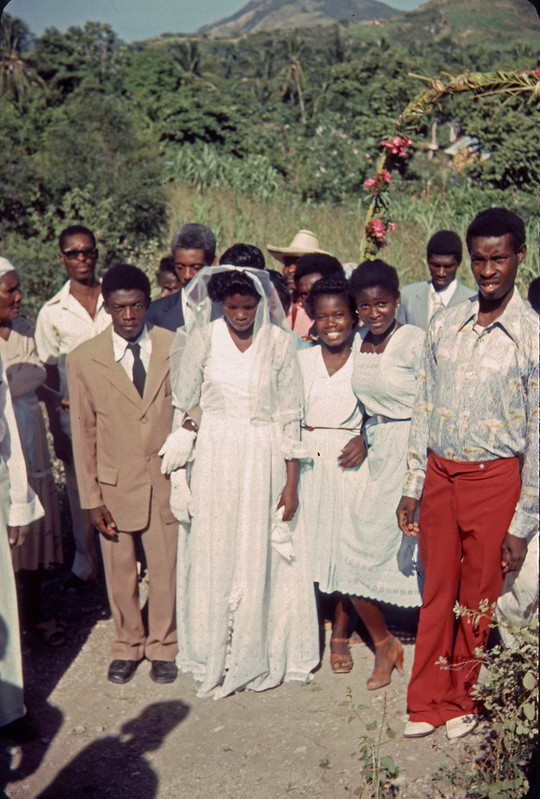
Wedding Haut St Marc Haiti Oct 1981
At the Wedding


It was about skin color. If someone had a child with a white person, there was a chance the baby would have lighter skin, and lighter-skinned people were felt to be at economic advantage even in this overwhelmingly black country run by black people.

As foreigners, we were used to being called blanc, which literally translates as white, although the term was used to refer to foreigners regardless of skin color. White was associated with foreignness and foreignness meant money and power, two things desperately lacking in that impoverished land. And while many saw hope in pale skin, I saw the beauty in their dark faces and the ugliness of the foreigners who often used their power and money to exploit the poor. It took a lot of moral character to not do that, especially when there were such easy opportunities for sex and abuse of power just because one had white skin.

This incident probably marked the beginning of my learning about the relationship between skin color and power; I realized that I had to be careful so as not to abuse that power. It isn't always easy and I don't always succeed.

Skin-color issues are not always simple to understand. Living in Thailand for the past while, I've been amazed at the number of skin products that have whitening properties. I'm challenged to find deodorant without bleaching agents. There are even whitening products to use in places where the sun doesn't shine! I hear girls bemoaning the fact that they are not beautiful because, among other things, their skin is too dark—even when it isn't as dark as my tanned skin. Teenage girls we know have shared a post on social media that says, "what guy would love a girl with small breasts and dark skin?" Their ideal of beauty comes from the very light-skinned models that they see pictured in magazines and on the internet. And these models are usually Asian, not European.

In Thailand the idea seems to be that since you get dark skin by working under the hot sun, if you have light skin, people are less likely to see you as an uneducated, unrefined hick. The term, "from the country," is not a compliment. And it is not just color that matters. Beauty and handsomeness are seen as signs of good karma, and whiter skin is part of that. The better-looking you are, the better your chance of getting a good job. I once saw a job posting on a bulletin board in the shopping mall for a "young attractive female." I expected it to be about selling beauty products, but it wasn't. It was an ordinary job staffing a sales booth and they were looking for eye candy. At least they were open about it.

We humans get so hung up on outward appearances. It is sad to me that the young people in Thailand find it necessary to try to have paler skin in order to have better job opportunities or to get a boyfriend or girlfriend. Why should that matter? Why should pale skin be a ticket up or a pass to get into the right crowd? Why can't people be fully accepted and integrated into society as they are with whatever skin color God gave them?

For me, one of the challenges of working in Thailand is understanding the complicated relationships between status (and all the things that go with that) and color and power. Unfortunately, skin color is one of those things that fits into the status equation. In my western egalitarian mindset, I don't want people to agree with me or defer to me just because I am higher status. It can be hard to get an honest opinion sometimes because people may outwardly agree with me just because I appear to have higher status. And I have to be extra careful that I not use my inferred power (white skin) to try to take advantage of people. (There is also discrimination against us due to skin color, but that is another story.)

This past year, we have been back in the USA, stuck here because of COVID-19. This has given me opportunity to be in America when issues related to skin-color are in the news and the topic of many conversations. I find I still have a lot of learning to do. Over the years, I've had black co-workers, supervisors and friends but I had not really thought much about the extra challenges they face due to their skin color. It shouldn't matter, but it does, and that bugs me.

I think it is especially troubling when there is racism and classism in the church. One of the characteristics of the New Covenant ushered in by Jesus is that there is no longer room for an "us and them" mentality. Prior to that it was acceptable for Jews to keep separate from non-Jews. But now those barriers are removed. Paul writes in Colossians 3:11 (MSG)

Words like Jewish and non-Jewish, religious and irreligious, insider and outsider, uncivilized and uncouth, slave and free, mean nothing. From now on everyone is defined by Christ, everyone is included in Christ.

In Christ we are all baptized into one body:

For we were all baptized by one Spirit into one body—whether Jews or Greeks, slave or free—and we were all given the one Spirit to drink. (1 Corinthians 12:13 - NIV)

There is no place in the church for division based on outward appearances. There is only one Holy Spirit, how can we then try to exclude or treat differently those who who share in the same Spirit?

A big challenge is that often disparate treatment of others happens unintentionally. We may not be aware of how our words or actions affect others. I've learned from experience that the way I perceive things may not be the way they are perceived by others. So, how can we know? I figure the best way is to ask—to invite people of color into conversation about these issues without getting defensive if the conversation becomes uncomfortable.

I like the words Jesus gave to His disciples:

Your love for one another will prove to the world that you are my disciples. (John 13:35 - NLT2)

When I read this, I like to picture a gathering of people from many different language and ethnic groups where each person's unique culture would lend to the character of the group. This miraculous display genuine love by the power of the Holy Spirit would become the distinctive of the church in the eyes of the world. How beautiful that would be. Wouldn't it be wonderful if we heard things like, "They must be Christians, look at how they get along with each other and treat one another even if they are so different and have so little in common."

Are we there yet?

Friday, July 3, 2020

Cousins

Genealogy is a popular thing these days. There is something exciting about doing some detective work to research who your ancestors are. And now, affordable DNA tests can shed a little more light on your genealogical research.

When you've done your research, you can boast about your pedigree with phrases like, "Queen Elizabeth is my nth cousin x times removed."

The thing is, by using that formula, you can demonstrate that just about everyone who has ever lived who is not in your direct lineage (ancestor, descendant, sibling, aunt, uncle, niece, or nephew) is your cousin. You may just have to use some large numbers for n and x. You just have to go far enough back down you family line—maybe as far as Noah, or Adam, or, if you don't like the Biblical accounts, whoever is our first Homo sapiens ancestor couple.

Everybody is your relative. It doesn't matter if they share the same skin color or language or ethnicity. We're all related to each other. We're all family.

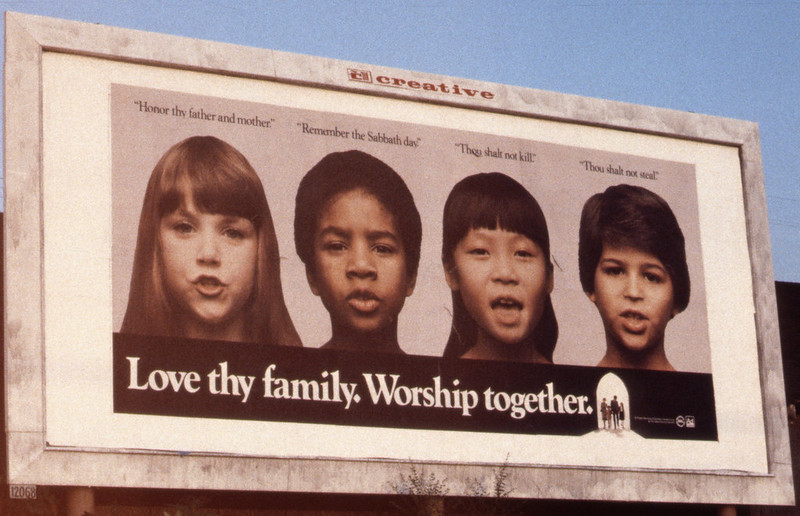
I was recently going through some old photographic slides and I found this photo I took of a billboard back in the early 1980's when I was living in Alabama:


One Family - billboard in Alabama Sept 1983


I don't want to get too nit-picky about the commandments that were chosen for this billboard or the choice of commandments chosen to place over each person other than to say with a caption that talks about worship, I find it strange that the first commandment is not listed.

What struck me was that at the time, and particularly in the South, the idea of worshiping together with people of different ethnicity was almost unheard of. Even in recent days I have often heard the quote, "Sunday mornings are the most segregated time in America."

What I like about the billboard is the first part of the caption: Love thy family.
My family. My brothers and sisters and cousins of every shade of color and who speak one or more of 6500 different languages scattered all across the globe.

In these days in the aftermath of the George Floyd killing, we are hearing many stories about how people of color are looked upon differently and treated differently, and not in a good sense. It breaks my heart to hear about such things happening in my family. Because ultimately, George Floyd is a distant cousin of mine. And what's sad is that Derek Chauvin, the guy who knelt on his neck—well that's also another distant cousin. I suppose such violence between cousins should not be surprising when even siblings can sometimes get so upset about trivial things that they don't speak to each other.

For the past several years I have had the privilege of working with distant cousins in another country whose language and culture differ drastically from mine and whose skin color is a shade or two darker. I've learned how easy it is to offend, or be offended by, people I love due to misunderstandings in language and culture. And when these offenses have happened, we've had a choice to make. We could hang onto the offenses and let them simmer until we do something stupid and/or violent. Or we could take a different path involving humility, grace, forgiveness and reconciliation. The latter choice is not always easy, in fact, it can be very difficult. It's often easier to hang onto an offense than to humbly ask forgiveness for where we screwed up. And sometimes I would rather nurture a grudge than forgive someone who has offended me.

I'm grateful, though, that God doesn't struggle so much with these issues. Through the blood of Jesus, He forgives all of our sins—not holding onto grudges. How many times have I had to go to God, for the umpteenth time, for some silly sin I repeated again (redundancy intended). I'm glad God doesn't have a three strikes law, because there would be no hope for me. Jesus, when asked if we needed to forgive people for an offense as many as seven times, said that we needed to forgive 70 times 7 times; but the implication was that we need to be ready to forgive even more than 490 times. (Matthew 18:21, 22)

This same Jesus said that when we pray to God we should say something like: "And forgive us our sins, For we also forgive everyone who is indebted to us." (Luke 11:4 NKJV) In that prayer, we are asking God to forgive use based on how much we have forgiven others. If that is the case, do I want to be stingy with forgiveness?

There is a lot of talk these days about justice. Justice is a good thing, it means everyone gets what they deserve, no more and no less, and all are treated the same. The Bible talks a lot about justice—about not showing favoritism to different classes of people. The prophetical books in particular point out the injustice that was prevalent at the time: the rich and powerful used their money and power to the disadvantage of the poor and the weak. Does that sound familiar? In our day and age people are still treated less favorably because of the color of their skin, or their accent, or the shape of their eyes, or because of their age, or something else. But these people who look, talk and act different than us are still our cousins. Why should they be treated differently?

And while I like the concept of justice, there is another concept in the Bible I like more, and that is mercy. You see with justice, I get what I deserve. And because I'm a sinner, I deserve death. In Romans 6:23 we read For the wages of sin is death. But that same verse also points out the mercy option available in Jesus: but the free gift of God is eternal life in Christ Jesus our Lord.(Emphasis mine)

If we're really honest with ourselves, we'll admit that we don't want what we deserve, we want better than we deserve. We want mercy.

One time, King David screwed up really bad. He raped a women and had her husband murdered. If there was ever a case for the death penalty, this would probably qualify, and he knows it. David didn't appeal to justice, he appealed to mercy:

1 Have mercy on me, O God,
    according to your unfailing love;
according to your great compassion
    blot out my transgressions.
2 Wash away all my iniquity
    and cleanse me from my sin.
3 For I know my transgressions,
    and my sin is always before me.

Psalm 51:1-3 (NIV)

James makes a challenging statement about justice and mercy:

12  Speak and act as those who are going to be judged by the law that gives freedom, 13  because judgment without mercy will be shown to anyone who has not been merciful. Mercy triumphs over judgment! (James 2:12-13 NIV)

Mercy can be sorely lacking. We can be quite hypocritical about justice and mercy. When we are offended or when we stand to gain, we will cry for justice. We shout, "I want what's mine!" or "I want what's coming to me!," but deep down we have to admit we want more than we deserve. However, when the tables are turned, and we are the ones who owe, we appeal to mercy. We want others to pay up, but we don't want to have to pay up ourselves.

So if I am offended or hurt by one of my cousins, regardless of the color of their skin or their appearance or the language they speak, I need to think carefully about how I will respond. And if somebody does something wrong or commits a crime we need to consider our response.The offense may even be so grave that the person deserves to die, according to the law. But that doesn't mean they should be put to death or punished to the max. Instead, we can chose to respond with mercy the same way God shows us mercy.

Especially since they are family.

Sunday, November 24, 2013

Hidden Color

It’s not the same as where I grew up.

Nothing can quite compare with all of the amazing color displays we would see every fall in New England.

Fall colors in the back yard where I grew up

In California, many people plant exotic species to try to pick up some of that fall feel.

Pistacia chinensis Bunge Anacardiaceae-Chinese Pistache 7
The Chinese Pistache tree in our front yard in Fresno, California
But this whole fall color thing is really amazing.  If I recall some of my biology properly, the colors we see in the fall are present all year round, but are masked by the chlorophyll.  Then, before the tree starts shutting down for the winter, a lot of nutrients and stuff are shuttled out of the leaves and into the tree.

First the leaves change color.

Then the leaves fall off.

(Unlike my hair, most of which fell out before the rest started turning gray.)

As a result, we get to enjoy this awesome color display each year in climates that are conducive to it.

In Thailand, we don’t get in on this phenomena.  (But we also don’t get the cold weather, either, so I guess that’s a bit of a tradeoff for us.)

I don’t suppose God had to make things as pretty as this, but He did, and I’m glad for it.

I think people can often be like these trees.  Sometimes, when we first meet people, we don't see what they are really like.  We may never see it.  Often we are wearing masks, so people won't see the real us.  We may do this intentionally or unintentionally. Sometimes our low self-esteem makes us think people won't like us if they really knew us.  Or there might be some secret that we try to hide--some event from our past (or present) that if people knew about, would really change how they felt about us.   Sometimes, we may have some character flaws that we try to keep under control (which can be a good thing, if they are damaging traits).

Often, it is during times of stress, when our true colors come out.  Good character qualities may come out when we have to rise to an occasion. Our more negative traits may show when we lose control.

Why are we so afraid to be ourselves, to show our true colors?  Do we have a lot of skeletons in our closet?  It seems like wearing a mask is often the norm in society.

One of the more interesting compliments Jesus makes about someone is in John 1:47, when Jesus approaches Nathanael for the first time.

When Jesus saw Nathanael approaching, he said of him, "Here is a true Israelite, in whom there is nothing false." (NIV)
 

The New Living Translation puts it: he was a man of complete integrity.  This is the only one of his disciples about whom  Jesus makes this statement.  Was he the only one who wasn't afraid to be himself?  Was it because he was the only one of the twelve who had nothing to hide?

We don't get to see the pretty colors of the trees but once a year, and that just before they fall off.

 But we can be people of integrity all year round.  How good it would be if we didn't hide parts of ourselves because we had nothing to hide.

Paul writes of a day when this will happen.

Now we see but a poor reflection as in a mirror; then we shall see face to face. Now I know in part; then I shall know fully, even as I am fully known. 1 Corinthians 13:12 (NIV)

In heaven, there will be no more masks--no more hiding.  It will be like switching from the monotone green of summer to the brilliant blend of colors of fall.  And all of our beauty, which may have been hidden by our sin all of our lives, will shine for all to see.