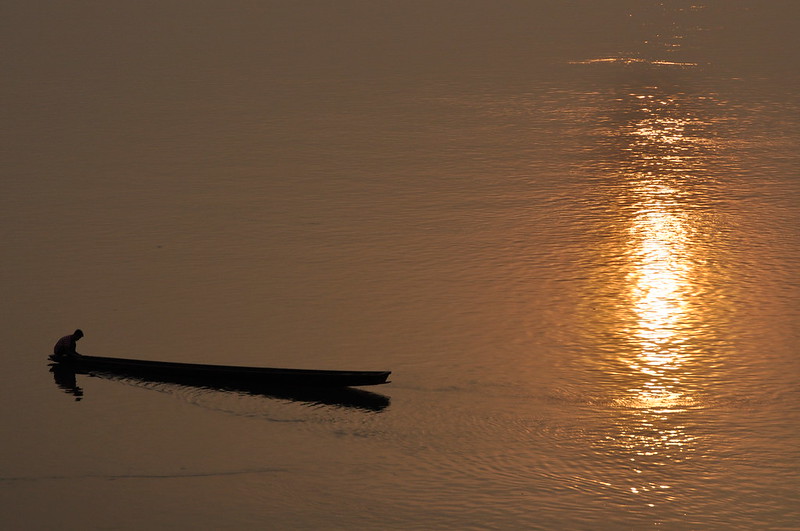
Sunset Over the Mekong River

Saturday, May 5, 2012

Life in the bubble

Casuarina equisetifolia Casuarinaceae 2

Recently we had the opportunity to visit the island of Phuket in southern Thailand for a retreat/conference with fellow MB Missionaries that are working here in Thailand.  As is my usual habit when I am traveling, I like to get up on the early side and enjoy the sights before the crowds of people arrive.  On one morning everything had a more sparkling look because of the drops left behind from the evening rains.  As I peered through a drop on the end of a branchlet/needle of a Casuarina tree I was able to see the path in front of me—but it was upside down.

Imagine if you had to live in the drop.  In one sense you would think you had a clear understanding of the world around you, everything would be sharp and in focus and there would be an order to everything that you could make sense of—except it was upside down!  We would not have a true perspective because we our perspective would be from the limited world of life within the bubble.

That is kind of like what life is like for us humans.  We see the world around us and there is an apparent order to everything and everything seems to make sense.  But we don’t see everything.  Our perspective is limited by our humanity.  God’s perspective is is much bigger than ours.  And our perspective is often upside-down.  Here are just a few examples from the words of Jesus about how God’s perspective is often opposite from our perspective:
  • For whoever wants to save his life will lose it, but whoever loses his life for me will find it. (Matthew 16:25-NIV)
  •  Sitting down, Jesus called the Twelve and said, "If anyone wants to be first, he must be the very last, and the servant of all."  (Mark 9:35-NIV)
  •  When Jesus heard this, he said to him, "You still lack one thing. Sell everything you have and give to the poor, and you will have treasure in heaven. Then come, follow me."  (Luke 18:22-NIV)
  • Blessed are you when people insult you, persecute you and falsely say all kinds of evil against you because of me. (Matthew 5:11-NIV)
One day some of the limitations of our perspective will be removed.  The Apostle Paul writes of that day: Now we see but a poor reflection as in a mirror; then we shall see face to face. Now I know in part; then I shall know fully, even as I am fully known. (1 Corinthians 13:12-NIV)  But even before that day comes, the Holt Spirit can help us to see things as God does.  Jesus said,  But the Counselor, the Holy Spirit, whom the Father will send in my name, will teach you all things and will remind you of everything I have said to you. (John 14:26-NIV)  The Holy Spirit enabled the disciples to remember Jesus’ word that they might record them for us who would follow after them.

God, I thank you that you have chosen to reveal yourself to us through the prophets, through the scriptures, through Jesus, and through the Holy Spirit.  I thank you that you did not want us to live our lives with the distorted view of life from the inside the bubble.  But I confess that there is a lot of pressure to conform and I often give in and choose to life my life as though there is no more to the universe than what can be seen with our eyes or comprehended by our brains.  By Your Holy Spirit help me to see things as you do and respond to things as you would.

Tuesday, April 10, 2012

How old are you?

Where are you going?  How old are you?

These were the first two phrases out of the mouth of an elderly gentleman as I walked along the rim of the Mekong River in Tha Bo in northeast Thailand.  While it is not unusual to hear these two questions early in a conversation, the second question did come a little more abruptly than usual.

Thabo 23
View from the rim of the Mekong in Tha Bo


While these seem like somewhat intrusive questions to those of us from North America, they are not all that unusual here in Thailand. “Where are you going?” is used similar to “How are you?” in our culture.  It is just a question to open a conversation if the hear is actually in the process of traveling somewhere.  Otherwise they may ask, “Have you eaten yet?”

The second question is related to the status system in Thailand.  There are a lot of unwritten rules here in Thailand with regard to how you communicate with and relate to people depending on their status relative yours.  Thai people who do not know each other will quickly try to figure out their relative status so that they know how to behave.  The age question is only used if it is not obviously clear who is the older one.  There may also be questions related to employment, salary, education, etc.

The status thing here in Thailand can be a bit disconcerting to those of us who come from a more egalitarian culture.  But when everyone follows the rules it does add a measure of civility to the culture.  And it is nice to be respected as an older person rather than disdained or deemed irrelevant as is so common in the west.  The saying back in the hippie era was something like, “never trust anyone over 30.”

What is hard for us foreigners is that we don’t know all the rules.  And it is not like you can buy a book that explains it all.  For example, it is standard when greeting someone for the person of lower status to initiate the greeting with a “way” (palms held together below the chin).  But sometimes I don’t know where I stand.  As an older, foreign male with a college education my status tends to be relatively high.  But in language school I have had a hard time trying to figure out what to do.  Typically the student is lower status than the teacher and so initiates the greeting. But what if the teacher is a female, half my age and does not have as much college education as I do?  Fortunately our school tends to not adhere to the rules to closely.
Too add a complication to all of this, things in Thailand appear to be changing rapidly.  Young people are dropping cultural traditions at a rather rapid rate, especially in large cities.  This makes things a lot easier for us foreigners.  When we move to a more remote part of Thailand or when we work in the rural areas we will have to be more careful.

Our desire in Thailand is not to impress people with western culture (many are already enamored with it) but to shine the light of Jesus into the culture.  This is not an easy task.  But we want to say, like the Apostle Paul said, “I have become all things to all men so that by all possible means I might save some.” 1 Corinthians 9:22 (NIV)

Tuesday, April 3, 2012

Lambak (ลำบาก)

 
For the gate is narrow and the way is hard that leads to life, and those who find it are few. Matthew 7:14 (ESV)
 
เพราะประตูที่แคบและทางที่ลำบากนั้นนำไปสู่ชีวิต และพวกที่หาพบก็มีน้อย (มัทธิว 7:14)
 
One of the nice things about learning a new language is that as you read the Bible in that language you find they will use words the bring up different connotations in your head.

Matthew 7:14 is one of those verses that I got a whole new picture of as I read it in Thai.  The word translated hard in English is translated lambak in Thai.  When I use the word lambak, the picture I often get in my brain is that of the walking portion of my commute to school.

Walking in Bangkok can be a bit dangerous/hazardous.  One book I read written for foreigners moving to Thailand recommended that foreigners not even attempt to get around Bangkok by walking. And if there are any hazards in walking in Bangkok I encounter them on my walk down Rang Nam Avenue each day:
  • missing paving stones
  • tilted paving stones (trip hazards)
  • trees/poles/steel cables sticking out of the side walk
  • manure  of various kinds
  • motorcycles/cars driving/parked on the sidewalks
  • restaurants on the sidewalks, narrowing the walkway to one person wide that is occupied by the person serving or people eating
  • gas or charcoal grills
  • pots of hot cooking oil
  • awnings or umbrellas lower than head height
  • people with umbrellas with the wires right at eye level
  • people walking, not watching where they are going
  • crowds of people, not moving, blocking the sidewalk
  • wet/slippery spots
  • drain pipes that drain water into the middle of the sidewalk
  • uneven pavement
  • vendors selling lottery tickets out of wooden trays protruding into the walkway
  • people selling all manner of whatever
  • beggars
  • holes that open to the sewer
  • hole that seem to have no apparent bottom
  • people selling “services”
There may be more, but you get the picture.  Difficult.  Hard.  Lambak.  No wonder the author of the book recommended taking a taxi (is that safer if the driver is on meth?) or having your own car with a hired driver (who you can at least screen for drug use).  I will often walk in the street, which is also dangerous, but at least I can get to my destination.

If you want to walk on the sidewalks of Bangkok, you need determination and you have to really pay attention, or you will end up waylaid, injured or perhaps dead.

Jesus says that the way that leads to life is hard.  There are difficulties and distractions along the way. No wonder he says so few will make it.

But there is hope in this as well.  Even though there will be difficulties and hardships in the Christian life (they seem to be guaranteed), if we endure the difficulties and don’t get sidetracked by the temptations, we can make it to an infinitely better destination than the one at the end of the wide, easy road. We may be scarred and bruised, but that is no more than Jesus endured to make the way possible for us to have abundant, eternal life.

 "For God so loved the world, that he gave his only Son, that whoever believes in him should not perish but have eternal life. John 3:16 (ESV)
 The thief comes only to steal and kill and destroy. I came that they may have life and have it abundantly. John 10:10 (ESV)

Friday, March 23, 2012

Insanity

Bangkok Skies-8
The dirty skies of Bangkok (normally it is not THIS bad)
Yesterday I had to go see a  doctor to see if I am healthy enough to renew my work permit here in Thailand.  Among the conditions that are not acceptable for a work permit:
  • TB in the infectious state
  • Alcohol additction
  • Drug addiction
  • Stage 3 Syphilis
  • Severe manifestations of elephantiasis
  • Insanity
I’m glad he didn’t question me too hard on the last item.  I could see it now, “So you quit a nice job in order to take on a new one with much less pay and harder work.  You then moved out of a nice house in the suburbs and into a city where the air is toxic to breathe and it is so warm and humid all the time that you work up a sweat going upstairs in an elevator.  You must be insane.”

In my darker moments I sometimes wonder the same thing.  I remember when we started this adventure that I laid it all on the line—willing to even give up my life so that others may hear the good news of the gospel.  But somehow, subjecting my body to extreme physical conditions doesn’t seem to have the same glory attached to it as being a martyr for the gospel. 

I’ve been reading a book by a Thai author who paints a very dark picture of Bangkok and what people endure in this city because, as bad as it is, it offers more than they had in NE Thailand.  As I read it I find myself wondering if I want to agree with him or not, because if it is really that bad, then why did I purposely come here?

But it is all a matter of perspective.  We quit our jobs and moved out of our nice house in order to follow our Lord to a place where we can bring hope to a people who live in a culture devoid of such hope, which makes their spiritual environment far worse than  their physical one.  The joy we see we the eyes of people who come out of darkness and into light far outweighs any environmental conditions we may have to endure.  And if we do endure these conditions to better reach those who also must endure them, then it becomes not only an acceptable cost of doing business but a pathway to joy.

Stop deceiving yourselves. If you think you are wise by this world’s standards, you need to become a fool to be truly wise. For the wisdom of this world is foolishness to God. 1 Corinthians 3:18-19a (NLT)

Tuesday, March 20, 2012

Terryville Tunnel

Not far from where I used to live, there is a mile-long train tunnel called the Terryville Tunnel.
image

One night when I was a teenager, some friends and myself decided to go visit the tunnel.  It was quite dark, no lights anywhere around.  We entered the tunnel with our flashlights and walked to about the halfway point—which we estimated by when the dark gray openings (which we could barely see) on either end of the tunnel were about the same size.  It was a strange feeling to be in such a dark place where the light was not much brighter than the dark.  Kind of like this image I made here—see if you can even see the light colored spot.

Last night I wake up and was not able to sleep for a bit.  So I decided to pray for Isaan, that part of Thailand where we may one day bring the light of the good news of Jesus.  As I prayed, the image of our night-time visit to the tunnel came to mind.  This is a part of the Thailand where in most places no one has heard the the name of Jesus and in in a few places there are only a handful that have found hope in Him.  It is a dark place where even the bright places aren’t very bright. This makes me think of the words of Jesus, “If then the light in you is darkness, how great is the darkness!” Matthew 6:23 (ESV)

How grateful we are that God provided a way out of darkness: the people dwelling in darkness have seen a great light, and for those dwelling in the region and shadow of death, on them a light has dawned (Matthew 4:16-ESV)
image

Thursday, March 15, 2012

Sunrise over Isaan

Sunrise at Green View Resort 9

Welcome to Isaan
Driving the Friendship Highway (Highway 2) east out of Saraburi you come to a crack in a narrow ridge of mountains (a feature that I presume gives rise to the name of the nearby community, Pak Chong=”mouth of the hole”).  This seemed an appropriate location for someone to put a dam, so there is a very nice lake here.  But as you pass through this gap in the hills, you enter the elevated portion of Northeast Thailand called the Khorat Plateau.  This is known as the Isaan Region (variously spelled in English, Isarn, Isan or Esarn). 

Map Showing the Isaan Region of Thailand
CC BY-SA 3.0, https://commons.wikimedia.org/w/index.php?curid=51258


Lake at Gateway to Isaan

Gateway to Isaan

Isaan is an area that is more Lao than Thai.  The language (Isaan) is more similar to Lao than Thai as is the food and culture.  While most people can speak Thai (it is taught in schools and heard and seen in mass media), the older people all speak Isaan.

Social Issues
Over 30% of Thai citizens live in the Isaan, but it remains the neglected and poorest part of the country.  For that reason, many people have left Isaan to work in Bangkok or other cities, or work overseas.  It is the goal of many parents to have a child marry a foreigner, for it offers them a way up.  I heard somewhere that there are about 100,000 Isaan people are married to foreigners and living overseas.  Another 20,000 foreigners are married to Isaan people (primarily foreign men and Isaan women) and live in the Isaan.  It seems most villages have at least one foreigner living there-though they often don’t speak the language.

(Our little corner of Bangkok is almost like little Isaan.  The streets are filled with vendors selling all kinds of cooked food—much of it Isaan style food cooked by people who have migrated to the city to improve their economic outlook.)

The cities have a lot of problems common to cities throughout the world.  Drug and alcohol abuse.  Infidelity. (Infidelity is a problem throughout the country. A Bangkok Post commentator (originally at http://m.bangkokpost.com/opinion/271595, but link is not longer valid) referenced a survey in which just over 50% of both men and women reported cheating on their partner.) Incomes that are not on par with the standard of living or, more likely, not on par with a desired lifestyle. While in the past women might have been sold into prostitution, these days women enter the trade because they can earn for more money than they can with a "normal" job.  So it is not surprising that there are a significant number of people that are HIV positive.  In one province for which there is data, 16.66% of children under the age of 2 are HIV positive.(data originally from http://www.unescap.org/esid/psis/population/database/thailanddata/northeast/NakhonRatchasima.htm, but link is no longer valid)

There are a couple of reasons for Isaan being economically depressed. One is that it is a bit remote. It is not on the way to any place in particular except Lao, which is also much poorer than Thailand. There are not many resources there to cause factories to locate there. Agriculture is the dominant industry, but the area is also dry. It is the driest part of Thailand and there is no irrigation water in much of the area.  As a result they can only grow one crop a year, unlike the 2 or 3 crops that are grown throughout most of the rest of the country.


Isaan Produce-Note the Red Chilies!

Hog Farm

Sugar Cane Truck

Photogenic Cow

Religion
The Isaan is strongly Buddhist.  The temple remains the center of community life.


There are few or no Christians in most towns and villages. Some of the cities might have several churches but they are generally quite small.  (For more detail, you can view the map at http://e-star.ws/harvest/christian-presence-map.html)


Sakon Nakhon Baptist Church

Living Water Community Church in Borabue

At this point it looks like we will be moving to the Isaan in the near future.  There would be many opportunities for us to use our technical skills and abilities as we start building communities of faith.  Pray that the light of Jesus would shine brightly through us.

In the same way, let your light shine before men, that they may see your good deeds and praise your Father in heaven. Matthew 5:16 (NIV)


Saturday, February 18, 2012

Focal Point

When designing things or taking pictures, we often use the concept of focal points.  The focal point of an image or object is that part or parts which our eyes are drawn to without even thinking about it.  Advertisers are masters at using these.  But the idea is not original to man, God had the idea first.

Often when we look at flowers, the design is such that insects or pollinators attention will be  drawn to a certain part of the flower.  Some of these may be obvious to us, others only to the pollinators that use them.

Our lives need focal points as well.  We may call them goals, objectives, targets or any one of a number of things.

As we finish up language study here in Bangkok, the concept of focal points becomes very important.  During our time here in Thailand so far, we have become aware of all kinds of good things that we could be doing.  But just because something is good, does not mean we should be doing it. We have to constantly go back to the question: Why are we here in Thailand?

While originally we had an idea as to the specific location and type of ministry we should be doing, for a lot of reasons it looks like that won't be happening--at least right now.  So where do we go?  What do we do?  We have been presented with various options and have prayed for God to help show us the next steps.  All of the options have been good, in that they are meaningful ministries that are helping bring the Kingdom of God to Thailand.

But we go back to the question, Why did we quit our jobs and leave the location we loved to embark on this journey?  Back in 2008, when we were still enjoying our lives in Fresno, the message we seemed to hear from God is this: that we should be on a team, starting faith communities among the least reached.  This is our three-pronged vocational focal point.  We don't always quite understand why we have this compulsion to be doing such a thing when it seems so far removed from who we thought we were or what we thought we should be doing.  But that is why we left our jobs, left Fresno, and left our family and friends to come here to Thailand.

As we think about all the things we could be doing here, we weigh the options in light of the focal point mentioned above.

During the next few weeks we and some others with us will be trying to discern what exactly that will look like during the next period of our lives.  The uncertainty is at times disconcerting but it is also exciting.  We look forward to seeing how God will use the persons He designed us to be to move us toward the focal point of our lives.

Let us fix our eyes on Jesus, the author and perfecter of our faith, who for the joy set before him endured the cross, scorning its shame, and sat down at the right hand of the throne of God.  Hebrews 12:2 (NIV)