Sunset Over the Mekong River

Friday, January 2, 2015

Bookends 2014

The Road Less Traveled

Each year for the past few years, I take my first and last photos of the year to create a blog post.  This year's entries speak a little about who we are.

First Photo: Scarecrow in rural Chachoengsao
Scarecrow in Rice Paddy

My wife and I are  not city people.  I used to say: “if I ask you directions to the city, it is so that I know which way NOT to go.”  While Thailand still has a dominant rural/small town population, there are areas where the population is quite dense.

When we lived in Chachoengsao, we had a mix of both worlds.  Our subdivision was close to the border of Bangkok and not far from Bangkok’s main airport.  The subdivision was designed for the lower middle income bracket—and served primarily to house people who worked at the airport or related industries.  And while the subdivision was surrounded by rice paddies, it was full of densely packed townhouses such as you might find in the city.

One of the challenges of urban life in Thailand is driving.  Someone suggested that one reason driving is so challenging is that people learn to drive on a motorcycle first, and they drive those as if there aren't any rules in particular that apply to them (traffic signs, direction of traffic, uses of lanes, etc., are for cars.)  Eventually they move up to a car or van or even a big freight truck but the bad habits from their motorcycle years remain.

Add to that the fact that roads aren't just for driving.  They are also for temporary storage of construction materials, parties, selling, etc. They are also in some areas the favored sleeping spots for dogs.

The result is that driving is one of my least favorite things to do here.  In Chachoengsao, the road to our subdivision was along a canal.  It had two narrow lanes and no shoulder.  Much of the way the road was lined with houses that were in the narrow space between the road and the canal. One had to be especially careful not to hit someone or something.  So in the dry season, I tended to take an alternate route.  There was another road ran parallel the canal road that went through the fields.  It was mostly unpaved and quite rough about a month into wet season. But there was little traffic and hardly any homes to speak of.  So I found the drive to be much more relaxing.

The main crop grown along the road was rice—at least 3 crops per year.  And scarecrows could be seen in many of the fields.  Sometimes, from a distance, on would almost think they were people as they moved about in the wind.  I like the touch of adding a CD to the above scarecrow.  Now if you could just get scarecrow to do karaoke—that would keep the birds away!

Last photo: hibiscus
Hibiscus sp. Malvaceae 2

A year later finds us far removed physically and culturally from Chachoengsao.  We are living in a small town—so small there isn't even a Seven-Eleven (though rumor has it one is coming).  While many people don’t like living in such a small town as this, it is well suited to us.  A weekly trip to the grocery store in Chiang Khong (30 km away) supplies us with some of those things that our foreign taste buds enjoy that we can’t find in the market or small shops here.

We rent a house with a yard that even has space to plant things.  So now it’s a challenge for me to visit a plant nursery because there are so many beautiful and/or edible things to plant, but the yard is only so big and time to keep it up is limited.  And now that our goals for our work here have changed, it means we may actually be able to stay in our house a few years.  Consequently, we can think down the road when choosing what to plant.

We were at a plant nursery in Chiang Rai a couple of weeks ago.  One of the sellers had a good selection of different types of hibiscus.  All so beautiful.  We ended up getting two.  The one in the photo got a pretty pot and became a New Year's gift for our landlord.  I still have to figure out where to put the other one.

Wiang Kaen is not where we had hope to be living—we had dreams to be working in a different part of the country.  But if one has to live some place, this, for us, is a nice place to live.

Take delight in the LORD, and he will give you your heart’s desires.Psalm 37:4 (NLT)

Top Twelve 2014

It’s time for my yearly challenge of trying to pick one favorite photo from each month of the past year.  With only several thousand to pick from, the process of dong this reminds me of how God has been at work in my life and in the lives of those around me during the past twelve months.

January-Reunion


January was a busy month.  We had just returned from 3 months in the states and soon we were off for a week to look at places to live in Chiang Rai province.  We returned via Chiang Mai and then, on our way back from there, Ingrid broke her arm

Just after we got back to Chachoengsao, we were able to meet up with my Norwegian sister, Ingrid, and he husband, Einar.   It was our first time to meet Einar.  We took them on an outing to Chonburi.  We visited the monkeys at Monkey Hill and we showed them the mangrove conservation area.  They were happy to get to visit this atypical tourist spot (few foreigners come there).  We enjoyed watching the mudskippers and listening to the popping sounds of the shrimp.  I set my camera on the tripod along the boardwalk to catch this selfie.

February-Still Rambling
Wiang Kaen house 3-Ramblong Russells

February was our month to move to our new home in Northern Thailand.  We had found a place the previous month.  When we arrived at the house, we decided the place needed painting before we moved in.  Then, I flew back to Bangkok and headed back to or old place in Chachoengsao to get stuff ready for the moving truck.  That was my romantic Valentine’s day.

After the truck was loaded, I flew back to Chiang Rai and drove the two hours to Wiang Kaen.  We met the movers at about 4 am the next morning and unloaded the truck

We felt it appropriate to hang up this sign on the front post.  My dad had made this to hang up at our campsites on the many trips we made during the 1960’s.

March-Butler Church meets CLC
FCBC Medical Team Wiang Kaen Day 2 31

In March we had a 3 week window between when Bob and Chris came back from Mobilization in North America (MINA) and when Phone Keo and Chansone left on their MINA.  During this time the Changing Life Center had a visit from a medical team from the First Chinese Baptist Church in Fresno.  We were helping with logistics and translation.

A challenge was that many of the people did not speak Thai very well—so we had to rely on the few people that know both Khmu and English—such as Phone Keo.  In the photo above, he is translating for Dr. Jack Patton.  Both are from our home church in Fresno-Butler Church.

April-A new association 
Thailand Khmu MB church association formation meeting

Most of our work here centers around working with leaders of the various Khmu churches in helping them along the path to self-sufficiency.  One of the important steps in that process was to create a formal organization of Khmu Churches that will eventually be completely responsible for the work here.  In April, that organization was launched and leaders were selected.  Here we are praying for the leaders of the organization-Yut, Koon, Amarin and Naan.

May-SOLA Team
SOLA team at Huai Caw 23

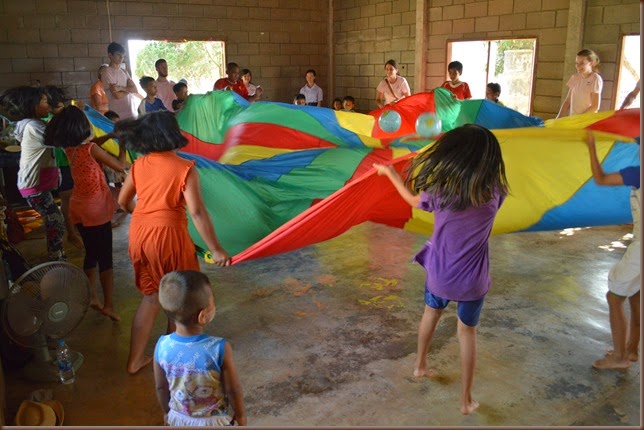
SOLA—the young adult ministry of Northview Church in Aboottsford—sent a team to help us with various ministries.  With their assistance we had an English camp in one one of the local schools. They also put on some VBS programs, such as the one pictured here in Huai Jaw church.  With these parachutes anyone can create a lot of fun—even if you don’t speak the language.

June-Funeral 
Funeral 024

In June, our next door neighbor passed away.  It was for us an amazing time of learning about North Thai culture and building relationships.  Because of the very close proximity of our houses, we got to experience much of what went on even without leaving our home.  The crowd spilled over onto our front porch during the evening chanting and the canopies set up over the dining are came up under our eaves.

Phawkham left behind his widow, his son (above right) and granddaughter—all of whom lived with him.  Our landlord—younger brother of the deceased—is pictured above on the right.

July-visit from family and vacation 
Along Sam Roi Yod Beach 2

It was especially hard to pick a photo from this month.  Our landlord’s daughter passed away while she was visiting from her home in Hong Kong, and they asked us to take photos and videos of the event.  Then we had a team come and help us with an English camp and other things.  This team included soem young people from our home church, so we were quite excited about that.  Also this month was our annual MB Family Camp—with people from all the MB churches across Thailand coming together in Kanchanaburi province.

We combined attending Family Camp with joining up with Ingrid’s sister and our niece who came to visit.  This made our longest road trip in Thailand ever.  Not all those who visit us will get to experience Thailand like they did.

We went to one of our favorite places—Sam Roi Yod—located southwest of Bangkok on the Gulf of Thailand.  We saw monkey’s and caves and some really fascinating places.  We stayed at the Juniper Tree lodge, located across the street from the beach pictured here.

August—Pummelo festival 
Pummelo Festival Parade 11

The end of August saw the convergence of two events.. One event was the biannual conference of Anabaptists which we hosted at the Changing Life Center.  At the same time was the annual pummlo festival in Wiang Kaen.  (Pummelos are a type of citrus fruit that resemble a grapefruit)  Pummelos are one of the leading crops of this area.

The festival is kind of like a county fair—lots of vendors selling things, produce displays, entertainment, fair food (not the same as the Big Fresno Fair) and, to kick it off, a parade.

Lai is a Hmong girl who we have been helping to teach English.  She has become kind of like a daughter to us.  It was a joy for us to see her playing saxophone in the High School Marching Band.  (She is the saxophonist closest to the camera in the above photo.)

September-Rice 
Oryza sativa L.  Poaceae: rice, ข้าว

Thailand is the world’s leading exporter of rice.  But there is still plenty left for local consumption.

Before I came to Thailand, I only knew of rice as a crop grown in paddies.  But here in Southeast Asia there is a lot of upland rice.  Generally, the upland rice here is sticky (glutinous) rice.  Sticky rice is favored by many of the tribal groups in Thailand as well as the North Thai and Isaan Thai (both of which are culturally and linguistically distinct from Central Thai).

In the photo above, I am standing on a hillside surrounded by upland rice.  But not far away in the creek bottom is paddy rice.  The paddy rice is darker green because it has not yet begun to form seed heads.  The photo was taken about 12 kilometers up the Ngao River Valley from where we live.

October-Cloud Forest
Ang Ka Nature Trail 16

In October we decided to take the remainder of our vacation time in Chiang Mai province.  While there we got to see some waterfalls and a large garden park. We were able to visit with friends who were there from Fresno as well.  Chiang Mai province is also home to Doi Inthanon—the highest mountain in Thailand.

The top of the mountain is often called a “cloud forest” because it is in the clouds so much of the time. There is a unique area near the summit that looks almost like coastal BC with its mossy trees and there is even an area of sphagnum moss—something quite unusual in the tropics.  There is a boardwalk (pictured above) to take you through this area called Ang Kaa (Crow Basin).

November-Clear Mountain Views
Doi Pha Tang Park 13

Clear blue skies are unusual here in Northern Thailand.  During rainy season, there are the ubiquitous clouds that turn the skies gray for about 6 months.  Soon after that, the rice and corn is harvested and then they burn off the fields making the skies murky.

But in November, the rainy season here in the north has just come to an end.  And since the rice harvest is just underway, they have not started burning the field yet.  As a result, this is the time of year when we have the bluest skies.  It is a great time to go to the mountains.

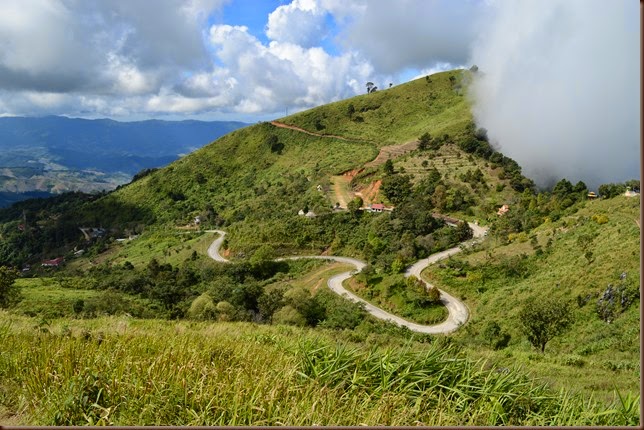
The closest area to visit the mountains near us is called Pha Tang, located about 30 kilometers away (the last 15 km contain some very steep stretches).  The elevation there is over 4000 feet.  On this day, the morning fog-clouds were almost finished breaking up.  In the photo above, the warm air was moving up the west slope, effectively halting the movement of the clouds blowing in from the east.  This picture was take about noon time—by 3 pm there was hardly a cloud in the sky.

December-Place of Worship 
Pa Tung panorama 2

In the advent season, we take the opportunity to tell the story of the first Christmas.  Our calendar becomes filled with various Christmas related outreach events.

During this season, we continue to worship at Pa Tung Church.  This church was the dream of Somsak (playing guitar above).  Somsak is from the area and when he was in High School not so long ago, he stayed in the dorms that MB Mission had near the high school campus.  During that time he became a Jesus follower.  He went on to get his education degree and has come back to the area to teach, along with his wife (also a teacher).

There are few Christians in his village (one other adult besides his wife).  He had a bamboo structure erected in his front yard to hold worship services.  The thatch roof had just been replaced a few days before I took the above photo.

There are a couple of reasons we have been worshiping at this location.  One is that worship is conducted in Thai (most of the other worship services in our area churches are in Khmu, which we don’t understand).  The other reason is that this is a very young church and we are able to help with leadership training.

This is a good closing photo, because it highlights what will be the focus of our work for the next few years--helping equip disciples who can lead and grow the church.  Our team will be changing soon, with the addition of another couple, and then we will work together towards this goal.

Jesus said:

Therefore go and make disciples of all nations, baptizing them in the name of the Father and of the Son and of the Holy Spirit, and teaching them to obey everything I have commanded you. And surely I am with you always, to the very end of the age. Matthew 28:19-20 (NIV) 

Saturday, December 20, 2014

White Unto Harvest, Black Unto…


Burnt rice paddies in Pang Hat 4

With the dry season and the end of harvest for some of the corn and rice plantings, it is common to see plumes of smoke coming from the fields.  As dry season goes on, the air just gets more and more smoky.

As I was looking bicycling past some of the fields this pas week, I noticed that there were people out in the blackened paddies.  And as I looked more closely, I saw that they were out planting in the fields.  In fact, some of the other paddies were flooded as if irrigating a new crop.

As I watched the workers in the black fields the words of Jesus came to mind: “the fields are white unto harvest.”  And I thought, “these fields are anything but white.”  But then, they were not harvesting, they were planting.

And I thought this is a good picture of one aspect of missionary life.  Before a field is “white unto harvest”, it must first be planted an cultivated.  And when we first plant the gospel, sometimes things seem very dark.

Today, one of the young women who comes to our English club had to rush off afterwards to join her family for some ritual involving ancestor worship.  She is a young believer but still under the authority of her non-believing father.

Darkness.

This afternoon, a long, slow parade of vehicles was following a car with a loudspeaker announcing a special opportunity to make merit—trying to increase the chances that one’s next life will be better than this one (but no guarantees).

Darkness.

But the good news is that darkness  hopeless.

Indeed it is in these blackened fields that we can plant seeds of hope and light.

Sowing.

There is the young man who went to school to become a teacher, and then, when he had opportunity, he moved back to his home village to bring the good news of Jesus to that place.  Still, few adults in this community want to risk getting the spirits angry by following Christ.  Yet this teacher perseveres in his faith.

Cultivating.

There is another young man who has been holding youth meetings in another village every week.  For the longest time there was no interest on the part of the adults in following Jesus.  But now there is talk about some of the village leaders even setting aside a piece of land for a church.

Harvest.

A group of people come from across the river to declare their faith by dipping in the Mekong River. 

We are grateful for the opportunity to help plant seeds of light in the darkened fields.  And we till the fields in hope of a great harvest.

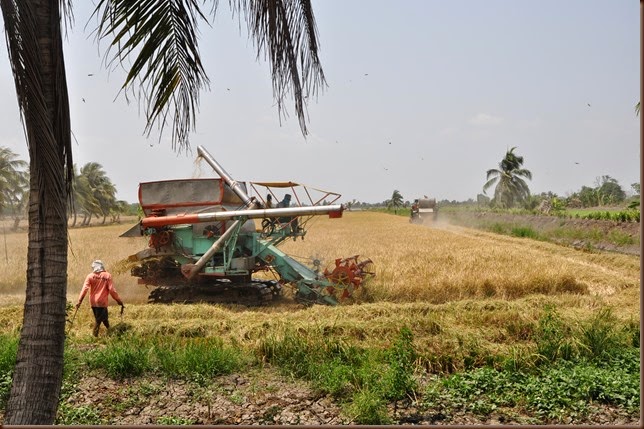
Rice harvest

Friday, November 14, 2014

I’m Not Lost


NorthernThailand

Last Sunday I was teaching in church from the story of Zacchaeus.  Luke closes the story with Jesus explaining why he came.  Jesus says, “For the Son of Man came to seek and to save the lost.” (Luke 19:10 ESV)

A challenge in seeking the lost, I explained, is that the lost don’t always think they are lost.  Usually they think they’re doing just fine.

A few weeks ago, we were hosting a team at the Changing Life Center.  Arrangements had been made for a van to take the team back to Chiang Rai.  However, due to the amount of luggage, another vehicle was needed.  I volunteered to take the luggage in our truck.

The problem was, I had no idea where this hotel was that they were going to, and I didn’t have time to research it.  (The person who had made the arrangements was not there.)  So I check my phone to see if perhaps the location was in Google ® maps.  It was!  So I turned on the GPS and had the program get me directions how to get there.

(One might ask, why not call and ask for directions.  The challenge with that in Thailand is invariably I get  names of landmarks/streets that 1) I don't know, 2) don't exist on or differ from what is listed on any map, and 3) don't have any signs posted to let me know when I see them.)

A couple of hours later, we get a call from some of the other team members, “Our van just arrived at the hotel, where are you?”  “I’m just a few minutes away”, I replied.

The problem was, I was lost, but I didn’t know it.  For as we got near the destination we found out that the location on the map was wrong.  Where the map said the hotel should be, there was a temple.  Our hotel, we found out, was 9 kilometers south of where we were.

Since the lost don’t always know they are lost, it was necessary for Jesus not only to save them, but also to first seek them.

When I became as Jesus-follower, I had not been look for Jesus or even any kind of religion.  But Jesus knew I was lost—even if I didn’t—and He sought me.

Thank you, Jesus, for being the seeker of the lost.

Saturday, October 25, 2014

A True Compliment


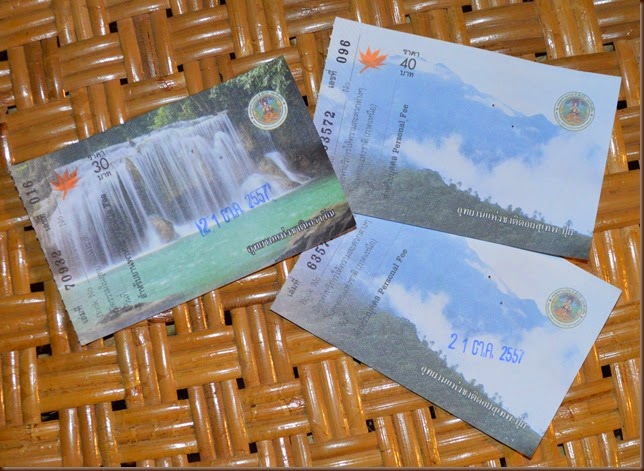
I walked up to the ticket counter to enter Doi Inthanon National Park, home of Thailand’s tallest mountain, Doi Inthanon.  The following brief conversation took place (in Thai):

     Me: Two adults and one car.
     Ticket agent: That will be 110 baht.

I walked away with my 3 tickets (one for each of us and one for the car) with a smile, having received one of the best compliments I’ve ever received for Thai speaking abilities.

DSC_0348

You see, in Thailand, attractions such as parks and museums often have two prices—one for Thai people and one for visitors.  The visitors don’t often know this because there will be two signs-one in Thai and one in English—with the Thai one using Thai numbers (0-9=๐ ๑ ๒ ๓ ๔ ๕ ๖ ๗ ๘ ๙) to help conceal this fact (most of the time they use Arabic numbers).

Sometimes, they will let foreigners with a long-term visa pay the Thai price.  Usually to get this price, one has to request the price and then show their visa or a Thai driver’s license (which I had to do the following day at another park).  However in this case, I was offered the Thai price just on my speaking ability.

To me this was a better compliment of my language skills than a direct one.  In Thai culture, being nice is a higher value than being truthful.  So people might sometimes give a false compliment because they don’t want you to feel bad.  There are occasions when I have been given compliments about my Thai speaking abilities when I KNOW I just butchered their language.  (And I’m sure there are many more times when I’ve been given a compliment when I UNKNOWINGLY butchered their language.)

Learning this cultural aspect of language use is just as difficult as grammar and pronunciation.  We are much more used to direct and even confrontational speech.  Here the emphasis is on making the other person feel good and especially to NOT offend.  And we can offend not just with our choice of words but also with they way we say the words.

The apostle Paul wrote: Let your speech always be gracious, seasoned with salt, so that you may know how you should answer everyone. (Colossians 4:6 (NET))

I pray, then, the God would help me not only know the correct words to use when I speak Thai, but that I would also use the correct words correctly.

Thursday, October 16, 2014

Reflected light


I remember a night, many moons ago.  Our team of 3 guys had climbed up in the hills above Montrouis, Haiti, to a place called Kournol.  It was my first time in the tropical mountains under a full moon.  It was so bright—Randy was out reading by moonlight.

But as bright as that moon was, it’s nothing compared to the light from its source, the sun.  For the moon only reflects a small portion of the light from the sun.  So even under the most optimum conditions, I would not want to try to do things like driving by moonlight (unless I was going really slow) or doing something like embroidery.

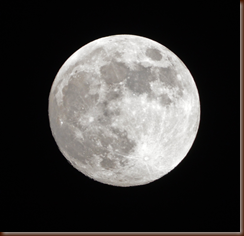
Here in northern Thailand, the air is seldom clear enough for the moon to be anywhere near as bright as what I experienced that time in Haiti.  In the rainy season the moon is obscured by the clouds and in the dry season, smoke and smog dim the its light.  Though there was that day last week—the day before the eclipse—when the haze wasn’t too bad and I was able to capture a great photo of the moon (wish it was so nice the day of the eclipse.)


Full Moon - เดือนเพ็ญ
Almost full moon the day before the eclipse

Trying to understand God can be like trying to do delicate embroidery by the Hazy moon of Wiang Kaen.

Lunar Eclipse-จันทรุปราคา
Hazy view of the moon coming out of the eclipse


Paul writes:  Now we see things imperfectly as in a cloudy mirror, but then we will see everything with perfect clarity. All that I know now is partial and incomplete, but then I will know everything completely, just as God now knows me completely. 1 Corinthians 13:12 (NLT) 

I’m grateful that God is a God of revelation.  He has revealed Himself through His creation (Romans 1:19, 20), through the prophets (Hebrews 1:1) and ultimately through His Son, Jesus Christ (Hebrews 1:2).  And I’m grateful for all those who faithfully recorded the activities and prophecies and words of God in the Bible.  So there is a lot we can know about God.  Still, even with the Bible there is so much I don’t know about Him.  Not only don’t I know a lot of things about God, I am incapable of it.  And so, like Paul, I look forward to that day when I will see God face to face.


Tuesday, September 16, 2014

Watch out for the little guy…

It was probably a couple of weeks ago that a little virus taunted my 6 foot tall, 180 pound body saying, “Watch out, big guy, you’re going down.”

To which my body replied, “Says who?  You’re so small you make a grain of sand look like a mountain!”

“Don’t be too brash,” said the virus, “I got people.”

And my body brashly replied, “Where, I don’t see anyone?” 

At that point the virus found a nice comfy place in a mucous membrane, and self-replicated until there were probably a few million of them, wreaking havoc on my throat and sinuses.  So my body is using most of its available resources trying to quash the rebellion—leaving me not much energy for anything else.

Watch out for the little guy—with friends.

There was once a little guy named David.  When David saw the giant, he ran fearlessly toward him with his sling.  David wasn’t afraid because the giant made fun of his God and he knew God would give him the victory.  So David let loose the stone and the stone hit true and the giant fell in a heap. (1 Samuel 17)

Watch out for the little guy—with a friend named God.

There was once a working-class man from a part of the country that was looked down upon by the rest.  Being a fisherman, this guy didn’t have time to invest in a quality education.  When he spoke he had a tendency to put his foot in his mouth, so much so that, on more than one occasion, Jesus had to rebuke him for speaking brashly.

But then the day came when Peter stood before a huge crowd and people marveled at the preaching of the uneducated man from Galilee.  And people were cut to the heart and many responded positively to his words. (Acts 2:1-40)

Watch out for the little guy—with a friend named God.

Last Saturday, three high school girls listened in rapt attention to this irrelevant old white guy as I struggled to tell them, in Thai, some of the things that Jesus has done for me and the reason we came to Thailand.  I’m sure if there were a Thai language instructor present, his face would be all distorted from the constant wincing and biting of the tongue.  But somehow, in spite of me, God was able to keep the attention of these three young women.’'

And so my prayer is, “God, don’t let my Thai language abilities get so good that I think that I can accomplish something worthwhile in Thai without your help.”

Kids Club 2014-9-13 4e
Some of those who listen to our teaching in spite of us.