Sunset Over the Mekong River

Sunday, April 27, 2014

Decisions, Decisions

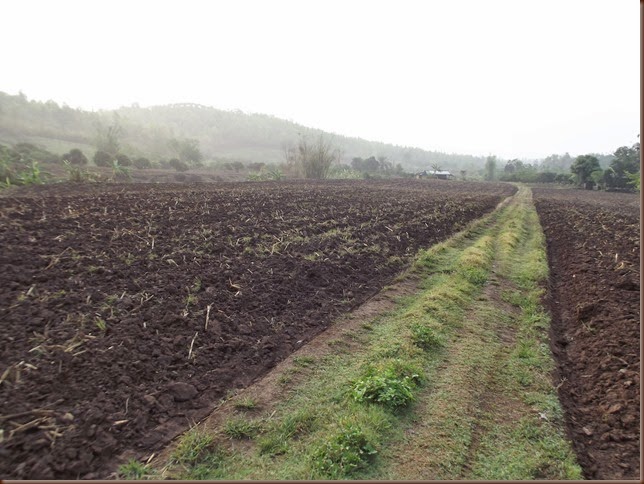
The other day I was out exploring/exercising on my bicycle.  I was trying to follow a dirt track which, according to Google maps, went back out to the main road.  But Google maps has not always proved correct when it comes to some of these back roads.

At any rate, I came to a fork in the road and it was time to make a decision.  The road to the left was newer, wider, in better condition, and went in the general direction I needed to go.

But I took the other road—and it turned out to be a wise decision.

The reason for my decision: it looked like the road to the right had been around a while and was well used.  Hence it was narrower (overgrown with time) and in poorer shape because it was used more.


In the fields above Thung Kham 2

People tell me I can be a fairly good navigator.  Since I was a child I’ve loved maps.  I remember studying the maps on a cross-country road trip that our family took when I was seven.  Back then, most gas stations gave out free maps--that was always a highlight for me!  And it certainly helped to have good map reading and navigational skills in my previous occupation where I made maps.

But navigating is not just about maps—it’s also reading road and traffic conditions.  One trick I will often use in unfamiliar territory is to follow the dominant traffic flow—at least if I’m trying to stay on a through road.  Occasionally that backfires—as when I once ended up at a Coscto.

I think of my crossroad decision—where I followed what appeared to be the more “traveled” road—and I compare it to the last lines of Robert Frost’s famous poem:

Two roads diverged in a wood, and I—
I took the one less traveled by,
And that has made all the difference.


Robert Frost has a different take on navigation here.  And his take is perhaps a bit more relevant to how we navigate through life.

Often, if we want to do the right thing, we will not be doing the popular thing.  Or if we are leading in a given area, we will often be blazing a new trail.

Jesus said:

13 "Enter by the narrow gate. For the gate is wide and the way is easy that leads to destruction, and those who enter by it are many.
14 For the gate is narrow and the way is hard that leads to life, and those who find it are few.
–Matthew 7:13-14 (ESV)

This well-know verse comes near the end of the Sermon on the Mount.  And in the Sermon on the Mount there is a collection of sayings that go like: “you have heard it said…, but I say to you…” where Jesus contrasts the normal way of doing things with God’s way.  The implication is that God's way of doing things is often along the "road less traveled".

Sometimes it can be lonely when you take the road less traveled.  It is a road where we can find ourselves misunderstood quite often.  It takes courage to walk that road.

Today in church, a young woman got up during the sharing time and started telling a story.  I had a hard time following what she was saying because she was talking very fast and in a mixture of Thai and Khmu all of which was muffled by her tears.  The young woman was confessing some sin in her life and apologizing to those she had offended.

It took a lot of courage for her to do that.  Afterwards, one of the church leaders got up and reminded people about the importance of what had just happened, commending the young woman for daring to do what she just did, and trying to make sure that she was not misunderstood. This opened the way for mending of relationships that had been broken or messed up because of her behavior.

This young woman had come to one of the many crossroads in life and had to decide whether she was going to follow the well-traveled road—and pretend like her misbehavior was okay or did not matter—or whether she was going to follow the less-traveled road of obedience to Jesus.

She took the road less-traveled…

…and it made all the difference.

Friday, April 25, 2014

Seafood Buffet

Yesterday we went for a short afternoon drive to get a break from the heat (the car has A/C, the house does not).  While we were out we checked out a store in our town that we had not been to before.

Wiang Kaen has lots of little stores that sell pretty much the same thing, but each store has its own unique personality and carries some things the others don’t.  I’m glad we checked out this one because it is the only one we’ve found so far that sells wheat flour and it sells 3 kinds—all-purpose flour, bread flour and cake flour.

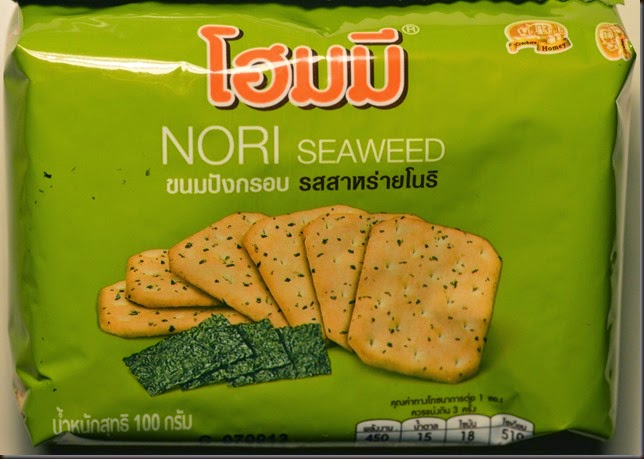
Since it was such a hot day, we we’re looking for something salty to eat so we got some crackers.  A challenge buying crackers here in Thailand is they tend to be sweet rather than salty—so we settled on some seaweed laced crackers that had less sugar than most.  Ingrid found a can of sardines.  And that became dinner (along with raw veggies).

Nori seaweed crackers

As we were eating dinner, all of a sudden, I was having a memory flashback to about 30 years ago.  At the time we lived in Perry County, Alabama, where I was working on a soil survey.  MacArthur Harris was my supervisor.  He good teacher and manager and he was also a lot of fun.

Soon after we arrived in the county, MacArthur and I were out working in a place called Suttle—about half way between Marion and Selma.  Suttle was named after the family that owned the main ranch in the area.  The family had a small store that sold various groceries and miscellaneous items.  We stopped in there to get lunch; I figured that I would get something at the deli counter.  But MacArthur said he was going to get the seafood buffet.  This really got me wondering, “seafood buffet?”  “In Suttle Store?”  I had been in the store more often than MacArthur and I had never seen such a thing.

image
Soil map of Suttle area in Perry County, Alabama.
The store is the large building between the "14" and "MlA"

After we made our purchases, we carried the brown bags containing our purchases to the picnic table outside to eat.  MacArthur proceeded to pull out an onion, a box of saltines, and a can of sardines.  He sliced the onion and then laid a slice of onion and some sardine on the each cracker.

MacArthur, wherever you are, you trained me well.  The tradition lives on.

Our Second Home in Marion Alabama
The house where we lived in Marion--we rented the upstairs.

Saturday, April 12, 2014

You can’t get lost…

…if you don’t have a destination

DSCF8124

Today, I was out on my bicycle, combining my morning workout with exploring parts of our district that I had not visited before.  My journey took me up an unpaved road that turned into a field road that petered out on a hillside garden.

As I was coming back, I decided to check out some of the side streets of the nearby village.  As I was rounding one corner, I noticed a group of people standing around in one of the yards.

“Are you lost?” they asked.

I told them that I was not lost but I was new to the area and I was exploring.  What I wanted to say, but I did not know how to say in Thai, is that you can’t get lost if you don’t have a destination.  Instead, it is more like how the old saying puts it, “wherever you go, there you are.”

While this kind of attitude is great for exploring, it is not very helpful for most things in life, whether it be working or writing or doing a project around the house.  And I must confess that I do struggle in this area—I’m a better starter than a finisher.

I know I’ve listened to sermons that were put together by someone who did not have a goal.  After a while the listening gets tiring and I check out.  “Where is he going?” I’ll as myself.  Sometimes the speaker will get me by surprise and actually reach a destination. At other times I’ll notice that the speaker himself did not seem to have a goal.  I find myself looking to be fed but coming up empty.

The destination is important.

I see the importance of having a goal these days in continuing my Thai studies.  When we were in language school, there was always a goal—usually marked by the completion of a workbook and a test of some sort.  Now the struggle is to find a goal that is reasonable, in the light of ministry commitments, and then to work towards that goal.  Without such a goal, it is hard to stay motivated to study.

Our life also needs a goal.  While I don’t underestimate the value of the journey itself—our life is all about that journey—it should be a journey to someplace.

Paul noted the importance of a life goal.

10 that I may know him and the power of his resurrection, and may share his sufferings, becoming like him in his death, 11 that by any means possible I may attain the resurrection from the dead.
 12 Not that I have already obtained this or am already perfect, but I press on to make it my own, because Christ Jesus has made me his own. 13 Brothers, I do not consider that I have made it my own. But one thing I do: forgetting what lies behind and straining forward to what lies ahead, 14 I press on toward the goal for the prize of the upward call of God in Christ Jesus.
Philippians 3:10-14


Paul’s goal was to know Jesus and be like Him.  He notes that this is not an easy goal to attain, but that it was worth straining forward for and pressing on towards.

It is interesting to note that Paul’s goal was not to win X number of people to Jesus—though he spent his life trying reach those who had not yet heard about Jesus.  In fact, in Acts 9:15 we read that Jesus gave him a clear call to do this very thing. Yet even though his life was consumed with bringing the good news to the non-Jewish world, his actual goal was to know and be like Jesus.

Reaching people for Jesus was his task.

Being like Jesus was his goal.

I admit that my pursuit of this kind of goal often seems to lack the ardor and zeal that marked Paul’s life.  It is easy to get distracted with other things—even good things.

We read a story about this kind of thing in Luke 10:38-42 (NIV):

38 As Jesus and his disciples were on their way, he came to a village where a woman named Martha opened her home to him. 39 She had a sister called Mary, who sat at the Lord's feet listening to what he said. 40 But Martha was distracted by all the preparations that had to be made. She came to him and asked, "Lord, don't you care that my sister has left me to do the work by myself? Tell her to help me!"
41 "Martha, Martha," the Lord answered, "you are worried and upset about many things, 42 but only one thing is needed. Mary has chosen what is better, and it will not be taken away from her."


Martha missed out on the "better" part because she let the task (serving Jesus) distract her from what should have been her goal (knowing Jesus).  Both the task and the goal are important—but if we lose sight of the goal, the task has no value, and we get lost.

God, help me to fix my eyes on that which is better—that which is most important.

Thursday, April 3, 2014

Eternal Bliss

A few weeks ago we were in the city of Chiang Rai for the weekend.  One morning I was walking around looking for a baking supply store and I found myself in the part of the city that caters to budget tourists and backpackers.

I stopped at a roadside stand for a coffee and noticed that the hotel across the street seemed to be quite busy, even though it was only 7:30 am.  The hotel looks like it might have been quite a nice place a few decades ago, but the tropical rain and sun seemed to have dulled its appearance over the years.

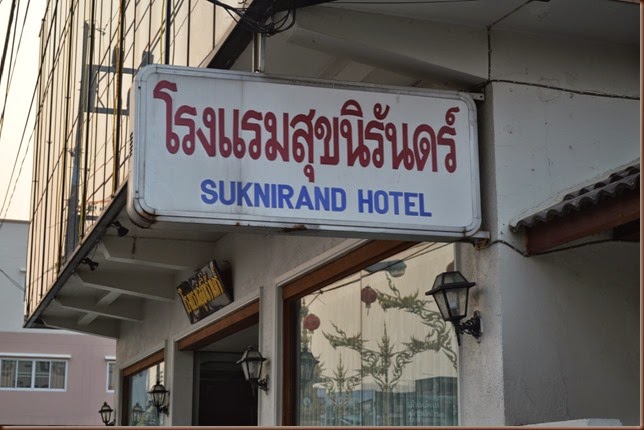
After I finished my coffee, I walked across the street and noticed the sign for the hotel:

Eternal Bliss Hotel
Suknirand Hotel sign

As is fairly normal for us anglophiles, I read the English name first.  Suknirand—I thought it might be a name or something.  But then I noticed that it was just a transliteration of the Thai.

สุขนิรันดร์

The name roughly translates “eternal bliss”.

I’ve never been inside this hotel and it may be quite nice.  But somehow when I think of eternal bliss, an older hotel does not come to my mind.  I’m not sure that it does for a Thai person either, though their thinking on eternity and heaven may be considerably different than mine—something that makes it a challenge to communicate the good news about what Jesus has done for us.

This differences in thought about heaven, hell, and eternity is apparent when one visits the “White Temple” an unconventional Buddhist Temple designed by artist Chalermchai Kositpipat.(เฉลิมชัย โฆษิตพิพัฒน์).  It is located about a 20 minute drive south of the city of Chiang Rai.

The center of the temple is the judgment hall.  From here you can either cross a bridge to the “heaven” (Nirvana) side or another bridge to the “hell” side.

The “hell” side is by far the more ornate side with lots of images of serpents and demons and such.  It appeals more to the senses than the heaven side because of the ornate detail.

When one talks about “eternal life” to a Buddhist here, it is not seen as desirable because means forever being caught up in the cycle of birth and rebirth into a life of suffering and not attaining Nirvana.

White Temple 2
The "hell" side of the White Temple

The “heaven” side, on the other hand, is very plain looking.  I’m guessing this is because the most desirable end for the Buddhist is Nirvana which is basically extinction.  One ceases to exist as an individual anymore.  The only way to get to Nirvana is to cease desiring--hence the design with little to appeal to the senses.

White Temple 16
The "heaven" side of the White Temple

This is a strong contrast to the Christian for whom heaven is a desirable place to spend eternity.
In the Bible, we read a description of heaven as the New Jerusalem.  And while I don’t know how literally the author, John, wants us to take this description, we get the idea that heaven is supposed to be a really nice place:

The foundations of the wall of the city were adorned with every kind of jewel. The first was jasper, the second sapphire, the third agate, the fourth emerald, the fifth onyx, the sixth carnelian, the seventh chrysolite, the eighth beryl, the ninth topaz, the tenth chrysoprase, the eleventh jacinth, the twelfth amethyst.  And the twelve gates were twelve pearls, each of the gates made of a single pearl, and the street of the city was pure gold, transparent as glass.
Revelation 21:19-21 (ESV)

In reality, I don’t think John really had words to describe what he saw in the vision—it was just the ultimate place to imagine spending eternity.  I’m thinking that the Eternal Bliss hotel, though it may be a really nice place to spend a few days, does not quite meet the standards described by John in the book of Revelation.

Thursday, March 20, 2014

Engrained


I bought a length of PVC pipe today and I was tying it to the roof of our truck.  I was thinking, “a clove hitch would be ideal for this,” but it had been years since I had tied one.

Yet, almost without thinking, there it was.

Engrained.


Clove Hitch s
Clove Hitch

The clove hitch was one of the first knots I learned.  All this goes way back to my childhood.

Many years ago in a town called Otis, Massachusetts, the Girl Scouts had a camp called Sequina.  My mom was heavily involved in Girls Scouts and every year our family would make the long drive up route 8—long before the expressway  existed and before all the dams were in along the Naugatuck and Farmington Rivers—in order to set up the tents in preparation for the summer camping season.

The tents were set on platforms and attached to the platform with a rope secured with a clove hitch.  Though I was too small to reach the cross beam to which the ropes were fastened, my dad told me the name of the knot and showed me how it was tied.  He also used this knot when our family would go camping and that is where I first actually attempted to tie one.

Later, it was while I was in the Boy Scouts that I learned to use the knot on my own.

What is so strange is that now I still don’t really have the confidence that I know how to tie the knot correctly.  Yet yesterday, when I needed the knot, I could tie it—and I knew I had it right because the rope did not slip on the pipe when I was finished.

So, somehow, this process of early exposure and later practice and use got something so well engrained in my head, that I could do something without thinking about it many years into the future.

We read in the book of Proverbs: Train up a child in the way he should go; even when he is old he will not depart from it.    Proverbs 22:6 (ESV)

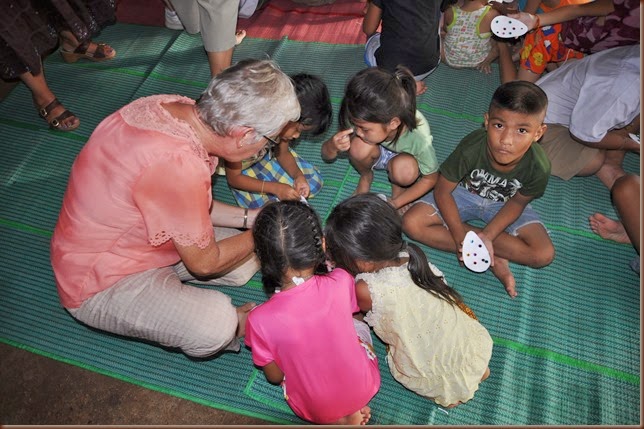
Here in Thailand, we have become involved in various kinds of children’s ministries.  As I was curious about the clove hitch and wanted to learn about it when I was a child, these children are often eager to learn, whether it be English, or Bible stories, or even new games to play.  Sometimes I have wondered how much we are getting across, and how much is sticking with them.  My experience with the rope yesterday encourages me to keep pushing forward.

VBS in Ban Khlong Cao 2013-6-25 84
"Training Up" children

Tuesday, March 18, 2014

Rice, Part 1: Eat Rice

(Note: I’m calling this Part 1, because I will probably add more blogs about rice at some point in the future)


Rice with kap khao
(กับข้าว-food that goes with rice)
Rice is an important part of Thai culture.


Rice is by far the most important crop grown in the country, and until some bizarre government policies changed things a couple of years ago, Thailand had for years been the worlds leading rice exporter.

The importance of rice shows up in how the Thai people view eating and even the way the word rice is used.

The phrase eat rice (กินข้าว kin khao) is synonymous with to eat a meal.  When Thai people greet each other, instead of saying, “How are you?” like we might do in America, they will often say “Have you eaten rice yet” (กินข้าวแล้วหรือยัง kin khao laew ruer yang).

The Thai people often eat rice, in some form or another, three times a day. For morning it might be rice soup.  Then it might be soup with rice noodles for lunch and steamed rice or sticky rice for dinner.

For many Thai people, unless they have had rice, they feel like they have not eaten.  One of our missionaries tells of an occasion when the youth got together for a pizza party.  When it was over, it was time to go eat because—you guessed it—they had not had rice yet.

Eating Pizza-Not Real Food


Today I was at a store with one of our co-workers.  The store had two main eating establishments—a KFC and a food court.  The food court had many individual booths each selling some variety of Thai food. Since it was lunch time, I asked our co-worker if she wanted to eat at KFC or the food court.  She said she wanted to “eat rice”, implying that she wanted to eat at the food court (the french fries at KFC just aren't same, I guess).

So I went to one vendor and got some crab fried rice.  She went to another and got noodle soup.  I mentioned to her that I’m not sure I will ever understand Thai people.  Here she did not want to eat at KFC, but instead she wanted to “eat rice”.  But then she ends up getting soup. (By the way, there are some rice options at KFC.  You can even get fried chicken with rice, something many people will buy on the street.)

My take home from this is that for some people, the phrase “eat rice”  may mean eating the kinds of food they are used to as opposed to foreign food.

As for us, we are okay if we don’t eat rice three times a day, in fact, we have rarely ever done so.  Also, when we buy food on the street, we will often not get rice with it.  Rather, we will cook our own brown rice at home which has a bit more nutritional value than the steamed white rice or sticky rice sold on the street.

So, whether you eat or drink, or whatever you do, do all to the glory of God.  (1 Corinthians 10:31 ESV)

Happy eating.

Saturday, March 15, 2014

A Drop in the Bucket

Perseverance must finish its work so that you may be mature and complete, not lacking anything.  James 1:4 (NIV)

These days, the skies at the Changing Life Center are not only filled with the smoke from all of the fields being burned at this time of year, there is also a lot of dust.

The dust is associated with the lining of the banks of the Mekong River with rocks on the outside of the bends in the river.  This is to keep the riverbanks from washing into the river, which was eating into the banks up to several feet a year.

It is easy to understand why.  The Mekong River is the largest river in southeast Asia.  It originates in the mountains of the Tibetan region of China.  By the time it gets to the Changing Life Center, it already has a couple of thousand kilometers behind it!  The banks at the Changing Life Center are more than 50 feet above the water level.

It is a gargantuan task.  These large trucks come down the road, laden with huge boulders.  It looks like a lot of rock.

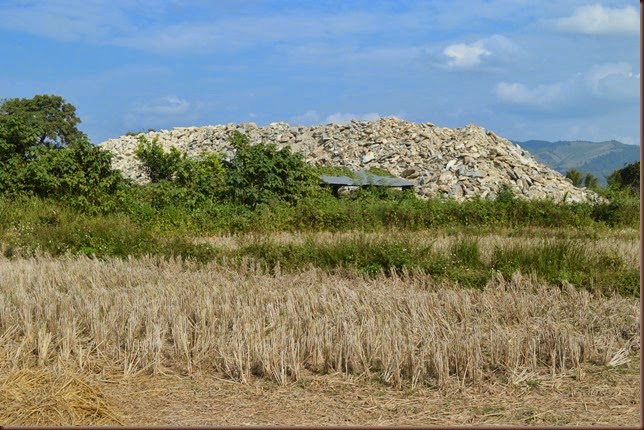
But then they dump the rock in a huge stock pile, and the pile of rock is so large, one hardly notices the difference that it makes that this load of rock has made.

Eventually the rocks in the stock pile make it down to the river, were they are dumped and then scooped into the river with an excavator.  The rocks seem to disappear without making any difference at all.  And then you look at all that has been done and all that remains to be done and one wonders how the task will ever be completed and at the expense of how many mountains that have to be removed in order to get enough rock to complete the task.

Yet steadily, day after day, the work goes on until the task is done.  One only need to look at the parts that are completed to know that it is possible.

This process reminds me of the task of learning the Thai language.  We keep studying Thai, yet it seems like we are hardly getting anywhere.  When we listen to someone speak, sometimes we catch so little we wonder what difference all of that studying has made.  After three years it seems like we have made so little progress.  (I think if I had made as much effort studying the Haitian language when we lived in Haiti, I would have spoken it better than the natives.)

But like the putting the riprap along the Mekong River, there are signs that progress is being made.  We just have to look back at the part that is completed now and then, and not just at what remains to be done, to see that this is the case.  And then we need to persevere at the task of learning the language. And perhaps we will live here long enough to see the task completed.

River bank construction in Wiang Kaen, Thailand
A partially loaded truck (they don't fill them when moving them from the stockpile to the river)
Riverbank construction in Wiang Kaen 5
One of the many stockpiles
River bank construction in Wiang Kaen, Thailand
The backhoe taking the rock from the truck
River bank construction in Wiang Kaen, Thailand
The not so large excavator