Sunset Over the Mekong River

Tuesday, April 7, 2015

The Walled City

And the mountains shall be thrown down, and the cliffs shall fall,
and every wall shall tumble to the ground.
 Ezekiel 38:20b (ESV)


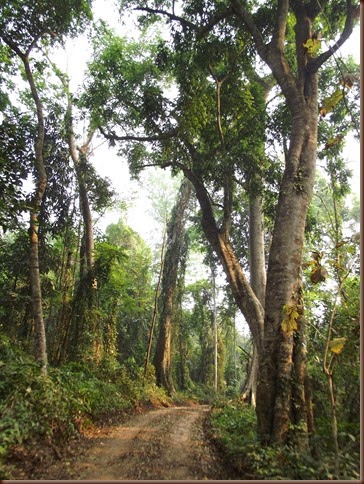
Soon after we moved to Wiang Kaen, we discovered a forest near our home that still had a lot of very large, old trees.  We were surprised because there aren't a lot of old native trees left in Thailand, especially near towns.

Satan Boran Forest scenes 8
Road through the forest

Looking at Google maps, we noticed that this Forest was fairly large in size.


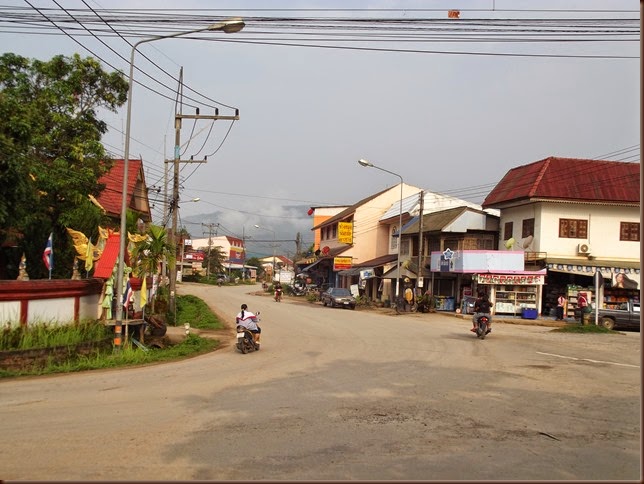
Another thing that struck us when we moved here is the name of the place: Wiang Kaen. “Wiang” is a term used to describe walled cities, and we certainly didn't seem to be any walls around that we could notice.

Downtown Wiang Kaen
Wiang Kaen today: Where's the wall?

Recently, they have been doing some cleaning up around the old forest, and in the process we have discovered something—the reason that this old forest still exists is because it is the old, walled city—it’s just that the forest have covered up a lot of the walls and moats and other historical landmarks in the place.  But now there is a map that shows the general layout.  Knowing this we have become aware of the old moat, quite deep in places and often near the present roads, but obscured by brush and trees.

The name of this place is “Boran Satan Wiang Kaen” (โบราณสถานเวียงแก่น which roughly translates: ancient Wiang Kaen) or “Wiang Kaen Forest” (ดงเวียงแก่น).  The old city was founded about 700 years ago.


Boran Satan 3
Map of the old city

The general pattern of the border is an exterior wall, then the moat, then a larger, interior wall.  Below are two photos of where the interior wall has been cut for a road.

Satan Boran Wall 1
The cut through the wall looking into the old city

Satan Boran Wall 1b
The cut through the wall looking out of the city

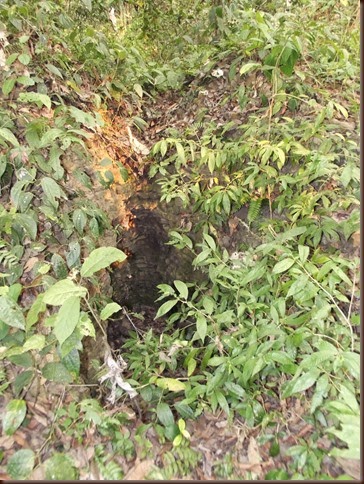
The moat is so grown over with vegetation, it is usually hard to notice that it exists.  In the photos below, I traced the approximate cross section of the moat.

Satan Boran Moat e
The moat


The Moat


The are a few small “hills” which are the remains of old chedis.  The one below is labeled #3 on the map.  It has been opened up so that you can see some of the old bricks inside.


Satan Boran Point 3 Chedi 2
One of the old chedis

Satan Boran Point 3 Chedi 8
Looking down into the chedi

Another old chedi is across from the present, simple, Buddhist temple.  This one has a large tree growing in it.

Boran Satan Point 4 Chedi
Another remains of an old chedi

The are other, interesting relicts scattered about the forest.  This Buddha image of uncertain vintage is along a mostly overgrown trail.  Some “lucky bamboo” plants in front of it show that it seems to have received some attention in recent times.

Boran satan Buddha image 1
Old Buddha image with newer
planting of lucky bamboo

The Buddhist temple is a bit different.  It is constructed like an ordinary building instead of using the usual ornate architecture.  The entrance is a roll-up steel door.  Often it is closed.

Muang Yai Forest Temple 1
The temple

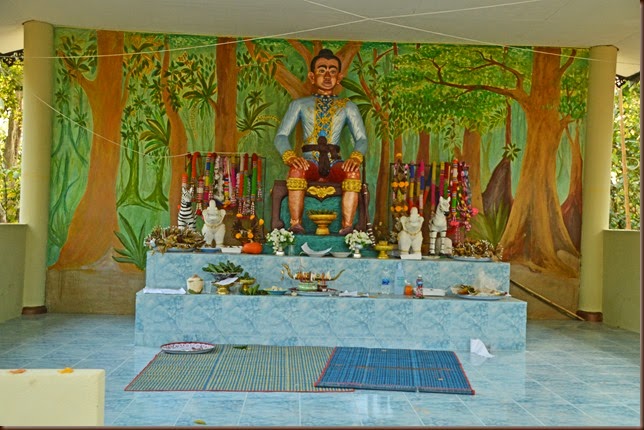
There is a shrine to the “Lord (spirit) of Wiang Kaen” (เจ้าหลวงเวียงแก่น).  A new one has just been built in the last couple of months; it is adjacent to the old one.

Jao Luang Wiang Kaen Shrine
Shrine of the "Lord of Wiang Kaen"

It's interesting to look back at this old city and see what it has become.  I'm sure that the people of the old city thought that what they built would endure for ages, but instead all that remains are a few mounds of dirt.

In the same way, we often behave like or think that the things we see around us, the product of the labors and imaginations of mankind, will last forever.  In reality, we really have no idea what our hometown will look like in 50 or 100 years.

Only God is the eternal, unchanging one; He and His word will remain forever.


Why spend money on what is not bread,
    and your labor on what does not satisfy?
Listen, listen to me, and eat what is good,
   and your soul will delight in the richest of fare.
Isaiah 55:2 (NIV) 

For he is the living God
   and he endures forever;
his kingdom will not be destroyed,
   his dominion will never end.

Daniel 6:26b (NIV)

Tuesday, March 31, 2015

A Touch of Gold


Yellow is the King’s color.  Consequently it is popular to plant things with yellow flowers.  It’s amazing how many tree species there are with yellow flowers.  Not only are there planted trees, there are a lot of wild ones as well.

Today when I was bicycling I was surprised to see a bunch of unfamiliar yellow blooms on the road that had fallen off of a tree.  I quickly turned my bike around to investigate.  As I picked up a bloom, it was apparent to me that it must be some kind of gardenia.  A quick sniff caught a pleasant fragrance that seemed to confirm this.

The Golden Gardenia is native to the dry forests of Thailand (“dry” meaning that there is a significant dry season when many trees lose their leaves.)

Gardenia sootepensis Hutch. Rubiaceae-Golden Gardenia, คำมอกหลวง
Gardenia sootepensis (Rubiaceae)
Golden Gardenia, คำมอกหลวง

When I think of all the amazing diversity just in the yellow flowers of Thailand, I am in awe of such a creative God that could put such things together.  I think of the King of Thailand, who appears quite majestic when decked out in his golden outfits, yet which pales in comparison to the clothing that God has placed on his creation.

Jesus said: Consider the lilies of the field, how they grow: they neither toil nor spin, yet I tell you, even Solomon in all his glory was not arrayed like one of these. (Matthew 6:28, 29)

Below is a sampling of some of the yellow flowered trees in Thailand.  Were I to add shrubs, and ground covers and vines, it would be a much larger set of photos.

Tabebuia chrysantha Bignoniaceae: Golden Trumpet Tree, เหลืองอินเดีย
Tabebuia aurea (Bignoniaceae)
Silver Trumpet Tree, เหลืองปรีดียาธร

Cochlospermum religiosum (L.) Alston Bixaceae: Silk-cotton tree ฝ้ายคำ
Cochlospermum religiosum (Bixaceae)
Silk-cotton tree ฝ้ายคำ

Cochlospermum regium (Schrank) Pilg. Bixaceae: yellow cotton tree, yellow silk cotton, ฝ้ายคำ
Cochlospermum regium (Bixaceae)
yellow cotton tree, ฝ้ายคำ

Pterocarpus indicus Willd. Fabaceae Faboideae (Papilionoideae) paduak 15
Pterocarpus indicus (Fabaceae: Faboideae)
paduak, ประดู่บ้าน

Peltophorum inerme (Roxb.) Naves ex Villar Fabaceae: Yellow poinciana, นนทรี
Peltophorum inerme (Fabaceae: Caesalpinioideae)
Yellow poinciana, นนทรี

Cajanus cajan (L.) Millsp. Fabaceae Papilionoideae: pigeonpea, ถั่วแระ
Cajanus cajan (Fabaceae: Faboideae)
pigeonpea, ถั่วแระ

Acacia auriculiformis A.Cunn. ex Benth. Fabaceae Mimosoideae: Black Wattle, กระถินณรงค์
Acacia auriculiformis (Fabaceae: Mimosoideae)
Black Wattle, กระถินณรงค์

Senna surattensis ( Burm. f.) Irwin & Baruaby Fabaceae Caesalpinioideae: scrambled eggs, ทรงบาดาล
Senna surattensis (Fabaceae: Caesalpinioideae)
scrambled eggs, ทรงบาดาล

Golden Shower Tree near Kaeng Pha Day 3
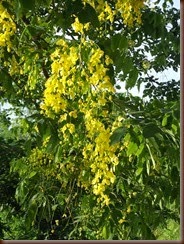
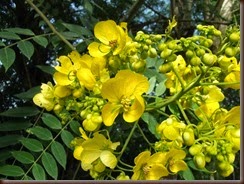
Cassia fistula (Fabaceae: Caesalpinioideae)
golden shower tree, ราชพฤกษ์

Cassia alata (L.) Roxb. Fabaceae Caesalpinioideae: Candle bush, ชุมเห็ดเทศ
Cassia alata (Fabaceae: Caesalpinioideae)
Candle bush, ชุมเห็ดเทศ

Senna spectabilis (DC.) H.S.Irwin & Barneby Fabaceae Caesalpinioideae: ขี้เหล็กอเมริกัน, สุวรรณพฤกษ์
Senna spectabilis (Fabaceae: Caesalpinioideae)
สุวรรณพฤกษ์

Senna siamea (Lam.) Irwin & Barneby Fabaceae Caesalpinioideae: Siamese cassia, ขี้เหล็กไทย, ขี้เหล็กหลวง
Senna siamea (Fabaceae: Caesalpinioideae)
Siamese cassia, ขี้เหล็กไทย

Ochna integerrima (Lour.) Merr. Ochnaceae: Mickey Mouse Tree, ช้างน้าว
Ochna integerrima (Ochnaceae)
Mickey Mouse Tree, มิกกี้เมาส์, ช้างน้าว

Wednesday, February 18, 2015

The Invisibles


Each year about this time we prepare our budgets for the following fiscal year.  As I look at the process of creating budgets, getting them approved and managed and all of that, I am reminded of an awesome group of people we have working behind the scenes that help us to be here:

The finance team.

This group of people do things like:
  • making sure our finances pass the requirements of tax laws in two countries
  • processing payroll (making sure we get paid)
  • receiving and receipting gifts
  • processing expense vouchers
  • overseeing the budgets of all people and projects
  • seeing that our budgets align with our mission and vision

These folks aren’t in it for fame and glory.  Most of the time we aren’t aware of them as they quietly process numbers and make sure at the end of the day that everything adds up—which is hard enough if you only have to deal with one currency.

So I want to say a big thank you to:

Al, Dale, Dianne, Gayle, Kathy, Rachel, Selwyn, Susan, and Viv
(did I miss any?)

They do what they are called to do so that we can do what we are called to do.

(You can read more about them here.)

But as it is, God arranged the members in the body, each one of them, as he chose. If all were a single member, where would the body be? As it is, there are many parts, yet one body. (1 Corinthians 12:18-20)


Saturday, January 24, 2015

What is Food?


Recently I saw a video about Asian food on facebook.  It was about how Asian food is much different from some other types of food.  One of the strange lines in it, though, mentioned that they don’t eat dog, that the most exotic they eat is frog.


And I’m thinking that maybe they’re only part Asian.  Because I’ve seen way more “exotic” kinds of food here.

Including frog.

Huay sed 31
I'm thinking the frogs aren't happy about being food

AND including dog.

One time we were having a meeting.  Those in charge had ordered grilled chicken, sticky rice and papaya salad for lunch.  That is actually one of my favorite meals.  Some of the guests, however, were wanting something a little less mundane.  So someone was going around asking if anyone wanted to contribute for some special food, i.e., dog.

I stuck with the chicken.

If there was a key to what constitutes food among the Khmu and the other tribal groups, it would probably look something like this:

1a Was never once living Generally not food-except things like salt, MSG, etc
1b Is or was alive at some point Potential Food (go to 2)
2a Is generally considered poisonous Mostly not food (except possibly in small amounts as medicine)
2b Is not generally considered poisonous Go to 3
3a Never moved on its own (i.e. plant products) Probably food
3b Does now or once moved on its own Go to 4
4a Is/was human not food
4b Is/was not human Probably food

The one exception I can think of to this is domestic cat: I have not heard of the Khmu people eating cat (though when we lived in Haiti, some people would almost drool over our well-fed kitty.)

It’s interesting, though, that even my Khmu friends can be a bit picky.  One time I was sitting with some friends and they were discussing the merits of different kinds of wild food.  One fellow was saying that Lampang was a great place because they could get monkeys there—and monkeys brains were wonderful!

However, further on in the conversation, the person who was raving about monkey brains said, in all earnestness, “but the Chinese eat really strange food.”

Monkey Hill-27
Me: potentially dangerous wild animal
My Khmu friends: food

What’s the difference between a rat and a rabbit?

Since a rabbit and a rat are both rodents, one might say that the difference between them is that one has short ears and a long tail, the other has long ears and a short tail.  Since I used to raise rabbits for meat, I guess it should not be surprising that I have no problem considering rats to be food as well.

Here in northern Thailand, there are not a lot of wild animals left.  There are however certain species of rat that live in the forests.  I’ve eaten this kind of rat and it tastes okay, except they’re small and it’s hard to get the meat off the bones.

Forest Rat: Where's the meat?

So I was telling my friends once that when we lived in Chachoengsao, at certain times of the year one could buy rice rats.  They would sell this grilled from roadside stands.  The rats were big and they tasted okay, though the meat was a bit pricey.  But my friends here stated unequivocally that the rice rat meat was not as good as forest rat.

Rice Rat 4
Rice Rat: Lot's of meat on this, but not as good as forest rat

Snake Hunting

A missionary friend of mine tells of an occasion when he was driving down the road with some Khmu friends and a snake started to cross the road.  One of the Khmu guys told my friend to hit the snake—so he did.  Then they stopped the car and went out to gather up dinner.

Cooking snake at Golden Triangle 3
Snake got too close to the fisherman's boat.  Within minutes it was being turned into lunch.

Of course, it may be that you would rather just use the snake for flavoring.  At the Golden Triangle and other places, there are many vendors selling liquor imbued with snake and other creatures, which is supposed to impart certain forms of prowess to the drinker.

Donesao Island Tourist Market 11
Do you want your liquor with scorpion, cobra, or both?

What bugs you?

All kinds of insects can be had to eat in Thailand.  With insects, texture is more an issue than actual flavor.  For example, deep fried caterpillars and grubs taste similar too and look almost like small French fries.  But the legs of grasshoppers get easily stuck in the teeth.

You can also get fried grubs in the night market
Bamboo worms: good if fried crisp

Bite the Hand That Eats You

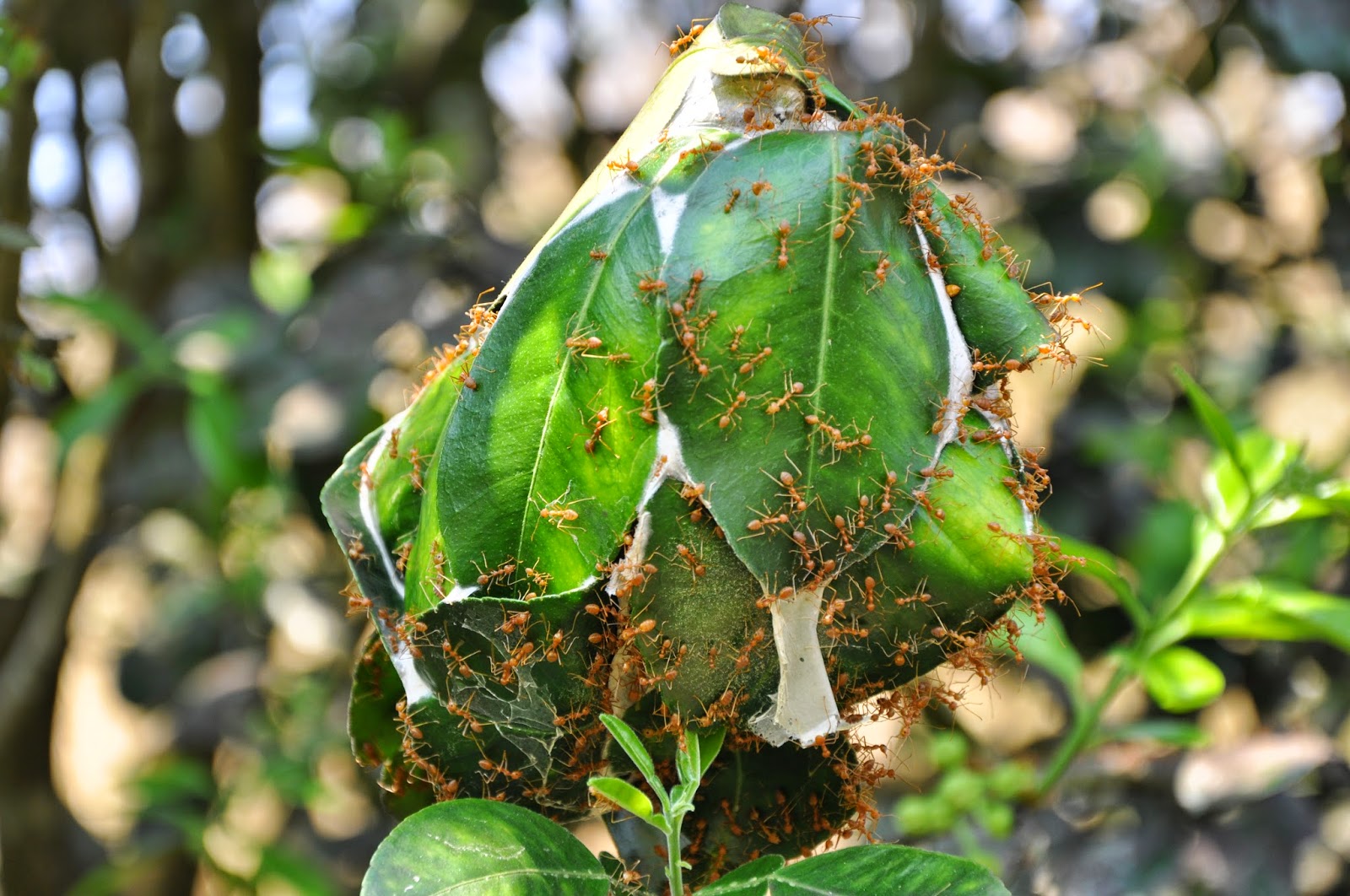
Here in Thailand there is a species of ant that builds it's nest in trees, using leaves to make the nests.  These ants inflict a painful bite.  However, their eggs are a valued source of food.  So to harvest the nests and get the eggs, they put a net on a long pole so hopefully they can get the nest loose before the ants get to biting.  The eggs look like rice, but they are soft.


Ants on nest in pummelo tree

Nets for harvest ant nests

Ant eggs for sale in the market

Friday, January 2, 2015

Bookends 2014

The Road Less Traveled

Each year for the past few years, I take my first and last photos of the year to create a blog post.  This year's entries speak a little about who we are.

First Photo: Scarecrow in rural Chachoengsao
Scarecrow in Rice Paddy

My wife and I are  not city people.  I used to say: “if I ask you directions to the city, it is so that I know which way NOT to go.”  While Thailand still has a dominant rural/small town population, there are areas where the population is quite dense.

When we lived in Chachoengsao, we had a mix of both worlds.  Our subdivision was close to the border of Bangkok and not far from Bangkok’s main airport.  The subdivision was designed for the lower middle income bracket—and served primarily to house people who worked at the airport or related industries.  And while the subdivision was surrounded by rice paddies, it was full of densely packed townhouses such as you might find in the city.

One of the challenges of urban life in Thailand is driving.  Someone suggested that one reason driving is so challenging is that people learn to drive on a motorcycle first, and they drive those as if there aren't any rules in particular that apply to them (traffic signs, direction of traffic, uses of lanes, etc., are for cars.)  Eventually they move up to a car or van or even a big freight truck but the bad habits from their motorcycle years remain.

Add to that the fact that roads aren't just for driving.  They are also for temporary storage of construction materials, parties, selling, etc. They are also in some areas the favored sleeping spots for dogs.

The result is that driving is one of my least favorite things to do here.  In Chachoengsao, the road to our subdivision was along a canal.  It had two narrow lanes and no shoulder.  Much of the way the road was lined with houses that were in the narrow space between the road and the canal. One had to be especially careful not to hit someone or something.  So in the dry season, I tended to take an alternate route.  There was another road ran parallel the canal road that went through the fields.  It was mostly unpaved and quite rough about a month into wet season. But there was little traffic and hardly any homes to speak of.  So I found the drive to be much more relaxing.

The main crop grown along the road was rice—at least 3 crops per year.  And scarecrows could be seen in many of the fields.  Sometimes, from a distance, on would almost think they were people as they moved about in the wind.  I like the touch of adding a CD to the above scarecrow.  Now if you could just get scarecrow to do karaoke—that would keep the birds away!

Last photo: hibiscus
Hibiscus sp. Malvaceae 2

A year later finds us far removed physically and culturally from Chachoengsao.  We are living in a small town—so small there isn't even a Seven-Eleven (though rumor has it one is coming).  While many people don’t like living in such a small town as this, it is well suited to us.  A weekly trip to the grocery store in Chiang Khong (30 km away) supplies us with some of those things that our foreign taste buds enjoy that we can’t find in the market or small shops here.

We rent a house with a yard that even has space to plant things.  So now it’s a challenge for me to visit a plant nursery because there are so many beautiful and/or edible things to plant, but the yard is only so big and time to keep it up is limited.  And now that our goals for our work here have changed, it means we may actually be able to stay in our house a few years.  Consequently, we can think down the road when choosing what to plant.

We were at a plant nursery in Chiang Rai a couple of weeks ago.  One of the sellers had a good selection of different types of hibiscus.  All so beautiful.  We ended up getting two.  The one in the photo got a pretty pot and became a New Year's gift for our landlord.  I still have to figure out where to put the other one.

Wiang Kaen is not where we had hope to be living—we had dreams to be working in a different part of the country.  But if one has to live some place, this, for us, is a nice place to live.

Take delight in the LORD, and he will give you your heart’s desires.Psalm 37:4 (NLT)

Top Twelve 2014

It’s time for my yearly challenge of trying to pick one favorite photo from each month of the past year.  With only several thousand to pick from, the process of dong this reminds me of how God has been at work in my life and in the lives of those around me during the past twelve months.

January-Reunion


January was a busy month.  We had just returned from 3 months in the states and soon we were off for a week to look at places to live in Chiang Rai province.  We returned via Chiang Mai and then, on our way back from there, Ingrid broke her arm

Just after we got back to Chachoengsao, we were able to meet up with my Norwegian sister, Ingrid, and he husband, Einar.   It was our first time to meet Einar.  We took them on an outing to Chonburi.  We visited the monkeys at Monkey Hill and we showed them the mangrove conservation area.  They were happy to get to visit this atypical tourist spot (few foreigners come there).  We enjoyed watching the mudskippers and listening to the popping sounds of the shrimp.  I set my camera on the tripod along the boardwalk to catch this selfie.

February-Still Rambling
Wiang Kaen house 3-Ramblong Russells

February was our month to move to our new home in Northern Thailand.  We had found a place the previous month.  When we arrived at the house, we decided the place needed painting before we moved in.  Then, I flew back to Bangkok and headed back to or old place in Chachoengsao to get stuff ready for the moving truck.  That was my romantic Valentine’s day.

After the truck was loaded, I flew back to Chiang Rai and drove the two hours to Wiang Kaen.  We met the movers at about 4 am the next morning and unloaded the truck

We felt it appropriate to hang up this sign on the front post.  My dad had made this to hang up at our campsites on the many trips we made during the 1960’s.

March-Butler Church meets CLC
FCBC Medical Team Wiang Kaen Day 2 31

In March we had a 3 week window between when Bob and Chris came back from Mobilization in North America (MINA) and when Phone Keo and Chansone left on their MINA.  During this time the Changing Life Center had a visit from a medical team from the First Chinese Baptist Church in Fresno.  We were helping with logistics and translation.

A challenge was that many of the people did not speak Thai very well—so we had to rely on the few people that know both Khmu and English—such as Phone Keo.  In the photo above, he is translating for Dr. Jack Patton.  Both are from our home church in Fresno-Butler Church.

April-A new association 
Thailand Khmu MB church association formation meeting

Most of our work here centers around working with leaders of the various Khmu churches in helping them along the path to self-sufficiency.  One of the important steps in that process was to create a formal organization of Khmu Churches that will eventually be completely responsible for the work here.  In April, that organization was launched and leaders were selected.  Here we are praying for the leaders of the organization-Yut, Koon, Amarin and Naan.

May-SOLA Team
SOLA team at Huai Caw 23

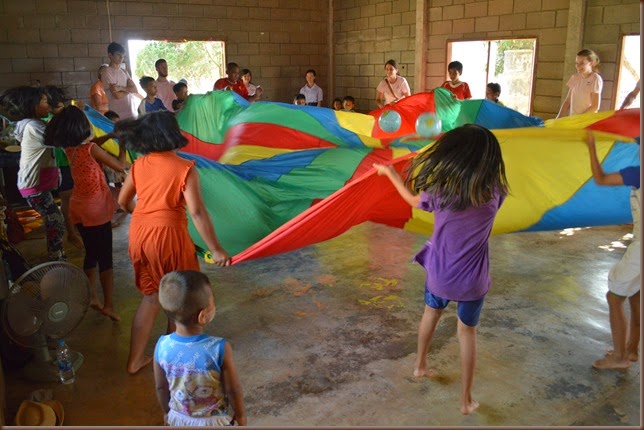
SOLA—the young adult ministry of Northview Church in Aboottsford—sent a team to help us with various ministries.  With their assistance we had an English camp in one one of the local schools. They also put on some VBS programs, such as the one pictured here in Huai Jaw church.  With these parachutes anyone can create a lot of fun—even if you don’t speak the language.

June-Funeral 
Funeral 024

In June, our next door neighbor passed away.  It was for us an amazing time of learning about North Thai culture and building relationships.  Because of the very close proximity of our houses, we got to experience much of what went on even without leaving our home.  The crowd spilled over onto our front porch during the evening chanting and the canopies set up over the dining are came up under our eaves.

Phawkham left behind his widow, his son (above right) and granddaughter—all of whom lived with him.  Our landlord—younger brother of the deceased—is pictured above on the right.

July-visit from family and vacation 
Along Sam Roi Yod Beach 2

It was especially hard to pick a photo from this month.  Our landlord’s daughter passed away while she was visiting from her home in Hong Kong, and they asked us to take photos and videos of the event.  Then we had a team come and help us with an English camp and other things.  This team included soem young people from our home church, so we were quite excited about that.  Also this month was our annual MB Family Camp—with people from all the MB churches across Thailand coming together in Kanchanaburi province.

We combined attending Family Camp with joining up with Ingrid’s sister and our niece who came to visit.  This made our longest road trip in Thailand ever.  Not all those who visit us will get to experience Thailand like they did.

We went to one of our favorite places—Sam Roi Yod—located southwest of Bangkok on the Gulf of Thailand.  We saw monkey’s and caves and some really fascinating places.  We stayed at the Juniper Tree lodge, located across the street from the beach pictured here.

August—Pummelo festival 
Pummelo Festival Parade 11

The end of August saw the convergence of two events.. One event was the biannual conference of Anabaptists which we hosted at the Changing Life Center.  At the same time was the annual pummlo festival in Wiang Kaen.  (Pummelos are a type of citrus fruit that resemble a grapefruit)  Pummelos are one of the leading crops of this area.

The festival is kind of like a county fair—lots of vendors selling things, produce displays, entertainment, fair food (not the same as the Big Fresno Fair) and, to kick it off, a parade.

Lai is a Hmong girl who we have been helping to teach English.  She has become kind of like a daughter to us.  It was a joy for us to see her playing saxophone in the High School Marching Band.  (She is the saxophonist closest to the camera in the above photo.)

September-Rice 
Oryza sativa L.  Poaceae: rice, ข้าว

Thailand is the world’s leading exporter of rice.  But there is still plenty left for local consumption.

Before I came to Thailand, I only knew of rice as a crop grown in paddies.  But here in Southeast Asia there is a lot of upland rice.  Generally, the upland rice here is sticky (glutinous) rice.  Sticky rice is favored by many of the tribal groups in Thailand as well as the North Thai and Isaan Thai (both of which are culturally and linguistically distinct from Central Thai).

In the photo above, I am standing on a hillside surrounded by upland rice.  But not far away in the creek bottom is paddy rice.  The paddy rice is darker green because it has not yet begun to form seed heads.  The photo was taken about 12 kilometers up the Ngao River Valley from where we live.

October-Cloud Forest
Ang Ka Nature Trail 16

In October we decided to take the remainder of our vacation time in Chiang Mai province.  While there we got to see some waterfalls and a large garden park. We were able to visit with friends who were there from Fresno as well.  Chiang Mai province is also home to Doi Inthanon—the highest mountain in Thailand.

The top of the mountain is often called a “cloud forest” because it is in the clouds so much of the time. There is a unique area near the summit that looks almost like coastal BC with its mossy trees and there is even an area of sphagnum moss—something quite unusual in the tropics.  There is a boardwalk (pictured above) to take you through this area called Ang Kaa (Crow Basin).

November-Clear Mountain Views
Doi Pha Tang Park 13

Clear blue skies are unusual here in Northern Thailand.  During rainy season, there are the ubiquitous clouds that turn the skies gray for about 6 months.  Soon after that, the rice and corn is harvested and then they burn off the fields making the skies murky.

But in November, the rainy season here in the north has just come to an end.  And since the rice harvest is just underway, they have not started burning the field yet.  As a result, this is the time of year when we have the bluest skies.  It is a great time to go to the mountains.

The closest area to visit the mountains near us is called Pha Tang, located about 30 kilometers away (the last 15 km contain some very steep stretches).  The elevation there is over 4000 feet.  On this day, the morning fog-clouds were almost finished breaking up.  In the photo above, the warm air was moving up the west slope, effectively halting the movement of the clouds blowing in from the east.  This picture was take about noon time—by 3 pm there was hardly a cloud in the sky.

December-Place of Worship 
Pa Tung panorama 2

In the advent season, we take the opportunity to tell the story of the first Christmas.  Our calendar becomes filled with various Christmas related outreach events.

During this season, we continue to worship at Pa Tung Church.  This church was the dream of Somsak (playing guitar above).  Somsak is from the area and when he was in High School not so long ago, he stayed in the dorms that MB Mission had near the high school campus.  During that time he became a Jesus follower.  He went on to get his education degree and has come back to the area to teach, along with his wife (also a teacher).

There are few Christians in his village (one other adult besides his wife).  He had a bamboo structure erected in his front yard to hold worship services.  The thatch roof had just been replaced a few days before I took the above photo.

There are a couple of reasons we have been worshiping at this location.  One is that worship is conducted in Thai (most of the other worship services in our area churches are in Khmu, which we don’t understand).  The other reason is that this is a very young church and we are able to help with leadership training.

This is a good closing photo, because it highlights what will be the focus of our work for the next few years--helping equip disciples who can lead and grow the church.  Our team will be changing soon, with the addition of another couple, and then we will work together towards this goal.

Jesus said:

Therefore go and make disciples of all nations, baptizing them in the name of the Father and of the Son and of the Holy Spirit, and teaching them to obey everything I have commanded you. And surely I am with you always, to the very end of the age. Matthew 28:19-20 (NIV)