Sunset Over the Mekong River

Sunday, May 17, 2015

Bitter-Sweet

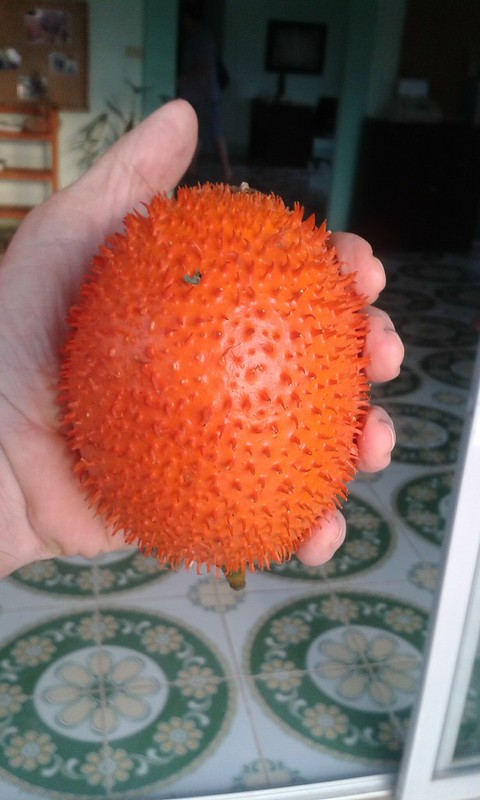
Recently, our teammates gave us a fruit (vegetable?*) that a market vendor persuaded them to buy.  They did so, owing to the fact that it was such an unusual looking thing.

I immediately recognized it as a fruit from the melon/squash family (Cucurbitaceae) because I had seen smaller ones growing in our neighborhood.  I could remember, however, neither the English nor Thai name for it.  (Our teammates told us the vendor had said it was called fakkhao).  And I certainly had no idea how to eat it.

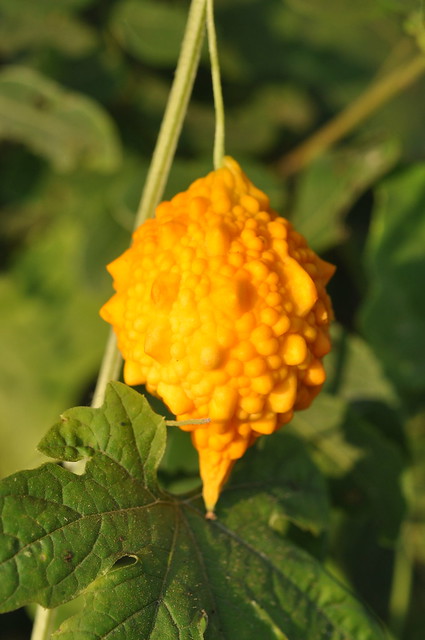
Since I had my computer open, I quickly found that its name is Spiny Bitter Gourd (Momordica cochinchinensis; Thai: ฟักข้าว), and it certainly seemed like an appropriate name.


Momordica cochinchinensis (Lour.) Spreng. Cucurbitaceae-Spiny Bitter Gourd, ฟักข้าว


The plant is related to the bitter melon**, a popular vegetable in some SE Asian cultures.

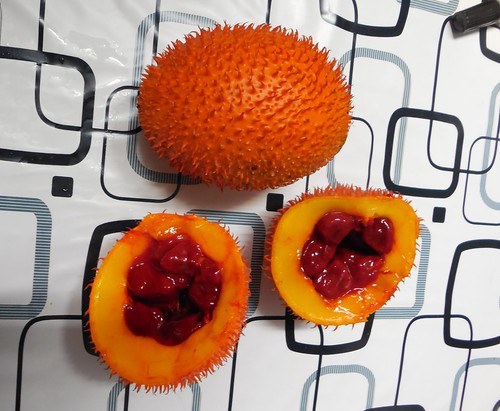
We took the fruit home and cut it open.


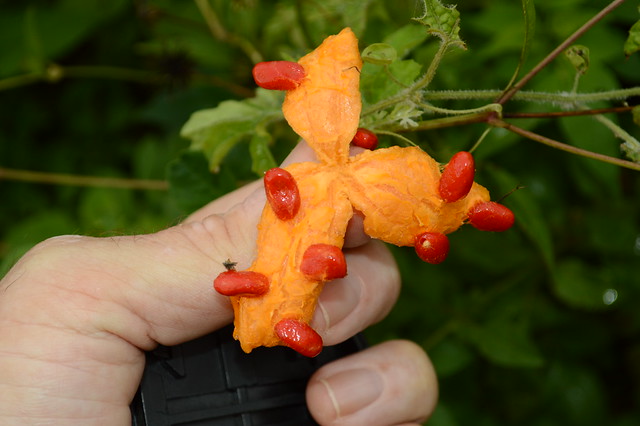
Momordica cochinchinensis (Lour.) Spreng. Cucurbitaceae-Spiny Bitter Gourd, ฟักข้าว


A quick taste of the orange flesh let us know quickly how it got its name: it certainly was bitter.  However, we decided to suck the pulp on the seeds and it had a slightly sweet, pumpkin-like flavor.  (Apparently the seeds are used to add a red color to some food dishes.)

Bitter.

Sweet.

Both in one.

So it struck me that the fruit is somewhat a picture of life.  Our life gets filled with many kinds of experiences and some of them are sweet, but some of them are also bitter.  Maybe the bitter parts make the sweet parts sweeter--like sucking on the red seeds AFTER eating some of the orange flesh.

I don't think it's possible to escape this life without having both bitter and sweet.  The challenge is to get through it while still remaining sweet and not becoming bitter oneself.  I've met many old people who have allowed their experiences to make them bitter, and they are certainly not pleasant to be around.  People tend to avoid them--which make them even more bitter.

I don't want to end up that way.  So I want to try to practice what the bitter people seem to avoid doing:

Forgive easily.

Don't hold onto grudges.

That way I can be more like the sweet smooth seeds of the Spiny Bitter Gourd and less like its prickly, bitter flesh.

As Paul writes in Colossians 4:6--Let your conversation be always full of grace, seasoned with salt, so that you may know how to answer everyone. 

* Botanically, this is a fruit.  Some however might consider it to be a vegetable.  In a similar way to how people consider a cantelope to be a fruit, but its close relative and similar looking food, the cucumber, is considered a vegetable.

**
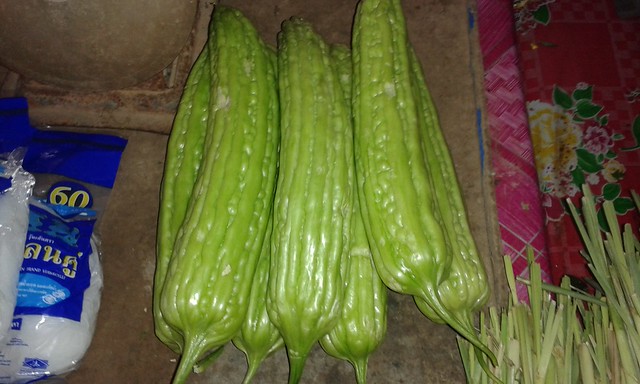
The bitter melon, which one can buy in the markets, looks like this.  This is the cultivated version.


Momordica charantia L. var. charantia Cucurbitaceae: bitter cucumber, มะระ


The wild version of the same species, however, looks much different.


Momordica charantia L. Cucurbitaceae: bitter cucumber, มะระ


When the wild bitter melon matures, it bursts open to reveal red seeds, similar to the Spiny Bitter Gourd.


Momordica charantia L. var. abbreviata Cucurbitaceae: bitter cucumber, มะระ

Monday, May 4, 2015

The Summit


This past week it was our joy to attend the Southeast Asian Leadership Summit.

A lesson in linguistics

This event brought together MB Mission leaders from throughout the region.  As such, there were several languages being used.  At times my head would spin from not knowing which speaker/language to latch onto.

Andy organized the event.  He had our agency's mission and vision statement reduced to a quasi-mathematical formula that could be printed on t-shirts that our participants could wear--even in places not friendly to the gospel.


The summary statement was printed in full in three languages on our notebooks, and would have been in four, if Khmu had a written language.


We were blessed by a visit from Randy F. as he shared some stories of how the mission and vision of MB Mission is playing out around the world.


In a country where being a leader typically means having a title, an office and a nice salary while others serve you and do all the work, we were honored to be able to demonstrate the nature of leadership as modeled by Jesus in serving others.


Encouragement

We had the opportunity both to be prayed for and to pray for others.


Worship through music was in Thai, English, Burmese or Khmu--depending on which group was leading.


It is easy to get discouraged when we are constantly surrounded by "problems" that need to be fixed.  As our team has been working to implement changes to bring about lasting solutions, we were encouraged by this conference which laid out a foundation for what we are trying to do--and in a very timely manner.

Let us not give up meeting together, as some are in the habit of doing, but let us encourage one another--and all the more as you see the Day approaching. Hebrews 10:25 (NIV)


Tuesday, April 14, 2015

The Wait

About Christmas-time last year, we were looking for a gift.  We thought that a desert rose would be a nice gift for the person had in mind.

The desert rose (Adenium obesum) is not actually related to a rose at all, but is in the same plant family as dogbane—a common weed where I grew up in Connecticut.  It is a plant that is often trained for bonsai.  By pinching back the tips, the shrub will remain short but will get quite stout.

The particular pant we saw was looking not very attractive in a pot that was overgrown with weeds.  The owner of the nursery seemed a bit reluctant to sell.  It was somewhat expensive, but I was expecting that, because he had been raising it for 7 years.

We brought it home, cleaned it up, and repotted the plant and soon it rewarded us by dropping what few leaves it had.

For three months we patiently watered and weeded the woody skeleton.

And then this happened.

Adenium obesum (Forssk.) Roem. & Schult. Apocynaceae desert rose, impala lily 3

About a week later it was like this.

20150407_104440

Perhaps one day it will look like this large specimen we saw in Chiang Mai.

Adenium obesum (Forssk.) Roem. & Schult. Apocynaceae: desert rose, impala lily, ชวนชม

While it seems like we had to be rather patient with the desert rose, our pineapple plants have done a much better job at testing our patience.

Shortly after we moved here in February of last year, we stuck a pineapple top in the ground.

Ananas comosus (L.) Merr. Bromeliaceae Pineapple 7

It seemed like it was doing OK, as it began to grow.  But once it got to a certain point, it seemed to stagnate—not dying but not growing either.  It was like this for many months.

Ananas comosus (L.) Merr. Bromeliaceae Pineapple 8

Then, all of a sudden, the innermost leaves started to turn red and a flower bud began to emerge.

Ananas comosus (L.) Merr. Bromeliaceae Pineapple 3

After several more weeks, it is looking more and more like a pineapple.  And who knew they had such pretty purple and white flowers.

Ananas comosus (L.) Merr. Bromeliaceae Pineapple 12

I’m not great at waiting.  But it seems that to achieve most good things in this life it takes patience and hard work.

The Bible is full of verses about “waiting on God” and being patient with others.  A few examples:

In the morning, O LORD, you hear my voice; in the morning I lay my requests before you and wait in expectation. Psalm 5:3 (NIV)

Therefore the LORD waits to be gracious to you, and therefore he exalts himself to show mercy to you. For the LORD is a God of justice; blessed are all those who wait for him. Isaiah 30:18 (ESV)

Love is patient 1 Corinthians 13:4 (NIV)

Be patient, therefore, brothers, until the coming of the Lord. See how the farmer waits for the precious fruit of the earth, being patient about it, until it receives the early and the late rains.  You also, be patient. Establish your hearts, for the coming of the Lord is at hand. 
James 5:7-8 (ESV)

 
I’m not sure how much longer it will be until we can eat some fruit, but we’re certainly looking forward to it, and I’ll try to be patient.

Ananas comosus Bromeliaceae: pineapple, สับปะรด


Thursday, April 9, 2015

The Bride Price

   An excellent wife who can find?
        She is far more precious than jewels. 
   Proverbs 31:10 (ESV)

A couple of days ago we were invited to a nearby Khmu village for a house dedication ceremony. However, the person who had invited us was at a dowry ceremony, so we got to sit in on that instead.

At the beginning, there were only a few men, but the crowd gradually grew to include women as well.

In the photo below, the father of the groom is assembling the dowry tray.  Among other things, several parts of a pig are included, especially, we were told, the head and the tail.  Without those two things, the dowry would not be accepted.  In this photo, the heart and the tongue are being tied together by a piece of bamboo cord.

The man in the light blue shirt on the left is the father of the bride.


Below is a photo if the tray, which contains most of the dowry.  There is a bamboo basket containing cash and a few ingots that date back to the days of French Indochina.  From a pig there is the split skull, a piece of the rump skin with tail attached, the heart, and the tongue.  There is also a small boiled chicken.

The green leaves are from a special plant that is revered for decor because it does not suffer from insect or disease damage.  There pink flowers are Bougainvillea, the red ones are a type of Ixora.


The fellow in the orange shirt appears to be the dowry broker as he is the one who checked to see that everything is in order.  Having counted the cash, he has the father of the bride verify the count before placing it back in the basket for the official presentation.

You can also see from this photo that there are generous amounts of orange Fanta going around.


The broker then takes the chicken and removes its legs and and wishbone to see if they are sufficient quality.


After he inspects the chicken parts.  The broker then grabs the heart, which has already been cut open, and checks to see if it is good.  Then he examines the split open skull to see it that also is of good quality.  (The rest of the pig is in process of becoming dinner.)


Once everything has been inspected and approved, it is officially presented to the parents of the bride.  The father of the groom, groom and bride to be hold the basket on one side and the father and mother of the bride receive it on the other.


In addition to the gift to the parents of the bride, there is a gift to the bridal couple as well.  There is a package of fabric to be used as a wrap-around skits (ผ้าถุง), which is opened and the pieces of fabric are counted--there are twelve of them.  There are also a couple of blankets.  In the photo below you can also see a bamboo canister which contains sticky rice (there are two of these.)


The groom's family is Christian and does not drink alcohol.  However, this is not the case for the bride's family.  A bottle of strong liquor is opened and a shot glass is filled and given to the father of the bride.  The same cup is refilled again and again until the important guests are served.  The bottle and shot glass are then passed among the guests.  It seems to spend most of its time with a group of three men.


The father of the groom then offers up a prayer for the bridal couple.


Throughout most of this ceremony, the bridal couple seems disinterested and somewhat bored.  I'm not sure they ever smiled.  (That was also the case for the two Khmu weddings we have attended since moving here.)

Finally, dinner is served.  Trays of various foods are placed on the floor and bags of sticky rice are distributed to the guests.  Ingrid and I share one bag of rice.   I don't eat too much of this special food as four of the five dishes are heavily laced with cilantro.  The soup contains just a little bit of cilantro and so it is tolerable for me to dip the rice in that.

The dishes on the tray are:
Top left: raw pigs blood mixed with a few other things.
Top right: chopped organ meat and other meat
Bottom left: pork soup
Bottom right: ground raw pork

Off to the right is minced pork (lab ลาบ).


The wedding itself is scheduled for the following day.

While we enjoyed being a part of this cultural event, I have mixed feelings about the concept of dowries in general.  To me there seems to be the implication that a woman is "property", which can be sold.  Functionally, I'm not sure what the difference is between selling a daughter as a bride or selling her to be a prostitute.

To the husband, then, she is not an equal human, but merchandise that he has paid for. If he gets tired of her, he can buy another, newer one.  Or maybe just a temporary one.  After all, you can cheat on your wife, but not your property.

There is also the problem of the amount of the dowry--is the measure of the value of a woman only the amount of money that the father thinks he can get for her?

If wives could only be had for what women are worth, then even the Donald Trumps of this world would be single.

Some will say that the dowry is to help cover the cost of raising the daughter.  If that is the case, why are the sons not also sold?

Still, it is better than some cultures where the parents of the bride pay the parents of the groom to take her--as if the woman has negative value.

Tuesday, April 7, 2015

The Walled City

And the mountains shall be thrown down, and the cliffs shall fall,
and every wall shall tumble to the ground.
 Ezekiel 38:20b (ESV)


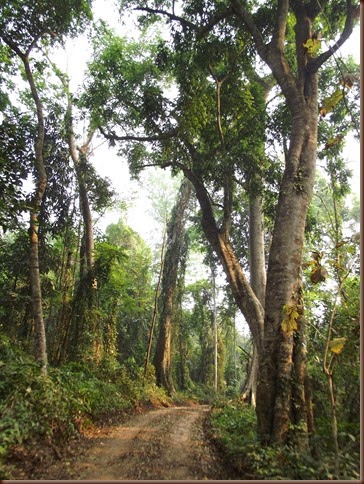
Soon after we moved to Wiang Kaen, we discovered a forest near our home that still had a lot of very large, old trees.  We were surprised because there aren't a lot of old native trees left in Thailand, especially near towns.

Satan Boran Forest scenes 8
Road through the forest

Looking at Google maps, we noticed that this Forest was fairly large in size.


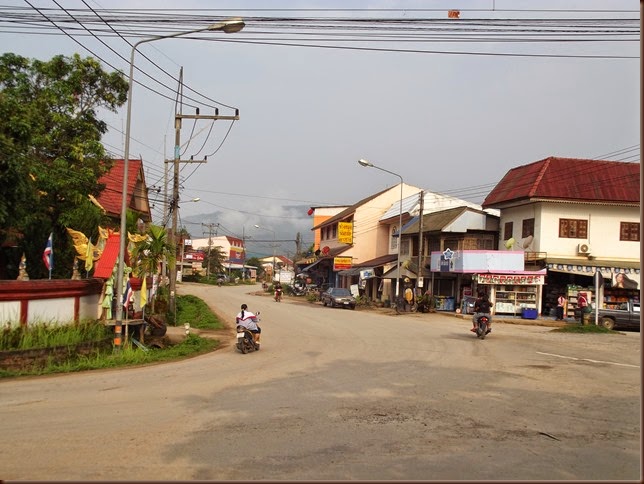
Another thing that struck us when we moved here is the name of the place: Wiang Kaen. “Wiang” is a term used to describe walled cities, and we certainly didn't seem to be any walls around that we could notice.

Downtown Wiang Kaen
Wiang Kaen today: Where's the wall?

Recently, they have been doing some cleaning up around the old forest, and in the process we have discovered something—the reason that this old forest still exists is because it is the old, walled city—it’s just that the forest have covered up a lot of the walls and moats and other historical landmarks in the place.  But now there is a map that shows the general layout.  Knowing this we have become aware of the old moat, quite deep in places and often near the present roads, but obscured by brush and trees.

The name of this place is “Boran Satan Wiang Kaen” (โบราณสถานเวียงแก่น which roughly translates: ancient Wiang Kaen) or “Wiang Kaen Forest” (ดงเวียงแก่น).  The old city was founded about 700 years ago.


Boran Satan 3
Map of the old city

The general pattern of the border is an exterior wall, then the moat, then a larger, interior wall.  Below are two photos of where the interior wall has been cut for a road.

Satan Boran Wall 1
The cut through the wall looking into the old city

Satan Boran Wall 1b
The cut through the wall looking out of the city

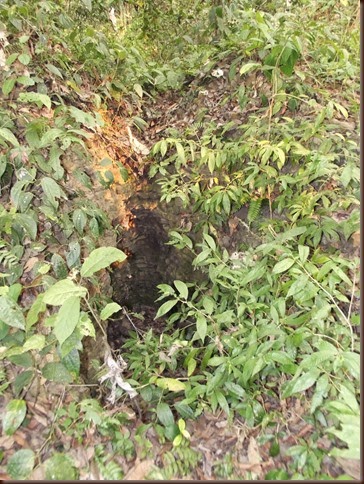
The moat is so grown over with vegetation, it is usually hard to notice that it exists.  In the photos below, I traced the approximate cross section of the moat.

Satan Boran Moat e
The moat


The Moat


The are a few small “hills” which are the remains of old chedis.  The one below is labeled #3 on the map.  It has been opened up so that you can see some of the old bricks inside.


Satan Boran Point 3 Chedi 2
One of the old chedis

Satan Boran Point 3 Chedi 8
Looking down into the chedi

Another old chedi is across from the present, simple, Buddhist temple.  This one has a large tree growing in it.

Boran Satan Point 4 Chedi
Another remains of an old chedi

The are other, interesting relicts scattered about the forest.  This Buddha image of uncertain vintage is along a mostly overgrown trail.  Some “lucky bamboo” plants in front of it show that it seems to have received some attention in recent times.

Boran satan Buddha image 1
Old Buddha image with newer
planting of lucky bamboo

The Buddhist temple is a bit different.  It is constructed like an ordinary building instead of using the usual ornate architecture.  The entrance is a roll-up steel door.  Often it is closed.

Muang Yai Forest Temple 1
The temple

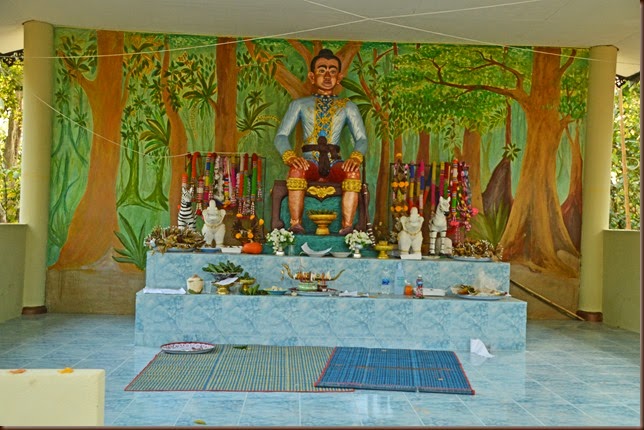
There is a shrine to the “Lord (spirit) of Wiang Kaen” (เจ้าหลวงเวียงแก่น).  A new one has just been built in the last couple of months; it is adjacent to the old one.

Jao Luang Wiang Kaen Shrine
Shrine of the "Lord of Wiang Kaen"

It's interesting to look back at this old city and see what it has become.  I'm sure that the people of the old city thought that what they built would endure for ages, but instead all that remains are a few mounds of dirt.

In the same way, we often behave like or think that the things we see around us, the product of the labors and imaginations of mankind, will last forever.  In reality, we really have no idea what our hometown will look like in 50 or 100 years.

Only God is the eternal, unchanging one; He and His word will remain forever.


Why spend money on what is not bread,
    and your labor on what does not satisfy?
Listen, listen to me, and eat what is good,
   and your soul will delight in the richest of fare.
Isaiah 55:2 (NIV) 

For he is the living God
   and he endures forever;
his kingdom will not be destroyed,
   his dominion will never end.

Daniel 6:26b (NIV)

Tuesday, March 31, 2015

A Touch of Gold


Yellow is the King’s color.  Consequently it is popular to plant things with yellow flowers.  It’s amazing how many tree species there are with yellow flowers.  Not only are there planted trees, there are a lot of wild ones as well.

Today when I was bicycling I was surprised to see a bunch of unfamiliar yellow blooms on the road that had fallen off of a tree.  I quickly turned my bike around to investigate.  As I picked up a bloom, it was apparent to me that it must be some kind of gardenia.  A quick sniff caught a pleasant fragrance that seemed to confirm this.

The Golden Gardenia is native to the dry forests of Thailand (“dry” meaning that there is a significant dry season when many trees lose their leaves.)

Gardenia sootepensis Hutch. Rubiaceae-Golden Gardenia, คำมอกหลวง
Gardenia sootepensis (Rubiaceae)
Golden Gardenia, คำมอกหลวง

When I think of all the amazing diversity just in the yellow flowers of Thailand, I am in awe of such a creative God that could put such things together.  I think of the King of Thailand, who appears quite majestic when decked out in his golden outfits, yet which pales in comparison to the clothing that God has placed on his creation.

Jesus said: Consider the lilies of the field, how they grow: they neither toil nor spin, yet I tell you, even Solomon in all his glory was not arrayed like one of these. (Matthew 6:28, 29)

Below is a sampling of some of the yellow flowered trees in Thailand.  Were I to add shrubs, and ground covers and vines, it would be a much larger set of photos.

Tabebuia chrysantha Bignoniaceae: Golden Trumpet Tree, เหลืองอินเดีย
Tabebuia aurea (Bignoniaceae)
Silver Trumpet Tree, เหลืองปรีดียาธร

Cochlospermum religiosum (L.) Alston Bixaceae: Silk-cotton tree ฝ้ายคำ
Cochlospermum religiosum (Bixaceae)
Silk-cotton tree ฝ้ายคำ

Cochlospermum regium (Schrank) Pilg. Bixaceae: yellow cotton tree, yellow silk cotton, ฝ้ายคำ
Cochlospermum regium (Bixaceae)
yellow cotton tree, ฝ้ายคำ

Pterocarpus indicus Willd. Fabaceae Faboideae (Papilionoideae) paduak 15
Pterocarpus indicus (Fabaceae: Faboideae)
paduak, ประดู่บ้าน

Peltophorum inerme (Roxb.) Naves ex Villar Fabaceae: Yellow poinciana, นนทรี
Peltophorum inerme (Fabaceae: Caesalpinioideae)
Yellow poinciana, นนทรี

Cajanus cajan (L.) Millsp. Fabaceae Papilionoideae: pigeonpea, ถั่วแระ
Cajanus cajan (Fabaceae: Faboideae)
pigeonpea, ถั่วแระ

Acacia auriculiformis A.Cunn. ex Benth. Fabaceae Mimosoideae: Black Wattle, กระถินณรงค์
Acacia auriculiformis (Fabaceae: Mimosoideae)
Black Wattle, กระถินณรงค์

Senna surattensis ( Burm. f.) Irwin & Baruaby Fabaceae Caesalpinioideae: scrambled eggs, ทรงบาดาล
Senna surattensis (Fabaceae: Caesalpinioideae)
scrambled eggs, ทรงบาดาล

Golden Shower Tree near Kaeng Pha Day 3
Cassia fistula (Fabaceae: Caesalpinioideae)
golden shower tree, ราชพฤกษ์

Cassia alata (L.) Roxb. Fabaceae Caesalpinioideae: Candle bush, ชุมเห็ดเทศ
Cassia alata (Fabaceae: Caesalpinioideae)
Candle bush, ชุมเห็ดเทศ

Senna spectabilis (DC.) H.S.Irwin & Barneby Fabaceae Caesalpinioideae: ขี้เหล็กอเมริกัน, สุวรรณพฤกษ์
Senna spectabilis (Fabaceae: Caesalpinioideae)
สุวรรณพฤกษ์

Senna siamea (Lam.) Irwin & Barneby Fabaceae Caesalpinioideae: Siamese cassia, ขี้เหล็กไทย, ขี้เหล็กหลวง
Senna siamea (Fabaceae: Caesalpinioideae)
Siamese cassia, ขี้เหล็กไทย

Ochna integerrima (Lour.) Merr. Ochnaceae: Mickey Mouse Tree, ช้างน้าว
Ochna integerrima (Ochnaceae)
Mickey Mouse Tree, มิกกี้เมาส์, ช้างน้าว

Wednesday, February 18, 2015

The Invisibles


Each year about this time we prepare our budgets for the following fiscal year.  As I look at the process of creating budgets, getting them approved and managed and all of that, I am reminded of an awesome group of people we have working behind the scenes that help us to be here:

The finance team.

This group of people do things like:
  • making sure our finances pass the requirements of tax laws in two countries
  • processing payroll (making sure we get paid)
  • receiving and receipting gifts
  • processing expense vouchers
  • overseeing the budgets of all people and projects
  • seeing that our budgets align with our mission and vision

These folks aren’t in it for fame and glory.  Most of the time we aren’t aware of them as they quietly process numbers and make sure at the end of the day that everything adds up—which is hard enough if you only have to deal with one currency.

So I want to say a big thank you to:

Al, Dale, Dianne, Gayle, Kathy, Rachel, Selwyn, Susan, and Viv
(did I miss any?)

They do what they are called to do so that we can do what we are called to do.

(You can read more about them here.)

But as it is, God arranged the members in the body, each one of them, as he chose. If all were a single member, where would the body be? As it is, there are many parts, yet one body. (1 Corinthians 12:18-20)