Sunset Over the Mekong River

Saturday, June 6, 2015

hacer faire ทำ fè

Other than English, I have studied, to one extent or another, four languages in my life.

And in those four languages (French, Spanish, Haitian and Thai) they combine two English words in one.

make, do=hacer faire fè ทำ

Today we were trying to explain the difference between these two words.  Generally it seems fairly simple.  Do is usually used with work or activity.  Make is usually used with things and intangibles, such as "make peace."  But it doesn't always seem so cut and dry.  Even we can mix it up a bit:

   What did you do today?
      I made a list of things to do.
   Did you do anything on the list you made?
      No, but I made an attempt at some of them.
      I even made an appointment to do some of them.

And then there are other subtle nuances.

Making a bed has a much different connotation than making the bed.

(I didn't try to confuse them with that one today.)

Then if you combine the two words, you get something else altogether: I'll make do with what I have.  (The Haitian language has a wonderful word with connotations similar to make doDégajè is such a handy word, it was hard to get used to not having it when we left Haiti.)


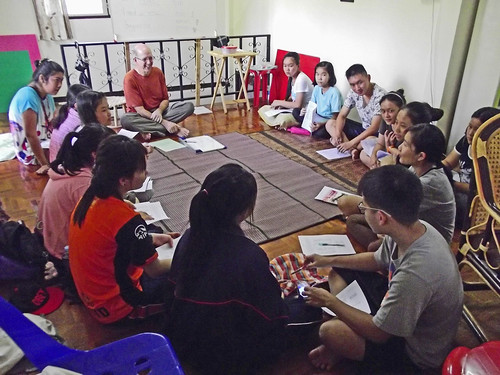
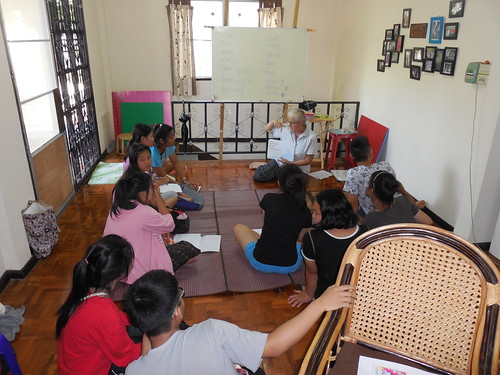
It was great to have a large group of teenagers in our house today for the class.  Even though there were more people than we expected, we made do and had a good time.  It was even hard to get them to leave when we were done.


Teaching English at home

Teaching English at home

Monday, June 1, 2015

All you can eat?

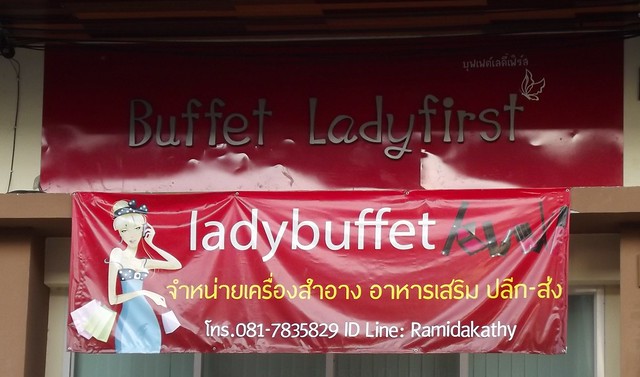
Lady Buffet

The use of English in Thailand is quite interesting.  Places are sometimes named in English, even though they are marketing to the Thai.  Perhaps this is supposed to be cool or make the place seem more upscale, I don't know.  But sometimes one sees some intriguing signs.

Take the store I saw in Chiang Mai recently:

ladybuffet

The name of the store was only written in English, there was no Thai name nor even a Thai phonetic spelling of the English.

So what kind of place is ladybuffet?

The English suggests one of two things:

A place where women can taste from all kinds of food.
A place where one can taste from all kinds of women.

(Interesting, that in the strange grammar that is English, it could be said of either of these that "they serve ladies", depending on whether "ladies" is the direct object or the indirect object.)

However, I've been in Thailand long enough to figure that this establishment was not either of the scenarios that I listed above.

There is a chain of beauty supply stores in Thailand called "Beauty Buffet".  My guess is that the owner of this place was playing off of that name and called it something similar, not realizing the strange nuances of the English language.

As I read the Thai, my suspicions were confirmed:

จำหน่ายเครื่องสำอาง อาหารเสริม  ปลีก-ส่ง

which translates:

Sell cosmetics, nutritional supplements, retail-delivery

Language is interesting.

It's not just words and meanings of words. It's how we use the words.  We often don't use words in a grammatically correct fashion but communication happens nonetheless.  Context is extremely important.

By naming his establishment ladybuffet, the owner is trying to make a statement.  I, as an outsider, may not get it.  The Thai people who visit will likely not understand the English meaning, but will probably understand the owner's meaning better than I.  For even though ladybuffet looks and spells like English, it is probably more of a Thai word than an English one.

So as we continue to try to improve our Thai language skills, we move beyond the words, to the context:

What did they say before and after?
What was their body language saying?
What was the venue in which it was spoken?
Are they, for cultural reasons, not actually saying what they mean?
What is the status of the speaker relative to the listener?
How do the speaker and the listener perceive each other?

Sometimes it can be rather simple to try to say what I mean.  At other times it can be quite complicated.

As I move into a new role here, where I am often in a leadership position in meetings, I have to think about these things a lot more.  What might have worked well for me in North America, may not work so well here.

I tend to speak short and to the point.  Why say something in 10 words if you can say it in 5?  Why do we need a 30 minute sermon if we can say the same thing in 10 minutes?

The Khmu people are storytellers.  They go on for several minutes giving background and context before they get to the main subject.  Sometimes I get lost before they get there and I'm wondering what they are talking about.

I, on the other hand, probably come across as if I don't care about them because I speak so directly.

As one leading a meeting, do I need to put the brakes on and redirect a speaker or do I let them continue?  (I usually tend to let them speak more so I can speak less.)

This past week I went to visit one of our church leaders known as Uncle John.  I didn't really have a lot to say.  John had lots to say.  Several days later he was still overflowing with gratitude, not because I went to say something to him, but because I spent time with him.  "Worth more than gold," he said.

Sometimes in communication one just needs context, words aren't so important.

For everything there is a season, and a time for every matter under heaven: 
    ... a time to keep silence, and a time to speak;  (Ecclesiastes 3:1, 7b)


Tuesday, May 26, 2015

cot cott cut

Last week we were teaching some high school students how to speak English.  The subject I briefly touched on that day was vowel pronunciation.

When one teaches such a subject, one becomes aware of just how complicated the English language is to read and write.  For as difficult as the Thai language is to write (because of the various symbols that can be used to represent the same sound), it is fairly easy to pronounce.  Vowels only have one sound.  Cononants only have one sound.  There are some exceptions to tone rules, but they are fairly few.

(For a light-hearted review of the Thai writing system, see https://www.youtube.com/watch?v=gKVtpCByEy4)

English, on the other hand...

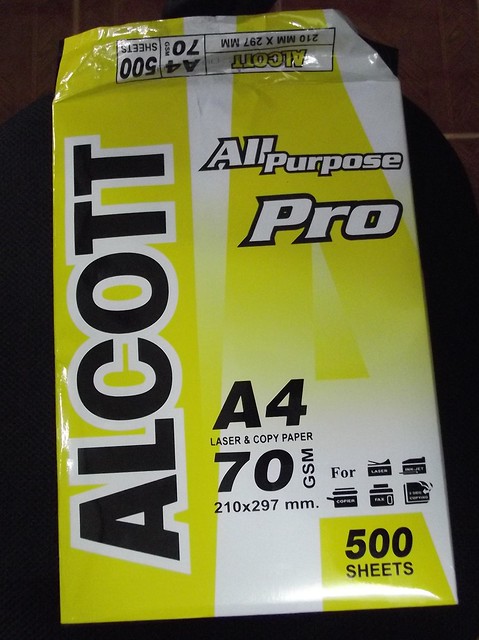
Well, lets start with a paper brand they sell in Thailand.  This particular brand, Alcott, is used by the largest copy shop here in Wiang Kaen.

Alcott paper

Alcott is a name that is dear to me.  It is the name of the school I attended for 8 years.  (I am one of few who did this.  When my siblings attended the school it only went to 6th grade.  After I left it became a middle school.)  The school is named after Amos Bronson Alcott (father of Louisa May Alcott).  I also have some relational connections to the name. (For more on that, see my brother's blog here: http://ramblinrussells.blogspot.com/2015/05/genealogy-story-my-wolcott-connections.html)

The pronunciation of the vowels in Alcott follows the standard rules.  Since both syllables each have only one vowel, the vowels have a short vowel sound.

The name of the town that the school is located in, however, is a different story:

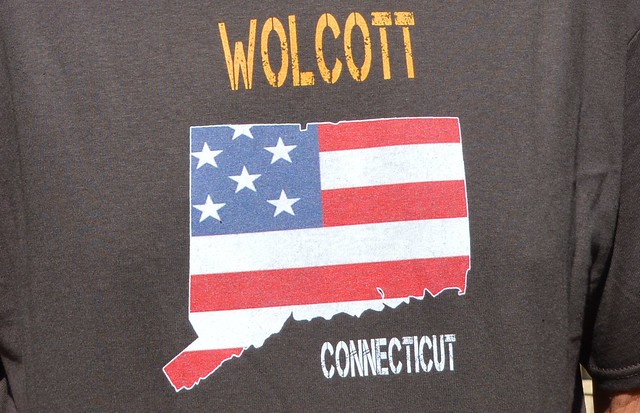
Wolcott.

Wolcott is named after the person who was governor of Connecticut at the time the town was incorporated.  He played a critical role in its becoming separated from Farmingbury to be a town in its own right.  I have no idea how HE pronounced is name.  But I do know how I grew up saying it.

If one followed the normal rules Wolcott would be pronounced something like wahl-kaht.  And maybe in some places that is how they say it--

--but not where I grew up (who knows, maybe its changed since then).

Instead it's pronounced more like what happens when a sheep goes to the barber:

wool-cut


  Wolcott Shirt 2

Go figure!

Students of English, I feel your pain.

I summarize the difference between English and Thai this way:

In English a letter has many sounds.
In Thai, a sound has many letters.

A few weeks ago we were at a conference where there were representatives from several language and culture groups.  My favorite part is when we were all praying aloud in our own languages.  I quit praying just to listen.  I don't know what was being said, but it was beautiful.

Somehow God can figure all of that out.  For me I look forward to that day when language will no longer be a barrier to communication.  I imagine heaven to be somewhat like that time in the early days of the church when "they were bewildered, because each one was hearing them speak in his own language." (Acts 2:6b ESV)

(Meanwhile I will keep trying to improve my Thai language abilities.)

Sunday, May 17, 2015

Bitter-Sweet

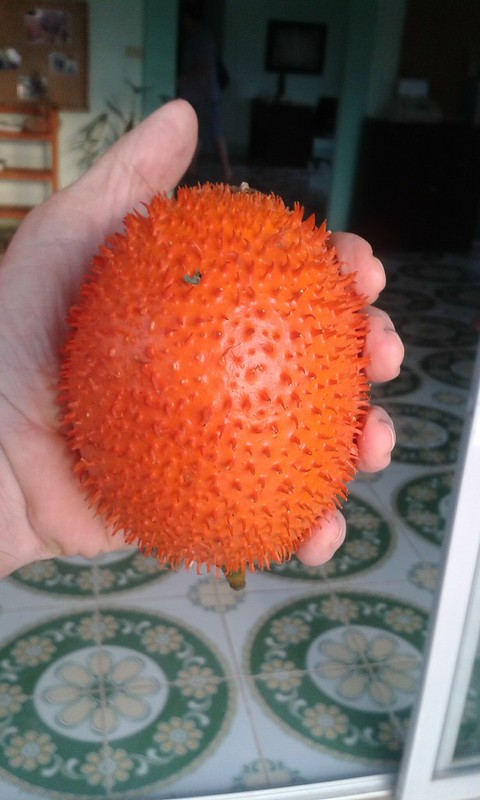
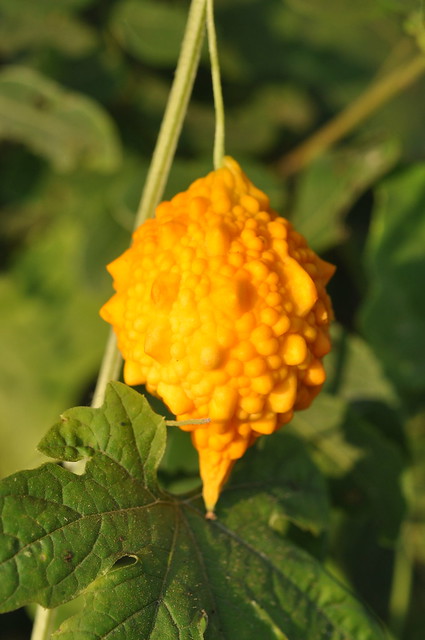
Recently, our teammates gave us a fruit (vegetable?*) that a market vendor persuaded them to buy.  They did so, owing to the fact that it was such an unusual looking thing.

I immediately recognized it as a fruit from the melon/squash family (Cucurbitaceae) because I had seen smaller ones growing in our neighborhood.  I could remember, however, neither the English nor Thai name for it.  (Our teammates told us the vendor had said it was called fakkhao).  And I certainly had no idea how to eat it.

Since I had my computer open, I quickly found that its name is Spiny Bitter Gourd (Momordica cochinchinensis; Thai: ฟักข้าว), and it certainly seemed like an appropriate name.


Momordica cochinchinensis (Lour.) Spreng. Cucurbitaceae-Spiny Bitter Gourd, ฟักข้าว


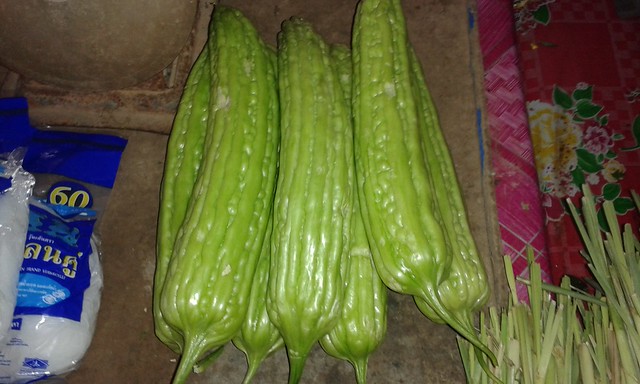
The plant is related to the bitter melon**, a popular vegetable in some SE Asian cultures.

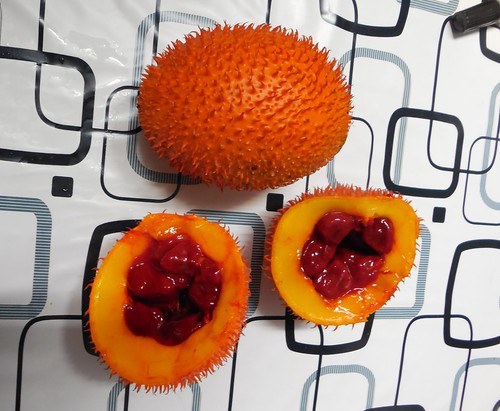
We took the fruit home and cut it open.


Momordica cochinchinensis (Lour.) Spreng. Cucurbitaceae-Spiny Bitter Gourd, ฟักข้าว


A quick taste of the orange flesh let us know quickly how it got its name: it certainly was bitter.  However, we decided to suck the pulp on the seeds and it had a slightly sweet, pumpkin-like flavor.  (Apparently the seeds are used to add a red color to some food dishes.)

Bitter.

Sweet.

Both in one.

So it struck me that the fruit is somewhat a picture of life.  Our life gets filled with many kinds of experiences and some of them are sweet, but some of them are also bitter.  Maybe the bitter parts make the sweet parts sweeter--like sucking on the red seeds AFTER eating some of the orange flesh.

I don't think it's possible to escape this life without having both bitter and sweet.  The challenge is to get through it while still remaining sweet and not becoming bitter oneself.  I've met many old people who have allowed their experiences to make them bitter, and they are certainly not pleasant to be around.  People tend to avoid them--which make them even more bitter.

I don't want to end up that way.  So I want to try to practice what the bitter people seem to avoid doing:

Forgive easily.

Don't hold onto grudges.

That way I can be more like the sweet smooth seeds of the Spiny Bitter Gourd and less like its prickly, bitter flesh.

As Paul writes in Colossians 4:6--Let your conversation be always full of grace, seasoned with salt, so that you may know how to answer everyone. 

* Botanically, this is a fruit.  Some however might consider it to be a vegetable.  In a similar way to how people consider a cantelope to be a fruit, but its close relative and similar looking food, the cucumber, is considered a vegetable.

**
The bitter melon, which one can buy in the markets, looks like this.  This is the cultivated version.


Momordica charantia L. var. charantia Cucurbitaceae: bitter cucumber, มะระ


The wild version of the same species, however, looks much different.


Momordica charantia L. Cucurbitaceae: bitter cucumber, มะระ


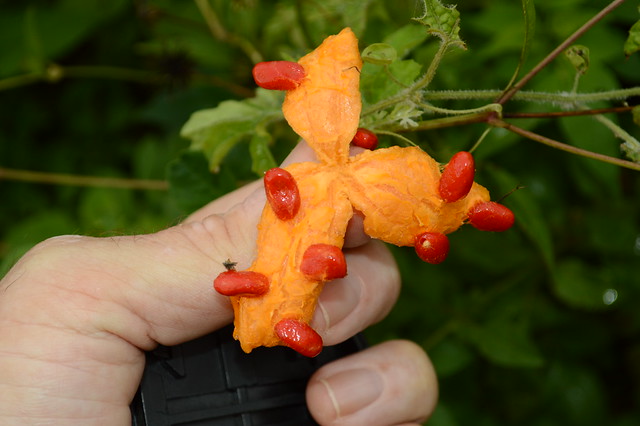
When the wild bitter melon matures, it bursts open to reveal red seeds, similar to the Spiny Bitter Gourd.


Momordica charantia L. var. abbreviata Cucurbitaceae: bitter cucumber, มะระ

Monday, May 4, 2015

The Summit


This past week it was our joy to attend the Southeast Asian Leadership Summit.

A lesson in linguistics

This event brought together MB Mission leaders from throughout the region.  As such, there were several languages being used.  At times my head would spin from not knowing which speaker/language to latch onto.

Andy organized the event.  He had our agency's mission and vision statement reduced to a quasi-mathematical formula that could be printed on t-shirts that our participants could wear--even in places not friendly to the gospel.


The summary statement was printed in full in three languages on our notebooks, and would have been in four, if Khmu had a written language.


We were blessed by a visit from Randy F. as he shared some stories of how the mission and vision of MB Mission is playing out around the world.


In a country where being a leader typically means having a title, an office and a nice salary while others serve you and do all the work, we were honored to be able to demonstrate the nature of leadership as modeled by Jesus in serving others.


Encouragement

We had the opportunity both to be prayed for and to pray for others.


Worship through music was in Thai, English, Burmese or Khmu--depending on which group was leading.


It is easy to get discouraged when we are constantly surrounded by "problems" that need to be fixed.  As our team has been working to implement changes to bring about lasting solutions, we were encouraged by this conference which laid out a foundation for what we are trying to do--and in a very timely manner.

Let us not give up meeting together, as some are in the habit of doing, but let us encourage one another--and all the more as you see the Day approaching. Hebrews 10:25 (NIV)


Tuesday, April 14, 2015

The Wait

About Christmas-time last year, we were looking for a gift.  We thought that a desert rose would be a nice gift for the person had in mind.

The desert rose (Adenium obesum) is not actually related to a rose at all, but is in the same plant family as dogbane—a common weed where I grew up in Connecticut.  It is a plant that is often trained for bonsai.  By pinching back the tips, the shrub will remain short but will get quite stout.

The particular pant we saw was looking not very attractive in a pot that was overgrown with weeds.  The owner of the nursery seemed a bit reluctant to sell.  It was somewhat expensive, but I was expecting that, because he had been raising it for 7 years.

We brought it home, cleaned it up, and repotted the plant and soon it rewarded us by dropping what few leaves it had.

For three months we patiently watered and weeded the woody skeleton.

And then this happened.

Adenium obesum (Forssk.) Roem. & Schult. Apocynaceae desert rose, impala lily 3

About a week later it was like this.

20150407_104440

Perhaps one day it will look like this large specimen we saw in Chiang Mai.

Adenium obesum (Forssk.) Roem. & Schult. Apocynaceae: desert rose, impala lily, ชวนชม

While it seems like we had to be rather patient with the desert rose, our pineapple plants have done a much better job at testing our patience.

Shortly after we moved here in February of last year, we stuck a pineapple top in the ground.

Ananas comosus (L.) Merr. Bromeliaceae Pineapple 7

It seemed like it was doing OK, as it began to grow.  But once it got to a certain point, it seemed to stagnate—not dying but not growing either.  It was like this for many months.

Ananas comosus (L.) Merr. Bromeliaceae Pineapple 8

Then, all of a sudden, the innermost leaves started to turn red and a flower bud began to emerge.

Ananas comosus (L.) Merr. Bromeliaceae Pineapple 3

After several more weeks, it is looking more and more like a pineapple.  And who knew they had such pretty purple and white flowers.

Ananas comosus (L.) Merr. Bromeliaceae Pineapple 12

I’m not great at waiting.  But it seems that to achieve most good things in this life it takes patience and hard work.

The Bible is full of verses about “waiting on God” and being patient with others.  A few examples:

In the morning, O LORD, you hear my voice; in the morning I lay my requests before you and wait in expectation. Psalm 5:3 (NIV)

Therefore the LORD waits to be gracious to you, and therefore he exalts himself to show mercy to you. For the LORD is a God of justice; blessed are all those who wait for him. Isaiah 30:18 (ESV)

Love is patient 1 Corinthians 13:4 (NIV)

Be patient, therefore, brothers, until the coming of the Lord. See how the farmer waits for the precious fruit of the earth, being patient about it, until it receives the early and the late rains.  You also, be patient. Establish your hearts, for the coming of the Lord is at hand. 
James 5:7-8 (ESV)

 
I’m not sure how much longer it will be until we can eat some fruit, but we’re certainly looking forward to it, and I’ll try to be patient.

Ananas comosus Bromeliaceae: pineapple, สับปะรด


Thursday, April 9, 2015

The Bride Price

   An excellent wife who can find?
        She is far more precious than jewels. 
   Proverbs 31:10 (ESV)

A couple of days ago we were invited to a nearby Khmu village for a house dedication ceremony. However, the person who had invited us was at a dowry ceremony, so we got to sit in on that instead.

At the beginning, there were only a few men, but the crowd gradually grew to include women as well.

In the photo below, the father of the groom is assembling the dowry tray.  Among other things, several parts of a pig are included, especially, we were told, the head and the tail.  Without those two things, the dowry would not be accepted.  In this photo, the heart and the tongue are being tied together by a piece of bamboo cord.

The man in the light blue shirt on the left is the father of the bride.


Below is a photo if the tray, which contains most of the dowry.  There is a bamboo basket containing cash and a few ingots that date back to the days of French Indochina.  From a pig there is the split skull, a piece of the rump skin with tail attached, the heart, and the tongue.  There is also a small boiled chicken.

The green leaves are from a special plant that is revered for decor because it does not suffer from insect or disease damage.  There pink flowers are Bougainvillea, the red ones are a type of Ixora.


The fellow in the orange shirt appears to be the dowry broker as he is the one who checked to see that everything is in order.  Having counted the cash, he has the father of the bride verify the count before placing it back in the basket for the official presentation.

You can also see from this photo that there are generous amounts of orange Fanta going around.


The broker then takes the chicken and removes its legs and and wishbone to see if they are sufficient quality.


After he inspects the chicken parts.  The broker then grabs the heart, which has already been cut open, and checks to see if it is good.  Then he examines the split open skull to see it that also is of good quality.  (The rest of the pig is in process of becoming dinner.)


Once everything has been inspected and approved, it is officially presented to the parents of the bride.  The father of the groom, groom and bride to be hold the basket on one side and the father and mother of the bride receive it on the other.


In addition to the gift to the parents of the bride, there is a gift to the bridal couple as well.  There is a package of fabric to be used as a wrap-around skits (ผ้าถุง), which is opened and the pieces of fabric are counted--there are twelve of them.  There are also a couple of blankets.  In the photo below you can also see a bamboo canister which contains sticky rice (there are two of these.)


The groom's family is Christian and does not drink alcohol.  However, this is not the case for the bride's family.  A bottle of strong liquor is opened and a shot glass is filled and given to the father of the bride.  The same cup is refilled again and again until the important guests are served.  The bottle and shot glass are then passed among the guests.  It seems to spend most of its time with a group of three men.


The father of the groom then offers up a prayer for the bridal couple.


Throughout most of this ceremony, the bridal couple seems disinterested and somewhat bored.  I'm not sure they ever smiled.  (That was also the case for the two Khmu weddings we have attended since moving here.)

Finally, dinner is served.  Trays of various foods are placed on the floor and bags of sticky rice are distributed to the guests.  Ingrid and I share one bag of rice.   I don't eat too much of this special food as four of the five dishes are heavily laced with cilantro.  The soup contains just a little bit of cilantro and so it is tolerable for me to dip the rice in that.

The dishes on the tray are:
Top left: raw pigs blood mixed with a few other things.
Top right: chopped organ meat and other meat
Bottom left: pork soup
Bottom right: ground raw pork

Off to the right is minced pork (lab ลาบ).


The wedding itself is scheduled for the following day.

While we enjoyed being a part of this cultural event, I have mixed feelings about the concept of dowries in general.  To me there seems to be the implication that a woman is "property", which can be sold.  Functionally, I'm not sure what the difference is between selling a daughter as a bride or selling her to be a prostitute.

To the husband, then, she is not an equal human, but merchandise that he has paid for. If he gets tired of her, he can buy another, newer one.  Or maybe just a temporary one.  After all, you can cheat on your wife, but not your property.

There is also the problem of the amount of the dowry--is the measure of the value of a woman only the amount of money that the father thinks he can get for her?

If wives could only be had for what women are worth, then even the Donald Trumps of this world would be single.

Some will say that the dowry is to help cover the cost of raising the daughter.  If that is the case, why are the sons not also sold?

Still, it is better than some cultures where the parents of the bride pay the parents of the groom to take her--as if the woman has negative value.