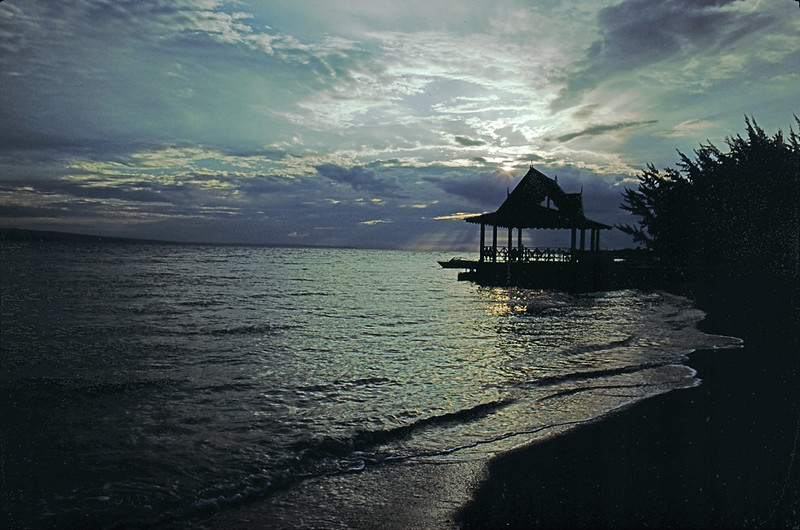
It seems like a long time ago.
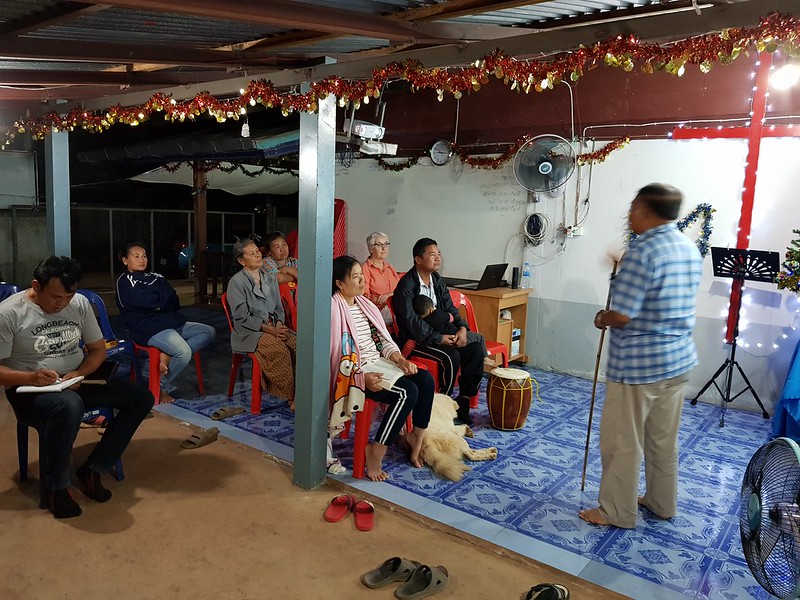
We had just moved into our rented townhouse in Chachoengsao province and we were having a time of worship and offering our house to God. A large group of people from our church and some fellow missionaries were gathered.
Someone asked if we had Thai names yet, to which we replied that we had not. The task of assigning the names fell to Pee Chin, who offered up the following:
Edd: Mahnah (มานะ) = perseverance; persistence; grit; tenacity
Ingrid: Neet (นิจ) = continued; stable; lasting; regular; constant; durable
When I heard the meaning of the names, I thought to myself, "he doesn't know me". I've always been a better starter than a finisher. Quitting has come easy for me—not so much that I can't finish, but because I get bored and distracted and start something else. If I have any persistence it's because my wife helps me to stay focused.
What I've learned over the past few years is that my name wasn't so much descriptive as prophetic. During our time of debriefing at the end our term last month, we were congratulated: "You made it! You did it!"
Our previous term had not finished well. And this past term has been very challenging, as was expected. There were several occasions we were ready to pack our bags. But we made it to the end, exhausted, but feeling good about the fact that we hadn't given up. There had been challenges in our ministry and it was important that we stayed and worked through them and not give up.
Thai people, in general, are a lot like me. They are conflict-avoiders. Harmony is a strong value in their society. If there is conflict, one tends to just smile be agreeable (even if the really disagree) or to flee. We had wanted to do the latter on numerous occasions, but we didn't.
Towards to end of our term, there were some people in our church facing conflict. Some were wanting to run away from their problems. I could totally relate.
On our last Sunday in Thailand, we had a prayer time for any who felt they needed prayer for anything. As we were praying, a picture comes to mind. I'm not sure if it was for the church—or if it was a prophetic vision for me.
In the picture in my mind, there is a rugged mountain. At the top of the mountain there is a huge treasure. But getting there is not easy. If you want to get to the treasure, you will have to work hard. There will be times when you will fall. You will suffer bruises and scrapes and maybe some broken bones.
The valley floor is flat. There are smoothing walking paths meandering all over the landscape. And scattered throughout Satan has placed some small piles of coins—not high value coins, more like pocket change. Not enough to thrive, but enough to survive. And from our precarious perches on the mountain, we can look down at any time and see them.
The meaning of the vision was that if one wants to see ministry bear great fruit, one will have to endure trials and suffering. But the enemy doesn't want our ministry to bear fruit. So he has put out these little rewards in plain view to draw us away. His message is, "You don't need to see a large, thriving church of people whose lives have been transformed by the power of the gospel. Be content with a small comfortable family."
Paul wrote: "Therefore we do not give up. Even though our outer person is being destroyed, our inner person is being renewed day by day." 2 Corinthians 4:16 (HCSB)
And again, "So let's not get tired of doing what is good. At just the right time we will reap a harvest of blessing if we don't give up." Galatians 6:9 (NLT)
We are planning to return to Thailand in a couple months, but we have no illusion that it will be easy. The last season was difficult, the next may be moreso. But we don't want to quit and give Satan the victory. And perhaps I will grow into my name: perseverance.
Saturday, February 8, 2020
Tuesday, January 28, 2020
Outsider View
Two of my most appreciated photos from this month have to do with where people live. And what is kind of strange is that the photos are of ordinary things. These are things that the people who live in these homes see often yet, like so many things that are common place, they go unnoticed or unappreciated. Until...
Until an outsider comes along and takes a picture.
Granted, there is something to be said for photography techniques, composition and post-processing. But a big part of the attraction of these photos is that I, as an outsider, take a picture of what is unusual for me, though commonplace for those who live in that environment.
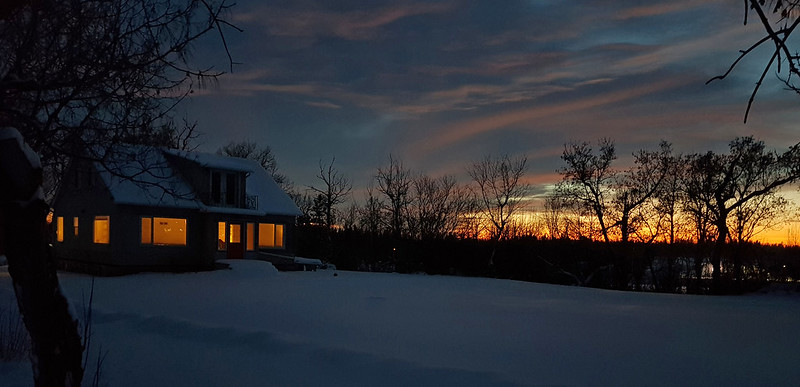
In this first photo, I was walking to the home of a family member. Two things struck me as I approached the home. One is that the glow from the windows matched the color of the sunset sky. But the main thing was the "warm" color of the windows looked particularly inviting as I was walking along the cold, snowy road. It was not just the warm temperatures I was looking forward to, but also I would soon be surrounded by the warmth of relationships with family.
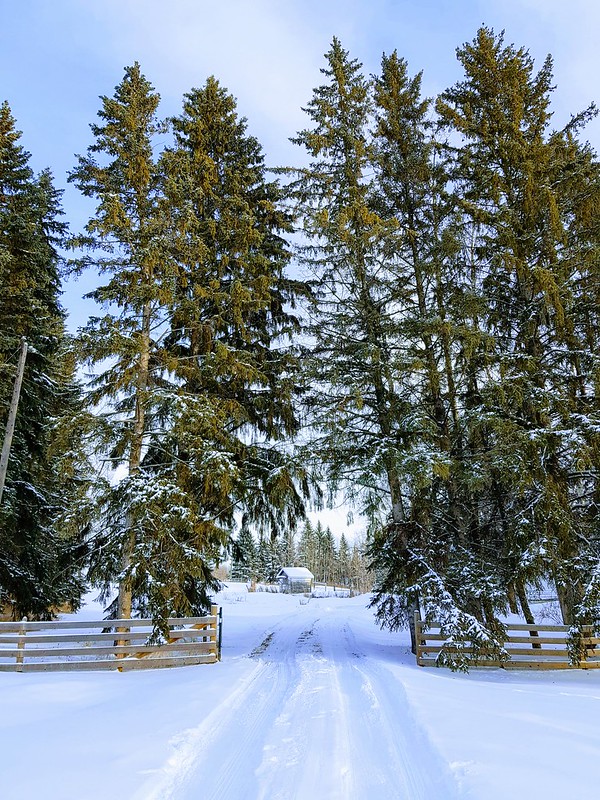
The next picture was also taken as I was walking toward the home of a cousin after parking the car at the beginning of the driveway. Because of the colder than normal temperatures, they had not gone out to clear the driveway of snow, which made it harder for driving into the yard. What was hard for the car, though, was nice for the photo, as there was lots of clean, white, snow to make for an idyllic scene. It was actually starting to get dark (mid-afternoon in northern latitudes) and I had to play with the photo a bit to bring out the colors.
Where am I going with this?
I, as an outsider, can bring a different perspective.
Sometimes (often?) we find ourselves so surrounded by the problems we face and the situations we're dealing with, that we lose hope. We can't see a way out or a reason to continue going on. There may be light at the end of the tunnel, but we're still trying just to find the tunnel.
Then someone comes along, who is not having to deal with all the very real problems we have and, without diminishing the difficulties, reminds us of all those other good things that are hard for us to see or, perhaps we just quit noticing.
There are many days when life and ministry can be quite challenging. I said to my wife recently, "I'm tired and I want to go home--except I don't know where that is, actually."
What helps me during these times is to hop on my bicycle and go for a ride among the rice paddies and rubber plantations with all the ponds and bogs that constantly interrupt the otherwise agrarian landscape. And as I'm pedaling past the paddies I find myself saying, "I can't believe I get to live here!" Because it really is quite beautiful, but I often don't have time or take time to appreciate that.
Sometimes, when even the bicycle ride is not enough to clear my vision, we'll get a visitor who'll point out these amazing things that we haven't noticed or that seemed inconsequential in our view. It really is helpful to have people in our lives that can give us an outside perspective.
When the photos above were taken, we were in Northern Alberta, Canada, to help some family members as they were dealing with some challenges in their lives. It was not a time of year I would typically pick to visit that part of the world. But in spite of the cold atmosphere and the chilling effect of life's events, there was still the warmth of family to be had. And it really is a pretty place to be. I'm just the guy who happened to have a camera at the right time to take a photo to remind us of those things. (But I am happy to be headed south to warmer climes.)
Proverbs 17:17 reads: A friend loves at all times (not just the good times), and a brother is born for adversity. (NIV, parentheses mine.)
I'm thankful for these friends and "brothers" who help us see from a different perspective.
Until an outsider comes along and takes a picture.
Granted, there is something to be said for photography techniques, composition and post-processing. But a big part of the attraction of these photos is that I, as an outsider, take a picture of what is unusual for me, though commonplace for those who live in that environment.
In this first photo, I was walking to the home of a family member. Two things struck me as I approached the home. One is that the glow from the windows matched the color of the sunset sky. But the main thing was the "warm" color of the windows looked particularly inviting as I was walking along the cold, snowy road. It was not just the warm temperatures I was looking forward to, but also I would soon be surrounded by the warmth of relationships with family.
The next picture was also taken as I was walking toward the home of a cousin after parking the car at the beginning of the driveway. Because of the colder than normal temperatures, they had not gone out to clear the driveway of snow, which made it harder for driving into the yard. What was hard for the car, though, was nice for the photo, as there was lots of clean, white, snow to make for an idyllic scene. It was actually starting to get dark (mid-afternoon in northern latitudes) and I had to play with the photo a bit to bring out the colors.
Where am I going with this?
I, as an outsider, can bring a different perspective.
Sometimes (often?) we find ourselves so surrounded by the problems we face and the situations we're dealing with, that we lose hope. We can't see a way out or a reason to continue going on. There may be light at the end of the tunnel, but we're still trying just to find the tunnel.
Then someone comes along, who is not having to deal with all the very real problems we have and, without diminishing the difficulties, reminds us of all those other good things that are hard for us to see or, perhaps we just quit noticing.
There are many days when life and ministry can be quite challenging. I said to my wife recently, "I'm tired and I want to go home--except I don't know where that is, actually."
What helps me during these times is to hop on my bicycle and go for a ride among the rice paddies and rubber plantations with all the ponds and bogs that constantly interrupt the otherwise agrarian landscape. And as I'm pedaling past the paddies I find myself saying, "I can't believe I get to live here!" Because it really is quite beautiful, but I often don't have time or take time to appreciate that.
Sometimes, when even the bicycle ride is not enough to clear my vision, we'll get a visitor who'll point out these amazing things that we haven't noticed or that seemed inconsequential in our view. It really is helpful to have people in our lives that can give us an outside perspective.
When the photos above were taken, we were in Northern Alberta, Canada, to help some family members as they were dealing with some challenges in their lives. It was not a time of year I would typically pick to visit that part of the world. But in spite of the cold atmosphere and the chilling effect of life's events, there was still the warmth of family to be had. And it really is a pretty place to be. I'm just the guy who happened to have a camera at the right time to take a photo to remind us of those things. (But I am happy to be headed south to warmer climes.)
Proverbs 17:17 reads: A friend loves at all times (not just the good times), and a brother is born for adversity. (NIV, parentheses mine.)
I'm thankful for these friends and "brothers" who help us see from a different perspective.
Labels:
Alberta,
Barrhead,
Canada,
perspective,
photography,
snow,
winter
Tuesday, January 14, 2020
Last Supper
A little more than 2-1/2 years ago, we came back to Thailand, not sure what would be awaiting us.
We started off by moving a 12-hour drive away from where we used to live, and Phon Phisai has been our home since then.
In our time here, we've made many new friends, so it is hard to uproot for a return back to North America for a few months. Some of our friends here are undergoing challenges, and we find ourselves not wanting to abandon them at this point in their lives.
In our own lives we've encountered circumstances that would make us want to put off our travels for a few months, but those same circumstances make it harder to.
So it was with these things on our minds and our fridge and cupboards being already empty, that we went out for dinner last night. Our last inexpensive Thai food for a while. We chose Ban Phon Phisai- The White House for our last supper.
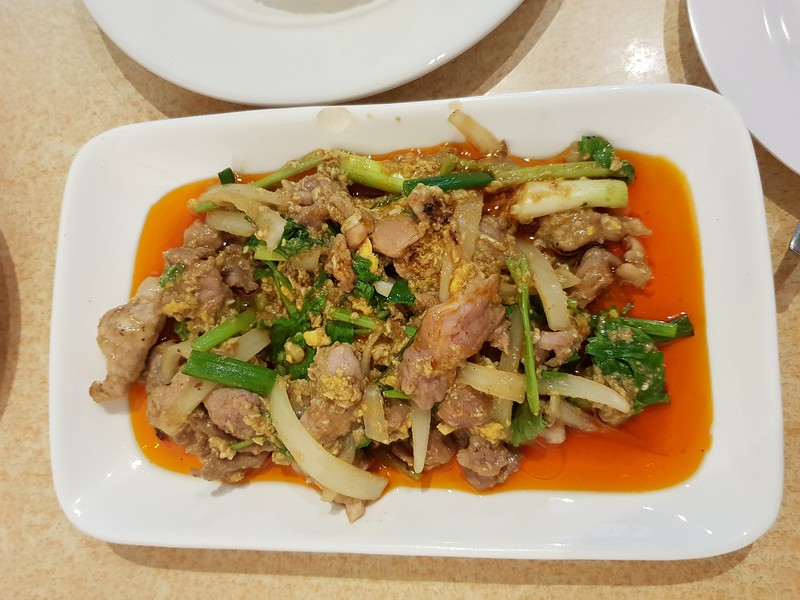
For this special occasion we chose Yellow Curry with Pork (ผัดผงกะหรี่หมู). It was our first time to have this dish at this restaurant, but we were quite pleased with it.
To go with that we had what is probably our favorite Thai meal, Cashew Chicken (ไก่ผัดเม็ดมะม่วง). There are many different ways to make this and we are usually disappointed, but never at this establishment.
Having eaten, it was time to go home and finish cleaning an pack. Goodbye, Phon Phisai, we'll see you soon, the -40 degree temperatures of Alberta are waiting for us.
We started off by moving a 12-hour drive away from where we used to live, and Phon Phisai has been our home since then.
In our time here, we've made many new friends, so it is hard to uproot for a return back to North America for a few months. Some of our friends here are undergoing challenges, and we find ourselves not wanting to abandon them at this point in their lives.
In our own lives we've encountered circumstances that would make us want to put off our travels for a few months, but those same circumstances make it harder to.
So it was with these things on our minds and our fridge and cupboards being already empty, that we went out for dinner last night. Our last inexpensive Thai food for a while. We chose Ban Phon Phisai- The White House for our last supper.
For this special occasion we chose Yellow Curry with Pork (ผัดผงกะหรี่หมู). It was our first time to have this dish at this restaurant, but we were quite pleased with it.
![]() |
| Yellow Curry with Pork |
To go with that we had what is probably our favorite Thai meal, Cashew Chicken (ไก่ผัดเม็ดมะม่วง). There are many different ways to make this and we are usually disappointed, but never at this establishment.
![]() |
| Cashew Chicken |
Having eaten, it was time to go home and finish cleaning an pack. Goodbye, Phon Phisai, we'll see you soon, the -40 degree temperatures of Alberta are waiting for us.
Labels:
chicken,
curry,
departures,
food,
parting,
pork,
saying goodbye,
Thai,
Thailand
Wednesday, January 1, 2020
Bookends 2019
One way to measure things is by doing a before and after comparison. This is one way I like to look back at my year, by looking at photos from the first and last day on which I took photos in a given year. But this is not just the beginning of a new year, it is also the beginning of a new decade. So this year I will look back not just to January 1, 2019 but also the first day of the decade: January 1, 2010.
Another way of looking back can be found in Top Twelve 2019
This was my first Christmas visit to the farm where my wife grew up. It was also to be the last Christmas visit to the farm, as he parents would end up moving to the town not long after this.
It was a time of transition for us as well. We had only recently found out that we would eventually be going to Thailand and we had also just finished our training with MB Mission (Multiply) before we traveled to Alberta.
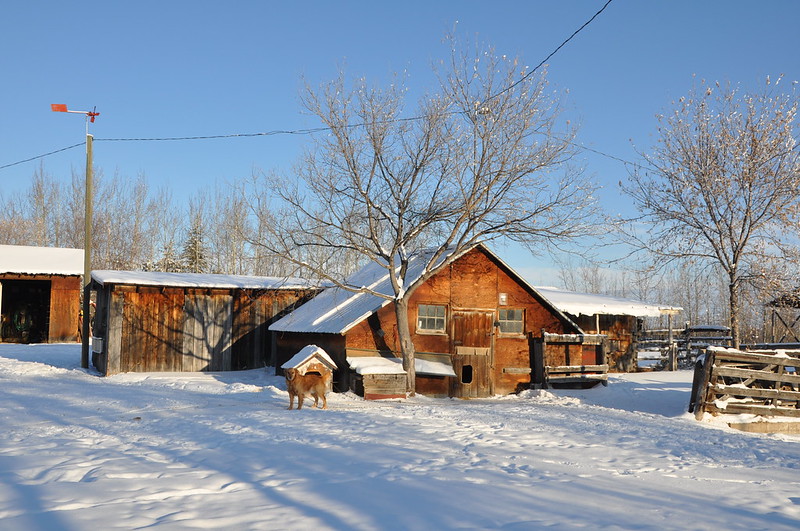
The bright sun brought in the new decade. But unlike Thailand, where sunny means very hot, in this case it might that the temps would go up into the -20s C. Pictured below is the henhouse at the farm in Freedom, Alberta. Rex, the dog, is taking a break from hunting mice in the snow.
A normal New Year's Day activity here in Thailand is to go to the mall. You know—where lust for stuff has brought crowds together in a frenzy in what appears to be training for Armageddon. Where four-wheeled dragons belch black smoke (the dragons here tend to consume diesel) in the "Battle for the Parking spot".
I suppose we could have joined them. So I asked my wife, "do you want to go swamping?" And my amazing wife agreed. I suppose it's not surprising. Who wouldn't jump at the chance to go visit some swamps? Wouldn't you? I wrote more details about that trip here.
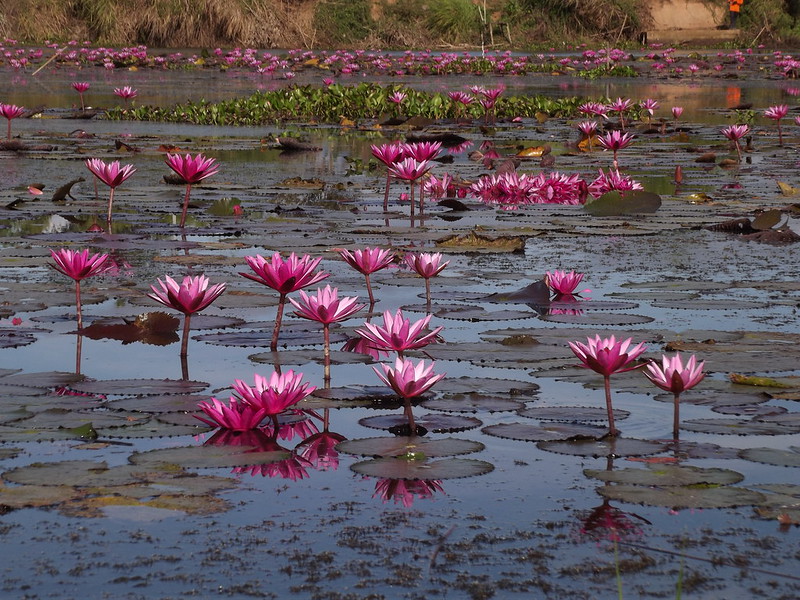
Our first stop was at Nong Nguem Noi. (หนองหงึมน้อย) There was not a lot of floral variety here, but there were a lot of red lotus flowers (บัวแดง) blooming. This is a type of water lily that is native to this part of the world and can be found scattered everywhere, but not always in such abundance as in this swamp. I only wish I had a canoe or kayak to get out amongst the blooms.
Many people in this world are looking for a sign from God. If they don't believe in God, some might waiting for the universe to speak to them instead. Many people travel great distances to see a miracle. Not a few will go after a counterfeit sign yet ignore the miracle right in front of their faces.
On January 1st, we witnessed a miracle. We saw the handwriting of God—a New Year's Card, if you will. "See how the lilies of the [pond] grow. They do not labor or spin. Yet I tell you that not even Solomon in all his splendor was dressed like one of these. If that is how God clothes the grass of the field, which is here today and tomorrow is thrown into the fire, will he not much more clothe you, O you of little faith?" (Matthew 6:28-30 NIV)
But there was no alcohol at our party. Our church gathered for a feast of fire-roasted tilapia, stir-fried pork, stir-fried squid tentacles and steamed clams. Afterwards we gave the kids some marshmallows to roast and served up some "New Year's Cookies" (aka fritters) that Ingrid made for the occasion.
Next there was a time of singing then a we heard the word of God. A good way to finish up the year.
After all this, we were in bed before 11 pm. The fireworks at midnight barely woke us.
Good-bye 2019. Good-bye 2010's. A new decade is calling.
Another way of looking back can be found in Top Twelve 2019
January 1, 2010
It was my first winter experience in Alberta, Canada. I've always said I don't want to live where Fahrenheit and Celsius come together on a regular basis (-40), and this was one of those years. We just missed the record breaking cold by a day or two when our bus arrived in Edmonton. But it was still cold.This was my first Christmas visit to the farm where my wife grew up. It was also to be the last Christmas visit to the farm, as he parents would end up moving to the town not long after this.
It was a time of transition for us as well. We had only recently found out that we would eventually be going to Thailand and we had also just finished our training with MB Mission (Multiply) before we traveled to Alberta.
The bright sun brought in the new decade. But unlike Thailand, where sunny means very hot, in this case it might that the temps would go up into the -20s C. Pictured below is the henhouse at the farm in Freedom, Alberta. Rex, the dog, is taking a break from hunting mice in the snow.
![]() |
| Winter at the Farm |
January 1, 2019
Nine years later, we find ourselves delighted if the temperature drops down to +20 C at night. The climate in Thailand has little in common with Alberta, Canada.A normal New Year's Day activity here in Thailand is to go to the mall. You know—where lust for stuff has brought crowds together in a frenzy in what appears to be training for Armageddon. Where four-wheeled dragons belch black smoke (the dragons here tend to consume diesel) in the "Battle for the Parking spot".
I suppose we could have joined them. So I asked my wife, "do you want to go swamping?" And my amazing wife agreed. I suppose it's not surprising. Who wouldn't jump at the chance to go visit some swamps? Wouldn't you? I wrote more details about that trip here.
Our first stop was at Nong Nguem Noi. (หนองหงึมน้อย) There was not a lot of floral variety here, but there were a lot of red lotus flowers (บัวแดง) blooming. This is a type of water lily that is native to this part of the world and can be found scattered everywhere, but not always in such abundance as in this swamp. I only wish I had a canoe or kayak to get out amongst the blooms.
Many people in this world are looking for a sign from God. If they don't believe in God, some might waiting for the universe to speak to them instead. Many people travel great distances to see a miracle. Not a few will go after a counterfeit sign yet ignore the miracle right in front of their faces.
On January 1st, we witnessed a miracle. We saw the handwriting of God—a New Year's Card, if you will. "See how the lilies of the [pond] grow. They do not labor or spin. Yet I tell you that not even Solomon in all his splendor was dressed like one of these. If that is how God clothes the grass of the field, which is here today and tomorrow is thrown into the fire, will he not much more clothe you, O you of little faith?" (Matthew 6:28-30 NIV)
December 31, 2019
The drinking starts early on New Years Eve. People seem unconcerned with the police checkpoints that are set up all over the place to try to cut down on drunk driving. Since everyone knows where the checkpoints are, they just find ways to avoid them.But there was no alcohol at our party. Our church gathered for a feast of fire-roasted tilapia, stir-fried pork, stir-fried squid tentacles and steamed clams. Afterwards we gave the kids some marshmallows to roast and served up some "New Year's Cookies" (aka fritters) that Ingrid made for the occasion.
Next there was a time of singing then a we heard the word of God. A good way to finish up the year.
After all this, we were in bed before 11 pm. The fireworks at midnight barely woke us.
Good-bye 2019. Good-bye 2010's. A new decade is calling.
![]() |
| New Years Celebration |
Tuesday, December 31, 2019
Top Twelve 2019
In my annual review of pictures this year, I tried to contain myself to 12 photos, but in the end I ended up with a baker's dozen.
We decided to go to Phu Ruea (pronounced poo rur-ah), which means "place of the boat." We've driven through Phu Ruea on several previous occasions, traveling back and forth to Northern Thailand. I had always wondered how a mountainous area is named "place of the boat," a name that would seem more fitting for a beach town. It turns out that viewed from the valley below, the mountain is shaped like a boat.
There are several national parks near Phu Ruea, one of which bears the same name. You can drive almost to the highest point in the park. From there, you can hop on a tram (pickup truck with benches in the back) or walk to the summit. We opted to walk, and we had the trail mostly to ourselves, as most people took the tram.
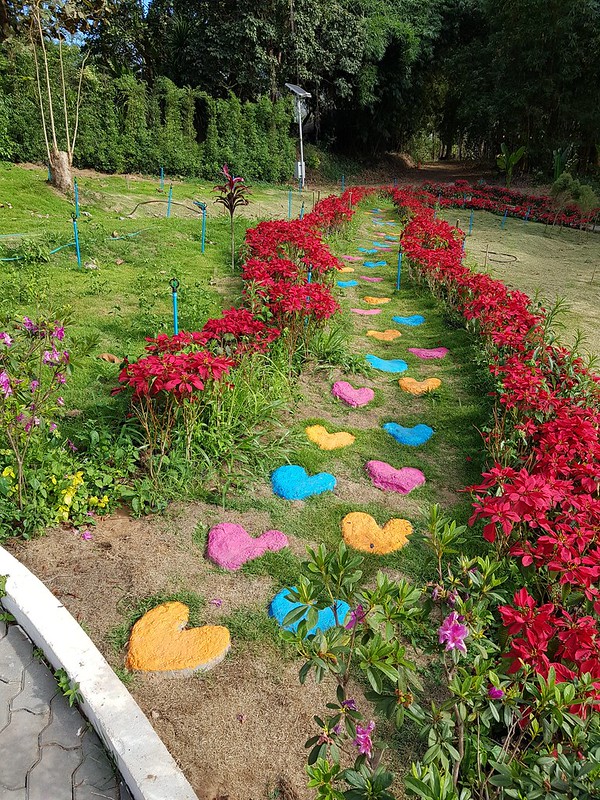
Phu Ruea has a flower festival over the New Year's holiday, and we came in on the tail end of it. So many flowers! The dominant flowers were poinsettias in red, pink, yellow and white. The main theme of the flower festival is hearts. Flower gardens shaped like hearts. Big heart-shaped signs. And even heart shaped pavers winding through the poinsettias. For more photos of Phu Ruea, see here.
In February, we had a visit from a couple from Canada. They are friends of our co-workers and we were told that they like outdoorsy stuff. Since we have a vehicle and know about many of the outdoorsy activities to be had in the area, our co-workers made us responsible for one day's activities. So we put together as list of possibilities and presented it to our visitors. They decided to go to Phu Phrabat.
We like Phu Phrabat because it has some of the most well-groomed sets of forest trails for walking in the area. The park is considered an "historical park" and is run by the Arts and Culture ministry rather than the forestry department. That must be why the park has one of the classiest restrooms in Thailand!
The geology of the area includes some hard layers of sandstone which are underlain by softer material. This has contributed to the formation of lots of unusual rock formations. Several hundred years ago, these features were used for human settlement, either for living places, animal shelters or religious worship sites.
The picture below is from one of the most famous structures on the park. It is called Hor Nang Usa (หอนางอุสา), which means, "Ms. Usa's Tower". Nang Usa is a character in the anecdotal stories of the history of the structures.
More pictures from Phu Phrabat can be found here.
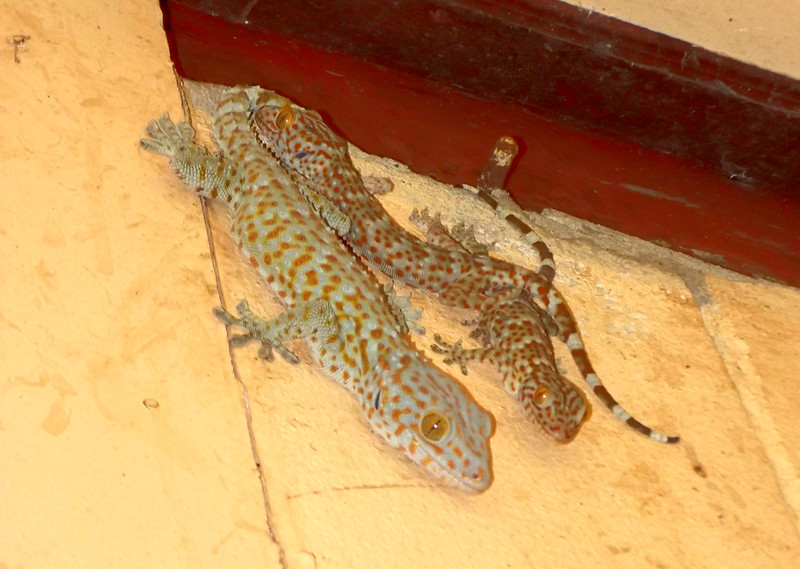
The home of the creatures in the photo is above our front porch. They even have a trail mark from the hole where they get in and out. I would seal it, but I don't want them to die in the attic because the smell of rotting gecko bodies makes the fragrance of a dead rat like sweet perfume in comparison. Mama and papa had two babies this past year, one of which shows in this photo. They are cute, in a way, with their turquoise colored bodies covered with bright red spots. (The photo doesn't really do it justice.)
Sometimes on our day off, we drive north to a place called Pak Khat for dinner. Along the way there is a small town called Rattanawapi. There are several coffee shops in the town that have closed, but one day we noticed a new one, Ban Card Coffee. For a while it seemed like this one, too, succumbed to poor planning because it closed down soon after it opened (a common occurrence with restaurants and coffee shops in Thailand). But then, to our surprise, it reopened.
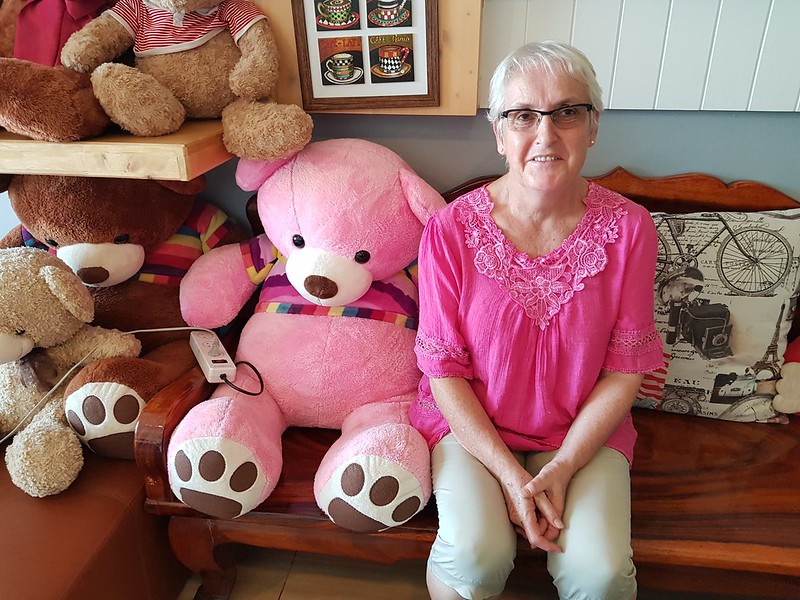
The staff in this cozy establishment are friendly and they make our coffee the way we like it. Prices are good and so is the internet connectivity. And it has some cuteness value—especially if you bring along a pretty girl with an outfit to match the decor.
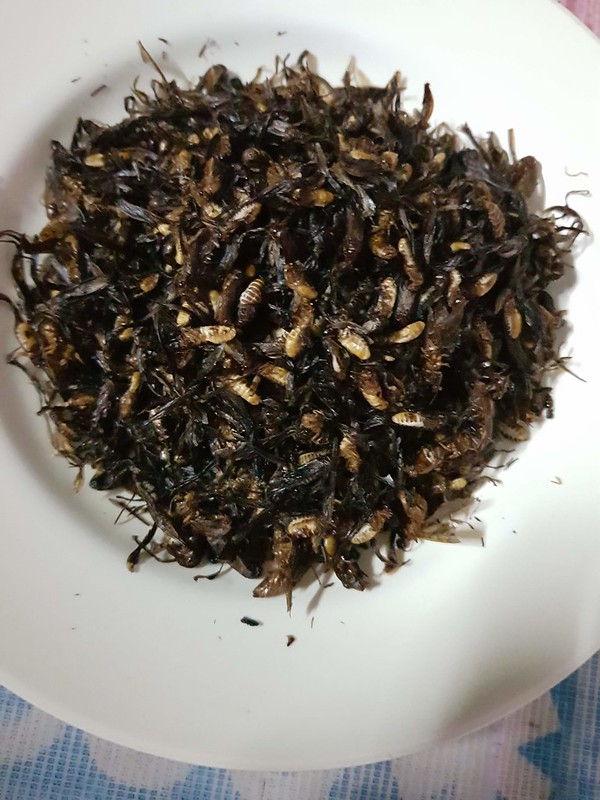
One day, we were presented with a plate of...
...something.
April is the season that the termites swarm. These species of termites (Macrotermes sp.) somehow manage to acquire wings and they gather by the thousands around light sources at night. The Thai name for these, Malaeng Mao (แมลงเม่า) refers to their appearance being like a way that rice is sometimes prepared (Mao). The insects are very fragile and usually the floor under a light is covered with the bodies of these creatures, On many individuals, the wings may have already fallen off.
It is easy to gather a huge bowlful of these creatures. After pulling the wings off, they can be stir-fried and served with your meal.
Bon Appétit!
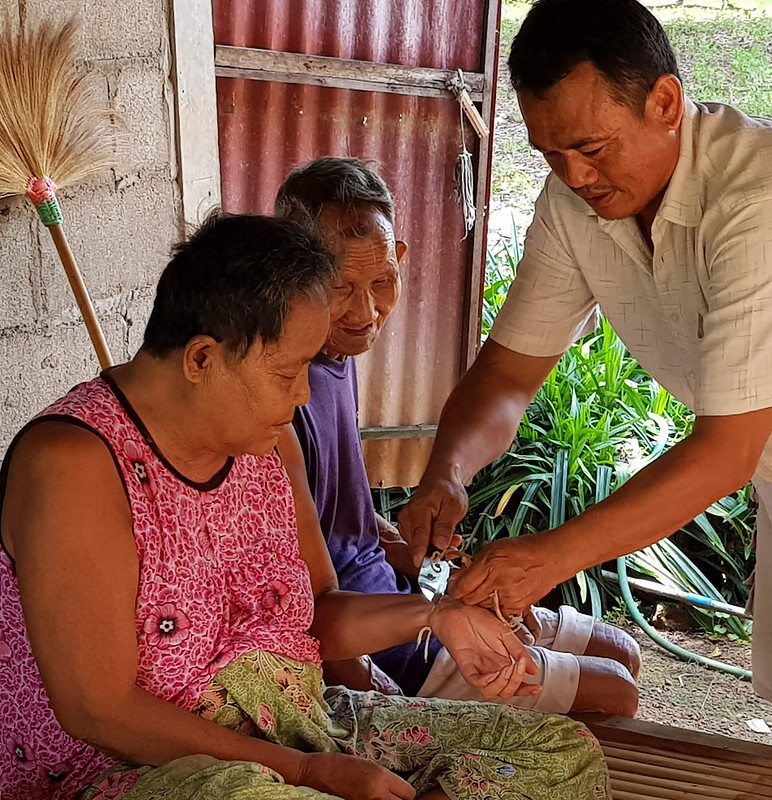
Our first visit was to a man who has had difficulty walking for several years due to a motorcycle accident. The second was to a woman who had an inoperable condition in her spine. In each place, we explained the gospel message to the people, then they prayed to confess belief in Jesus.
What happened next was the string cutting. Sacred strings are tied around the wrist to indicate a binding commitment. In most cases, it is as symbol of belief in Buddhism. But even some Christians will use these cords as part of a marriage ceremony, akin to the wedding ring used in western weddings. To cut the string means to say you no longer trust in the old way of doing things as a way to earn religious merit. Instead, you confess that you are now placing your trust in Jesus.
The man we visited first that day later bowed to pressure from family and reneged on his decision. The lady, however, has remained true to her new faith.
For more about family relationships and choosing Christ, click here.
Seven leaves. Seven hearts.
I grew up in a family of seven, and while my parents are no longer with us on this side of heaven, I still think of our family as a family of seven. So my Hoya with seven hearts was a symbolic reminder to me of family.
Interestingly, the vine has not made any new leaves in the six months since then. It still sits in its small pot with seven hearts attached to the vine.
We made plans to visit some relatives who live in Jordan, and to combine that with some visits to some Biblical historical sites. We had most of the details figured out, but had no peace about them. "I need to visit George," I told my wife.
My brother-in-law had a rare form of cancer, and we did not expect him to be around much longer. Better to visit him while he's alive than to pay homage to a box of ashes after he's gone.
George was not very strong during our visit, but he did rally a bit and made it to church one Sunday, when this photo below was taken. I'm glad we went. A month and a half later, George opted for a better life with neither pain nor sorrow. Since I could tell his days remaining were few, I penned a eulogy ahead of time, so that he could read it. Better to enjoy the company of our loved ones while they are with us than to regret it later.
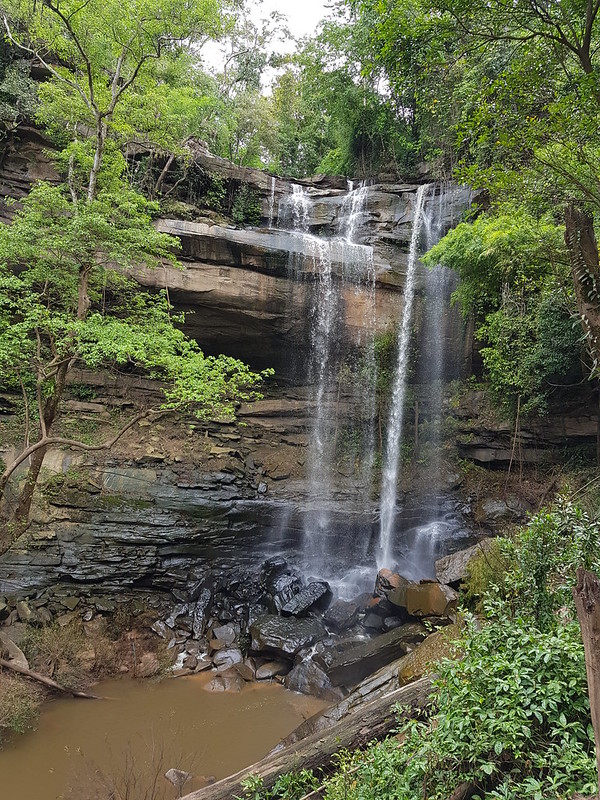
In spite of it being so dry, we decided to visit a waterfall a 3 hour drive west of where we live. The last time we visited Nayung Namsom National Park it was dry season and the waterfall was nothing but a rock bluff. This time around, things were slightly better. The climb to Yung Thong waterfall is challenging in some places, and we did not go all the way to the top because my knee had still not fully recovered from an injury incurred while in California the previous month. We did make it to the main viewpoint of the waterfall, though. And while the waterfall was not spectacular, as waterfalls go, if was a nice quiet day for a walk in the forest. And a bonus was that we did not have to pay to visit the park!
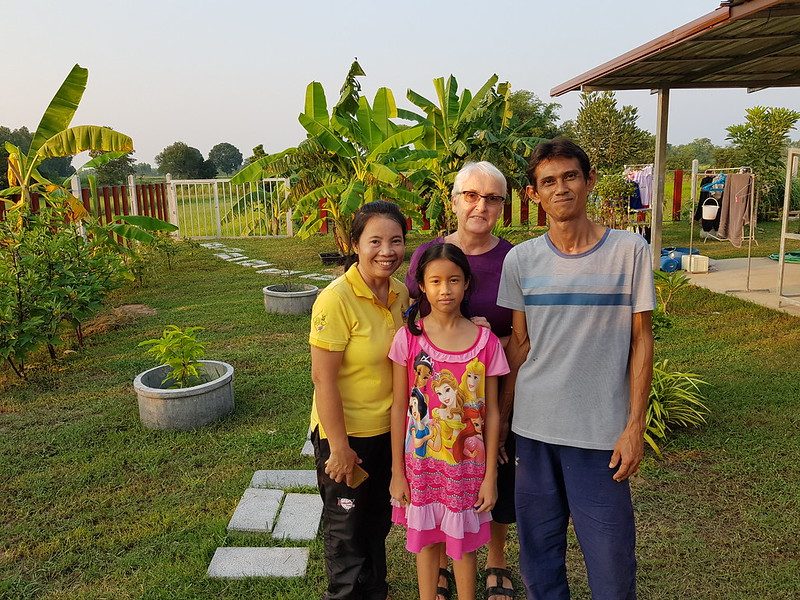
It seemed like we were just getting to know this family when Rung got a transfer to Kalasin province. Since they were the closest friends we had made, we really missed them.
The missionaries working in the Isaan region gather to pray together about three times a year. We meet in various places. We don't get to join with them all of the time because of our schedules. In October, the meeting was in Kalasin. We made use of the opportunity to visit Yai and his family. We had not seen or spoken to them since they had moved, but they were happy to see us again.
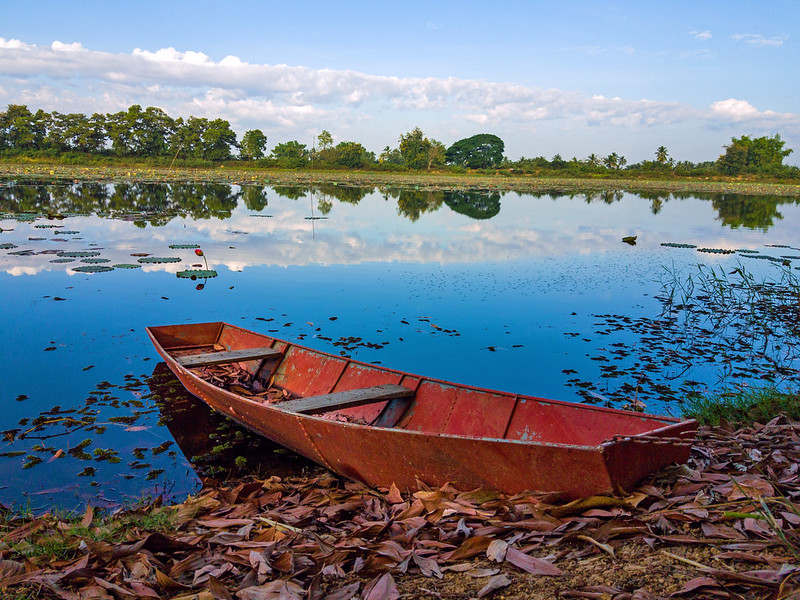
November happens to be the month with the clearest skies. The rainy season clouds are gone and the smoke from burning all the forests and fields hasn't started to build up much yet. On this day, it was early enough that the morning breezes had not picked up yet and so the water was very still. The blue skies reflected in the pond made a nice backdrop for the red boat.
In December, my sister came to visit from California. It was her first time traveling internationally by herself since her college days. Originally, she had hoped to come to Thailand with her husband, but that was not to be.
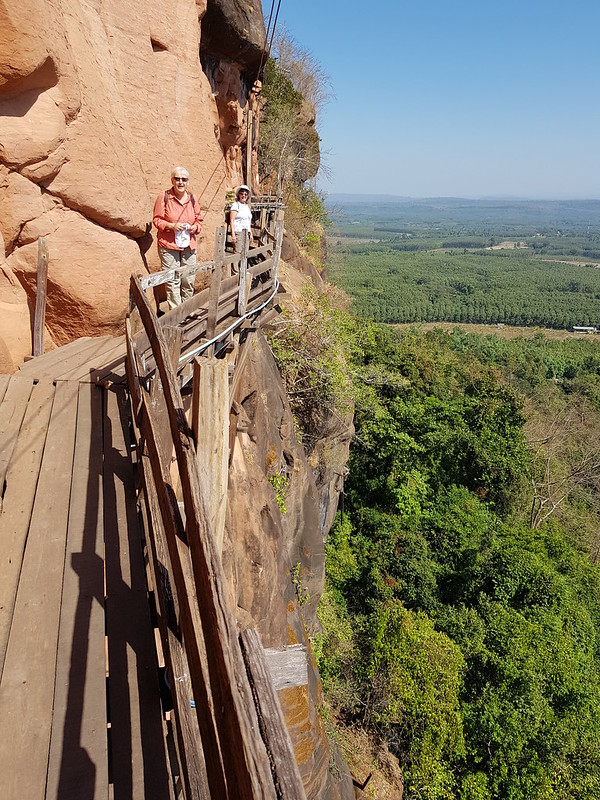
On one day during her visit, we visited Phu Tawk (variously spelled Phu Tok or Phu Thok). The skies were nice and clear and the cooler than normal temperatures made it more comfortable to climb the hundreds of stairs.
Phu Tawk is not for people with a fear of heights. Our teammate, Somdy, was with us and he was constantly commenting about the safety of the handiwork. I've never heard of anyone dying here, so I'm guessing it must be fairly safe, even if it doesn't always look that way.
The mountain is a sacred site, and there are several shrines scattered about. They say there are seven levels, but I'm not sure how some of the "levels" are called such, except that seven is a sacred number (though 9 is more so) so it helps it the top is level 7, I suppose. Probably most of the people we saw were at the mountain as part of a religious pilgrimage, hoping to obtain special merit by making an offering at level seven, if they make it that far (there are merit making opportunities on several of the levels).
For us, it was an opportunity to get out and get some exercise and marvel at the handiwork—not so much of the people who put all of the walkways together, but instead at the handiwork of God, who put the mountain together.
For more photos of this big, red rock, click here.
With our last wet season being not so wet, I was surprised at the number of people planting irrigated rice in the dry season. If water is less, why are we irrigating more? I've seen people pumping water in places I had not seen since moving here.
The reason for more off-season planting is that because the rains quit early last summer, the rice harvest in the area was much less than normal. Some fields were not even harvested because there was nothing to pick. Those fields that were harvested had a smaller crop than normal. For this reason, many families did not harvest enough rice to eat, let alone sell. So there is a push to get another crop in. We pray that the water supplies will last, because even the Mekong is at its lowest level Inver 50 years--and there are still several more months of dry season left.
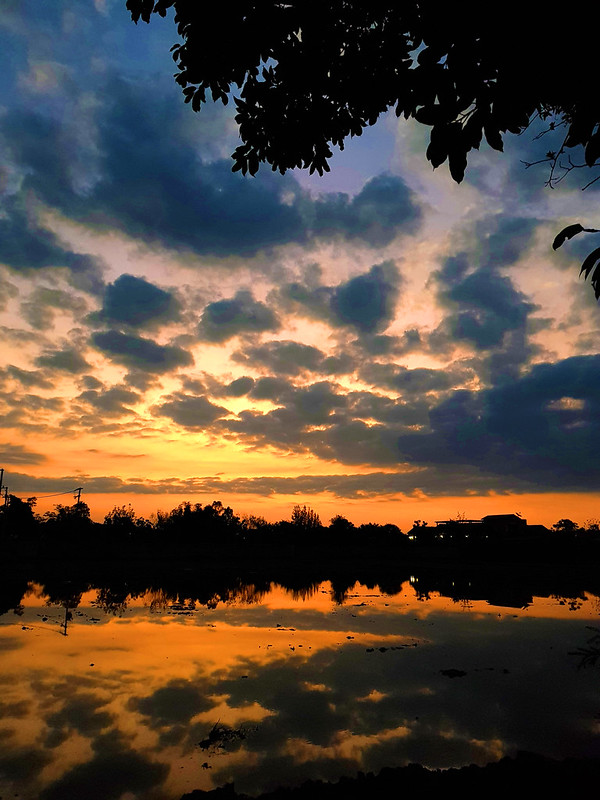
A side benefit for us, though, is that even our neighbor decided to plant a second crop. So he plowed and smoothed his paddies, making a nice reflecting pond for us, at least until the rice crop comes on. So we finish up the year having to put up with sunrise views from our house like the one below.
And so another year has gone by. Some things have gone as expected, many things have not. There have been good times and challenging times. All of which makes it a normal year.
I count it a blessing to finish the year with the same wife that I have shared the past 36 years with. Not everyone is so fortunate.
I also thank God for His faithfulness in helping get through some challenges during the year. Several times, I have wanted to give up, as my faith and strength were not up to the task. Fortunately, God is up to the task.
There is a saying that God does not give us more than we can handle. I'm not sure where this comes from, for my understanding from scripture is that God never gives us more than He can handle. As Paul writes, "We do not want you to be uninformed, brothers, about the hardships we suffered in the province of Asia. We were under great pressure, far beyond our ability to endure, so that we despaired even of life. Indeed, in our hearts we felt the sentence of death. But this happened that we might not rely on ourselves but on God, who raises the dead." (2 Corinthians 1:8-9, NIV)
We don't know what the coming year will bring. My prayer is that, no matter what happens, good or bad, we continue to rely on God.
Happy New Year
January - Follow your heart in Phu Ruea
For my birthday, I told Ingrid I wanted to go to the mountains. Going to the mountains isn't as easy here as it was in California, where I could be in the mountains in just over an hour. From where we live now, we are talking about a 5-hour drive or longer.We decided to go to Phu Ruea (pronounced poo rur-ah), which means "place of the boat." We've driven through Phu Ruea on several previous occasions, traveling back and forth to Northern Thailand. I had always wondered how a mountainous area is named "place of the boat," a name that would seem more fitting for a beach town. It turns out that viewed from the valley below, the mountain is shaped like a boat.
There are several national parks near Phu Ruea, one of which bears the same name. You can drive almost to the highest point in the park. From there, you can hop on a tram (pickup truck with benches in the back) or walk to the summit. We opted to walk, and we had the trail mostly to ourselves, as most people took the tram.
Phu Ruea has a flower festival over the New Year's holiday, and we came in on the tail end of it. So many flowers! The dominant flowers were poinsettias in red, pink, yellow and white. The main theme of the flower festival is hearts. Flower gardens shaped like hearts. Big heart-shaped signs. And even heart shaped pavers winding through the poinsettias. For more photos of Phu Ruea, see here.
![]() |
| Heart-shaped pavers in Phu Ruea |
February - Phu Phrabat
Our second entry also has a "Phu" in it. (December's entry does as well.)In February, we had a visit from a couple from Canada. They are friends of our co-workers and we were told that they like outdoorsy stuff. Since we have a vehicle and know about many of the outdoorsy activities to be had in the area, our co-workers made us responsible for one day's activities. So we put together as list of possibilities and presented it to our visitors. They decided to go to Phu Phrabat.
We like Phu Phrabat because it has some of the most well-groomed sets of forest trails for walking in the area. The park is considered an "historical park" and is run by the Arts and Culture ministry rather than the forestry department. That must be why the park has one of the classiest restrooms in Thailand!
The geology of the area includes some hard layers of sandstone which are underlain by softer material. This has contributed to the formation of lots of unusual rock formations. Several hundred years ago, these features were used for human settlement, either for living places, animal shelters or religious worship sites.
The picture below is from one of the most famous structures on the park. It is called Hor Nang Usa (หอนางอุสา), which means, "Ms. Usa's Tower". Nang Usa is a character in the anecdotal stories of the history of the structures.
More pictures from Phu Phrabat can be found here.
![]() |
| Hor Nang Usa - what would happen if you jumped up and down on the part that sticks out? |
March - Tokay Geckos
Anybody want a pet lizard? I'd be happy to part with these cute, (no so) little, lizards. The tokay gecko is the type species of the gecko family, hence its scientific name, Gekko gecko. I like the Thai name, tookay (ตุ๊กแก) because it aptly describes the sound of this creature. Nothing like the "tookay, tookay, tookay" blasting from the ceiling from above your bed to wake you up at night.The home of the creatures in the photo is above our front porch. They even have a trail mark from the hole where they get in and out. I would seal it, but I don't want them to die in the attic because the smell of rotting gecko bodies makes the fragrance of a dead rat like sweet perfume in comparison. Mama and papa had two babies this past year, one of which shows in this photo. They are cute, in a way, with their turquoise colored bodies covered with bright red spots. (The photo doesn't really do it justice.)
![]() |
| Calling Geckos on the wall of our house |
April - Pretty in Pink
We're always in the mood for a good coffee shop. When your home is your office, sometimes it's nice to have an "away office." There are lots of chain and independent coffee shops in Thailand, but price, coffee quality and quality of internet connection vary greatly.Sometimes on our day off, we drive north to a place called Pak Khat for dinner. Along the way there is a small town called Rattanawapi. There are several coffee shops in the town that have closed, but one day we noticed a new one, Ban Card Coffee. For a while it seemed like this one, too, succumbed to poor planning because it closed down soon after it opened (a common occurrence with restaurants and coffee shops in Thailand). But then, to our surprise, it reopened.
The staff in this cozy establishment are friendly and they make our coffee the way we like it. Prices are good and so is the internet connectivity. And it has some cuteness value—especially if you bring along a pretty girl with an outfit to match the decor.
May - Dining Adventures
On most Thursday evenings, we meet a with a couple that helps lead our church, Tha and Nok. Nok is from Laos and she comes from a poor background, so she has learned to live off the land. She amazes us with the food she can prepare from whatever they caught or scrounged up in the forest on any given day.One day, we were presented with a plate of...
...something.
April is the season that the termites swarm. These species of termites (Macrotermes sp.) somehow manage to acquire wings and they gather by the thousands around light sources at night. The Thai name for these, Malaeng Mao (แมลงเม่า) refers to their appearance being like a way that rice is sometimes prepared (Mao). The insects are very fragile and usually the floor under a light is covered with the bodies of these creatures, On many individuals, the wings may have already fallen off.
It is easy to gather a huge bowlful of these creatures. After pulling the wings off, they can be stir-fried and served with your meal.
Bon Appétit!

June - Cutting the Cord
On a steamy Wednesday morning, several of us piled in the truck and headed off to Ban Klum Pattana—a village about 14 kilometers north of the main town of Phon Phisai. We were on our way to visit some people who were interested in hearing the story of Jesus.Our first visit was to a man who has had difficulty walking for several years due to a motorcycle accident. The second was to a woman who had an inoperable condition in her spine. In each place, we explained the gospel message to the people, then they prayed to confess belief in Jesus.
What happened next was the string cutting. Sacred strings are tied around the wrist to indicate a binding commitment. In most cases, it is as symbol of belief in Buddhism. But even some Christians will use these cords as part of a marriage ceremony, akin to the wedding ring used in western weddings. To cut the string means to say you no longer trust in the old way of doing things as a way to earn religious merit. Instead, you confess that you are now placing your trust in Jesus.
The man we visited first that day later bowed to pressure from family and reneged on his decision. The lady, however, has remained true to her new faith.
For more about family relationships and choosing Christ, click here.
![]() |
| Tha cutting the string from Bor Wan's wrist |
July - Seven Hearts
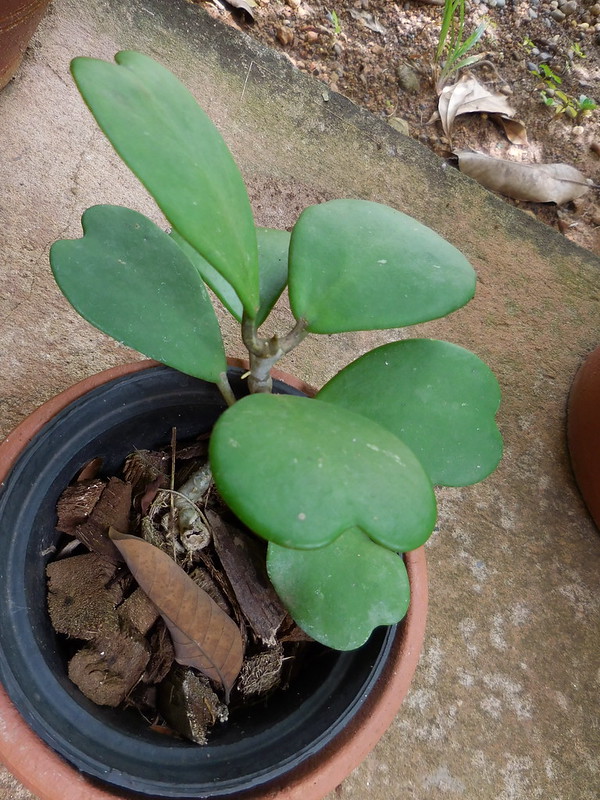
In a previous blog, I wrote about our Sweetheart Plant (Hoya kerrii), and the patience it took to wait for a leaf stuck in the soil to take root and start growing. Once the vine started growing, however, it put out new leaves relatively quickly. By July, about 11 months after it started putting out its first leaf, the Hoya had amassed seven leaves.Seven leaves. Seven hearts.
I grew up in a family of seven, and while my parents are no longer with us on this side of heaven, I still think of our family as a family of seven. So my Hoya with seven hearts was a symbolic reminder to me of family.
Interestingly, the vine has not made any new leaves in the six months since then. It still sits in its small pot with seven hearts attached to the vine.
August - Celebrating Life
We had big plans for our 25th anniversary. But when the time came around, our life was full of too much uncertainty, and not much happened. So we figured, maybe we'll do something big for our 30th. But when that came around, we were in the midst of a very hectic schedule and settled for a couple of days in Monterey, California. Five years later we took a few days attached to a retreat I was on in Switzerland, but it was still not what we had in mind. So we figured we'd do something special this year.We made plans to visit some relatives who live in Jordan, and to combine that with some visits to some Biblical historical sites. We had most of the details figured out, but had no peace about them. "I need to visit George," I told my wife.
My brother-in-law had a rare form of cancer, and we did not expect him to be around much longer. Better to visit him while he's alive than to pay homage to a box of ashes after he's gone.
George was not very strong during our visit, but he did rally a bit and made it to church one Sunday, when this photo below was taken. I'm glad we went. A month and a half later, George opted for a better life with neither pain nor sorrow. Since I could tell his days remaining were few, I penned a eulogy ahead of time, so that he could read it. Better to enjoy the company of our loved ones while they are with us than to regret it later.
![]() |
| Enjoying our last weekend with George |
September - Yung Thong Waterfall
Our wet season this past year was less than spectacular. The rains were fewer and they stopped over a month sooner than usual. Usually, September and October are a great time to visit waterfalls, because it is the end of the wet season and the rivers are at their peak.In spite of it being so dry, we decided to visit a waterfall a 3 hour drive west of where we live. The last time we visited Nayung Namsom National Park it was dry season and the waterfall was nothing but a rock bluff. This time around, things were slightly better. The climb to Yung Thong waterfall is challenging in some places, and we did not go all the way to the top because my knee had still not fully recovered from an injury incurred while in California the previous month. We did make it to the main viewpoint of the waterfall, though. And while the waterfall was not spectacular, as waterfalls go, if was a nice quiet day for a walk in the forest. And a bonus was that we did not have to pay to visit the park!
![]() |
| Yung Thong Waterfall in Nayung Namsom National Park |
October - Reunion with Friends
Shortly after we moved to Phon Phisai, we made friends with the proprietor of a coffee shop in town. Yai is a man from the southern peninsula of Thailand. Yai's wife, Rung, is a police captain. Rung had recently been transferred to Phon Phisai. They have a daughter named Khao Hom. Khao Hom came to the English / Bible story classes we had and often her mother would stay and listen to the stories as well. Rung is originally from Kalasin province, about a four-hour drive south of Phon Phisai. About once a month, they would travel there because they were working on building a house there so that at some point, Rung could move back to her hone area.It seemed like we were just getting to know this family when Rung got a transfer to Kalasin province. Since they were the closest friends we had made, we really missed them.
The missionaries working in the Isaan region gather to pray together about three times a year. We meet in various places. We don't get to join with them all of the time because of our schedules. In October, the meeting was in Kalasin. We made use of the opportunity to visit Yai and his family. We had not seen or spoken to them since they had moved, but they were happy to see us again.
![]() |
| Rung Arun, Khao Hom, Ingrid and Yai by their new home |
November - Nong Ngaeng
One of my favorite bike rides is to follow some irrigation canals to a pond called Nong Ngaeng. (That's okay, I can't pronounce it either.) The Acacia mangium trees planted along the east side of the pond provide a shady respite from the tropical sun. Often, while riding under this treed canopy, I will take a break to enjoy the peaceful setting.November happens to be the month with the clearest skies. The rainy season clouds are gone and the smoke from burning all the forests and fields hasn't started to build up much yet. On this day, it was early enough that the morning breezes had not picked up yet and so the water was very still. The blue skies reflected in the pond made a nice backdrop for the red boat.
![]() |
| Red Boat in Nong Ngaeng |
December - Phu Tawk
My photo for December is similar to my photo for November, last year.In December, my sister came to visit from California. It was her first time traveling internationally by herself since her college days. Originally, she had hoped to come to Thailand with her husband, but that was not to be.
On one day during her visit, we visited Phu Tawk (variously spelled Phu Tok or Phu Thok). The skies were nice and clear and the cooler than normal temperatures made it more comfortable to climb the hundreds of stairs.
Phu Tawk is not for people with a fear of heights. Our teammate, Somdy, was with us and he was constantly commenting about the safety of the handiwork. I've never heard of anyone dying here, so I'm guessing it must be fairly safe, even if it doesn't always look that way.
The mountain is a sacred site, and there are several shrines scattered about. They say there are seven levels, but I'm not sure how some of the "levels" are called such, except that seven is a sacred number (though 9 is more so) so it helps it the top is level 7, I suppose. Probably most of the people we saw were at the mountain as part of a religious pilgrimage, hoping to obtain special merit by making an offering at level seven, if they make it that far (there are merit making opportunities on several of the levels).
For us, it was an opportunity to get out and get some exercise and marvel at the handiwork—not so much of the people who put all of the walkways together, but instead at the handiwork of God, who put the mountain together.
For more photos of this big, red rock, click here.
![]() |
| Ingrid and Dawn on the wooden walkway |
December - Bonus pic
With our last wet season being not so wet, I was surprised at the number of people planting irrigated rice in the dry season. If water is less, why are we irrigating more? I've seen people pumping water in places I had not seen since moving here.
The reason for more off-season planting is that because the rains quit early last summer, the rice harvest in the area was much less than normal. Some fields were not even harvested because there was nothing to pick. Those fields that were harvested had a smaller crop than normal. For this reason, many families did not harvest enough rice to eat, let alone sell. So there is a push to get another crop in. We pray that the water supplies will last, because even the Mekong is at its lowest level Inver 50 years--and there are still several more months of dry season left.
A side benefit for us, though, is that even our neighbor decided to plant a second crop. So he plowed and smoothed his paddies, making a nice reflecting pond for us, at least until the rice crop comes on. So we finish up the year having to put up with sunrise views from our house like the one below.
![]() |
| Sunrise reflections in the rice paddy |
And so another year has gone by. Some things have gone as expected, many things have not. There have been good times and challenging times. All of which makes it a normal year.
I count it a blessing to finish the year with the same wife that I have shared the past 36 years with. Not everyone is so fortunate.
I also thank God for His faithfulness in helping get through some challenges during the year. Several times, I have wanted to give up, as my faith and strength were not up to the task. Fortunately, God is up to the task.
There is a saying that God does not give us more than we can handle. I'm not sure where this comes from, for my understanding from scripture is that God never gives us more than He can handle. As Paul writes, "We do not want you to be uninformed, brothers, about the hardships we suffered in the province of Asia. We were under great pressure, far beyond our ability to endure, so that we despaired even of life. Indeed, in our hearts we felt the sentence of death. But this happened that we might not rely on ourselves but on God, who raises the dead." (2 Corinthians 1:8-9, NIV)
We don't know what the coming year will bring. My prayer is that, no matter what happens, good or bad, we continue to rely on God.
Happy New Year
Labels:
cliffs,
family,
flowers,
friends,
geckos,
hearts,
Isaan,
lizards,
ministry,
parks,
reflections,
rice paddies,
sacred string,
sandstone,
sunrise,
swamps,
termites,
Thailand,
water lilies,
waterfalls
Wednesday, December 25, 2019
Traditions
Family traditions.
We grow up with family traditions. Without thinking, we assume we will carry these on all our lives. When we marry, we have to figure out how to blend two sets of traditions, which can be a source of conflict. Then we end up adding our own spin on things and figure we will pass these new traditions down to our children.
![]() |
| Christmas tree from the early years before Alan was taller than the tree. |
One tradition I remember is that on one of my brother's birthdays (December 15th), we would drive down the hill to a Christmas tree farm. Dad would go pick a tree his height and we would cut it down, bring it home, and decorate it.
On Christmas Eve, we were allowed to open one gift.
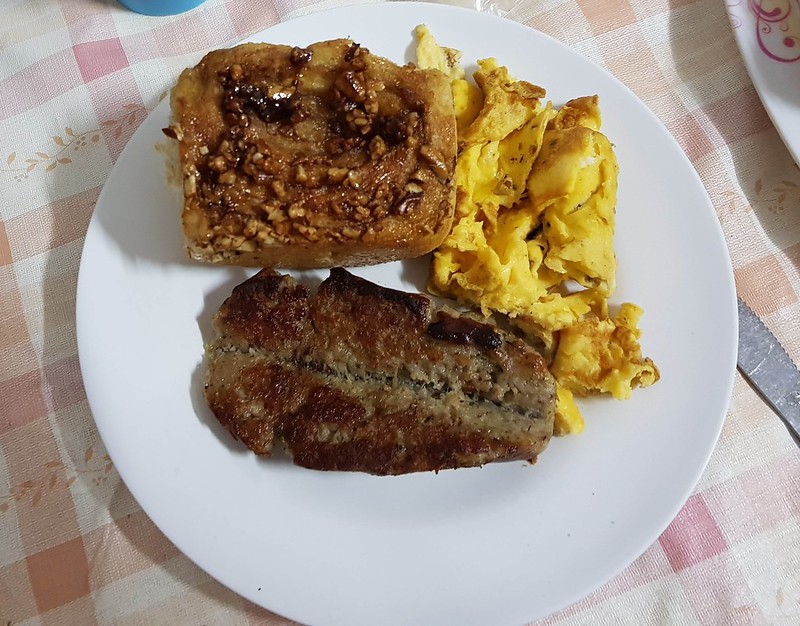
On Christmas morning, we kids were up early. We were allowed to open our stockings early, while our parents were sleeping. Then we would have breakfast. The staples of Christmas breakfast were scrambled eggs, Brown 'n Serve® sausages and Pillsbury Pop 'n Fresh® cinnamon rolls—two kinds: orange glaze and caramel topping. To drink there was orange juice and hot chocolate served in Santa Claus mugs.
![]() |
| Modern version of traditional Christmas breakfast |
Ingrid's traditions were a bit different. Christmas Eve was a time to celebrate in the church, where the children would receive a Christmas Tüte, a brown paper bag with treats inside. In her house, the parents set up the Christmas tree on Christmas Eve while the kids were out of the way.
I remember our first Christmas together we had to work out what our blended family traditions would look like. What things would we like to pass on to our children? Even the Christmas cookie offerings had to be figured out. From my childhood there were almond snowballs, Starlight mint surprise cookies, thumbprint cookies (yuletide gems), and peanut butter blossoms. Ingrid brought Pfferneuse (which for many years Ingrid's mom made and sent to us) and Stöllen into the mix. Both of us were used to the sugar cookies and cookie-press cookies. A sister introduced us to almond Rocha.
But then there were no children. No one to pass family traditions down to.
And then we ended up living places where we could not get the things we associated with family traditions.
So we improvised. One year, some friends sent us some coconut-based fruit cake. They did this for several years and eventually we started making our own. A new tradition was born, added to the various cookie receipts we inherited from our families.
Many years I ended up making my own cinnamon rolls. Brown 'n Serve sausages were seldom an option, but usually we could find some other kind.
When we lived in Haiti, after breakfast on Christmas Day, we would drive two hours to our mission's main office to have dinner with the other missionaries. Then we would head to the beach house in Montrouis for a few days. There they had palm trees naturally decorated with green, coconut-shaped ornaments. Now that's my kind of Christmas tree.
![]() |
| Montrouis, Haiti, a nice place to spend Christmas |
One year we spent Christmas Eve in Morro Bay. In our hotel room on Christmas morning we turned on a television station that had a video of a burning fireplace with Christmas carols playing. Lunch was a picnic on a cool, misty beach with smoked salmon and crackers.
But this year, things are really different. In addition to the usual busyness of Christmas outreach events (one of which was on Christmas day), we are preparing to leave for the US for a few months shortly afterwards. So our theme for presents was things that took up no space and had no weight. There is also a lot of prep to do before traveling back to North America. Add to that all the stuff to do for visa renewals.
Who has time for Christmas? Not much time for tradition. No Christmas cake this year. Limited variety of Christmas cookies.
No tree this year—not even our tiny artificial one. But we did take out some manger scene ornaments and set them out on a table.
Christmas Eve was mostly working. So for Christmas Eve dinner, we picked up a cooked ham leg at the grocery store on the way home from rehearsing music.
I did not make homemade cinnamon rolls this year, as we are trying to empty our cupboards and didn't have all the ingredients. But there was some leftover sticky rice in the freezer from some Khao Lam someone gave us a couple weeks ago. How about we add some cinnamon and coconut milk to that? And there were some British-style sausages in the freezer, too. No orange juice, but fresh oranges instead. Thus, Christmas breakfast is born.
On Christmas Day, I told Ingrid that as I thought back over all of our Christmases together, there is only one constant tradition—that we spend it together.
I was never one for much in the way of Christmas decorations, and this detachment from tradition makes that tendency even stronger. But this year even I felt myself missing some of the trappings of the season.
Some may decry me for lack of "Christmas spirit" since I don't buy into all the glitter and glam. But, on the other hand, I think I have even more "Christmas spirit," for what makes Christmas special is not a tree, or stockings, or a fat man with a long white beard in a red suit. The Spirit of Christmas is the Spirit of Jesus, whose birth we celebrate on this day.
Here in Thailand, many think that Christmas is Santa Claus' birthday. That is probably more true than I like to admit, because December 25th is more closely associated with Santa Claus than it is with the actual birthday of Jesus. I actually don't have a problem with separating Jesus from this celebration of stuff that happens each December, because I don't think Jesus is all too happy if we get the latest toys and tech gadgets and then let those things take us further from Him. The greatest Christmas present of all time was wrapped in cloth and lying in a manger.
It makes no difference if we have the greatest nativity scene in town and then live our lives as if Jesus doesn't exist.
We may not have much in the way of Christmas traditions, and even if what we do have should pass away, I pray that my heart, like a manger, will continually be a place where the Spirit of Christmas dwells.
The angel said,
Fear not, for behold, I bring you good news of great joy that will be for all the people. For unto you is born this day in the city of David a Savior, who is Christ the Lord.
Luke 2:10, 11
Thursday, November 21, 2019
The Lame Will Walk
And he answered them, “Go and tell John what you have seen and heard: the blind receive their sight, the lame walk, lepers are cleansed, and the deaf hear, the dead are raised up, the poor have good news preached to them. (Luke 7:22 ESV)
We first met Wari in November last year. For over a year she had suffered from a condition that left her unable to walk except with a walker, and when she did walk it was with great difficulty and great pain. The doctors said there was nothing they could do for her.
We went to visit Wari at her home. We explained the good news of Jesus to her and she made the decision to follow Him.
Each week we would visit Wari's house to sing songs, study the Bible and pray for her. Slowly her condition improved.
By January, Wari felt strong enough to get baptized. At that point, she was still using a walker and we had to help her into the pool. But God continued to heal her, eventually she no longer needed a walker or cane. By springtime, she was able to ride a bicycle and in June she started riding her motorcycle to worship services. Several weeks ago, our truck got stuck in the mud when we were visiting another church member. She was quickly out the door of the truck to help push.
If you see Wari today, you would not recognize her as the person we first met. Her face is full of joy and she stands tall with confidence in Jesus.
God has given her a great voice which she uses to help lead praises to God during worship services. We praise God for the work he has done in her life. We praise God for the work He has done in her life. She is becoming one of the key leaders in our church. We are grateful to God for the miracles He has done in her life, but the miracles don't end there.
Wari’s father worked in central Thailand, but he developed a health condition that left him unable to work, so he came home. The first week he was back, Somdy, our team leader, went to visit him. At that time he didn’t want to hear the gospel. But the second week when Somdy met him he said, “If God will heal me, I will believe.” So Somdy prayed for him, he was healed and he put his faith in Christ and was baptized. Soon after that he returned to work in Central Thailand because God had healed him well enough to do so.
We thank God for these occasions when His love is poured out in the form of healing from medical conditions.
No less important is the miraculous work God does in our souls.
We lift our praises to the God who loves us inside and out.
We first met Wari in November last year. For over a year she had suffered from a condition that left her unable to walk except with a walker, and when she did walk it was with great difficulty and great pain. The doctors said there was nothing they could do for her.
We went to visit Wari at her home. We explained the good news of Jesus to her and she made the decision to follow Him.
Each week we would visit Wari's house to sing songs, study the Bible and pray for her. Slowly her condition improved.
By January, Wari felt strong enough to get baptized. At that point, she was still using a walker and we had to help her into the pool. But God continued to heal her, eventually she no longer needed a walker or cane. By springtime, she was able to ride a bicycle and in June she started riding her motorcycle to worship services. Several weeks ago, our truck got stuck in the mud when we were visiting another church member. She was quickly out the door of the truck to help push.
If you see Wari today, you would not recognize her as the person we first met. Her face is full of joy and she stands tall with confidence in Jesus.
God has given her a great voice which she uses to help lead praises to God during worship services. We praise God for the work he has done in her life. We praise God for the work He has done in her life. She is becoming one of the key leaders in our church. We are grateful to God for the miracles He has done in her life, but the miracles don't end there.
Wari’s father worked in central Thailand, but he developed a health condition that left him unable to work, so he came home. The first week he was back, Somdy, our team leader, went to visit him. At that time he didn’t want to hear the gospel. But the second week when Somdy met him he said, “If God will heal me, I will believe.” So Somdy prayed for him, he was healed and he put his faith in Christ and was baptized. Soon after that he returned to work in Central Thailand because God had healed him well enough to do so.
We thank God for these occasions when His love is poured out in the form of healing from medical conditions.
No less important is the miraculous work God does in our souls.
We lift our praises to the God who loves us inside and out.
Subscribe to:
Posts (Atom)